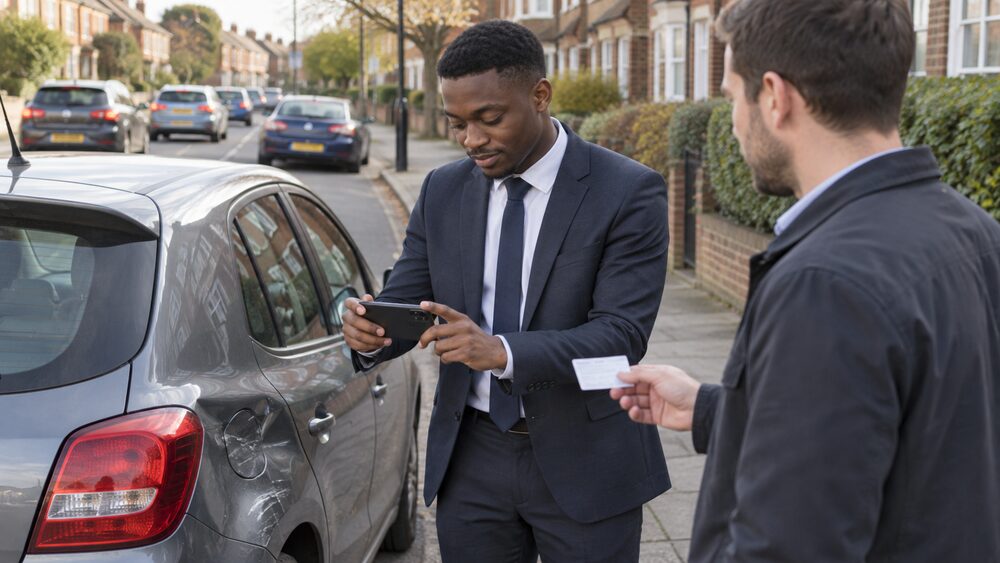
If you have been in a car accident, the law puts specific duties on you as the driver, starting at the scene. Under section 170 of the Road Traffic Act 1988 you must stop, and you must give certain details to anyone who reasonably needs them. If those details are not exchanged at the scene, you must report the accident to the police within 24 hours1. Failing to stop and failing to report are separate criminal offences, and the penalties for each include a maximum fine of £5,000 and five to 10 penalty points on your driving licence1.
Separately from the legal duty, you must tell your insurer you have been in an accident, even if you do not intend to make a claim2. This catches many people out: the duty to report the accident exists whether or not you ever claim on the policy, and a failure to report can give your insurer the right to refuse to cover you in the future1. If you decide to pay for repairs yourself, or to recover the cost from the other driver, you do not have to submit a claim to your insurer, which can help preserve a no claims discount1.
How the claim is then handled depends mainly on whether it is a fault or non-fault claim, what level of car insurance you hold, and what add-ons your policy includes. This page walks through each stage: what to do at the scene, what to report and to whom, how to get your car recovered or repaired, and what happens once the claim is registered.
What to do at the scene of an accident
The starting point is the law. If you are the driver and you have an accident that causes injury or damage, you must stop and give your name and address, and details of your insurance policy, to anyone who reasonably needs them5. The details you must be able to provide are your vehicle registration number, your name, your address, and the name and address of the vehicle's owner if that is not you1.
Beyond the legal minimum, what you do in the first few minutes shapes how smoothly the claim goes later. The British Insurance Brokers' Association (BIBA) advises drivers involved in an accident not to admit liability, to take the name and address of the other driver along with their insurance details and witness details, and to call the police if anyone is injured5. Admitting liability at the scene, even as a courtesy, can complicate the claim later, because fault is assessed by insurers on the evidence, not on what was said in the moment.
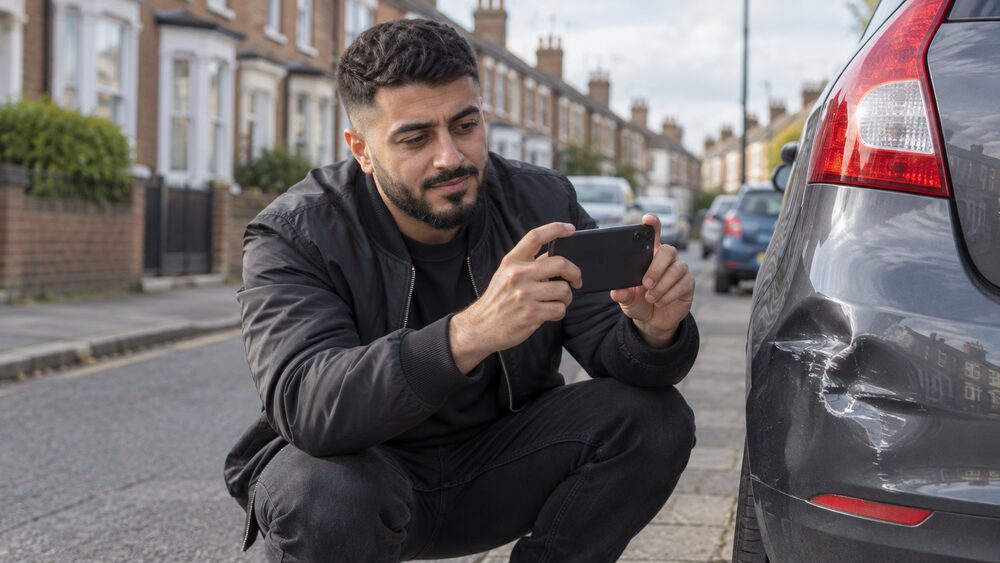
Evidence matters. The Financial Ombudsman Service, which settles disputes between consumers and insurers, lists the material it weighs in damage complaints: expert opinions, photos of the damage, a report with photos from a surveyor, loss adjuster or other expert, and customer testimony6. Photos taken at the scene of both vehicles, their positions, the road conditions and any debris are the most useful thing you can capture, because they are hard to dispute later. Note the time, the weather, the speed limit and the names and numbers of any witnesses before people disperse.
If another person is injured, an extra duty applies: you must produce your certificate of insurance to anyone at the scene with reasonable grounds to see it1. And if for any reason details are not exchanged, the 24-hour police reporting clock starts running, which our page on reporting an accident to the police covers in detail.
Details you must give, and the right to ask for insurance details later
The duty to exchange details does not have to be completed at the roadside. If someone holds you responsible for the accident, they have the right to request your insurance details later, not necessarily at the time of the accident1. This works both ways: if the other driver drove off before you could take their details, or refused to give them, you can ask for them afterwards, and a failure to provide insurance details without a reasonable excuse is itself an offence1.
The information you must give, when asked by anyone with reasonable grounds, is both your own and the vehicle owner's name and address, along with the registration number of the vehicle2. Keep this in mind if you were driving a car that belongs to someone else, such as a family member or an employer: the owner's details are part of the legal duty, not just yours.
For the other driver's side, collect the same set: their name, address, registration number, the vehicle owner's details if different, their insurer and policy number if offered, and the details of any independent witnesses5. If the police attend, note the incident or crime reference number they give, since insurers often ask for it.
One further point on accuracy: when you give information to your insurer, whether at the scene or later, it must be accurate. BIBA warns that if you fail to provide accurate information, a subsequent claim may be refused7. This applies to how the accident happened, not just to the details you gave when you bought the policy. If you are unsure about a detail, say so rather than guessing, because a wrong statement about speed, position or sequence of events can be treated as misrepresentation and can put the whole claim at risk.
Information your insurer will need for a claim
When you report the claim, the insurer will open a file and ask for a standard set of information. The Financial Ombudsman's guidance on fault and no-claims bonus disputes gives a picture of what a fully documented motor claim file contains: the policy schedule, the policy certificate, the full policy terms, contact records, claim forms and notes, a timeline of what has happened, engineer or expert reports, and vehicle valuations showing the registration number, the mileage and which valuation guide was used8.
In practice, for a straightforward accident claim you will normally be asked for:
- The date, time and location of the accident
- How the accident happened, in your own words
- The other driver's name, address, registration number and insurer
- Photos of the damage to both vehicles and the scene
- Witness names and contact details
- The police reference number, if the police were involved
- Whether anyone was injured8
Photos carry particular weight. The ombudsman treats photos of the damage and expert reports as core evidence when a claim is disputed6, so the more you can supply from the scene, the less the insurer has to rely on its own engineer's interpretation later.
If your policy is a black box (telematics) policy, there is an extra dimension. The data your box records may be shared with third parties who work with the insurer, such as claims professionals, and may be handed to the police with a court order, with your permission, or if you are suspected of fraud9. In a fault dispute, the driving data recorded around the time of the accident can therefore become part of the evidence.
Finally, the claim follows you to renewal. All claims, including incidents you reported but did not claim for, are declared when shopping around for new cover or renewing a policy10. Our page on telling your insurer about an accident when you do not claim explains why.
Ways to report a claim: phone, online and out of hours
Most insurers accept claims by phone and online, and the major claims lines operate around the clock, so an accident at night or at the weekend does not have to wait until Monday. Whatever channel you use, the timing matters: it will be a condition of your insurance policy that you report the accident to your insurer within a reasonable time, and what counts as reasonable differs between policies1. Check your own policy documents rather than assuming, and if you cannot find the wording, call your insurer and ask10.
The reason to be prompt is practical as well as contractual. Which?'s guidance on classic car claims makes the general point that you need to contact your insurer as soon as possible to avoid delays in processing your claim11, and the same applies to any motor claim: recovery, repair and a courtesy car all start from the point the claim is registered. A failure to report within the policy's timeframe can give your insurer the right to refuse cover in the future1, which is a far bigger consequence than most people expect from a late phone call.
When you call, the insurer will ask for your policy number, the details you collected at the scene and your photos. The insurer assigns a claim reference number, which is used in every later conversation. If the accident involved theft of the vehicle rather than a collision, the route is slightly different: the police are notified and a crime reference number obtained, then the claim is submitted as soon as possible11.
If things go wrong with how the claim is handled, complaints are common enough that the Financial Ombudsman publishes them by product: 4,096 complaints about car or motorcycle insurance were opened in the first quarter of 2026/2712. Our page on complaining about an insurer sets out the process and the time limits, and why claims are rejected covers the common reasons and what to do about them.
Emergency recovery when your car cannot be driven
If your car cannot be driven after an accident, who recovers it depends on what cover you have. Breakdown cover, whether standalone or as an add-on, does not include picking up vehicles after road traffic accidents: the Financial Ombudsman notes this is the responsibility of motor insurers or repairers13. So if the car is undriveable following a collision, the recovery is arranged through your motor claim, not by calling your breakdown service.
What breakdown cover does include, when it applies, is call-outs and roadside repairs, recovery of the vehicle to a garage, a hire car to continue your journey, and overnight hotel accommodation13. If you buy breakdown cover as an add-on to your car insurance, note that most car insurers only offer vehicle cover, meaning only the insured vehicle is covered rather than you as a person14. Policies can cover up to five named drivers where personal cover is offered, which can work well if several people in your household drive the same car14.
For the claim itself, comprehensive policies commonly include extras that matter here: a courtesy car while your car is being repaired, legal expenses, and insurance to recover your uninsured losses such as your excess2. Uninsured loss recovery is especially useful for third party fire and theft policyholders, because it attempts to recover vehicle damage costs from a negligent third party, along with the policy excess, hire car charges and other out-of-pocket expenses15. Our page on uninsured loss recovery covers this in depth.
After a non-fault accident, be aware that third parties may contact you directly offering replacement vehicles and repairs on credit terms. The ombudsman describes these credit hire and credit repair arrangements as usually a form of "after the event" (ATE) insurance16, and they can leave you owing money if the other insurer disputes the costs. Our page on third party capture explains the risks of accepting help from the other driver's insurer.
Windscreen and window damage: a separate claims route
Glass damage is usually handled through a separate, faster route than a general accident claim. Policies with glass cover typically name a specialist windscreen repair company, and the claim is made directly through that service rather than the insurer's main claims team. Some schemes, such as Motability, include car insurance with tyre and windscreen replacement cover as standard17.
The cost consequences of a glass claim are different from a general claim, and generally milder. Which? reports that it is possible but unlikely that a single windscreen claim would affect your premium for the forthcoming renewal10. However, several claims for glass in a short period of time may cause your insurer to consider you a higher risk and factor this in when you renew10. So a one-off chip repair is usually low-consequence, but a pattern of glass claims is treated as a signal.
Glass claims are still declared when shopping around for new cover or renewing a policy10, in the same way as any other claim. If your glass damage was caused by an accident rather than a stray stone, it may instead fall under the main accident claim, and the insurer will tell you which route applies when you report it.
What types of claim a car policy can cover
What your policy pays out for depends on its level. Third party only is the minimum level of cover required by law: it covers you if you have an accident causing damage or injury to any other person, vehicle, animal or property3, making compensation available for injury to other people, including your passengers, or damage to other people's property resulting from an accident caused by you2. It does not pay for repairs to your own car18.
Third party fire and theft provides the same cover as third party only and also insures you if your vehicle is damaged by fire or stolen2. Comprehensive cover provides the same as third party fire and theft, and also covers you if your vehicle is damaged in an accident2. Comprehensive policies usually also include damage caused by floods, storms, fallen trees or flying debris18, and cover usually extends to damage to upholstery and the vehicle's entertainment system, though the insurer may not pay out for personal possessions left in the vehicle19.
There are limits. Comprehensive car insurance should pay for repairs following an accident, but it will not help with or pay for repairs due to wear and tear14. Accidental damage cover, where it exists on a policy, is included in some policies but is more often sold as an optional extra19. And if the car is written off, once the claim is settled the policy usually ends, which catches people out when they expect cover to continue: our page on what happens if your car is written off explains this.
Some things sit outside the policy but can still be recovered. After an accident you may incur expenses which are not covered by your policy, such as the cost of hiring a car while yours is repaired or compensation for personal injury, and these might be claimed against the third party5. Legal expenses insurance exists to fund exactly that. Conversely, claiming on your own policy could be quicker and easier than pursuing someone else, but could mean the amount you pay for insurance goes up20, and claiming for garage damage on your car insurance could cost you your no claims bonus21.
Two exclusions are worth knowing about in advance. Only 7% of policies analysed by Which? covered lost car keys, and the same 7% covered car keys stolen from the house22. And almost all motor policies include a clause excluding cover for theft, attempted theft or malicious damage if the ignition keys were left in or on the vehicle23. The ombudsman has upheld insurers' refusals on this basis: in one case a car stolen from a driveway with the engine running, doors unlocked and keys in the car, the insurer was entitled to turn down the claim citing the "keys in car" exclusion23.
Claiming after an accident abroad
An accident abroad adds a layer of procedure. Which? advises contacting the police, but not admitting any liability and not signing any documents other than the European Accident Statement, and contacting your insurer as soon as you can1. The European Accident Statement, sometimes called the "Constat Amiable", is the standard form used across many European countries to record how an accident happened, and signing anything else at the scene can commit you to something your insurer has not agreed to.
Your UK motor policy may also cover less abroad than at home. BIBA notes that some insurers will ask you to pay an additional premium for comprehensive cover so that you have the same amount of protection as in the UK24, and basic cover abroad will not cover you for theft of or damage to your car24. If you do not tell your insurer about your plans and have an accident abroad, you may find yourself paying the extra costs that would not have been insured had the accident happened in this country24. Our page on driving abroad covers what to check before you go.
There are rules protecting UK drivers too. Under the FCA's claims handling rules, firms operating from an establishment in the European Economic Area carrying on motor vehicle liability insurance covering UK risks must have a claims representative in the United Kingdom to deal with claims arising out of events occurring in the UK25, and the claims handling rules apply to claims arising from any accident caused by a vehicle normally based in the United Kingdom25.
If the accident involves theft or another crime while you are abroad, report it immediately to the local police, your hotel and your tour operator, as insurers often require a written report26. Note also that the conditions of some policies mean you must report a crime within 24 hours26. Travel insurance is a separate matter from motor cover, and if you forgot to take out travel insurance before your trip and buy it while on holiday, most policies are likely to be void and you will not be able to claim27.
Tracking your claim once it is registered
Once you have reported the accident, it enters the insurer's system and stays there. Even if you reported an incident without making a claim, the report will normally stay on your insurer's record and will also be recorded on the shared industry central database4. This is why incidents must be declared at renewal even when no money changed hands: the information is shared across the market.
During the claim, keep your own file alongside the insurer's. Guidance on insurance claims recommends keeping a record of the dates and times you contact your insurer28. Note the name of everyone you speak to, what was agreed and the claim reference number. If the claim involves a stolen vehicle that is later found, tell your insurance company and give them precise details of its whereabouts29.
If your premiums increase after a reported incident, you can ask why. The ombudsman says that where premiums have increased after an incident was reported, it will ask the insurer to explain the reasons, though an incident may suggest someone is statistically more likely to make future claims8. Where an insurer has unfairly accepted liability for an accident, the ombudsman can tell it to change the way the claim was recorded so the customer's premium can be recalculated, refund extra money paid, and may award compensation for distress or inconvenience8. Reported figures also give a sense of scale: car insurance premiums rise by an average of 12% after an at-fault accident30.
If the claim is disputed or handled badly, complain to the insurer first, using its formal complaints process, and then to the Financial Ombudsman Service if you remain unhappy. If repairs done under a claim go wrong, you have consumer rights over the repair itself21. And if your insurer were to fail, claims against it are handled by the Financial Services Compensation Scheme, which lets you check a claim's progress in your online account31; our page on what happens if your insurer fails explains the protection.
Sources31 cited
- I've been in a car accident, do I have to claim on my insurance? Which?, 2026-03-31
- Motor insurance explained nidirect, 2026-05-27
- Vehicle insurance GOV.UK, 2026-09-26
- Fault claims and no claims bonuses Financial Ombudsman Service, 2026-07-10
- Accident checklist British Insurance Brokers' Association, 2026-09-26
- Accidental damage Financial Ombudsman Service, 2026-09-26
- How much will it cost? British Insurance Brokers' Association, 2026-09-26
- Fault claims and no claims bonuses Financial Ombudsman Service, 2026-09-16
- How black box car insurance works Which?, 2026-01-22
- Will claiming for a chipped windscreen make my car insurance cost more? Which?, 2026-03-02
- Classic car insurance explained Which?, 2026-01-22
- Quarterly complaints data Q1 2026/27 Financial Ombudsman Service, 2026
- Vehicle breakdown cover Financial Ombudsman Service, 2022-05-25
- Should you buy breakdown cover with your car insurance? Which?, 2025-01-30
- Uninsured loss recovery British Insurance Brokers' Association, 2023-02-13
- Credit hire and credit repair services following a no-fault accident Financial Ombudsman Service, 2026-09-16
- Driving and Motability Scope, 2026-07-16
- Is your car covered for flood damage? Which?, 2025-11-08
- Does your insurance cover damage caused by bad weather? Which?, 2025-12-08
- Claim compensation if an item or product causes damage Citizens Advice, 2026-09-25
- Problems with a car repair Citizens Advice, 2026-09-25
- Revealed: the disasters your home insurance policy might not cover Which?, 2022-03-11
- Financial Ombudsman technical guidance on motor insurance exclusions Financial Ombudsman Service, 2009-12
- Driving abroad British Insurance Brokers' Association, 2023-02-13
- ICOBS 8: motor vehicle liability insurance claims handling Financial Conduct Authority, 2021
- How to claim on your travel insurance Which?, 2026-05-21
- 7 common travel insurance mistakes to avoid when holidaying abroad Which?, 2024-04-27
- After a flood: making an insurance claim nidirect, 2024-08-29
- Vehicle theft British Insurance Brokers' Association, 2026-09-26
- How to save on car insurance when you've had an accident Which?, 2023-08-17
- Claim with FSCS Financial Services Compensation Scheme, 2026-09-25
 MoneyHelperFree, impartial money and pensions guidance, set up by government
 Financial Ombudsman ServiceFree, independent help when a complaint about a firm is not put right
 FSCSProtects your money if a bank, insurer or investment firm fails
 Citizens AdviceFree advice on money, consumer and legal problems in England and Wales
 GOV.UKOfficial information on tax, benefits and government services