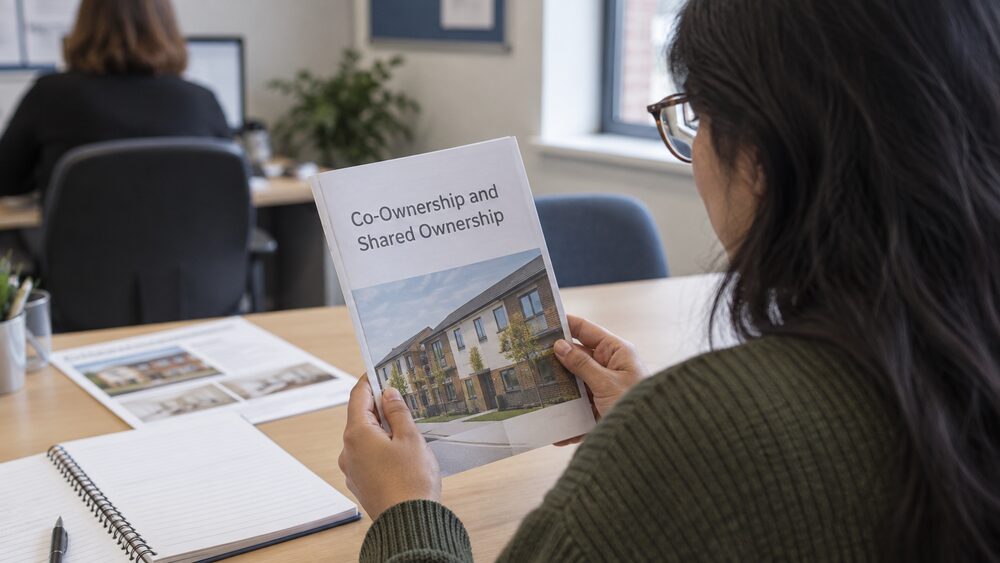
If you want to buy a home but cannot stretch to the full price, two part-buy, part-rent routes exist in the UK. In Northern Ireland, Co-Ownership is the shared ownership provider, offering two products: Co-Own, for buyers using a mortgage, and Co-Own for Over 55s, funded with savings or equity rather than a mortgage1. In England, shared ownership is a government-backed scheme where you buy a share of a property and pay rent to a housing association on the rest4.
The two are the same idea run by different organisations under different rules. Co-Ownership is a not-for-profit organisation and registered charity, and it operates only in Northern Ireland5. English shared ownership is delivered by housing associations under a national model, with an initial share of between 10% and 75% and a 990-year lease as standard6.
The practical differences matter most at three points: what you can buy and where, what you pay each month, and who pays when something needs fixing. This page sets out both models side by side so you can see which one fits your circumstances.
What each scheme offers
Co-Ownership describes itself as Northern Ireland's shared ownership provider, and it offers two products designed for different stages of life and different ways of financing a move1. Co-Own is for buyers using a mortgage to purchase their share3. Co-Own for Over 55s is for buyers using savings or equity from a current home, and there are no mortgage payments because the purchase is funded that way9.
Under Co-Ownership you buy a share of your home and pay rent to Co-Ownership on the share it owns, plus all your household bills and costs9. You can increase your share in 5% steps or lump sum amounts, or buy out the entire Co-Ownership share whenever you wish, and there is no requirement to increase your share at all5. The lease is 99 years5.
English shared ownership works differently in structure. You buy a share of the property and pay rent to a landlord for the share they own; it is also called part-buy and is a government-backed scheme4. Under the current model, you buy an initial percentage of between 10% and 75% and pay a reduced rent on the rest7. After becoming a shared owner you can buy more shares, usually increasing to up to 100%7. Around 4,000 to 5,000 shared owners a year staircase to full ownership9.
The share sizes have shifted over time. Older guidance describes shared ownership shares as usually between 25% and 75%10, while the newer model starts at 10%6. If you are looking at a specific home, the lease and the landlord's scheme rules will state the share on offer.
Fees, charges and eligibility
The costs of Co-Ownership start before you buy. There are Application Fees, Property Assessment Fees and Legal Fees involved in the process, and you will also need to confirm borrowing with a lender, instruct a solicitor and pay for a survey if the lender requires one9. The Application Fee is £100, payable before submitting your application, and it covers a check of your income, outgoings and credit history12. It is non-refundable, including if you apply and do not meet the criteria, or if problems are discovered after applying and paying the fee12.
Monthly costs under Co-Own are a mortgage on the share you own, paid to your mortgage lender, plus rent to Co-Ownership on the share it owns, plus all household bills9. Under Co-Own for Over 55s, monthly costs are rent to Co-Ownership on its share plus household bills, with no mortgage payments9.
Eligibility for Co-Ownership is set by the organisation. For Co-Own, you must not currently own any property or land, must have no outstanding adverse credit such as county court judgements or defaults, and the property must be your only residence14. You must not have had any payday loans or home credit in the last 12 months14. For Co-Own for Over 55s, any property you already own must be in the process of being sold14. Married, civil partnered or cohabiting applicants must apply together, both must meet the criteria, and both are equally responsible for the mortgage and rent payments14.
In England, shared ownership eligibility is set nationally. It gives first time buyers and those who do not currently own a home the opportunity to purchase a share in a property11. A prospective shared owner must have a household income of £80,000 or less, or £90,000 in London15. A deposit of at least 5% of your share is typical, alongside a mortgage for the rest9.
| Co-Ownership (Northern Ireland) | Shared ownership (England) | |
|---|---|---|
| Who runs it | Co-Ownership, a not-for-profit and registered charity5 | Housing associations under a government-backed scheme4 |
| Initial share | Set by the scheme; no requirement to increase5 | 10% to 75% under the new model6 |
| Maximum property value | £215,000 existing, £230,000 new build8 | Set by scheme and region |
| Lease length | 99 years5 | 990 years as standard7 |
| Application fee | £100, non-refundable12 | Set by landlord |
| Deposit | Set by scheme and lender | At least 5% of your share9 |
Buying a home: what you can buy and where
Co-Ownership customers choose a home on the open market, new build or existing16. New build homes can be anywhere in Northern Ireland, and existing homes can be anywhere in Northern Ireland8. The maximum property value is £215,000 for existing properties and £230,000 for new build properties8. The maximum purchase value is £230,000, and Co-Ownership does not support any purchase above these amounts17.
There are property criteria. New builds must have a suitable 10-year structural warranty, and existing properties under 10 years old must have the balance of their original structural warranty8. The home must have an Energy Performance Certificate8. All roads and sewers serving the home must be bonded or adopted8. Co-Ownership generally does not pay for extras in new builds, or for furnishings or moveable fittings, and the price must include all utility connection fees8.
Some properties are not accepted. These include properties that are architect certified, have no central heating, have non-standard or unconventional construction, are mobile homes or temporary structures, are defined as Houses in Multiple Occupation, have an annex, have Japanese Knotweed, are sold incomplete or "as is", are underpinned or stated to be defective, have agricultural use restrictions, are used for purposes other than as a residence, have a private water supply, have leased renewable energy systems (unless the system is owned by the seller), or do not front onto an adopted road8. Properties requiring more than £6,000 of work to resolve before purchase, or more than £6,000 after purchase, are also not accepted8.
Service charges are expected to be no more than £200 per year for a house and no more than £1,000 per year for an apartment8. You must declare any incentives you are offered by the seller or developer, and Co-Ownership may not agree to them8.
In England, shared ownership properties are usually leasehold, meaning shared owners are leaseholders18. The lease is a legal contract with the housing association that makes the shared owner the homeowner and states how long the lease is for, what the costs and fees are and the responsibilities of the homeowner19.
Paying each month: rent, mortgage and service charges
Under Co-Ownership, you pay a mortgage on the share you own, paid directly to your mortgage lender, plus rent to Co-Ownership on the share it owns9. The greater the share a shared owner buys in their home, the less rent they will pay to their housing association; at 100% no rent is paid20. Co-Ownership participates in Experian's Rental Exchange scheme, which means rent payments can be recorded on your credit history21.
In England, the purchaser pays rent to a housing association for the proportion of the home they have not purchased, and may pay a monthly service charge11. While rent increases are capped, increases to the service charge are not15. This is a point worth understanding before you buy: your rent is protected to some degree, but your service charge is not.
If you have a shared ownership tenancy, your Universal Credit housing costs payment can also include an amount for your rent22. Any mortgage in shared ownership cases is subject to Support for Mortgage Interest rules11. The size criteria is not applicable to shared ownership cases, which means the removal of the spare room subsidy does not apply11. Where applicable, any Housing Costs Contributions will continue to apply11.
Repairs and maintenance: who pays
This is one of the sharpest differences between the two models, and it catches many buyers out.
In England, the lease makes the shared owner the homeowner, and they are responsible for all the repairs and maintenance in their home, including major structural works and major repairs18. Shared owners agree to pay for the full costs of repairs and maintenance18. As the leaseholder owns the full legal interest in their lease, they also take on full responsibility for the property18. The shared owner has the same benefits and rights in relation to the common parts as any other leaseholder18.
The new model softens this slightly. Housing associations contribute up to £500 a year towards certain repairs and maintenance costs in the first 10 years of ownership, and this contribution can be rolled over for one year7. For flats, if the reserve fund does not cover the cost of external repairs, the cost will be divided between you and the other flat owners in the building23.
For Co-Ownership, the property assessment differs slightly depending on whether the property is an existing property or a new build, and the report is shared with the applicant24. The assessment is not the same as a property survey by a mortgage lender25.
Increasing your share and selling
With Co-Ownership, you can increase your share in 5% steps or lump sum amounts, or buy out the entire Co-Ownership share whenever you wish5. There is no requirement to increase your share, and you can continue paying rent on Co-Ownership's share for as long as you wish5. Requesting a buying-out valuation costs £755. When you sell, the proceeds are split between you and Co-Ownership based on the ownership shares in your lease26.
In England, staircasing is the process of buying more shares. Other staircasing transactions have a minimum of 5% rather than 10% under the new model7. There is an option to staircase in 1% increments per year for 10 years without undertaking a valuation9. For buying shares of more than 5%, the shared owner must pay for a valuation by a chartered surveyor15. There may also be an administration fee paid to the landlord of between £150 and £50015. There is no upper limit on share size purchased, up to 100%15.
The pace of staircasing is slow in practice. Research cited by the Levelling Up, Housing and Communities Committee estimated that only around 3% of shared owners reach 100% ownership each year15. Around 4,000 to 5,000 shared owners a year staircase to full ownership9.
A shared ownership lease provides similar rights to an ordinary long residential lease but there are some differences27. If you are considering buying more shares, the staircasing guide sets out the process, and the selling a shared ownership home page covers what happens when you move on.
Service and complaints
Co-Ownership has a complaints policy covering Co-Own, Co-Own for Over 55s and Rent to Own28. A complaint is defined as any expression of dissatisfaction with its service, regardless of how Co-Ownership becomes aware of it28. If someone else is complaining on your behalf, Co-Ownership needs your permission to discuss your case with them28.
The application process itself has service standards. Most applications take between three and six months from application to completion, although this can vary29. The application takes around 30 minutes to complete, with progress that can be saved and returned to later, and it is restricted to a maximum of two applicants14. On average it takes up to 5 working days to reach a decision, varying with complexity and how quickly information is received14. Unsubmitted applications are automatically deleted after 90 days14. Co-Ownership has approved on average 75% of applications over the past five years, although some months it is as many as 84%14.
You can apply online through your online account, via a mortgage adviser, or by booking a face-to-face appointment at the Belfast office where a team member completes the application on your behalf14. You can pay by debit or credit card through a secure payment system14. Co-Ownership uses Experian to review your credit history and carry out a full credit assessment, and both applicants' Experian credit history is reviewed during the application stage for joint applications14.
If your circumstances change during the process, you can choose another property and upload it for assessment via your online account if you are still within the Co-Ownership Approval period30.
For England, complaints about a housing association go through the landlord's own complaints process first. The complaining when buying a home goes wrong page covers the routes available.
Protection for your money
With Co-Ownership, the mortgage is secured against your share of the property, and both you and Co-Ownership will be named on the property title according to your respective shares31. This means the scheme's interest is registered alongside yours.
In England, the shared ownership lease is the document that protects your position. It states how long the lease is for, what the costs and fees are and the responsibilities of the homeowner19. The leaseholder purchases the full leasehold title to their home and enters into a lease contract with the landlord18.
The landlord may instead choose to rely on Grounds 10 and 11, which are also linked to non-payment of rent but do allow the court to consider any surrounding circumstances in choosing whether to award possession of the property to the landlord32. If you are struggling with rent or mortgage payments, free and impartial help is available from MoneyHelper and from debt advice charities such as StepChange.
For shared owners in England, the shared ownership arrears page explains what happens if you fall behind, and the shared ownership housing benefit page covers help with housing costs.
Where the two schemes differ most
The clearest differences come down to geography, price and responsibility.
Co-Ownership operates only in Northern Ireland, and its proceeds from sales are put back in the pot to help other people in Northern Ireland achieve home ownership5. Its maximum property values are £215,000 for existing properties and £230,000 for new builds8. English shared ownership has no equivalent national price cap in the same form, but eligibility is capped by household income at £80,000, or £90,000 in London15.
On repairs, the English model places full responsibility on the shared owner, softened by a time-limited contribution of up to £500 a year18. Co-Ownership's property assessment process and its own criteria govern what it will accept8.
On lease length, Co-Ownership offers a 99-year lease5, while the English new model uses a 990-year lease as standard, applied to existing shared owners as well7.
On staircasing, Co-Ownership allows increases in 5% steps or lump sums with a £75 buying-out valuation fee5. England's model allows 1% increments per year for 10 years without a valuation, with a chartered surveyor valuation required for shares of more than 5% and an administration fee of between £150 and £5009.
If you are weighing up whether to use one of these schemes or a standard mortgage, the Co-Own or a standard mortgage comparison looks at both. For the wider picture on buying in Northern Ireland, see buying a home in Northern Ireland, and for England, shared ownership in England.
Sources33 cited
- What is Co-Ownership Co-Ownership, 2026
- Understanding Co-Ownership Co-Ownership, 2026
- Starting the process Co-Ownership, 2026
- Mortgages Scope, 2026
- Paying your rent Co-Ownership, 2026
- Evaluation of the Help to Buy scheme GOV.UK, 2026
- Affordable home ownership: shared ownership National Housing Federation, 2026
- Increasing your share Co-Ownership, 2026
- Costs and responsibilities Co-Ownership, 2026
- Shared ownership guidance Parliament, 2025
- Shared ownership National Housing Federation, 2026
- Fees, costs and rent Co-Ownership, 2026
- How do I apply for Co-Ownership Co-Ownership, 2026
- Application process explained Co-Ownership, 2026
- Levelling Up, Housing and Communities Committee report Parliament, 2024
- Shared ownership in Northern Ireland Co-Ownership, 2026
- Can I bid on any type of property Co-Ownership, 2026
- Why are shared ownership customers responsible for paying for major structural works National Housing Federation, 2026
- Universal Credit regulations Legislation.gov.uk, 2025
- Complaints policy Co-Ownership, 2026
- Right to Shared Ownership GOV.UK, 2026
- Can I get Universal Credit housing costs element Turn2us, 2026
- Repairs and home improvements GOV.UK, 2026
- Is your property assessment the same as a property survey Co-Ownership, 2026
- What happens when I sell my home Co-Ownership, 2026
- Help to buy a home mygov.scot, 2026
- A shared ownership lease is an assured shorthold tenancy National Housing Federation, 2026
- Property assessment explained Co-Ownership, 2026
- Getting a mortgage Co-Ownership, 2026
- Manage and maximise your money Consumer Council, 2026
- Joint tenants vs tenants in common Which?, 2026
- Can shared owners lose all of their investment if they don't pay their rent National Housing Federation, 2026
- Housing Benefit Mental Health and Money Advice, 2025



 MoneyHelperFree, impartial money and pensions guidance, set up by government
 Citizens AdviceFree advice on money, consumer and legal problems in England and Wales
 ShelterFree housing advice from a charity
 GOV.UKOfficial information on tax, benefits and government services
 Financial Ombudsman ServiceFree, independent help when a complaint about a firm is not put right