
Shared ownership lets you buy part of a home and pay rent on the rest. The rent is charged only on the share you have not bought, so the bigger your share, the smaller the rent. Rent is usually worked out as a percentage of the value of the share you do not own, commonly between 2% and 3%, and under the Right to Shared Ownership it is capped at a maximum of 3% of the value of the equity stake you have not acquired1.
Shared ownership lets you buy part of a home and pay rent on the rest. The rent is charged only on the share you have not bought, so the bigger your share, the smaller the rent. Rent is usually worked out as a percentage of the value of the share you do not own, commonly between 2% and 3%, and under the Right to Shared Ownership it is capped at a maximum of 3% of the value of the equity stake you have not acquired1.
The share you can buy varies. Shared ownership offers the option to buy a share of your home, between 10% and 75%, and pay rent on the remaining share3. In Wales, the Help to Buy schemes describe an initial share of 25% to 75% of a property, with rent paid on the remaining share4. Co-Ownership in Northern Ireland works differently again: you buy a percentage share that suits your budget, between 50% and 90%5.
Your monthly outgoings are not just rent. You also pay a mortgage on the share you own, and usually a service charge. Each month you will usually pay your mortgage payment, your rent, and a service charge for things like cleaning shared areas6. This page explains how the rent itself is calculated, what else sits alongside it, how buying more shares reduces it, and what help exists if the cost becomes difficult.
You pay rent only on the share you do not own
The principle behind the rent is simple: it covers the landlord's cost of carrying the share you have not paid for. The rent payment detailed in the lease covers the landlord's cost of financing the percentage value of the property that the shared ownership leaseholder has not yet paid for8. The lease calls this the specified rent, a monthly payment due to the landlord in lieu of paying for the full 100% price for the property at the outset9.
In practice, that means the rent is a percentage applied to the value of the unsold share. This is worked out as a percentage, usually between 2% and 3%, of the share you do not own2. One lender describes the rental payment as typically around 2.75% of the share not being purchased10. Under the Right to Shared Ownership, the rent is limited to a maximum of 3% of the value of the equity stake you have not acquired, and landlords will often set the rent at the lower target rate of 2.75%1.
A worked example makes the shape of it clear. On a 50% part share of a property worth £200,000, you pay rent on the remaining £100,000 of the property you do not own11. The rent is not charged on the £100,000 you have bought.
The rent is not fixed forever. It is reviewed, and the review can follow an inflation measure. One official example of a rent review, using September 2021 as the relevant month, produced a 5.4% increase, made up of a 4.9% increase in RPI plus 0.5%7. Your lease sets out how and when your own rent can change, so the review terms matter as much as the starting figure.
Your monthly costs: mortgage, rent and service charge
Rent is one of three regular costs, and the other two can be substantial. Each month you will usually pay your mortgage payment, your rent, and a service charge for things like cleaning shared areas6. The service charge is usually included in your rent and is a priority debt if you rent your property12. If you live in a block of flats, you may have to pay a service charge to cover the maintenance of the building's communal areas, and you might also have to pay ground rent11.
Co-Ownership in Northern Ireland sets out the same structure in its own terms: you pay a mortgage on the share of your home that you own, paid directly to your mortgage lender, rent to Co-Ownership on the share it owns, plus all your household bills and costs13. For its Co-Own for Over 55s product, the monthly costs are made up of rent to Co-Ownership on its share, plus all household bills and costs, just like any homeowner13.
Illustrative figures from Co-Ownership show how the two elements sit together. One example shows a mortgage of £566 plus rent of £177, a total of £7435. Another shows rent of £156.25 per month on a home valued at £150,000 where the co-owner owns 50%, an annual rent of £1,87514. A third example gives monthly rent of £104.17 on a property valued at £100,000 with a 50% share15.
Buying a bigger share cuts your rent
Because rent is charged only on the unsold share, buying more of the property reduces it. Each time you buy more, the amount of rent you pay each month goes down because you own a bigger portion5. The standard lease form says the same: as the leaseholder buys further shares, the rent will be reduced proportionately to reflect the fact that the landlord's share has reduced16.
The reduction is proportionate, not a renegotiation. As the Leaseholder buys further shares, the rent will be reduced proportionately to reflect the fact that the Landlord's share has fallen16. Each time you buy more, the amount of rent you pay each month goes down because you own a bigger portion8. That is why staircasing is the main lever a shared owner has over their rent.
There is a related protection for leaseholders facing certain building costs. If you are a shared owner, your cap is reduced in proportion to your equity in the property17. Separately, under the Leasehold and Freehold Reform Act 2024, only the rent payable in respect of the tenant's share becomes a peppercorn on the grant of the extended lease18. That is a specific rule about lease extensions, not about your monthly rent.
The rent does not disappear at 75% in the standard scheme. You pay rent on the part you do not own, and no rent if you own 100%6. The Older Persons Shared Ownership scheme is the exception: once you own 75% of the home you do not have to pay rent on the remaining 25% share of the property19.
Staircasing: from 1% a year up to 100%
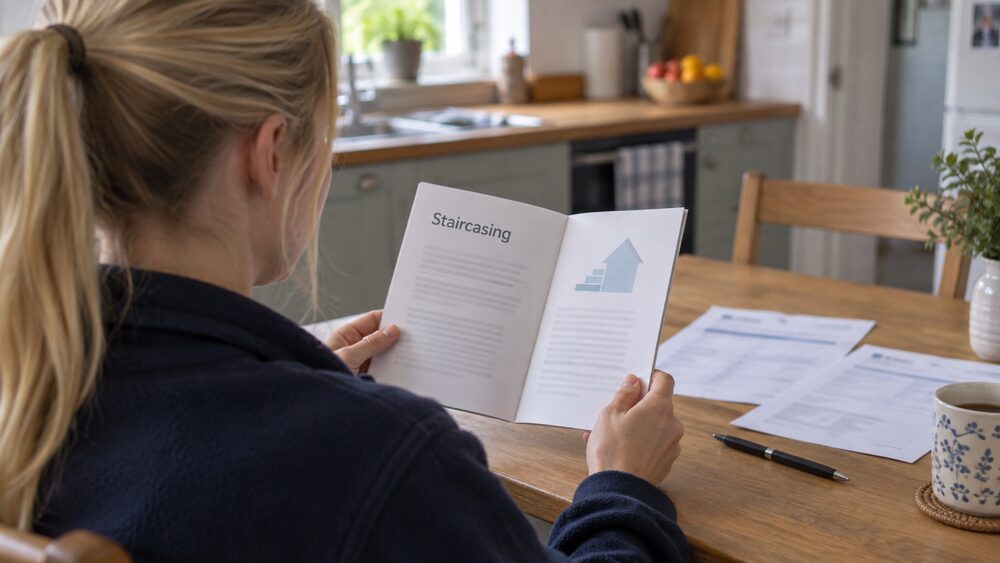
Staircasing is the process of buying more shares. The scheme offers the person the opportunity over time to increase their share within the property, known as staircasing, and eventually own the property in full20. Around 4,000 to 5,000 shared owners a year staircase to full ownership11.
The increments have been made smaller. New shared owners can buy additional shares in their home in 1% increments for up to 15 years, with heavily reduced fees21. Other staircasing transactions are reduced to a minimum of 5% rather than 10%11. New shared owners also get a 990-year lease as standard, which will also be applied to existing shared owners11.
The cost of each step depends on the property's value at the time you staircase, not what you paid originally. One official example, on a full market value of £325,000 at the time of staircasing, gives a cost of £3,250 for 1%, £16,250 for 5%, £48,750 for 15% and £81,250 for 25%7. The same guidance also gives a second set of figures for the same percentages: £4,250 for 1%, £21,250 for 5%, £63,750 for 15% and £106,250 for 25%7.
There is a separate page on staircasing: buying more shares in a shared ownership home and on what fees you pay when you staircase.
Who do I pay the rent to on a shared ownership home?
You pay it to the landlord, which is usually a housing association. Under the Right to Shared Ownership you buy a share of your home as a leaseholder, pay rent to the landlord on the rest, and usually pay monthly service charges1. The same structure applies more widely: you will purchase only part of the property initially and pay rent to a housing association or landlord for the share you do not yet own22.
The rent is not a profit line for the landlord in the way a market rent is. The rent payment detailed in the lease covers the landlord's cost of financing the percentage value of the property that the shared ownership leaseholder has not yet paid for8. That is why it is tied to the value of the unsold share rather than to local market rents.
Housing associations have built and sold 103,000 shared ownership homes in the last decade11. The Right to Shared Ownership allows eligible social housing tenants to purchase their social or affordable rented home on the same basis: buying a percentage of the property, and paying a reduced rent on the rest to a housing association11.
Is a service charge included in shared ownership rent?
Sometimes, and the answer changes what you owe and to whom. Guidance for tenants says the service charge is usually included in your rent and is a priority debt if you rent your property12. Where it is bundled in, you pay one amount and the landlord splits it internally.
Where it is not bundled, it is a separate bill. With shared ownership you are also responsible for service charges if you are in a block of flats, and regular rental payments24. You may have to pay a service charge to cover the maintenance of the building's communal areas, and you might have to pay ground rent and service charges11.
For flats, major works costs are shared. The cost will be divided between you and the other flat owners in the building if the reserve fund does not cover the cost25. Housing associations are expected to contribute up to £500 a year towards certain repairs and maintenance costs in the first 10 years of ownership11.
Help with rent and housing costs through benefits
If your income changes, help may be available for the rent element specifically. If you have a shared ownership tenancy, your Universal Credit housing costs payment can also include an amount for your rent26. You might also be eligible for Housing Benefit to help with your rent and service charge, whether or not you are eligible for help with mortgage costs27.
Support for Mortgage Interest works alongside this. If you live in a shared ownership property, you could get Support for Mortgage Interest as well as help with your rent28. Pension Credit can also help with housing costs such as ground rent or service charges29.
The rules differ depending on who your landlord is. If you rent from a private landlord, the amount of Housing Benefit you get will be worked out using Local Housing Allowance rates30. If you claim Housing Benefit and share facilities with other joint tenants, you get the shared accommodation rate of Local Housing Allowance31. The shared accommodation rate is paid to single Private Rented Sector claimants under the age of 35, and does not apply to under 35s living in supported housing in the Private Rented Sector28. It should cover the cost of renting a room in a shared house, but it is often not enough32.
There is a separate page on Housing Benefit and Universal Credit for shared owners.
Does the spare room subsidy removal apply to shared owners claiming benefits?
No. Official guidance states the size criteria is not applicable to shared ownership cases, which means the removal of the spare room subsidy does not apply33. That is a meaningful difference from the position for other social tenants.
For people of working age renting social housing generally, the eligible rent is reduced if they are considered to have one or more spare bedrooms, commonly referred to as the bedroom tax34. The reduction is 14% if you have one spare bedroom, or 25% if you have two or more spare bedrooms35. If you live in social housing and have a spare bedroom, the calculator will not split the spare room subsidy between joint tenants, and the full deduction will be applied if you enter that you have a spare room36.
There are exemptions from the spare room reduction for people with certain care needs. You can keep the room if you or your partner claims the care component of Disability Living Allowance at the middle or higher rate, or the daily living component of Personal Independence Payment37.
Where to get free help
If the rent, mortgage or service charge becomes unaffordable, free and impartial help exists. StepChange, National Debtline and Shelter all provide debt and housing advice, and there is a page on what happens if a shared owner falls behind on rent. For benefits questions, Turn2us and EntitledTo both publish calculators and guidance.
For the wider picture on how shared ownership works, including deposits and selling, see shared ownership in England, how much deposit do I need for a shared ownership home and selling a shared ownership home.
Sources37 cited
- Right to Shared Ownership GOV.UK, 2026-09-26
- Shared ownership mortgages Barclays, 2026
- What is Co-Ownership Co-Ownership, 2026-09-26
- Older Persons Shared Ownership GOV.UK, 2025-12-03
- Costs and responsibilities Co-Ownership, 2026-09-26
- Shared ownership mortgages NatWest, 2026-09-25
- Evaluation of the Help to Buy scheme GOV.UK, 2026-09-16
- Why are shared ownership customers responsible for paying for major structural works? National Housing Federation, 2026-09-26
- Service and ground charge arrears StepChange, 2026-09-25
- Shared ownership mortgages Teachers Building Society, 2026-09-26
- Shared ownership National Housing Federation, 2026-09-26
- Help to Buy Experian, 2026
- Paying your rent Co-Ownership, 2026-09-26
- Fees, costs and rent Co-Ownership, 2026-09-26
- Owning more of your home Co-Ownership, 2026-09-26
- Leaseholder contribution caps GOV.UK, 2024-07-24
- Leasehold and Freehold Reform Act 2024 legislation.gov.uk, 2024-05-24
- Shared ownership research briefing House of Commons Library, 2026-07-08
- Why is shared ownership considered ownership? National Housing Federation, 2026-09-26
- Mortgages Scope, 2026-04-01
- Help to Buy home schemes Welsh Government, 2026
- Shared ownership and shared equity mortgages Leeds Building Society, 2026-09-26
- Housing Benefit Mental Health and Money Advice, 2025-07-21
- Universal Credit housing costs element Turn2us, 2026-02-25
- Universal Credit payments for housing nidirect, 2026-09-01
- What is Housing Benefit? Shelter Cymru, 2026-08-26
- Shared ownership EntitledTo, 2026-09-26
- Housing Benefit and Council Tax Reduction Shelter Cymru, 2026-08-26
- Pension Credit GOV.UK, 2026-09-26
- Calculating your bedroom entitlement EntitledTo, 2026-09-26
- Benefits for under 35s in shared housing Shelter England, 2026-07-02
- Repairs and home improvements GOV.UK, 2026-09-28
- Rent arrears: standard occupation contracts National Debtline, 2026-09-25
- Housing Benefit Disability Rights UK, 2026-04-16
- Non-dependants EntitledTo, 2026-09-26
- Shared ownership guidance GOV.UK, 2025
- Mortgage jargon buster StepChange, 2026-09-25









 MoneyHelperFree, impartial money and pensions guidance, set up by government
 Citizens AdviceFree advice on money, consumer and legal problems in England and Wales
 ShelterFree housing advice from a charity
 GOV.UKOfficial information on tax, benefits and government services
 Financial Ombudsman ServiceFree, independent help when a complaint about a firm is not put right