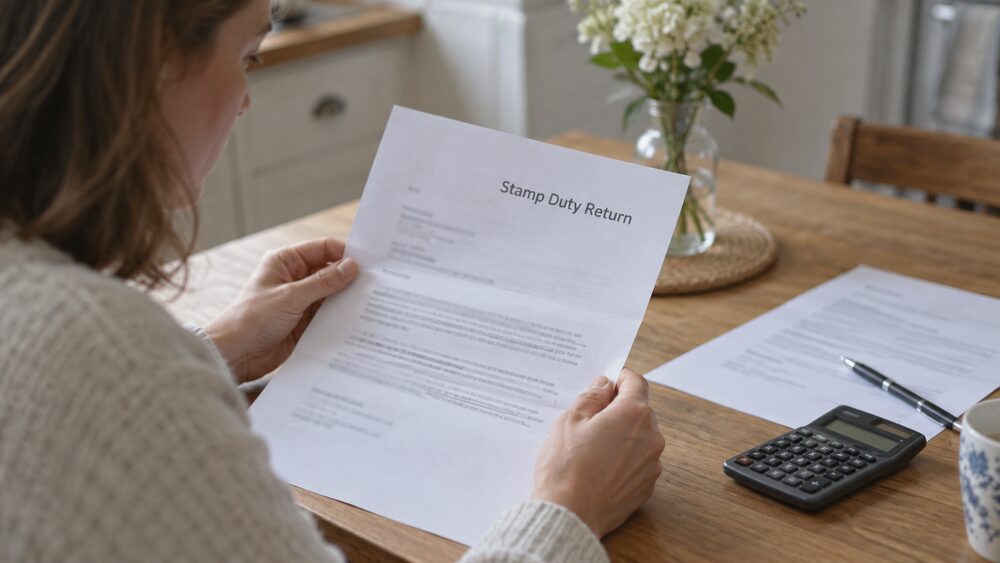
A gift towards your deposit does not change your Stamp Duty bill. Stamp Duty Land Tax is charged on the price you pay for the property, not on where the money came from, so money from a parent, a grandparent or anyone else is treated the same as money you saved yourself. The buyer owes the tax, and the person making the gift is not buying anything, so no Stamp Duty arises on the gift itself1.
A gift towards your deposit does not change your Stamp Duty bill. Stamp Duty Land Tax is charged on the price you pay for the property, not on where the money came from, so money from a parent, a grandparent or anyone else is treated the same as money you saved yourself. The buyer owes the tax, and the person making the gift is not buying anything, so no Stamp Duty arises on the gift itself1.
What can change the bill is who is buying and what they already own. First-time buyer relief can take the charge to nil on a home at a typical price, but it is lost if any buyer in the transaction has owned a home before, and gifted or inherited dwellings count when working out whether someone is a first-time buyer3. The higher rates for additional properties depend on what the buyer owns, not on who funded the deposit6.
The tax is normally due within 14 days of completion, and a return is usually needed even when nothing is payable3. In Scotland the equivalent tax is Land and Buildings Transaction Tax, and in Wales it is Land Transaction Tax7.
Stamp Duty is charged on the purchase price, not on where the deposit comes from
Stamp Duty Land Tax is a government tax payable when the price of the property you are buying is above a minimum amount set by the government, which can change at any time. The percentage varies with the value of the property and is paid on a sliding scale9. It applies in England and Northern Ireland only2.
The tax is charged on a slice basis: rates are graduated, so more expensive properties face progressively higher rates on the portions above each threshold2. That structure is why the bill depends on the price alone. A deposit assembled from savings, a gift, or a mix of the two produces the same charge on the same purchase price.
The name causes confusion because stamp duty also exists on shares, where it is charged at 0.5% of the purchase amount and paid only when you buy, not when you sell10. That is a different tax on a different transaction. A cash gift towards a house deposit is not a share purchase and does not attract it. Gifting shares is also outside it: transferring shares as a gift does not carry stamp duty11.
For a sense of scale, on a £292,000 purchase a first-time buyer would pay nothing, while a buyer of an additional property such as a buy to let would face £19,2004. The difference comes from the buyer's status and what they own, not from the deposit.
First-time buyer relief: nil up to £300,000 on homes up to £500,000
First-time buyers in England and Northern Ireland do not pay Stamp Duty on the first £300,000 of the price, and the relief cannot be claimed on transactions over £500,0004. On a £292,000 home, a first-time buyer's Stamp Duty is zero4.
The thresholds changed on 1 April 2025, when the rules for first-time buyers were significantly lowered and the standard buyer threshold reverted to £125,00013. Anyone working from older figures may be using the wrong numbers.
In Scotland the relief works differently. First-time buyers do not pay Land and Buildings Transaction Tax on the first £175,000 of the purchase price, against a standard nil-rate threshold of £145,000, potentially relieving up to £600 in tax7. The relief must be claimed in the first LBTT return made for the transaction, or in an amendment to that return14.
Two conditions matter for anyone using a gifted deposit. First, gifted or inherited dwellings are taken into account when determining whether someone is a first-time buyer, so a previous home received as a gift can remove the relief14. Second, the relief is not available if the transaction is one of a number of linked transactions14. Where a later linked transaction means the first purchase stops qualifying, tax or additional tax becomes chargeable on the first transaction as if the claim had never been made15.
Joint buyers and gifted deposits: when first-time buyer relief can be lost
Relief is assessed across everyone buying, so one buyer with a property history can remove it for the whole purchase. A gifted deposit does not itself affect eligibility, but the person receiving it might already own a home, or might have been given one.
In Scotland, first-time buyer relief is withdrawn if, after it has been claimed, the transaction becomes linked by virtue of a later linked transaction, and the taxpayer must make a further LBTT return to Revenue Scotland7. The same principle applies to the Stamp Duty relief in England and Northern Ireland15.
The higher rates for additional dwellings are separate from first-time buyer relief and turn on ownership. The first band of the higher rates is 5% on the portion up to £125,0006. There is a specific carve-out for jointly inherited dwellings: a person who jointly inherits a major interest in a dwelling with a beneficial share not exceeding 50% is not treated as having that major interest for three years from the inheritance6. The legislation also treats references to a dwelling as including dwellings outside England and Northern Ireland, with special provisions for Wales and for property elsewhere6.
If you are buying with someone else, the first-time buyer definition and the higher rates on additional properties are the two pages that set out who qualifies and when the surcharge bites.
Documenting a gifted deposit for your lender and solicitor
The tax treatment is simple; the paperwork is where gifted deposits take work. If you receive a gifted deposit, you need to tell both your lender and your solicitor16. Both will want to see a signed letter from the parties gifting the money17.
The letter normally confirms the gift is unconditional and will not be repaid, and the lender may also want evidence of where the money came from18. A short form signed by the donor verifying it is an unconditional gift, plus evidence of the source of the gift, is a common requirement19. Conveyancers may request bank statements as proof of the gift or loan as part of their money laundering checks18.
Gifted deposits need to be properly documented to avoid raising red flags during the mortgage application process20. Some lenders place a cap on what percentage of a deposit can be gifted, and where the money is a gift you will need to provide evidence to the lender that you will not be required to pay it back21.
One lender's criteria show how specific these rules can be. Gatehouse Bank accepts gifted deposits from immediate and extended family members, including parents, spouses, children, grandparents, siblings, aunts, uncles, legal guardians, step-relatives and in-laws. Vendor gifted deposits are not acceptable, builder or developer incentives may be accepted up to 5% of the purchase price, and a signed Gifted Deposit Declaration is required22.
There is also a rule that catches some buyers out. If you received your gift over 12 months ago, from outside or within the UK, you can use the money as a standard deposit23. More recent gifts face the full documentation process.
Paying Stamp Duty: the 14-day deadline and penalties
Stamp Duty must be paid within 14 days of completion4. The return must reach HMRC within 14 days of the effective date of the transaction, and the tax is payable at the point of completion3. As the buyer you have 14 days to pay any stamp duty you owe25.
Your solicitor will usually arrange the payment for you, often before your purchase is completed, but it is your legal responsibility to ensure the tax is paid26. It is paid to HMRC, usually handled by the solicitor or conveyancer, with the buyer ultimately responsible27.
A return is normally required even where no tax is due. There are exceptions, including where the property was left to you in a will1. If you are not represented, you must use the SDLT1 paper return and send it to HMRC by post3.
Late filing has consequences. HMRC charges a late filing penalty and interest if the return is not filed on time3. In Scotland, Revenue Scotland may charge penalties and interest if a return is not submitted or the tax is not paid on time28. If a repayment is received where the amount claimed was not due, it must be paid back along with any interest due29. HMRC will pay any refund to you unless you give permission for it to go to someone else, such as your solicitor or agent29.
Can Stamp Duty be added to my mortgage?
It is possible to add Stamp Duty to your mortgage, but it will incur interest over the duration of the mortgage term and will also affect your loan to value30. Borrowing the tax means paying interest on it for as long as the mortgage runs, and a higher loan to value can change the terms a lender is willing to offer.
The alternative is to pay it from available funds at completion, which is what most buyers do through their solicitor26. Where a gift is large enough to cover both the deposit and the tax, the money can be used for either purpose, because the charge depends on the price rather than the source1.
The choice is a cash flow question rather than a tax one. The tax bill is the same either way; what differs is whether interest is paid on it and how the loan to value looks to the lender30.
Scotland and Wales: different taxes on buying a home
Stamp Duty costs are different in Scotland and Wales12. In Scotland the tax is Land and Buildings Transaction Tax31. In Wales, Land Transaction Tax replaced Stamp Duty Land Tax on residential and non-residential property and land interests from 1 April 20188.
The three taxes are collected separately. Stamp Duty Land Tax revenues for England and Northern Ireland come from HMRC, Land and Buildings Transaction Tax revenues for Scotland come from Revenue Scotland, and Land Transaction Tax revenues for Wales come from the Welsh Government32.
The first-time buyer reliefs differ too. Scotland's nil-rate threshold for first-time buyers is £175,000 against a standard £145,000, potentially relieving up to £6007. The £500,000 cap on first-time buyer relief applies to Stamp Duty Land Tax in England and Northern Ireland5.
If you are buying outside England and Northern Ireland, the Land and Buildings Transaction Tax and Land Transaction Tax pages set out the rates, reliefs and returns for each. The costs of buying a house page puts the tax alongside the other bills that arrive during a purchase.
Sources32 cited
- Check if you need to send a Stamp Duty Land Tax return GOV.UK, 2026-06-26
- Stamp Duty Land Tax: research briefing House of Commons Library, 2026-07-08
- How to send a Stamp Duty Land Tax return GOV.UK, 2026-06-26
- Cost of buying a house calculator HomeOwners Alliance, 2026-06-11
- Review of Land and Buildings Transaction Tax Scottish Government, 2026-03-25
- Stamp Duty Land Tax Act 2003, Schedule 4ZA legislation.gov.uk, 2026
- First-time buyer relief worked examples Revenue Scotland, 2025-11-19
- Land Transaction Tax Welsh Government, 2026-09-28
- Our terminology explained Bank of Ireland UK, 2026-09-25
- Investment company performance figures and what they mean Association of Investment Companies, 2026
- How can I gift shares to a family member? AJ Bell, 2026
- Cost of moving calculator HomeOwners Alliance, 2026-06-11
- Stamp Duty calculator The Nottingham, 2025-04-01
- First-time buyer relief Revenue Scotland, 2025-11-19
- Stamp Duty Land Tax Act 2003, Schedule 6ZA legislation.gov.uk, 2026
- What is a gifted deposit? Yorkshire Building Society, 2026-09-26
- Get ready to apply for a mortgage Royal Bank of Scotland, 2026-09-25
- How can parents help first-time buyers? Which?, 2025-12-16
- Estate agent jargon buster Teachers Building Society, 2026-09-25
- 7 mistakes to avoid with your mortgage application Which?, 2026-06-05
- 95% mortgages Which?, 2026-04-02
- Home Purchase Plan criteria guide Gatehouse Bank, 2026-09-04
- Gifted deposit Nationwide Building Society, 2026
- Home buying and selling jargon HomeOwners Alliance, 2026-07-31
- Step by step mortgage process Yorkshire Building Society, 2026-09-26
- Everything you need to know about Stamp Duty Newcastle Building Society, 2026-09-26
- First-time buyer Stamp Duty Lloyds Bank, 2026-09-27
- Residential property Revenue Scotland, 2026-09-26
- Apply for a refund of Stamp Duty Land Tax GOV.UK, 2026-06-26
- Stamp Duty introduction NatWest, 2026-09-25
- Mortgage jargon buster Virgin Money, 2026
- Calculating the Household Costs Indices Office for National Statistics, 2026-05-28





 MoneyHelperFree, impartial money and pensions guidance, set up by government
 Citizens AdviceFree advice on money, consumer and legal problems in England and Wales
 ShelterFree housing advice from a charity
 GOV.UKOfficial information on tax, benefits and government services
 Financial Ombudsman ServiceFree, independent help when a complaint about a firm is not put right