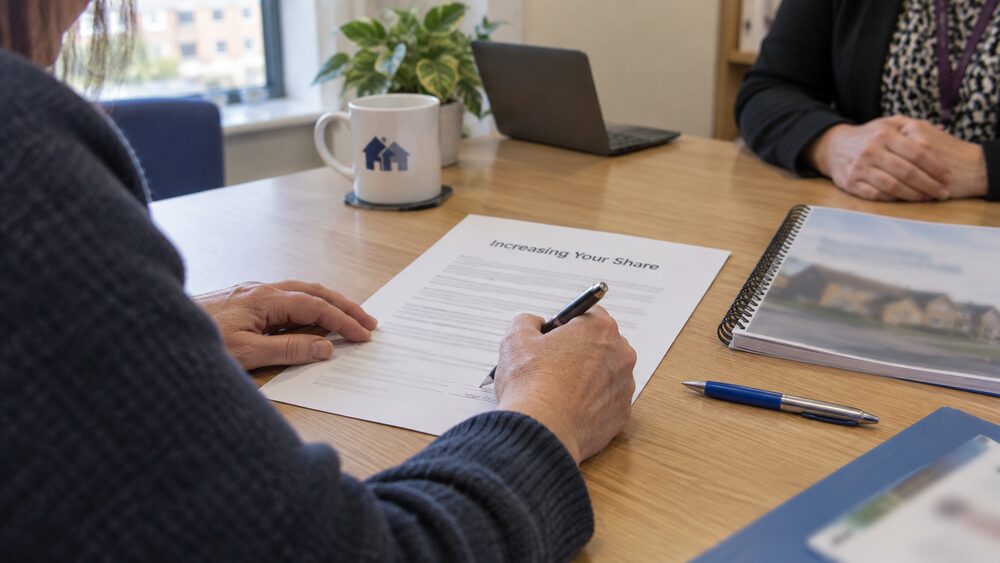
If you bought a home through the Open Market Shared Equity (OMSE) scheme in Scotland, you own part of it and the Scottish Government holds the rest under a shared equity agreement. You can buy more of it over time. The scheme guidance says that in most cases you can increase your share all the way up to 100%, meaning the Scottish Government no longer holds a stake1.
If you bought a home through the Open Market Shared Equity (OMSE) scheme in Scotland, you own part of it and the Scottish Government holds the rest under a shared equity agreement. You can buy more of it over time. The scheme guidance says that in most cases you can increase your share all the way up to 100%, meaning the Scottish Government no longer holds a stake1.
The mechanics are simple to state. You have to increase your share by at least 5% in a year, and you pay all the valuation and legal costs as well as the administration costs of the organisation that handles the request1. You can increase your stake regardless of whether the market value of the property has gone up or down2.
The exception worth knowing before you plan anything is the golden share. If your property has a golden share provision attached, you may only increase up to a maximum equity stake of 90%, so full ownership is not available on that home2.
How your share works in an Open Market Shared Equity home
OMSE helps first-time buyers on low to moderate incomes buy a home on the open market, within a certain price threshold3. You pay for the biggest share you can, usually between 60% and 90% of the home's cost, and the Scottish Government holds the remaining share under a shared equity agreement it enters into with you4.
Two things about that structure surprise people. The first is that you have complete title to your home and your name is on the title deeds for it, even though the Scottish Government holds a stake4. The second is that the value of your house is not affected by your share1. Your share is a financing arrangement, not a form of part-ownership in the everyday sense.
What you are responsible for is everything a full owner is responsible for: paying your mortgage, home contents insurance, building insurance, repairs and maintenance, council tax, heating, lighting and water bills, and fittings and furniture4. The Scottish Government's stake does not reduce those costs.
The Scottish Government's equity share is based on the valuation figure rather than the purchase price2. That matters when you come to increase your share, because the price of the extra slice is worked out from a valuation, not from what you originally paid.
Buying more of your home: at least 5% at a time, up to 100%
Increasing your share, sometimes called staircasing, is the process of buying back part of the Scottish Government's stake. The rule on size is a floor, not a ceiling: if you want to increase your share, you have to increase it by at least 5% in a year1. There is no stated maximum number of increases, but each one has to clear that 5% minimum.
The upper limit depends on your property. In most cases you can increase your share all the way up to 100%1. Where a golden share provision is attached, the maximum equity stake is 90%2. If you are unsure which applies to your home, the shared equity agreement you signed at purchase sets it out, and the administering agent can confirm it.
The same 5% minimum and the same cost rule apply to the New Supply Shared Equity scheme, the sibling scheme for new-build homes, where you also have to increase your share by at least 5% in a year and pay all the valuation, legal and administration costs6.
For comparison, other shared ownership products in the UK work differently. Under the Right to Shared Ownership in England you can buy more shares in the future, known as staircasing, and pay less rent on the rest of the property7. Shared ownership generally allows you to buy more shares, usually increasing to up to 100%8. The new national model for shared ownership in England lets new shared owners buy additional shares in 1% increments for up to 15 years, with heavily reduced fees9. OMSE has no equivalent small-increment route: 5% a year is the minimum step.
The costs of increasing your share fall on you
Every cost of increasing your share sits with you. The scheme guidance is explicit: you have to pay all the valuation and legal costs as well as the administration costs of the organisation that will handle the request1. The same wording applies to the New Supply Shared Equity scheme6.
That means three separate bills, and it is worth understanding what drives each.
| Cost | What triggers it | Who sets it |
|---|---|---|
| Valuation | You need a valuation from an independent professionally qualified valuer registered with the RICS10 | The valuer |
| Legal costs | Conveyancing on the transfer of the extra share | Your solicitor |
| Administration | The organisation handling your request charges for processing it1 | The administering agent |
The valuation requirement has a wrinkle. For an existing home, the valuation usually comes from the Home Report the seller provides, and you are asked to provide a copy of it5. For a new build, you are required to obtain a valuation at your own expense10. Either way, the figure that comes back sets the price of the share you are buying, because the Scottish Government's equity share is based on the valuation figure rather than the purchase price2.
Because each increase carries its own valuation, legal and administration costs, the number of times you staircase affects the total you spend on fees. Two increases of 5% cost more in fees than one increase of 10%, even though the share you end up owning is the same.
How to increase your share with Link Homes
Link Homes is the administering agent for the Open Market Shared Equity scheme11. The scheme guidance states that the first point of contact for anyone wanting to increase their share is the administering agent for the OMSE scheme, Link Homes1.
The order of events runs roughly like this:
- Contact Link Homes to tell them you want to increase your share1.
- Take independent financial and legal advice, as the scheme guidance advises2.
- Obtain a valuation from an independent professionally qualified valuer registered with the RICS, which for an existing home will usually be the Home Report10.
- Instruct a solicitor to handle the legal work on the transfer of the extra share.
- Pay the valuation, legal and administration costs1.
If you want to remortgage your home, the route is different: you have to contact the registered social landlord or local council who handled the sale1. That is a separate contact from Link Homes, and it is worth keeping the two straight.
Who values my home when I buy a bigger share?
The valuation has to come from an independent professionally qualified valuer who is registered with the RICS10. For an existing home, that valuation will usually form part of the Home Report, which the seller provides before you buy10. For a new build, you are required to obtain a valuation at your own expense10.
The valuation is not a formality, because it sets the price. The Scottish Government's equity share is based on the valuation figure rather than the purchase price2. If the valuation comes in higher than you expected, the share you are buying costs more; if it comes in lower, it costs less.
There is a separate question about what you have done to the property since you bought it. Changes to your home may increase or decrease its market value, and that can affect the price if you buy shares of 5% or more in the future12. So improvements you have made can raise the price of the next slice you buy. On the other side of the ledger, if a shared owner's home increases in value over a number of years they will receive this additional equity if they sell13. The two effects pull in opposite directions, and both flow from the same valuation.
Remortgaging, selling and what the Scottish Government gets back
When you sell, the split follows your share. If you have a 70% share of your home and you decide to sell it, you get 70% of the selling price and the Scottish Government gets 30%1. The same example appears in the New Supply Shared Equity guidance14.
The basis for that calculation is the sale price, not the valuation. On the sale of your home the equity percentage which is paid to the Scottish Government is based on the sale price of the property regardless of whether the property has increased or decreased in value and regardless of whether the sale price is above or below the valuation figure10. So a fall in the market reduces what the Scottish Government receives as well as what you receive, and a rise increases both.
If you increase your share to 100%, the Scottish Government no longer holds a stake, and there is nothing to repay on sale6. Until then, the Scottish Government will get a share of the money if you ever choose to sell the home4.
Remortgaging is a separate process with a separate contact. If you want to remortgage your home, you have to contact the registered social landlord or local council who handled the sale1.
Is OMSE available outside Scotland?
No. The OMSE scheme is available across Scotland only15. It is open to first-time buyers and priority access groups15, and it helps people buy a home within certain price thresholds for sale on the open market16. There are different threshold prices across Scotland4, and the thresholds are set at the middle (median) house price17.
If you are buying outside Scotland, the equivalent schemes are different products with different rules. In England, shared ownership lets you buy more shares in the property, usually increasing to up to 100%8, and the Right to Shared Ownership allows staircasing with reduced rent on the rest of the property7. In Northern Ireland, the House Sales Scheme lets you increase your equity share in multiples of five per cent at any time, which is known as staircasing18. In Wales, shared equity and shared ownership schemes operate under their own rules.
The Scottish Government also runs other shared equity products with their own repayment terms. Under the First Home Fund, the Scottish Government's equity stake is repaid at the time of sale or earlier, if the buyer wishes19. Under Mortgage to Shared Equity, the Scottish Government can buy up to 30% of your property, taking a financial stake in your home while you still own it and reduce monthly payments to your lender20.
Sources21 cited
- Open Market Shared Equity scheme: after buying mygov.scot, 17 March 2026
- OMSE scheme buyer information, page 7 Scottish Government, 19 September 2025
- Open Market Shared Equity scheme buyer information Scottish Government, 19 September 2025
- How the Open Market Shared Equity scheme works mygov.scot, 17 March 2026
- How to apply for the Open Market Shared Equity scheme mygov.scot, 17 March 2026
- New Supply Shared Equity scheme: after buying mygov.scot, 28 July 2026
- Right to Shared Ownership GOV.UK, 26 September 2026
- Shared ownership National Housing Federation, 26 September 2026
- The new national model for shared ownership House of Commons Library, 8 July 2026
- OMSE scheme buyer information Scottish Government, April 2025
- Shared equity post-sale information for buyers Scottish Government, 12 December 2017
- Shared ownership scheme: repairs and home improvements GOV.UK, 28 September 2026
- Why do customers sometimes lose money when they decide to sell their share having done lots of improvement and maintenance work? National Housing Federation, 26 September 2026
- New Supply Shared Equity scheme: how it works mygov.scot, 28 July 2026
- Help to buy a home mygov.scot, 24 June 2026
- Low cost initiative for first time buyers Scottish Government, 26 September 2026
- Open Market Shared Equity thresholds Scottish Government, 11 August 2026
- Equity sharing nidirect, 25 February 2026
- First Home Fund evaluation: quantitative analysis Scottish Government, February 2021
- Home Owners Support Fund: if you're separated from your partner mygov.scot, 14 July 2026
- Home Owners Support Fund information booklet Scottish Government, April 2015









 MoneyHelperFree, impartial money and pensions guidance, set up by government
 Citizens AdviceFree advice on money, consumer and legal problems in England and Wales
 ShelterFree housing advice from a charity
 GOV.UKOfficial information on tax, benefits and government services
 Financial Ombudsman ServiceFree, independent help when a complaint about a firm is not put right