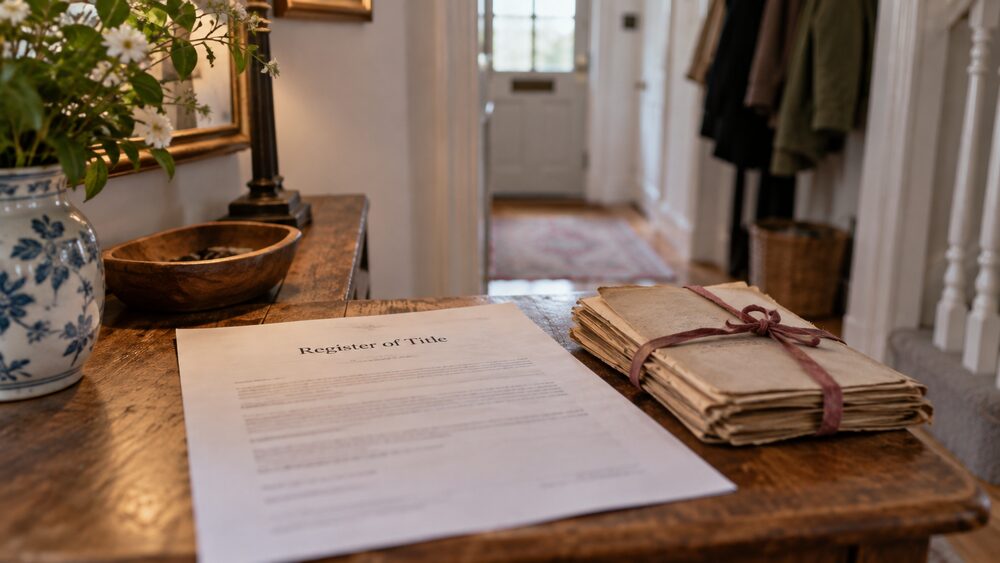
Buying a home does not end at completion. The moment the money is paid and the keys are handed over, a separate legal process begins: recording your ownership on an official register. Scotland and Northern Ireland run their own registers with the same purpose as England and Wales: to create a definitive, state-backed record of who owns what. In Scotland, the law defines a residential property owner by reference to someone who owns an interest registered or recorded, or capable of being registered or recorded, as a right of absolute ownership in the Land Register of Scotland or the General Register of Sasines1.
The register matters to you in practical ways. It is the evidence a future buyer's conveyancer will insist on seeing, it is what a mortgage lender relies on when lending against the property, and it is what official house price statistics are built from2. Ownership, in other words, is not fully "yours" in the official sense until it is on the register.
Which registry deals with your purchase depends on where the property is: HM Land Registry for England and Wales, Registers of Scotland for Scotland, and Land & Property Services for Northern Ireland. In most cases your conveyancer handles the registration for you, as part of the legal work described in our guide to conveyancing.
Why ownership is registered after you buy
Registration exists to answer one question with authority: who owns this property, and on what terms? Before registers existed, the only proof of ownership was the chain of paper deeds, which could be lost, forged or disputed. The modern system replaces that chain with a single official entry that a buyer, a lender or a court can rely on.
In Scotland, the concept is written into the definition of ownership itself: a residential property owner is an individual who owns an interest registered or recorded, or capable of being registered or recorded, as a right of absolute ownership in the Land Register of Scotland or the General Register of Sasines1. The General Register of Sasines is the older of the two Scottish registers, and the Land Register is progressively replacing it.
What the register records goes beyond bare ownership. It shows any mortgage charge against the property, which is why lenders care about it so much. It can also carry restrictions that shape what future owners can do. Under the First Homes scheme, for example, a restriction is registered on the property's title at HM Land Registry on the first sale, to ensure the discount and other restrictions apply to future sales7. A Help to Buy equity loan similarly appears as a charge on the title, and the government states it will apply to the Land Registry to remove the charge once the loan is fully repaid8. Shared equity purchases in Scotland also involve registration, and buyers under the First Home Fund are told their costs include registration fees alongside their share of the property's price and legal costs to their solicitor9.
Registration can also change your legal status in ways people do not expect. Under the House Sales Scheme in Northern Ireland, when you buy part of the property you are the leaseholder and no longer a tenant10. And because the register is the formal record, it is where evidence of how you own jointly is held: information on whether you own as tenants in common or joint tenants may be shown in the Transfer or Lease by which the property was acquired, or in a Trust Deed or Will, and the land register may also provide a clue11. If you are buying with someone else, our guide to buying a home jointly explains the difference that ownership form makes.
Which registry: England and Wales, Scotland or Northern Ireland
The United Kingdom does not have one land register. Three separate bodies keep the records, and which one holds yours depends entirely on where the property sits.
| Nation | Registry | What it keeps |
|---|---|---|
| England and Wales | HM Land Registry | The Land Register, with more than 27 million titles5 |
| Scotland | Registers of Scotland | The Land Register of Scotland and the older General Register of Sasines1 |
| Northern Ireland | Land & Property Services | The Folio for each registered property4 |
The three registries work together where it matters for consumers. HM Land Registry, Registers of Scotland, Land & Property Services together with the Northern Ireland Statistics and Research Agency, and the Valuation Office Agency all supply data for the UK House Price Index, the official measure of house price movements across the country2. The same official statistics note that HM Land Registry safeguards land and property ownership valued at nearly £9 trillion6. So the register your purchase lands in also feeds the national picture of what homes are selling for.
HM Land Registry is a government department created in 18622. Its scale is the reason the England and Wales register is the reference point for most discussion of land registration in the UK: the Land Register contains more than 27 million titles showing evidence of ownership for more than 90% of the land mass of England and Wales5. Legislation covering property matters routinely extends to all three jurisdictions, England and Wales, Scotland and Northern Ireland, even where the detailed systems differ12. If you are buying in Scotland or Northern Ireland, the practical steps differ and our guides to buying a home in Scotland and buying a home in Northern Ireland cover those differences.
Your conveyancer usually registers the purchase and the mortgage
Registration is not something you do yourself after moving in. It is part of the legal work your solicitor or conveyancer is instructed to carry out, and it happens in the weeks following completion. The official guidance on changing ownership of a Help to Buy home puts it plainly: your conveyancer will register the change of ownership with HM Land Registry13.
The same pattern applies when a mortgage is involved. When you repay a Help to Buy equity loan, for example, your conveyancer sends a letter of undertaking, telling the agency your completion date, your home's value and an agreement to pay the correct amount14. The lender's charge is registered alongside your ownership, which is how the lender's interest is protected. The basic mortgage valuation that sits behind the lending is arranged differently: the lender instructs the valuer, and the borrower generally pays for it as part of the mortgage application15.
The order of the steps matters. The tax return comes before the registration application, not after it, and in Scotland that order is enforced by law rather than by convention. Buyers are normally asked by their conveyancer to respond promptly to requests, to check the draft registration details, and to keep the completion statement. If something in the registered details is wrong, such as a misspelled name or the wrong price, it is far easier to fix before the application goes in than after.
Buying unregistered land: compulsory first registration
Most homes people buy today are already registered, but not all. If the seller's ownership has never been entered on the register, the purchase triggers what is called compulsory first registration: when you buy unregistered property or land, you must register the title in the Land Registry under the compulsory first registration process4. The effect is that the register grows each time an unregistered property changes hands.
As a rough guide for England and Wales, if you bought land or property since 1 May 2003, it is registered in the Land Registry4. That date is a useful rule of thumb rather than a hard legal boundary, and the compulsory registration rules have been extended over time, so a property last sold decades ago may still be unregistered even though a purchase today would have to be registered. If you are buying an unregistered property, your conveyancer will need the seller's deeds to prove the chain of ownership, which is why lost title deeds can cause real delays on an unregistered sale.
Compulsory first registration also applies to transactions that are not straightforward open-market sales. A regulated sale and rent back agreement, for instance, is an arrangement under which a firm buys all or part of an interest in land in the United Kingdom from a homeowner on the basis that the individual or a related person is entitled, and intends, to use at least 40% of the land as a dwelling17. Ownership passing under such an arrangement is still a transfer that has to be registered.
For buyers using government schemes, registration is where the scheme's rules are made permanent. On the first sale of a First Homes property, a restriction is registered on the property's title at HM Land Registry to ensure the discount and other restrictions apply to future sales7. A Help to Buy equity loan appears as a charge, and once the loan is fully repaid the agency applies to the Land Registry to have the charge removed8. Buyers in Scotland's First Home Fund are told their costs include registration fees as a standard part of the purchase9. If you are buying with any form of shared ownership or shared equity, the register is what records your share and everyone else's, and our page on shared equity schemes in Scotland explains how those interests are held.
Fees for registering in Scotland: tax first, then the registration payment
Scotland has a distinctive feature in its registration process: the tax authority and the registry are linked, and the tax comes first. Registers of Scotland will only accept an application for registration if the land transaction return has been made and the self-assessed Land and Buildings Transaction Tax has been paid3. The same rule is stated in Revenue Scotland's own guidance: an LBTT return must be submitted and arrangements made for payment of the LBTT due to Revenue Scotland before the Keeper of the Registers of Scotland can proceed with registration of title18.
A second point catches people out. Registration payments to Registers of Scotland must be paid separately to Registers of Scotland and not to Revenue Scotland19. The tax and the registration fee are two different payments to two different bodies, even though both must be dealt with before your title can be registered. Your solicitor normally handles both, and the two payments appear as separate items on a completion statement.
The practical costs for a Scottish buyer therefore include:
- The LBTT due to Revenue Scotland, calculated on the purchase price, which must be paid before registration can proceed18
- The registration fee, paid separately to Registers of Scotland19
- Legal costs to your solicitor, which the First Home Fund guidance lists alongside registration fees as standard buyer costs9
If you need documents afterwards, copies are not free. You can pay a fee to order a copy of your title deeds from the Registers of Scotland16. Evidence of a completed sale, which can be needed for tax purposes such as reclaiming the Additional Dwelling Supplement, can take the form of a copy of the disposition of sale, a copy of Land Registration documents, or a letter from your solicitor that clearly states the date of sale20. Our guide to Land and Buildings Transaction Tax covers the tax side in full, and who keeps the title deeds in Scotland answers the custody question for Scottish purchases.
What HM Land Registry holds: 27 million titles covering over 90% of England and Wales
The scale of the England and Wales register is hard to picture, but the official figures give a sense of it. The Land Register contains more than 27 million titles showing evidence of ownership for more than 90% of the land mass of England and Wales5. HM Land Registry safeguards land and property ownership valued at nearly £9 trillion6, and its registers enable over £1.66 trillion worth of personal and commercial lending to be secured against property across England and Wales21.
What this means for an individual homeowner is that the register, not the paper deeds, is the authoritative record. Each title has a number, a description of the property, the name and address of the owner, and any charges or restrictions. Because the register is the reference point, the data it produces has a second life in official statistics: HM Land Registry's price paid data feeds the UK House Price Index alongside the equivalent data from Registers of Scotland and Land & Property Services in Northern Ireland2.
The register is also what makes secured lending workable at scale. A mortgage lender knows its charge will appear on the title and be protected by law, which is part of what allows over £1.66 trillion of lending to be secured against property across England and Wales21. Without a reliable register, every mortgage would carry the risk that the borrower does not actually own what they are borrowing against. That is the quiet service the register performs for every homeowner with a mortgage, whether they ever look at their title or not.
Updating ownership details after completion
Registration is not a one-off event for the life of the property. The register is updated whenever ownership changes, and several common events trigger an update.
- A transfer of equity, such as adding or removing a partner after a divorce or separation: your conveyancer will register the change of ownership with HM Land Registry13. MoneyHelper notes that the family home is considered matrimonial property if it was bought after you married or became civil partners, or bought before the marriage specifically for use as a family home, which is often the context in which ownership has to be changed22.
- Repaying an equity loan: once a Help to Buy equity loan is fully repaid along with other costs, the agency applies to the Land Registry to remove the charge on the property8.
- Selling the home: the buyer's conveyancer registers the new ownership, and the seller may need evidence of the sale date for tax purposes, such as a copy of the disposition, Land Registration documents, or a solicitor's letter stating the date of sale20.
- Someone dying: if you are selling property belonging to the estate of someone who has died, you will need to include the information when reporting the estate to HMRC23.
The details on the register have to be right, because they are what everything else is checked against. Information on whether you own the property as tenants in common or joint tenants may be shown in the Transfer or Lease by which the property was acquired, or in a Trust Deed or Will, and the land register may also provide a clue11. If you are changing how you jointly own a home, a declaration of trust may also be needed, and our page on joint tenants or tenants in common explains the difference.
What triggers a tax return at £40,000
The £40,000 figure comes from the Scottish tax system, and it is a threshold for notification rather than for paying tax. Land transactions must be notified to Revenue Scotland unless the chargeable consideration is less than £40,00018. In other words, a transaction at or above that figure requires an LBTT return, and because the return and payment must come before registration, the threshold indirectly controls when registration paperwork is triggered too.
The connection between the tax return and the register is worth understanding, because it explains why your solicitor cannot register your purchase until the tax side is settled. Registers of Scotland will only accept an application for registration if the land transaction return has been made and the self-assessed LBTT has been paid3. The online LBTT return itself asks for property details, including the title number where you know it in full, and allows additional properties to be added within the same return where necessary24.
For most home buyers the threshold is irrelevant, because ordinary house prices sit well above £40,000. It matters for low-value transactions, such as a small piece of land or a share in a property, where the question is whether a return is needed at all. Our page on LBTT returns for property under £40,000 covers that narrow case, and when the LBTT return must be submitted explains the timing. The tax side of a purchase in England and Wales is covered in our guide to Stamp Duty Land Tax.
Protecting your property from title fraud
Property fraud happens when someone impersonates an owner, or exploits an owner's absence, to sell or mortgage a property that is not theirs to sell. The register is both the target of the fraud and one of the defences against it, because a buyer or lender dealing with a registered property relies on what the register says.
The official guidance lists the factors that put an owner at higher risk: your identity has been stolen, you rent out your property, you live overseas, the property is empty, the property is not mortgaged, the registered owner is dead, or the property is not registered with the Land Registry4. Several of these share a theme: nobody is watching the title. A property with no mortgage has no lender checking the register, and an empty or tenanted property may go unexamined for years.
There are practical protective steps:
- Property Alert: you can sign up to monitor a property if it is already registered with HM Land Registry, and receive an alert when something changes on the register25.
- An inhibition in Northern Ireland: if you think you are at risk from land or property fraud, you can apply to have an inhibition registered on the Folio4.
- Protective registration with Cifas: contacting Cifas, the UK's Fraud Prevention Service, places a warning flag against your name and other personal details on their National Fraud Database26.
If fraud does happen, reporting routes differ across the UK. Victims are most likely to report fraud to their bank or account provider, rather than the national reporting service Action Fraud or the police27, which means many cases never reach the bodies that track the crime. You can report fraud in England, Wales or Northern Ireland through the national reporting service, and if you live in Scotland or the fraud happened there, contact Police Scotland on 10128. Because stolen identity is often the route in, the same guidance recommends protective registration with Cifas as a follow-up step26.
Sources29 cited
- Shared ownership: paragraph 7, Schedule, SI 1998/1870 legislation.gov.uk
- UK House Price Index for May 2026 HM Land Registry, 2026-06-17
- Land and Buildings Transaction Tax: explanatory notes, ASP 2013/11 legislation.gov.uk
- Protect your land and property from fraud nidirect, 2021-07-02
- UK House Price Index for April 2026 HM Land Registry, 2026-04-22
- UK House Price Index for July 2026 HM Land Registry, 2026-09-16
- First Homes scheme research briefing, CBP-10740 House of Commons Library, 2026-07-08
- How to repay your equity loan using your own money GOV.UK, 2021-05-05
- First Home Fund: how to apply mygov.scot, 2026-08-31
- Equity sharing and the House Sales Scheme nidirect, 2026-02-25
- Debt when someone dies nidirect, 2026-06-26
- Section 3, Act of 2026 legislation.gov.uk
- How to change ownership of your Help to Buy home GOV.UK, 2021-05-05
- Help to Buy equity loan repayment application checklist GOV.UK, 2024-04-04
- Mortgage valuations and surveys Financial Ombudsman Service, 2026-09-26
- After you buy: buying a home in Scotland Shelter Scotland, 2024-07-25
- PERG 14.10: regulated sale and rent back agreements FCA Handbook
- Annual Summary of Trends in the Devolved Taxes 2023-24 Revenue Scotland, 2024-10
- How to pay LBTT Revenue Scotland, 2024-09-11
- How to claim a repayment of the Additional Dwelling Supplement Revenue Scotland, 2025-10-02
- UK House Price Index for March 2026 HM Land Registry, 2026-05-20
- Dividing the family home and mortgage during divorce MoneyHelper, 2026-09-25
- Tax when you sell property GOV.UK, 2026-09-26
- About the property section of the online LBTT return Revenue Scotland, 2019-07-26
- Property Alert GOV.UK, 2014-12-09
- What steps should I take if I have experienced a data breach ICO, 2026-09-25
- Identity theft and fraud reporting, POST PN-0720 Parliamentary Office of Science and Technology, 2026-06-07
- Credit and identity theft ICO, 2026-09-25
- Check if a letter you have received from HMRC is genuine GOV.UK, 2021-07-30


 MoneyHelperFree, impartial money and pensions guidance, set up by government
 Citizens AdviceFree advice on money, consumer and legal problems in England and Wales
 ShelterFree housing advice from a charity
 GOV.UKOfficial information on tax, benefits and government services
 Financial Ombudsman ServiceFree, independent help when a complaint about a firm is not put right