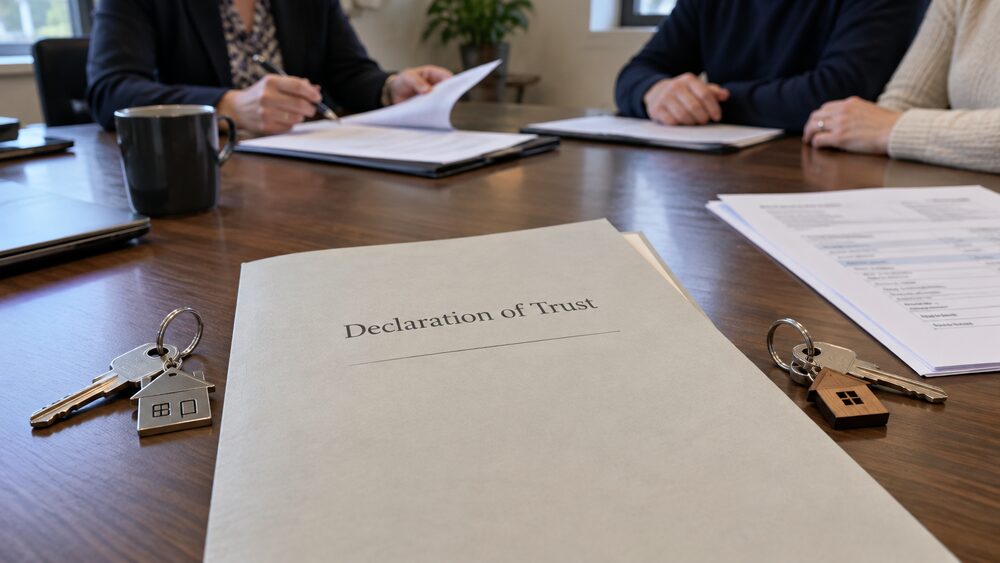
A declaration of trust is a legal document showing the financial details of a joint mortgage, including how much each owner paid towards the deposit and what should happen if the relationship breaks down, one owner cannot make repayments, or one owner wants to sell1. It is also called a deed of trust, and it is the usual way two buyers who put in different amounts record who paid what.
A declaration of trust is a legal document showing the financial details of a joint mortgage, including how much each owner paid towards the deposit and what should happen if the relationship breaks down, one owner cannot make repayments, or one owner wants to sell1. It is also called a deed of trust, and it is the usual way two buyers who put in different amounts record who paid what.
It matters because the way you hold the property and the way you paid for it are two different things. The legal ownership is registered as either joint tenants or tenants in common, and that register does not show that one of you found a larger deposit. A declaration of trust can include details such as how much money each joint owner paid towards the property deposit, and what should happen to their money if the relationship breaks down, one person is unable to pay their share of the mortgage, or you want to sell the property2.
The document is usually agreed on the purchase date, so it is prepared during the conveyancing process rather than months afterwards1. Once it has been accepted it is a legally binding document, which means the owners cannot change the way the money from the property will be divided1.
What a declaration of trust is
A declaration of trust is a written deed. In trust law terms it is an express trust, meaning a trust created deliberately by a settlor, usually in the form of a document such as a written deed or declaration of trust3. The person signing it is not handing the property to a stranger: they are setting out, in a form a court can read, what each person put in and what each should get back.
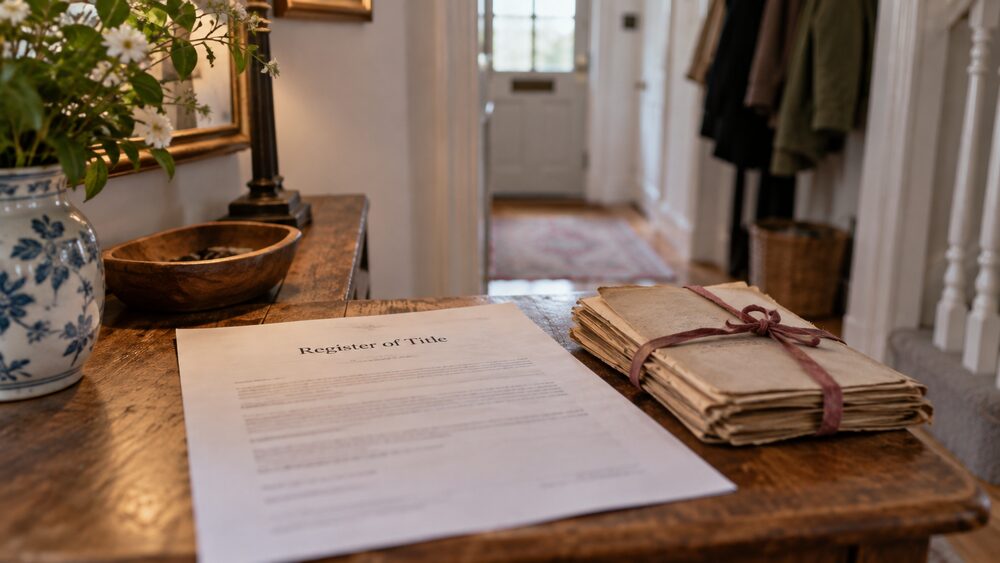
That is different from the register of ownership. The register says who owns the property; the declaration says how the value is shared between them. Where two people buy together, the legal title is normally held either as joint tenants, where the whole property passes to the survivor, or as tenants in common, where each holds a defined share. A declaration of trust is the document that puts figures and conditions on that share.
It is also different from the other things called trusts. A will trust is created within your will to allow you to protect property or assets you hope to pass on to your family4. A personal injury trust is generally any form of trust which was established with a payment received in respect of a personal injury, and is a description of the trust's purpose rather than a type of trust in itself5. A Scottish trust deed is a voluntary agreement of an entirely different kind, dealt with below6. The name is shared; the purpose is not.
A declaration of trust records who paid what
The core of the document is a record of contributions. It can include details such as how much money each joint owner paid towards the property deposit, and what should happen to their money if the relationship breaks down, one person is unable to pay their share of the mortgage, or you want to sell the property2. Those three triggers, separation, missed payments and sale, are the situations where the figures are most likely to be disputed, which is why they are the ones the document addresses.
Unequal deposits are the common reason. Where a buyer has been given the deposit as a gift, the lender will want a letter from whoever gave the money7. Where a parent helps, they may be required to sign a declaration that they have no legal interest in the property8. A declaration of trust between the buyers does a related but separate job: it fixes the position between the two of them, rather than between them and the lender or the person who gave the money.
The document can also set out what happens if one owner stops paying. If you are buying a property with someone else, you will need a joint mortgage, and both borrowers are liable to the lender for the whole debt regardless of what the declaration says between them9. The declaration governs the split of the proceeds; it does not reduce what either borrower owes the bank.
When joint buyers need one
There is no rule that only certain buyers need a declaration of trust, but the case for one is strongest where the money going in is unequal. Two buyers paying identical deposits and splitting every cost evenly have little to record. Two buyers where one is putting down most of the deposit, or where one will pay more of the mortgage each month, have a great deal.
It is not limited to unmarried couples. Married couples and civil partners can use one, and the position on separation differs by nation. In Scotland, your home will be considered matrimonial property if you bought it after you married or became civil partners, or bought it before the marriage or civil partnership specifically for use as a family home10. In England, Wales and Northern Ireland the treatment of the family home on divorce or dissolution follows different rules, and MoneyHelper covers dividing the family home and mortgage during divorce or dissolution10.
Joint buying itself is common and comes with its own limits. A maximum of four buyers may apply to jointly buy the property under Northern Ireland's House Sales Scheme, but at least one of the buyers must be the legal tenant11. In Scotland, where one of a pair of joint applicants for the First Homes Fund currently owns a property, they must have sold it before the purchase completes13. Joint buyers in Scotland also have joint and several liability for Land and Buildings Transaction Tax14.
Agreed on the day you buy
The declaration of trust for property is usually agreed on the purchase date1. In practice it is drafted by the conveyancer handling the purchase, signed alongside the other completion documents, and dated so it takes effect at the same moment as the transfer.
That timing is not arbitrary. The figures are known, both buyers are still in the transaction, and the lender's requirements are already being met. It also means the document can be checked against the mortgage offer and the land registry application at the same time, rather than reconstructed later from bank statements.
Where a purchase involves a gift, the paperwork runs in parallel. If you have been given the deposit as a gift, you will need a letter from whoever gave the money7. A parent helping may be required to sign a declaration that they have no legal interest in the property8. Both of those sit alongside the declaration of trust between the buyers, and a conveyancer will normally ask for all of them before completion.
Once signed, the split cannot simply be changed
A declaration of trust is a legally binding document, which means the owners cannot change the way the money from the property will be divided once it has been accepted1. That is the point of it: it removes the argument later by settling the position now.
The wider principle runs through trust documents generally. Once your policy has been put in trust, you can't usually change your mind and reverse this decision later on15. It's often very difficult to change or cancel a trust once it's been created, so understanding the implications before signing matters16. Once you put a policy in trust, you generally can't simply change your mind, and depending on the type of trust it may be difficult to change the beneficiaries or take the policy out of the trust later17.
If the arrangement genuinely needs to change, the usual route is a new document agreed by everyone affected, not an amendment to the old one. Anyone named on the mortgage should take advice before assuming that is possible, because the lender's position and the other owner's position both have to be respected.
"A declaration of trust is a legally binding document, which means the owners cannot change the way the money from the property will be divided once it has been accepted."
The Scottish trust deed is a different document
The phrase trust deed means something else entirely in Scotland, and the confusion is worth clearing up because the two documents have nothing in common. A trust deed is a legal agreement between you and your creditors to pay back part of what you owe over a set period18. It is a formal agreement between you and your creditors19, and a protected trust deed is a formal agreement with people you own money to repay what is owed over an extended period20.
A protected trust deed has that status from the date on which it is registered, referred to in the legislation as the date of protection21. Creditors who have not objected in writing within five weeks of the date of the notice of your trust deed will be treated as having agreed22. It shows on the Register of Insolvencies for five years23. The trustee's charge comes out of the trust deed fund, made up of monthly payments, assets included and equity included23, and the fees are usually about £4,000 or more24.
For anyone signing one, the protections are specific. A trust deed is not legally binding for the people you owe at first, but if they agree to your terms they are bound by law19. A trust deed is a legally binding agreement, so cannot be cancelled at will25. Where a trust deed was granted on or after 20 January 2025, the insolvency practitioner must provide the debtor with the material and adequate time to consider its contents26, and the trustee must give you a Trust Deed Information Document if you will be signing on or after that date18. Your trustee will advise that you must wait at least 3 days before signing the trust deed28.
None of this applies to a declaration of trust between two people buying a house. If you are buying in Scotland and someone refers to a trust deed, check which one they mean.
Where protection stops
A declaration of trust binds the people who signed it. It does not bind the mortgage lender, who can still pursue either borrower for the whole debt, and it does not change what the land register shows. If the property has to be sold because payments stop, the lender is repaid first and the declaration governs what happens to whatever is left.
It also does not protect against insolvency in the way people sometimes assume. A trust deed in the Scottish sense may require you to sell items of value29, and being a director of a limited company is affected: you cannot continue to be the director of a limited company unless your trustee agrees and unless the rules of the limited company allow you to enter into a trust deed24. Those are consequences of the Scottish debt solution, not of a declaration of trust, but they illustrate that a trust document can carry obligations well beyond the property.
Where money is held in trust, some protection exists at institution level. Trustees have a separate claim for each separate trust that they are a trustee of, for non-bare trusts, under the Financial Services Compensation Scheme30. That is about deposits held in a trust's name, not about the family home.
Free, impartial help is available. MoneyHelper covers dividing the family home and mortgage during divorce or dissolution10, and Citizens Advice Scotland explains money jargon including trust deeds6. A solicitor or conveyancer can say what a declaration of trust should contain in your circumstances, and it is worth asking before completion rather than after.
Sources30 cited
- Tenancy in common Experian, 2026
- Joint tenants vs tenants in common Which?, 2026-06-08
- Child Trust Funds Act 2004, Section 3 legislation.gov.uk, 2026
- Inheritance tax and trusts Which?, 2026-04-06
- Personal injury trusts Quilter, 2026-03-26
- Trust deeds Business Debtline, 2026-09-26
- Applying for a mortgage Which?, 2026-05-20
- How can parents help first-time buyers Which?, 2025-12-16
- Joint mortgages Shelter Cymru, 2026-08-28
- Dividing the family home and mortgage during divorce or dissolution MoneyHelper, 2026-09-25
- Equity sharing nidirect, 2026-02-25
- House Sales Scheme nidirect, 2026-02-18
- First Homes Fund: eligibility Scottish Government, 2026-06-24
- Land and Buildings Transaction Tax notes legislation.gov.uk, 2026
- Manage life insurance: trusts Zurich, 2026-09-26
- Mortgage life cover guide Post Office, 2026
- Is your life insurance set up to pay the right person Which?, 2026-07-11
- Trust deeds in Scotland National Debtline, 2026-09-25
- Getting a trust deed StepChange, 2026-09-25
- Are you in debt Accountant in Bankruptcy, 2026-07-16
- Bankruptcy (Scotland) Act 2016, section 163 legislation.gov.uk, 2026
- Bankruptcy in Scotland National Debtline, 2026-09-25
- Trust deed Scotland StepChange, 2026-09-25
- Credit reference agencies Business Debtline, 2026-09-26
- Trust deed Creditfix, 2026
- Protected trust deeds Accountant in Bankruptcy, 2025-01-20
- Trust Deed Information Document Accountant in Bankruptcy, 2024-12-19
- Money jargon A to Z Citizens Advice Scotland, 2026-09-25
- Trust deeds Debt Advice Foundation, 2026
- Charities claims FSCS, 2026-09-25







 MoneyHelperFree, impartial money and pensions guidance, set up by government
 Citizens AdviceFree advice on money, consumer and legal problems in England and Wales
 ShelterFree housing advice from a charity
 GOV.UKOfficial information on tax, benefits and government services
 Financial Ombudsman ServiceFree, independent help when a complaint about a firm is not put right