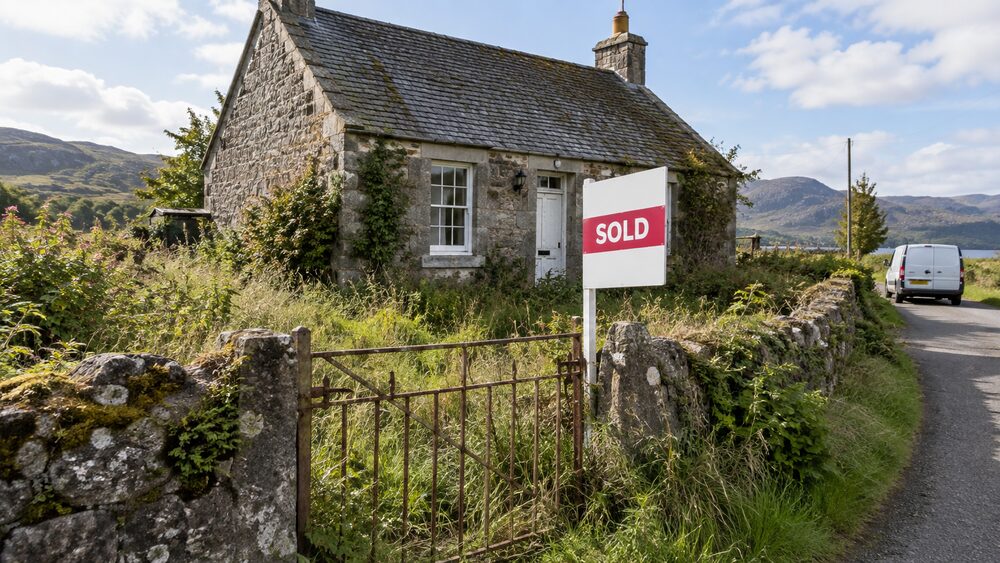
For most purchases of residential property in Scotland, an LBTT return is required where the chargeable consideration is £40,000 or more. Below that figure, transactions are generally not notifiable, so a buyer paying less than £40,000 for a property usually has nothing to file and nothing to pay1.
For most purchases of residential property in Scotland, an LBTT return is required where the chargeable consideration is £40,000 or more. Below that figure, transactions are generally not notifiable, so a buyer paying less than £40,000 for a property usually has nothing to file and nothing to pay1.
The £40,000 figure is a filing threshold, not a tax threshold. No LBTT is payable at all if the property is bought for less than the nil rate band, which for residential transactions is £145,0002. The two numbers do different jobs: £145,000 decides whether tax is due, and £40,000 decides whether Revenue Scotland needs to be told about the transaction at all.
There is one important exception. The Additional Dwelling Supplement, an extra 8% charge on second homes and buy-to-let purchases, applies to purchases of relevant residential properties at £40,000 and above3. That means a cheap second property can still be caught, and the deadline for filing is 30 days from the effective date of the transaction4.
Under £40,000: usually no LBTT return needed
The rule is set out in the legislation behind the tax. Notification is not required where the consideration for the transaction falls below a threshold of £40,0005. Revenue Scotland's own guidance puts it in plain terms: transactions with chargeable consideration of less than £40,000 are generally not notifiable1.
Chargeable consideration is defined as anything given in money or money's worth for the subject matter of the transaction2. That is a wide definition, and it is the reason the £40,000 test is not simply a question of the price written on the offer. What counts as part of the deal, and what sits outside it, is a matter for the solicitor acting on the purchase.
LBTT itself is a tax applied to residential and commercial land and buildings transactions, including commercial properties and commercial leases, where a chargeable interest is acquired4. It has different rates and bands for different types of property, with separate rates for residential property and for residential property bought with the Additional Dwelling Supplement4. The percentage rate for each band applies only to the part of the price over the relevant threshold and up to the next one, so the tax is built up band by band rather than charged at a single rate on the whole price4.
For a purchase below £40,000, none of that machinery is engaged in the ordinary case. There is no return to submit, no self-assessment to make and no tax to pay. The buyer's solicitor will normally confirm this as part of the conveyancing, and the purchase proceeds to registration without a Revenue Scotland step.
When a return is still needed: second homes and the Additional Dwelling Supplement
The Additional Dwelling Supplement is the main reason a purchase below £40,000 can still require a return. It is an additional amount of LBTT, charged at 8% of the relevant consideration for a transaction where the total purchase price of an additional dwelling is £40,000 or more3. The Scottish Budget confirmed that the supplement will remain at 8%6.
The threshold matters here in a specific way. The supplement is payable, as part of LBTT, on purchases of all relevant residential properties for £40,000 and above7. So the £40,000 line does double duty: it is the point at which a transaction becomes notifiable, and it is the point at which the supplement starts to bite on an additional dwelling.
Wales operates a comparable rule for its own tax. Land transaction tax higher residential rates apply to transactions of residential property costing £40,000 or more8. The parallel is worth knowing if you own property on both sides of the border, because the two systems are separate and a purchase in one nation does not follow the other's rules.
Where the supplement applies, the filing obligation follows. If a transaction is notifiable for LBTT, a return must be made to Revenue Scotland within 30 days of the effective date4. The effective date is normally the date of completion, which is when the clock starts.
Owing no tax is not the same as not filing: the £145,000 nil rate band
The nil rate band and the filing threshold are easy to confuse, and the confusion runs in both directions. The main LBTT nil rate threshold is £145,000, charged on purchase prices up to that figure2. The no-tax threshold has remained fixed at £145,000 since LBTT was introduced9.
That figure was not the original proposal. The zero tax threshold was set at £135,000 in the draft proposal and later raised to £145,0002. At introduction, a buyer purchasing an average-priced home in Scotland, £162,000 at the time, would either pay less tax or be exempt9.
The practical consequence is that a great many Scottish purchases pay no LBTT at all, and still require a return. A purchase at £150,000, for example, sits above the £40,000 filing threshold and below the £145,000 nil rate band, so there is a return to file and nothing to pay. The same is true of a purchase at £140,000: above £40,000, so notifiable, and below the nil rate band, so no tax.
First-time buyers have a higher nil rate band. Relief for first-time purchasers of a residential property exempts the first £175,000 of the purchase price from LBTT10. The Scottish Budget described this as increasing the residential nil rate band from £145,000 to £175,000 for first-time buyers6. An independent review estimated that the increased zero tax threshold up to £175,000 meant that an estimated 80% of first-time buyers would not pay any LBTT9.
Relief of that kind still has to be claimed. It must be claimed in the first LBTT return made in relation to the transaction, or in an amendment to that return10. Revenue Scotland's worked examples make the point that a return is required even where the relief removes the tax entirely: a buyer entitled to full relief of £100 on a £150,000 purchase is not due to pay any LBTT, although a return must still be filed10.
Registering the property with Registers of Scotland
The filing rule and the registration rule are linked, and the link is the reason a missed return causes real trouble rather than a letter. Registers of Scotland will only accept an application for registration if the land transaction return has been made and the self-assessed LBTT has been paid5.
That condition sits in the legislation rather than in guidance, which tells you how firmly it is meant. A buyer who should have filed and did not cannot simply wait for the tax authority to notice. The registration of their ownership is held up until the return is made and the tax is paid.
For a purchase below £40,000 that is genuinely not notifiable, there is no return to make and the condition is satisfied by default. The difficulty arises where a buyer assumes the £40,000 rule applies when it does not, most often because an additional dwelling is involved or because the chargeable consideration is higher than the price alone suggests.
Registration itself is handled by the buyer's solicitor as part of the conveyancing process. The guide to registering ownership after completion sets out how the three UK registers differ, and the guide to buying a home in Scotland covers the wider process from offer to completion.
If you do file: 30-day deadline, payment and penalties
Where a return is due, the deadline is 30 days from the effective date, and the return and the payment go together. If a transaction is notifiable for LBTT, a return must be made to Revenue Scotland within 30 days of the effective date4. The same 30-day period applies to submitting and paying the return in Wales11.
The tax is self-assessed, which means the figure on the return is the buyer's own calculation rather than one Revenue Scotland works out and sends. For a straightforward purchase the solicitor prepares it, but the liability sits with the buyer. If two or more buyers are acting jointly, they are jointly and severally liable for the tax, although it can be fully discharged by any one of them12. A single LBTT return has to be made and all buyers should be included12.
Late filing and late payment attract penalties, and the penalty notice itself has a deadline. If you have received a penalty notice you have 30 days from the date of the notice to pay or appeal it13. Missing that window closes off the appeal route.
Amendments are possible after filing. All details on the LBTT return can be amended apart from the 'About the return' field, which means a conveyance or transfer return cannot be changed into a lease return, or the reverse14. Where first-time buyer relief is withdrawn, the taxpayer must make a further LBTT return to Revenue Scotland10.
Refunds do happen in practice. Official statistics for Wales record refunded higher rates tax of £4.4 million in Q3 2018-19 and £0.9 million across April 2018-1915. For tax refunds generally, where more than £50 is due, an R40 form can be used to apply for a refund before the end of the tax year16.
How LBTT compares with the other UK property taxes
Scotland's tax is not the same as the one buyers pay south of the border, and the thresholds differ in ways that matter at the cheap end of the market.
| Tax | Where it applies | Filing threshold | Nil rate band |
|---|---|---|---|
| LBTT | Scotland | £40,000 chargeable consideration1 | £145,000 residential2 |
| SDLT | England and Northern Ireland | £40,000 or more price or value17 | Not stated in these sources |
| LTT | Wales | £40,000 transaction value for higher rates8 | Not stated in these sources |
The £40,000 figure appears in all three systems, which is a coincidence of design rather than a shared rule. Stamp Duty Land Tax statistics cover transactions where the value is £40,000 or above18, and an SDLT return is needed where the price or value of the property or land is £40,000 or more17. Guidance aimed at buyers in England puts the same point plainly: if the property is worth less than £40,000, there is no stamp duty to pay19.
The rates above the thresholds diverge sharply. In Scotland, the residential band from £325,001 to £750,000 carries a rate of 10%20. The band from £250,001 to £325,000 carries 5%21, and the band from £145,001 to £250,000 carries 2%22. The Scottish Budget confirmed that residential rates and bands would be maintained at their current level for 2026-276.
The guide to Land and Buildings Transaction Tax sets out the full Scottish rate card, and the guide to the Additional Dwelling Supplement covers the second home charge in detail. For the equivalent taxes elsewhere, see Stamp Duty Land Tax and Land Transaction Tax in Wales.
Where the £40,000 rule does not settle the question
A few points are worth holding on to when the answer is not obvious.
- The threshold tests chargeable consideration, not the asking price. Anything given in money or money's worth for the property forms part of it2.
- A second home changes the analysis. The Additional Dwelling Supplement applies at £40,000 and above, so a cheap additional dwelling can still be notifiable3.
- A return can be required with no tax due. The nil rate band is £145,000, well above the £40,000 filing threshold2.
- Registration depends on the return. Registers of Scotland will only accept an application for registration if the return has been made and the tax paid5.
- Joint buyers share the liability. They are jointly and severally liable, and a single return covers all of them12.
Where a purchase is genuinely below £40,000 and involves no additional dwelling, the answer is usually that no return is needed. Where any of the exceptions apply, the return is due within 30 days and the registration of the property depends on it being made.
Sources22 cited
- Residential property and LBTT Revenue Scotland, 2026-09-26
- Review of Land and Buildings Transaction Tax Scottish Government, 2026-03-25
- Additional Dwelling Supplement: overview and aims Revenue Scotland, 2024-12-04
- Land and Buildings Transaction Tax Revenue Scotland, 2026
- Land and Buildings Transaction Tax (Scotland) Act 2013: notes legislation.gov.uk, 2026
- Scottish Budget 2026-2027 Scottish Government, 2026-03-06
- Scottish Budget 2025-2026 Scottish Government, 2024-12-04
- Land Transaction Tax and anti-avoidance of devolved taxes: integrated impact assessment Welsh Government, 2024-06-18
- Review of Land and Buildings Transaction Tax: independent external policy analysis 2025-26 Scottish Government, 2026-03
- First-time buyer relief Revenue Scotland, 2025-11-19
- Land Transaction Tax statistics Welsh Government, 2025-09
- LBTT4005: liability to pay tax Revenue Scotland, 2015-03-08
- How to pay a penalty Revenue Scotland, 2024-09-11
- How to amend an LBTT return Revenue Scotland, 2024-10-01
- Land Transaction Tax higher rate refunds dataset Welsh Government, 2026-09-28
- Tax refunds TaxAid, 2025-10-21
- Check if you need to send a Stamp Duty Land Tax return HM Revenue & Customs, 2026-06-26
- Quarterly Stamp Duty Land Tax statistics: commentary HM Revenue & Customs, 2025-12-19
- Stamp duty on second homes Halifax, 2026-09-27
- Land and Buildings Transaction Tax residential rates 2026-27 Scottish Parliament Information Centre, 2026-01-14
- Land and Buildings Transaction Tax: rates and bands legislation.gov.uk, 2015-03-17
- Annual summary of trends in the devolved taxes 2023-24 Revenue Scotland, 2024-10



 MoneyHelperFree, impartial money and pensions guidance, set up by government
 Citizens AdviceFree advice on money, consumer and legal problems in England and Wales
 ShelterFree housing advice from a charity
 GOV.UKOfficial information on tax, benefits and government services
 Financial Ombudsman ServiceFree, independent help when a complaint about a firm is not put right