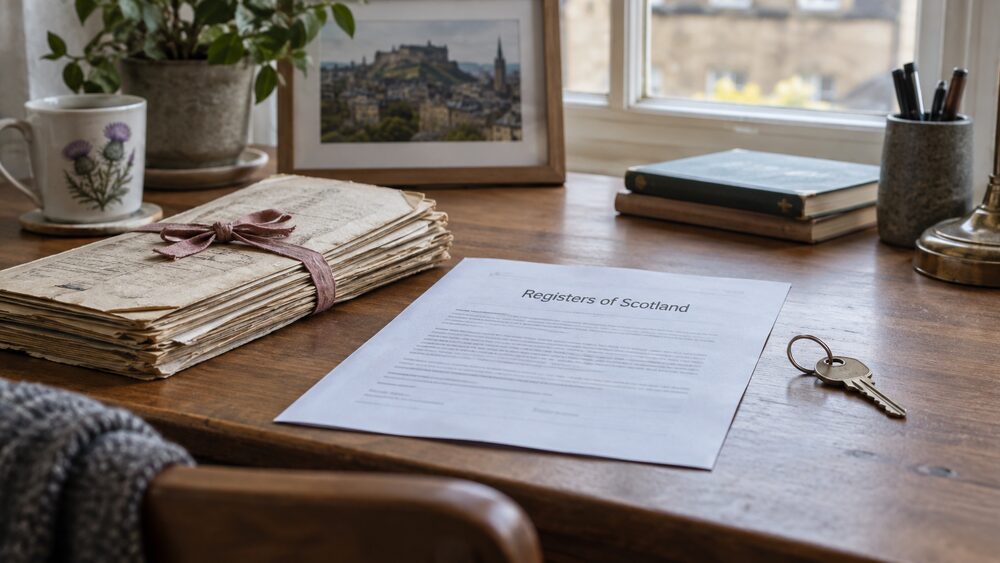
In Scotland, the answer to "who keeps the title deeds?" is usually nobody, because there is often no paper deed to keep. Ownership of registered property is recorded electronically by Registers of Scotland, the body responsible for maintaining all the property records in Scotland and where your ownership of a new property is formally recorded1. When you buy, the change of ownership is recorded there2.
In Scotland, the answer to "who keeps the title deeds?" is usually nobody, because there is often no paper deed to keep. Ownership of registered property is recorded electronically by Registers of Scotland, the body responsible for maintaining all the property records in Scotland and where your ownership of a new property is formally recorded1. When you buy, the change of ownership is recorded there2.
That does not mean the old paperwork has vanished. If your home still has physical deeds, they may be held by you, your solicitor or your lender, depending on whether there is a mortgage and whether the property was ever registered3. Where there is a mortgage, the lender keeps the title deeds until you pay it off3. Where there is no mortgage, the deeds are usually sent to your solicitor3.
What matters for most owners is not the paper but the record. You can check whether a property is on the Land Register and order a copy of the deed if it is4, and you can pay a fee to order a copy of your title deeds from Registers of Scotland3.
Scotland's Land Register replaces paper title deeds
Scotland has two registers of ownership. The Land Register of Scotland is the modern one, and the General Register of Sasines is the older one. The law defines a residential property owner in Scotland as someone who owns, as sole or joint owner, an interest in residential property registered or recorded, or capable of being registered or recorded, as a right of absolute ownership in the Land Register of Scotland or the General Register of Sasines8. That wording matters: it confirms that both registers can hold the live record, and that a property bought long ago may still sit on the older one.
When a home changes hands today, the buyer's solicitor registers the change. The Registers of Scotland is where your ownership of your new property is formally recorded1, and the change of ownership is recorded there at the end of the process2. Once that has happened, the electronic record, not a bundle of paper, is what proves who owns the home.
The practical consequence is that "keeping the deeds safe" is no longer the central task it once was. If the property is registered, the authoritative record sits with Registers of Scotland and can be retrieved on request. If it is not yet registered, the older paper chain still carries weight, and losing it is a genuine problem.
What Registers of Scotland holds about your home
The record for a registered property is built around the title sheet. It sets out who legally owns the home, the boundaries of the home, and any responsibilities the owner has, called burdens9. Those burdens are the conditions attached to the property, and they can include obligations to maintain shared parts, restrictions on use, or payments due to a former owner.
Because the title sheet is the definitive statement of ownership, it is also the document a buyer's solicitor examines before a purchase completes. The seller's solicitor provides it, the buyer's solicitor checks it, and the registration step at the end updates it to show the new owner.
Two features of Scottish title are worth knowing. First, ownership structure is written on the property's title deed, and owners can include a survivorship clause10. A survivorship clause means that when one joint owner dies, the property passes automatically to the other, without going through the estate. Second, changing that structure later means changing the legal papers. To sever a joint tenancy, you need to change the legal papers, known as the title deeds, and it is recommended you ask a solicitor to do this, with the other joint tenants also having to agree11. The same applies in reverse if you want to move from tenants in common to joint tenancy11.
Where your old paper deeds end up: you, your solicitor or your lender
For unregistered properties, physical deeds may still be held by the owner, the solicitor or the lender4. Which of the three depends on the mortgage position.
| Situation | Who normally holds the deeds |
|---|---|
| Mortgage outstanding | The lender, until the mortgage is paid off3 |
| No mortgage | Usually your solicitor3 |
| Unregistered property | Owner, solicitor or lender4 |
If you are unsure where yours are, the first call is your solicitor, who handled the purchase and will know whether the property was registered and whether any paper deeds were retained. Your lender is the second call if there is a mortgage, since it holds them as security.
How to get a copy of your title sheet
There are two routes, and which one applies depends on whether the property is registered.
If it is registered, a solicitor can download the deeds from the online portal, which usually costs between £3 and £66. If you are ordering directly, you can pay a fee to order a copy of your title deeds from Registers of Scotland3, and one independent guide puts the cost at £7 for each official copy of a document5.
The steps are straightforward:
- Check whether the property is on the Land Register4.
- If it is, order a copy of the deed4.
- If you would rather not deal with it yourself, ask your solicitor to retrieve it, since they can download registered deeds from the portal6.
When you need to prove ownership: selling, remortgaging or inheriting
Most owners never need to prove ownership directly, because their solicitor does it for them at each transaction. But there are moments when the question comes up.
Selling. The buyer's solicitor will examine the title. If the property is registered, this is a retrieval exercise. If it is unregistered, the paper chain has to be produced, which is why lost deeds on an unregistered property are a real complication.
Remortgaging. A new lender takes security over the same property, and the title record has to be checked and the charge updated. If you have paper deeds, the charge removal and re-registration steps run through your solicitor7.
Inheriting. In Scotland, the ownership structure is written on the property's title deed, and owners can include a survivorship clause10. Where there is no survivorship clause and no will, the estate is distributed in stages: prior rights, legal rights, then the remaining estate12. A surviving spouse with no children receives half of the remaining estate as their legal rights share13. Where the person died without a will and was married or in a civil partnership, the spouse is entitled to the home, the contents, and part of the remaining estate12.
Transferring ownership. If you are changing who owns the home, the conveyancer registers the change of ownership with the relevant registry14, and any existing mortgage on the home must be paid off when the home transfers to you14.
Keeping your title safe from property fraud
Property fraud in Scotland usually means someone trying to pass themselves off as the owner, or to change the register without the owner's knowledge. The electronic register is not immune, but it does leave a trail, and there are practical steps.
The Information Commissioner's Office publishes guidance on identity theft, including advice and information from Police Scotland for people who live in Scotland15. If you think your identity has been used to attempt a property transaction, that is the reporting route.
For owners of flats and shared buildings, there is a second layer. Property factors in Scotland must be registered, and registration exists to protect homeowners and make sure factors meet the required standards17. A factor who is not registered is not operating lawfully, and that is worth checking if you are asked to pay for work on a shared building.
Sources17 cited
- Buying a house in Scotland Scottish Building Society
- How to buy a house Which?
- After you buy Shelter Scotland
- Your title deeds Lloyds Bank
- The cost of selling a house Which?
- Legal and regulatory matters Equity Release Council
- Title deeds Nationwide
- The Civil Procedure Rules 1998, Schedule 1 legislation.gov.uk
- Making an offer on a home in Scotland Shelter Scotland
- How to make a will Which?
- Joint tenants vs tenants in common Which?
- After death: dealing with an estate Citizens Advice Scotland
- Intestacy rules Which?
- Conveyancing mygov.scot
- Identity theft Information Commissioner's Office
- Identity theft (Welsh) Information Commissioner's Office
- Property factors: responsibilities mygov.scot





 MoneyHelperFree, impartial money and pensions guidance, set up by government
 Citizens AdviceFree advice on money, consumer and legal problems in England and Wales
 ShelterFree housing advice from a charity
 GOV.UKOfficial information on tax, benefits and government services
 Financial Ombudsman ServiceFree, independent help when a complaint about a firm is not put right