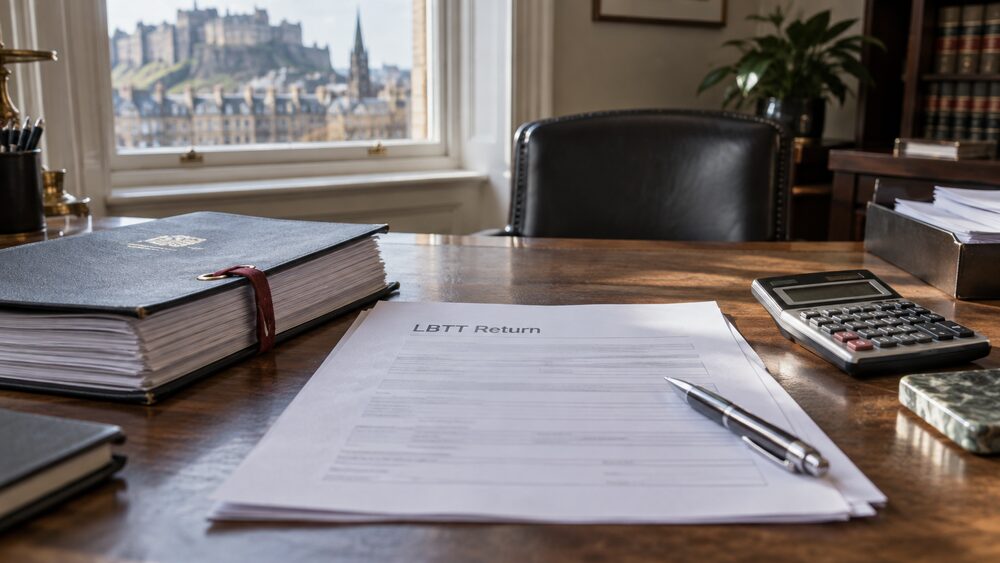
Land and Buildings Transaction Tax, almost always called LBTT, is the tax you pay when you buy property or land in Scotland. It is charged on residential and commercial land and buildings transactions, including commercial leases, where a chargeable interest is acquired1. It replaced Stamp Duty Land Tax in Scotland on 1 April 2015 and is collected by Revenue Scotland, while the Scottish Government sets the rates2.
For most home buyers the headline numbers are simple. Nothing is due on the first £145,000 of a home's price, then 2% applies to the slice from £145,001 to £250,000, 5% to £325,000, 10% to £750,000 and 12% above that3. First-time buyers get a higher nil-rate band of £175,0005. Buyers of second homes and buy-to-let properties pay an Additional Dwelling Supplement of 8% of the purchase price on top6. The tax works on slices, like income tax, so a higher rate never applies to the whole price.
What LBTT is and when you pay it
LBTT is a property transaction tax payable to Revenue Scotland on chargeable land transactions in Scotland1. It applies to standard house purchases and to other types of land transaction, including commercial property purchases and the grant of commercial leases1. The legal foundation is the Land and Buildings Transaction Tax (Scotland) Act 2013 and its supporting subordinate legislation2.
Two features of the tax matter to anyone buying a home. First, it is self-assessed: it is the taxpayer's responsibility to complete and submit an accurate LBTT return where one is required and to pay any tax due2. In practice a solicitor normally does this as part of the conveyancing, but the legal duty sits with the buyer. Second, the tax is charged regardless of whether there is a document setting out the terms of the transaction, whether any document was executed in Scotland, and whether any party was present or resident in Scotland at the effective date2. You cannot avoid LBTT by the form the deal takes.
The tax is charged on the "chargeable consideration", defined as anything given in money or money's worth for the subject-matter of the transaction1. For a straightforward purchase that is the price. Notification to Revenue Scotland is not required where the consideration falls below a threshold of £40,0008. There are some special rules at the edges: for example, LBTT is charged on the full market value of land purchased by a company with which the seller is "connected" where the consideration involves the issue or transfer of certain shares8.
LBTT only applies to land in Scotland. England and Northern Ireland still use Stamp Duty Land Tax and Wales has its own tax, Land Transaction Tax. If you are buying north of the border, the guide to buying a home in Scotland covers the whole process, of which LBTT is one of the costs of buying a house.
Residential LBTT rates: nothing to pay up to £145,000
The residential rates and bands are set by the Scottish Government. The current structure is:
| Purchase price | Rate |
|---|---|
| Up to £145,000 | 0%4 |
| £145,001 to £250,000 | 2%4 |
| £250,001 to £325,000 | 5%4 |
| £325,001 to £750,000 | 10%9 |
| Over £750,000 | 12%9 |
The £145,000 nil-rate band has been fixed since LBTT was introduced3. When the tax was designed, the Scottish Government noted that a buyer purchasing an average-priced home in Scotland, £162,000 at the time, would either pay less tax or be exempt3. Average prices have moved on since: the average house price for Scotland was £188,000 in January 2026, up 1.3% (£3,000) from a year earlier10, so a typical buyer now pays some LBTT, though the amount is modest because only the slice above £145,000 is taxed.
For context, the rates were set at introduction so that the devolved taxes were revenue neutral, assessed against a one-year adjustment to the block grant agreed with the UK Government for 2015-1611. The Scottish Government has confirmed that residential rates and bands will be maintained at their current level for 2026-2712.
How the bands work: each rate applies only to its slice of the price
The single most important thing to understand about LBTT is that it is progressive: different rates apply only to the portion of the price within each band, rather than one rate on the full price1. Revenue Scotland's guidance is to calculate the amount due within each rate band for the consideration above the nil-rate band, then add these together to reach the LBTT due4.
Take a £300,000 house. The first £145,000 is taxed at 0%. The slice from £145,001 to £250,000, which is £105,000, is taxed at 2%, giving £2,100. The slice above £250,000, which is £50,000, is taxed at 5%. Because each rate applies only to its own slice of the price, the total bill is far smaller than it would be if the top rate were applied to the whole £300,000, which is what a buyer who misunderstood the system would assume.
This slicing is why crossing a band threshold only costs a little extra. A buyer paying £250,000 owes 2% of £105,000, which is £2,100. A buyer paying just above £250,000 owes the same £2,100 plus 5% of only the small amount above £250,000. The band boundaries are not cliffs, and there is no advantage in shaving a few thousand pounds off an offer purely to stay under one.
The same principle applies to the non-residential bands and to the Additional Dwelling Supplement, which is charged on the whole relevant consideration rather than in slices, as explained below.
First-time buyer relief: no tax on the first £175,000
First-time buyers in Scotland do not pay LBTT on the first £175,000 of the property's purchase price5. In effect the relief raises the residential nil-rate band from the standard £145,000 to £175,000 for qualifying purchases4, potentially relieving up to £600 in tax13. The relief was introduced in 2018 and the £175,000 threshold has remained unchanged since14. The Scottish Government reported in March 2026 that almost 105,000 first-time buyers had benefited from the relief from its introduction to the end of November 2025, saving up to £600 of tax each12.
The relief works by lifting the nil-rate band, so the rates above £175,000 are unchanged. A first-time buyer purchasing at £200,000 pays 2% on the £25,000 above £175,000, which is £500, rather than 2% on £55,000. Revenue Scotland's worked examples show the same pattern at lower prices: a buyer of a £175,000 dwelling was entitled to full relief of £600, a buyer at £160,000 to full relief of £300, a buyer at £150,000 to full relief of £100, and a buyer at £175,000 in a 2018 example owed nothing at all, although a return still had to be filed in each case5.
The conditions matter:
- The relief only applies to purchases of entirely residential property3.
- It must be claimed in the first LBTT return made for the transaction, or in an amendment to that return; it is not applied automatically5.
- It is not available if the transaction is one of a number of linked transactions5.
- Where relief is later withdrawn, the taxpayer must make a further LBTT return to Revenue Scotland5.
Who counts as a first-time buyer for property tax purposes is covered in the first-time buyer definition. An independent analysis for the Scottish Government found no clear evidence that introducing the relief had a significant effect on the number of first-time buyer transactions, with increases reflecting a continuation of pre-existing upward trends14. The equivalent relief in England and Northern Ireland is covered in Stamp Duty first-time buyer relief.
Additional Dwelling Supplement: 8% on second homes and buy-to-let
The Additional Dwelling Supplement, usually shortened to ADS, is an extra charge on top of LBTT when you buy an additional dwelling in Scotland, such as a second home or a buy-to-let property. For transactions on or after 5 December 2024 the ADS is 8% of the purchase price6. It applies where the total purchase price of the additional dwelling is £40,000 or more15. The rate has risen over the years: it was 3% for transactions before 25 January 2019, 4% from 25 January 2019, and 6% from 16 December 2022, before reaching 8%6. The Scottish Government has confirmed the ADS will remain at 8 per cent12.
Unlike the main LBTT rates, the ADS is charged on the relevant consideration as a whole, not in slices. In mixed residential and non-residential transactions, the amount of ADS is 8% of the part of the chargeable consideration attributable to the residential dwelling or dwellings16. The supplement is paid at the same time as submitting the LBTT return, alongside any main LBTT due17.
The main exclusions are6:
- ADS will not apply if you only own one dwelling at the end of the effective date.
- It will not apply if the consideration is less than £40,000.
- It will not apply if you own an additional property valued at less than £40,000.
- It will not apply if you have disposed of your only or main residence in the 18 months before purchasing your new main residence.
That last exclusion is what protects people who are moving home and briefly own two properties. There is also a timing rule: ADS does not require to be paid where the sale of the previous main residence occurs after the effective date of the purchase but before the LBTT return has been made17. Where the supplement has been paid and the repayment conditions are later met, Revenue Scotland aims to process the repayment claim within 10 working days and repays the ADS with interest17. However, where the repayment conditions are not met, including where a previous main residence is sold outside the time allowed, no repayment may be claimed, and there are no provisions for exceptional circumstances17. The details, including the reclaim process, are covered in the dedicated guide to the Additional Dwelling Supplement and in getting the ADS back after selling your previous home.
One further rule worth knowing: where six or more dwellings are purchased in a single transaction, the purchase is treated as non-residential for LBTT purposes and fully exempted from the ADS1.
Non-residential and commercial property rates
Commercial property, land and mixed-use transactions are taxed on a different set of bands. The non-residential rates for conveyances are 0% on the portion of the purchase price up to £150,000, 1% above £150,000 to £250,000, and 5% above £250,0009. The 0% band up to £150,000 has applied since 25 January 20197.
Non-residential transactions are a meaningful part of the tax but a small part of the market: in 2020-21, non-residential conveyances accounted for 24 per cent (£126 million) of total LBTT declared due, and leases accounted for 4 per cent (£19 million)19. Commercial leases are taxed on the rent over the life of the lease rather than a single purchase price, which is why they sit inside LBTT alongside purchases1.
The boundary between residential and non-residential matters, because the bands differ. A purchase that genuinely mixes the two, such as a shop with a flat above, is a mixed-use transaction taxed at non-residential rates, and the ADS applies only to the residential part of the consideration16. The six-or-more dwellings rule described above is another point where a portfolio purchase is treated as non-residential1.
The LBTT return: 30 days to file and pay
LBTT is administered through a return to Revenue Scotland. Taxpayers have 30 days from the effective date of the transaction to submit their LBTT return7. In a standard house purchase, the filing date is 30 days beginning with the day after the effective date of the transaction20. The effective date is usually the date of completion or entry in Scotland. Where a transaction is notifiable for LBTT, a return must be made to Revenue Scotland within 30 days of the effective date, and where the ADS applies it is paid at the same time too17.
A return is required for most purchases of residential property where the chargeable consideration is £40,000 or more4, even if no tax is payable because the price is below £145,000. This catches many buyers out: a £100,000 flat attracts no tax but still needs a return showing zero due. Only transactions below the £40,000 threshold fall outside the notification requirement8. The narrow cases are covered in whether a return is needed under £40,000 and the return deadline.
In practice the solicitor acting in the purchase usually files the return and pays the tax as part of the conveyancing, but the statutory responsibility remains the buyer's because the tax is self-assessed2. If you are concerned that a return was not filed or tax was not paid, what to do if your conveyancer fails to pay property tax sets out the position.
Paying Revenue Scotland and getting an overpayment back
Payment is made to Revenue Scotland, which manages and collects the devolved taxes, while the Scottish Government is responsible for setting tax policy6. Where the Additional Dwelling Supplement applies, it is paid at the same time as the return17.
Mistakes can be corrected. Amendments to an LBTT return are allowed within 12 months of the filing date20, and Revenue Scotland aims to process any repayment claims within 10 working days20. If you have overpaid tax, you can claim a repayment from Revenue Scotland within five years of the filing date20. The amendment rules come from section 83 of the Revenue Scotland and Tax Powers Act 201420, and the practical steps are covered in how long you have to amend an LBTT return.
Two limits on refunds are worth knowing. Where the overpayment amount is less than £100 and repayment details are not held by Revenue Scotland, the refund will only be made on request21. And overpayments that are not reclaimed will be paid across to the Scottish Consolidated Fund21, so unclaimed money does not sit waiting indefinitely.
Revenue Scotland routinely conducts checks and may open enquiries to ensure the correct amount of tax has been paid and that claim requests meet the relevant conditions for repayment17. A repayment may be withheld pending the outcome of an enquiry17. Any omission, error or inaccuracy in a claim may render you liable to financial penalties and/or prosecution22, which is a reason to make sure claims, particularly for first-time buyer relief and ADS repayment, are properly grounded before they are submitted.
Late returns, late payment and what happens if you cannot pay
You may be charged penalties and interest if you do not submit or pay your tax return on time4. The penalties for a late return escalate in stages23:
| When | Penalty |
|---|---|
| Return not received for more than 3 months after the submission date | £10 per day for up to 90 days23 |
| Return not received for more than 6 months | Extra £300, or 5% of any unpaid tax, whichever is greater23 |
| Return not received for more than 12 months | Another £300, or 5% of any unpaid tax, whichever is greater23 |
Late payment of the tax itself carries its own penalties: 5% of the outstanding tax where the tax is not paid within 30 days of the date it is due to be paid, and a further penalty where the tax remains unpaid later, with the guidance setting a third penalty where tax is not paid within 11 months of the first late payment penalty date23. If a penalty is paid late, interest is chargeable and you may also become liable to a further penalty24. If you have received a penalty notice, you have 30 days from the date of the notice to pay or appeal it24.
The practical message is that the 30-day return and payment deadline is a real deadline with real costs attached. Because the solicitor usually files the return, most buyers never see this process, but the liability is the buyer's. If a completion has happened and you are not certain a return was filed, checking with Revenue Scotland before the deadlines pass is far cheaper than the penalty ladder above. Where tax genuinely cannot be paid, the position is a debt matter: Revenue Scotland's guidance covers penalties and payment, and free, impartial help with tax debts is available through the tax section and, for wider money problems, debt advice.
Other reliefs and transactions LBTT does not cover
Beyond first-time buyer relief, LBTT contains other reliefs and exclusions that change what is taxed. Multiple Dwellings Relief is a partial relief available when a buyer acquires more than one dwelling in a single transaction or a series of linked transactions3. Where a claim for Multiple Dwellings Relief has been made as part of a transaction, the amount of ADS reclaimable is the amount paid, based on the average consideration17. The history and current position of that relief across the UK is covered in Multiple Dwellings Relief.
Some things fall outside the tax altogether. Interests in moveable property, such as kitchen "white goods" or furniture, fall outside the scope of LBTT8, which is one reason the chargeable consideration can sometimes be less than the headline price where fixtures and fittings are genuinely separate. Interests in the seabed also fall outside the scope of LBTT8.
Inheritance is the clearest exclusion for households: individuals do not pay LBTT or the ADS on dwellings that they inherit16. The position on lifetime gifts is more subtle, because the tax is charged on chargeable land transactions regardless of the paperwork2, and advice from a solicitor is the right route there. The equivalent reliefs south of the border, including Stamp Duty reliefs and exemptions and when the higher rates on additional homes do not apply, work differently.
Sources24 cited
- LBTT review, page 2 Scottish Government, 2026-03-25
- LBTT legislation and guidance Revenue Scotland, 2026-09-26
- LBTT independent external policy analysis 2025-26 Scottish Government, 2026-03
- Residential property: LBTT rates and bands Revenue Scotland, 2026-09-26
- First-time buyer relief Revenue Scotland, 2025-11-19
- Additional Dwelling Supplement Revenue Scotland, 2026
- Annual Summary of Trends in the Devolved Taxes 2023-24 Revenue Scotland, 2024-10
- Explanatory notes to the Land and Buildings Transaction Tax (Scotland) Act 2013 legislation.gov.uk, 2026
- Scottish Budget 2025-2026 Scottish Government, 2025-26
- Private rent and house prices, UK: March 2026 Office for National Statistics, 2026-03-25
- The Land and Buildings Transaction Tax (Relief) etc. Order 2015, policy note Scottish Government, 2015-02
- Scottish Budget 2026-2027 Scottish Government, 2026-03-06
- First-time buyer relief worked examples Revenue Scotland, 2025-11-19
- LBTT review, page 7 Scottish Government, 2026-03-25
- ADS overview and aims Revenue Scotland, 2024-12-04
- ADS rules for particular transactions and buyers Revenue Scotland, 2026-09-26
- ADS return, payment and amendments Revenue Scotland, 2025-11-19
- The Land and Buildings Transaction Tax (Relief) etc. Order 2015 legislation.gov.uk, 2019-01-25
- Annual Summary of Trends in the Devolved Taxes 2020-2021 Revenue Scotland, 2020
- How to amend an LBTT return Revenue Scotland, 2024-10-01
- How to pay LBTT Revenue Scotland, 2024-09-11
- How to claim repayment of the Additional Dwelling Supplement Revenue Scotland, 2025-10-02
- LBTT penalties for submitting or paying late Revenue Scotland, 2024-06-03
- How to pay a penalty Revenue Scotland, 2024-09-11

 MoneyHelperFree, impartial money and pensions guidance, set up by government
 Citizens AdviceFree advice on money, consumer and legal problems in England and Wales
 ShelterFree housing advice from a charity
 GOV.UKOfficial information on tax, benefits and government services
 Financial Ombudsman ServiceFree, independent help when a complaint about a firm is not put right