
The 50/30/20 rule is one of the simplest ways to split your monthly income. You divide your take-home pay into three pots: 50% for essentials, 30% for day-to-day spending and non-essentials, and 20% for savings or clearing debts1. On a take-home pay of £1,800 a month, that works out at £900 for essentials, £540 for non-essentials and £360 for savings and debt repayment1.
The rule works on income after tax, not before it. Income tax is charged on income above your personal allowance, so the figure to use is the net pay that actually reaches your bank account, the number shown on your payslip rather than your gross salary2. If your income varies, use an average month or a cautious month as your baseline.
The percentages are a starting point, not a law. The point of the rule is to give every pound a job and to make sure saving is not whatever happens to be left over, which is often nothing. The sections below explain what goes in each pot, how the split looks on a real income, and what to do when your essentials cost more than the rule allows.
What the 50/30/20 rule is: needs, wants and savings
At its heart the rule answers a question most people never settle deliberately: how much of what I earn should go on things I must pay for, things I enjoy, and my future? The 50/30/20 split gives a one-line answer. Half of your take-home pay covers essentials, 30% covers day-to-day spending and non-essentials, and 20% goes to savings or clearing debts1.
The three categories matter more than the exact numbers. "Needs" are the payments that keep your life running: rent or a mortgage, energy, food, transport to work, and the minimum payments on any borrowing. "Wants" are everything you could stop tomorrow and survive: eating out, streaming, hobbies, holidays. "Savings and debt" is money paid to your future self, whether that builds an emergency fund, goes into a pension, or clears a balance faster than required.
The rule's strength is that it caps the fun category rather than the essentials. Many people budget the other way round, spending freely early in the month and hoping something remains for savings. By fixing the savings share at 20% and treating it as a bill, the rule makes saving happen by default rather than by luck1.
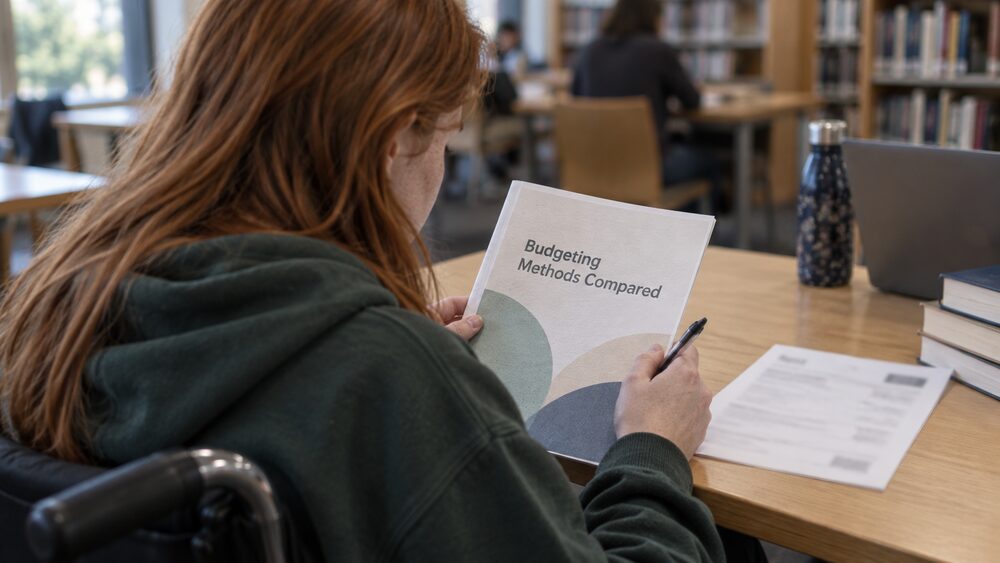
Its weakness is that it assumes essentials can be held to half your income. For people on low incomes, in high-rent areas, or with large debts, that assumption fails, and later sections cover what to do then. The rule is a framework to adapt, not a test to pass. If you are new to budgeting altogether, start with the wider guide to how to make a budget, and if you want to compare this method with others, see budgeting methods compared.
Needs: 50% for essentials like rent, bills and food
The essentials pot is the largest, and for good reason: these are the payments you cannot stop without serious consequences. The core of the category is housing, energy, water, food, and getting to work. On the £1,800 example, the rule allocates £900 a month to this pot1.
Housing is usually the single biggest item, and its size is often outside your control. Rent levels vary sharply across the country, and support with housing costs moves with them: Local Housing Allowance, which underpins help with rent for many private tenants, was uprated in April 2024 to the 30th percentile of local rents, after a freeze that had held it still since April 20203. In expensive areas that still leaves a gap between what support covers and what landlords charge, which pushes the essentials pot above the rule's 50% line before anything else is bought.
Working out what belongs in this pot is mostly common sense, but there are borderline cases. Minimum repayments on credit cards and loans belong here, because missing them brings charges and credit record damage. Insurance you are required to hold, such as buildings insurance under a mortgage, belongs here too. A car can be a need if it gets you to work, and a want if it is a second runabout used for pleasure trips. If a bill is essential but wildly variable, such as energy, budgeting for annual and irregular bills helps smooth it out.
If your essentials are comfortably under 50%, you have room to be generous elsewhere. If they are over, the answer is not to reclassify wants as needs but to look at the two levers that actually move the number: cutting the cost of essentials, through the steps in cutting household bills, and housing costs, covered in how much of your income to spend on rent.
Wants: 30% for non-essentials and fun
The wants pot is deliberately generous: nearly a third of your take-home pay, £540 a month on the £1,800 example, for day-to-day spending and non-essentials1. This is the money for meals out, cinema trips, clothes beyond the basics, streaming services and anything else that makes life enjoyable but could be paused.
The size of the category reflects how most people actually spend. When households were asked how they were responding to rising costs, the most commonly reported action was spending less on non-essentials, reported by 60% of respondents in April 20254, and by 69% of those asked in September 20235. Non-essential spending is where the flex sits in most budgets: it is the first thing cut in hard times and the easiest place to overspend in good ones.
Subscriptions deserve a special mention because they quietly eat the wants pot. The Digital Markets, Competition and Consumers Act 2024 introduced rules on subscription contracts, including a duty on traders to send reminders to consumers before a contract rolls over or auto-renews into a new term6. Consumers also gained rights to cancel subscription contracts during cooling-off periods7. Those rights make it easier to keep the wants pot honest: a reminder email is a prompt to ask whether you still use the service. The guide to tracking and cancelling unwanted subscriptions covers the practical steps.
Two things keep this category useful. First, honesty: a want is not a failure, and a budget with no fun in it rarely lasts. Second, a definition you can apply consistently. If you would still pay it after losing your job, it is probably a need; if you would cancel it, it is a want. Deciding the borderline cases once, and writing them down, saves the monthly argument with yourself.
Savings and debt: 20% for your future
The final fifth of your take-home pay, £360 a month on the £1,800 example, goes to savings or clearing debts1. This is the pot that changes your position over time: it builds the buffer that absorbs shocks, grows retirement saving, and shrinks the interest you pay on borrowing.
The "or" in "savings or debt" is important. Extra money paid towards expensive debt often does more for your finances than the same money saved, because the interest saved usually beats the interest earned. The comparison page on emergency fund or paying off debt first sets out how to choose between them, and the order to tackle things is covered in the order to sort out your finances.
For people on low incomes, there is a scheme designed to make this pot grow faster. Help to Save offers a 50% government bonus on up to £50 of monthly savings into a Help to Save account8. That means every pound saved in the scheme earns an extra 50p from the government, a boost no ordinary savings account matches. Eligibility depends on receiving certain benefits, and the scheme is aimed at working families on low incomes.
The habit matters as much as the amount. NS&I's guidance on saving without a specific goal suggests four habits: set up a regular payment into your savings; choose a point in the month when you usually have money available; put aside a bit of any extra money you receive; and increase or reduce what you save as your circumstances change9. The first two are the engine of the 20% pot: a standing order on payday means the money leaves before it can be spent, and how to start saving each month covers the mechanics.
How the split works on an £1,800 monthly income
Numbers make the rule concrete. Take a take-home pay of £1,800 a month, after tax. Following the 50/30/20 rule means each month you would have £900 to spend on essentials, £540 for non-essentials, and £360 for savings and debt repayment1.
The same source illustrates an alternative split for situations where essentials cost more. The 70/20/10 rule puts 70% of income towards essentials, 20% towards day-to-day spending and non-essentials, and 10% towards savings or clearing debt. On the same £1,800 income, that means £1,260 for essentials, £360 for non-essentials and £180 for savings and debt1.
| Split | Essentials | Non-essentials | Savings and debt | On £1,800 take-home pay |
|---|---|---|---|---|
| 50/30/20 | 50% | 30% | 20% | £900 / £540 / £3601 |
| 70/20/10 | 70% | 20% | 10% | £1,260 / £360 / £1801 |
The comparison shows what the rule trades off. Moving from 50/30/20 to 70/20/10 finds an extra £360 a month for essentials by taking £180 from non-essentials and £180 from savings. That is a realistic picture of what a tight budget actually does: the fun category shrinks first, and saving shrinks too, but it does not disappear.
Applying the numbers to your own income is a matter of the same arithmetic on your take-home pay. If you are paid weekly, or your bills are weekly, converting everything to the same period first avoids the most common budgeting error, and converting weekly amounts to monthly and weekly or monthly budget cover the choice. If your income changes from month to month, budgeting when your income varies adapts the idea.
Minimum repayments are needs, extra repayments are savings
Borrowing sits across two categories in the 50/30/20 rule, and the dividing line is simple: the minimum is a need, everything above it is savings.
The minimum repayment on a credit card or loan is a contractual obligation. Miss it and you face charges, and your credit record suffers, which affects what you are offered for years afterwards. That is why minimum repayments belong in the 50% essentials pot alongside rent and bills, whatever the rule's other attractions.
Anything paid above the minimum belongs in the 20% pot. It is money deliberately directed at your future, in this case a future with less debt and less interest. Two rules work in your favour when you pay extra on a credit card. Firms must first allocate a repayment to the debt subject to the highest rate of interest, then the next highest, and so on, for the outstanding balance on a credit card or store card10. And the consumer must have the option to pay any amount they choose, at or above the minimum, when making automated repayments11. Together these mean extra payments clear your most expensive debt first, and you can choose the size of that extra payment rather than being stuck with a fixed amount.
If you cannot afford even the minimums, the situation has moved beyond budgeting and into debt help. The debt section explains the free options, and none of them involve paying a fee up front.
When essentials take more than 50%
For a large share of households, the 50% line is not realistic. If rent or a mortgage, energy, food and transport come to 60% or 70% of take-home pay, the rule is not saying you have failed; it is saying the standard split does not describe your life. The 70/20/10 rule exists for exactly this situation, with 70% of income for essentials, 20% for non-essentials and 10% for savings or clearing debt1.
The causes are usually structural rather than a matter of choice. Housing support was frozen for years before being uprated in April 2024 to the 30th percentile of local rents3, and in high-rent areas even that leaves many tenants paying well beyond the rule's allowance from their own pocket. Evidence from the Help to Save evaluation shows what would actually encourage people on low incomes to save: among eligible non-users, 48% said the key motivator would be having more disposable income, 41% wanted a lower cost of living, including childcare costs, and 25% said receiving budgeting support to see if they could afford to save would help12. In other words, the barrier is income and fixed costs, not knowledge of the rule.
Where the pressure comes from housing debt specifically, Scotland has schemes worth knowing about. Mortgage to Rent allows the local council or a housing association to buy your home, and you continue living there as a tenant14. The Time to Pay scheme helps with certain debts, and the rules are different for rent or mortgage arrears debt15.
The practical response when essentials exceed 50% has three parts. First, attack the essentials: cutting household bills and reviewing housing costs move the biggest numbers. Second, protect a small savings pot even if it is closer to 10% than 20%, because a buffer is what stops a broken boiler becoming a debt spiral. Third, if income does not cover essentials at all, the page on spending more than you earn and the guidance on saving money on a low income are the right next steps.
Adjusting the split to suit your own situation
The percentages are a template, and almost everyone needs to adjust them. What matters is adjusting deliberately, with the numbers in front of you, rather than drifting into a split you never chose.
The most common adjustments follow life circumstances. A household with childcare costs may run 60/25/15. Someone aggressively clearing debt may run 50/20/30 for a year or two, then flip back. A person saving a house deposit may cut the wants pot hard for a fixed period. The rule's value is that each change is visible: you can see that taking from wants to feed savings costs £X of fun a month, and decide whether that trade is worth it.
Whatever split you land on, the mechanics of keeping it going are the same. NS&I's guidance suggests setting up a regular payment into your savings, choosing a point in the month when you usually have money available, putting aside a bit of any extra money you receive, and increasing or reducing what you save as your circumstances change9. The last point matters most: a split is a snapshot, and it needs revisiting when pay, rent or family circumstances change.
One adjustment people often miss is the interaction between savings and benefits. If you receive Pension Credit, savings above £10,000 are treated as income: every £500 over £10,000 counts as £1.00 of income a week16. Building savings can therefore reduce a means-tested award, which is worth knowing before you plan a large buffer. Similar capital rules apply to other benefits, so if you receive any, check how savings are treated before assuming a bigger pot is always better.
If you are budgeting as a couple, the split can be applied to household income or to each person's income separately, and the two approaches produce different fairness outcomes. Managing money as a couple covers the options. And if you have money left over at the end of the month, what to do with money left over each month picks up where the rule leaves off.
Building a savings buffer of a few months' rent or mortgage
The 20% pot's first job, before pensions or investing, is usually a buffer: money set aside to absorb shocks such as losing work, a broken boiler or a car failing its MOT. A buffer measured in months of essential costs, rent or mortgage, bills and food, is what turns a crisis into an inconvenience.
The legislation behind Help to Save describes the aim plainly:
"Help to Save will support working families on low incomes to build up a rainy-day fund by offering a 50% bonus on up to £50 of monthly savings"
Explanatory memorandum to the Help to Save regulations17
For eligible savers, that 50% bonus on up to £50 of monthly savings8 means the buffer grows half again as fast as it would otherwise. For everyone, the building method is the same: a regular payment each month, timed for when money arrives, topped up with a slice of any extra money, and adjusted as circumstances change9.
How many months to aim for depends on how secure your income is. A permanent employee with sick pay needs less than a self-employed person whose work stops the moment they do. The page on emergency funds covers how much to keep, whether emergency savings should sit in a separate account keeps the money out of easy reach, and the choice between building the buffer and attacking debt is set out in emergency fund or paying off debt first.
Where to get free help with a budget
You do not need to pay anyone to build a budget or apply the 50/30/20 rule. Free, impartial guidance is available, and free money guidance explains what MoneyHelper, Citizens Advice and money coaching each offer and how to reach them. If money worries are affecting your wellbeing, financial wellbeing lists sources of support.
Free tools do the arithmetic for you: free budget planners, spending trackers and apps covers what is available without paying. If debt is the main issue, the debt section explains the free routes, and help differs by nation: money help in Scotland, money help in Wales and money help in Northern Ireland list what is available where you live. If you want a professional opinion on bigger decisions, financial advice or guidance explains the difference, and paying for a financial adviser covers what advice costs and when it can be worth it.
Sources17 cited
- How to budget: money management The Marsden Building Society, 2026-09-26
- Tax when you come to the UK GOV.UK, 2026-09-26
- Understanding the cost of living crisis in Scotland Scottish Government, 2025-02
- Scottish Economic Bulletin 2025, page 7 Scottish Government, 2025-05-23
- Scottish Economic Bulletin, page 6 Scottish Government, 2023-10-09
- Digital Markets, Competition and Consumers Bill 2022-23: briefing House of Commons Library, 2026-07-08
- Digital Markets, Competition and Consumers Act 2024, Part 4 legislation.gov.uk, 2024-05-24
- Help to Save regulations explanatory memorandum legislation.gov.uk, 2025
- Saving without a goal NS&I, 2026-09-18
- FCA Consumer Credit sourcebook, CONC 6.7 Financial Conduct Authority, 2021-10-01
- Credit card market study: annex 2 Financial Conduct Authority, 2015-11
- Help to Save evaluation: synthesis report GOV.UK, 2025-11-03
- Help to Save evaluation: executive summary GOV.UK, 2025-11-03
- Home Owners Support Fund: separated from your partner mygov.scot, 2026-07-14
- Time to Pay debt arrangement scheme mygov.scot, 2024-04-05
- Income, benefits and Pension Credit nidirect, 2026-06-26
- Help to Save regulations 2018 explanatory memorandum legislation.gov.uk, 2018





 MoneyHelperFree, impartial money and pensions guidance, set up by government
 Citizens AdviceFree advice on money, consumer and legal problems in England and Wales
 StepChangeFree debt advice and solutions from a charity
 Turn2usFree benefits calculator and grants search from a charity
 GOV.UKOfficial information on tax, benefits and government services