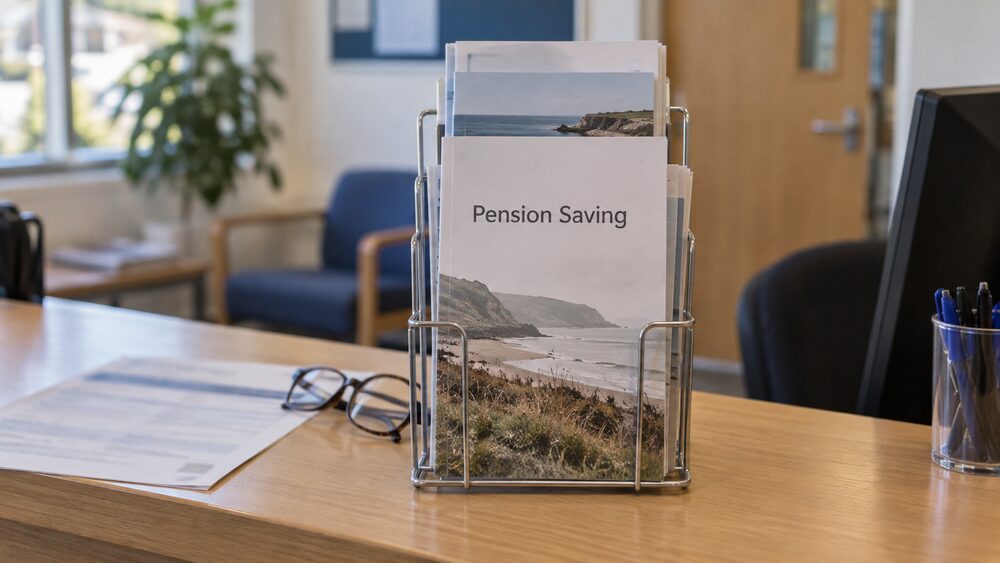
Sorting out your finances works best in a rough order, because some problems get worse if you leave them and some opportunities shrink as the years pass. The sequence most people benefit from is: cover your essential bills first, deal with priority debts (the ones with serious consequences for non-payment), build a small emergency fund, then tackle costly borrowing, then start or increase pension saving, and only then think about longer-term saving and investing. Each step stabilises the ground for the next one.
This page concentrates on the step people ask about most: where pension saving fits, and how it actually works once you start. Pension contributions come with government top-ups, employer money and an age when you can get it back, and each of those has rules and limits. Getting the order right matters less than getting started, but knowing the numbers helps you decide how much to commit and when.
Where pension saving fits when you sort out your finances
Pension saving usually comes after the essentials are secure, but before most other long-term saving, and the reason is the free money attached to it. Every payment you make is topped up by tax relief, and in a workplace pension your employer must pay in too. No savings account or general investment gets that kind of boost, which is why pension contributions tend to sit above investing in most people's order of priorities, but below clearing expensive debt and building a cash buffer you can reach in an emergency.
The trade-off is access. Money in a pension is locked away until your late fifties at the earliest, so it cannot be your emergency fund. A common approach is a small cash buffer first, then pension contributions, then other saving. If you are weighing the two against each other, the page on emergency fund or paying off debt first works through the trade-offs.
Once money is inside a pension, it is invested rather than sitting in cash. In a defined contribution scheme, your pot is put into various types of investment, such as shares, and all providers have to offer a default fund that meets the needs of most people, which is where your money goes automatically unless you choose otherwise6. Some schemes gradually move your money into lower-risk investments as you approach retirement, a process called lifestyling, so the risk falls without you having to act6.
If you build up several pensions over a working life, you may consider bringing them together by transferring them into one provider or scheme, which is known as pension consolidation7. It is not always the right move: check the charges, the guarantees you might give up and whether the receiving scheme suits you. The Financial Services Compensation Scheme publishes a set of key questions to ask your pension provider when you are considering where to put your money8.
Free, impartial help exists at every step. The Money and Pensions Service, which co-ordinates the UK Strategy for Financial Wellbeing, runs the MoneyHelper service, and its guidance is a good place to check your own order of priorities before committing money9. See free money guidance for what is available.
What counts as a pension contribution
A pension contribution is money paid into a pension scheme by you, your employer, or someone else on your behalf. Most people saving today are in a defined contribution scheme: the money paid in is used by the pension provider to buy investments, and the amount you end up with depends on how much was paid in and how those investments perform10. All personal pensions are defined contribution schemes2.
The other main type is a defined benefit pension, sometimes called a final salary pension, where the amount you receive is based on your salary and years of service rather than investment performance. If you have a defined benefit pension worth over £30,000 and want to transfer it into a defined contribution pension, you have to pay for financial advice first before the transfer can go ahead7. That rule exists because giving up a guaranteed income is a significant, one-way decision.
Contributions can be regular or one-off. With a personal pension you pay regular monthly amounts or a lump sum to a pension provider, who invests it on your behalf2. Government guidance confirms you can make either regular or individual lump sum payments11. A bonus, an inheritance or a tax refund can all go in as single payments, subject to the annual limits covered later on this page.
What comes out is also defined by rules. The only types of pension that can be paid from money purchase arrangements are scheme pensions, lifetime annuities or drawdown pensions11, and the options for taking your money apply if you are in a defined contribution scheme, which is a pot based on what you or your employer paid in12.
Tax relief: every £1 you pay in becomes £1.25
Tax relief is the government's incentive to save for retirement: it gives you relief on pension contributions, which reduces your tax bill or increases your pension fund13. For a basic-rate taxpayer, for every £100 saved into a pension, the government adds £25 in tax relief1. Put simply, every £1 you pay in becomes £1.25 in your pot.
Relief is applied in one of two ways depending on the scheme. Some schemes collect your contributions before income tax is taken off (net pay), so you never pay tax on that money in the first place. Others use relief at source: you pay in from your taxed income and the scheme claims basic-rate relief back and adds it to your pot. Income tax reliefs like this reduce the tax you pay if you qualify for them14.
Basic rate relief in one line: you pay £1, the government adds 25p, and £1.25 lands in the pot.
Scotland has its own income tax bands, and that changes the arithmetic. If you pay enough tax at the Scottish Intermediate Rate of 21%, you can claim an extra £1.58 for every £100 paid, and if you pay enough tax at the Scottish Higher Rate of 42%, you may be able to claim a further £26.58 per £1001. The relief you receive depends on the actual rate of tax you pay, not on where in the UK the scheme is based.
There is a ceiling on how much qualifies for relief. Each year you receive tax relief on pension contributions of up to 100% of your UK earnings, meaning salary and other earned income16. Contributions above that, and above the annual allowance, do not get the same treatment, as the next sections explain.
Higher and additional rate taxpayers: claiming the extra relief
Basic-rate relief is added automatically, but higher and additional rate taxpayers often have to claim the rest themselves. If your scheme uses relief at source and you pay higher or additional rates of tax, you need to claim your full tax relief by completing a tax self-assessment17. The same point is made in guidance on workplace pensions and tax relief: to get full tax relief as a higher or additional rate taxpayer, you claim back the extra tax on your annual tax return18.
The amounts are worth claiming. A higher-rate taxpayer paying the 40% rate can claim an extra 20% in relief, and an additional-rate taxpayer paying 45% can claim an extra 25%, but you may need to claim that relief proactively19. On a £100 contribution that is £20 or £25 that is yours by right but will not arrive unless you ask.
In practice this means many higher earners are quietly under-relieved. If you have never filed a tax return and pay into a personal pension or a relief-at-source workplace scheme, check with your provider which method your scheme uses and whether HMRC already has your claim. If your scheme deducts contributions before tax (net pay), the full relief is applied automatically and there is nothing to claim.
Annual allowance: up to £60,000 a year or 100% of your earnings
The annual allowance is the amount of pension saving that qualifies for tax relief in a tax year before a tax charge applies. It is set at £60,000 for most people, or 100% of your earnings if you earn less than that1. Contributions from you and your employer combined must be less than £60,000 to stay within the allowance20.
The allowance is broader than many people assume. It covers all contributions to your pension made by you, your employer or anyone else, and it includes the tax relief added21. In a final salary scheme, the allowance is applied to the increase in the value of your pension during the tax year rather than to cash paid in, so a pay rise or extra years of service can use up allowance without any money changing hands21.
Go over the allowance and the excess is added to your income and taxed at your marginal rate. Guidance is clear that if in any one year you build up more than a certain amount in your pension, you may have to pay a tax charge, and that this includes contributions from your employer18.
There is a safety valve. You can make use of any unused annual allowance left over from the previous three tax years, a process called carry forward21. This matters most for people with lumpy income: the self-employed with a good year, employees receiving a large bonus, or anyone returning to work after a break. You use the current year's allowance first, then the earliest of the carried-forward years.
Not earning? You can still pay in £2,880 and get £3,600
People with little or no earnings can still save into a pension and get tax relief. If you earn under £3,600, you can get tax relief on up to £2,880 of your pension contributions2. Because relief is added at the basic rate, paying in £2,880 produces a total of £3,600 in the pot: the £2,880 you paid plus £720 of relief. Independent guidance states the same rule from the other direction: you can get tax relief on contributions up to 100% of your earnings, or £3,600 if your earnings are lower22.
This matters for people taking career breaks, carers, people between jobs, and those making contributions for themselves in years with no salary. It also means a non-earning partner can build a pension in their own name, which can be worth more in the long run than relying on a partner's pension alone, because each of you gets your own tax-free allowances in retirement.
The relief is not unlimited. It applies to that £3,600 figure, not to unlimited contributions, and money paid in above it gets no relief. Remember too that pension money cannot be accessed until the minimum pension age, so this route suits long-term saving rather than money you may need sooner. For shorter-term goals, ISAs allow contributions without the age lock, though without the relief top-up.
How much should I put in my pension?
There is no single right number, but there are two useful reference points. Most financial experts recommend saving a minimum of 10-15% of your monthly salary into your pension each month1. The legal floor is much lower: minimum contributions to a workplace pension are set at 8% of your qualifying earnings, with your employer paying part of that23. If you are only paying the minimum, you are likely to be below the 10-15% range once the employer's share is counted in.
The gap between 8% and 15% is the decision. Paying the minimum is far better than nothing, especially with an employer contribution attached, but the extra percentage points compound over decades. A common approach is to increase contributions whenever pay rises, so the increase never feels like a cut in take-home pay.
Circumstances change the answer. Someone starting in their twenties has longer for contributions to grow, so a lower percentage can go further. Someone starting in their fifties may want to contribute more, and can use carry forward to pay in above £60,000 in a single year if they have unused allowance. Someone with expensive debts is usually better clearing those first, because the interest on costly borrowing typically outweighs the relief on contributions. The dedicated page on how much to pay into a pension works through this in detail, and setting financial goals helps you put a number on what you are saving for.
Salary sacrifice: no limit today, a £2,000 cap from April 2029
Salary sacrifice is when you agree to reduce your gross salary, or sacrifice a bonus, and in return your employer pays the same amount into your pension24. You give up part of your salary and your employer pays it straight into your pension25. Because your gross pay is lower, you pay less income tax and National Insurance on what remains, which is why many employers offer it.
Today there is no limit on the amount you can pay into your pension under salary sacrifice5. That changes on 6 April 2029. As announced at Autumn Budget 2025, the government is changing how salary sacrifice for pension contributions works24: from April 2029, the amount you can contribute to a workplace pension via salary sacrifice will be capped at £2,000 a year5. The reform removes the Optional Remuneration Arrangements excluded exemption for employer pension contributions for Class 1 National Insurance contributions where arrangements exceed the annual £2,000 cap26.
The scale of the change is significant. An estimated 7.7 million employees currently use salary sacrifice to make pension contributions, and of these, 3.3 million sacrifice more than £2,000 of salary or bonuses27. The government estimates 44% of employees contributing via salary sacrifice are likely to be impacted by the cap, while 56% making typical contributions will be unaffected5. The measure is expected to have a significant impact on 290,000 employers who operate such arrangements27.
When you can get the money back: minimum pension age rises from 55 to 57
Pension money is locked until a minimum age. You cannot withdraw any of your pension before the age of 55, and this is rising to 57 in 20283. The change takes effect on 6 April 2028, so anyone born after early April 1973 will wait until 57.
The earliest access age steps up by two years in April 2028.
This is the single most important constraint on pension saving in the order of priorities. Money you pay in today cannot be used for a house deposit, a period of unemployment or a debt you expect in your forties. That is why the emergency fund comes first: it is the money you can reach, and the pension is the money you cannot.
The rule applies to private and workplace pensions. The State Pension has its own, later starting point, based on your National Insurance record and your state pension age. If your retirement plan depends on accessing money at 55, check your date of birth against the April 2028 change, because the two-year delay can change when your other savings need to last from.
Where the limits bite: the £10,000 money purchase annual allowance and stopping payments
Once you start taking taxable money out of a defined contribution pension, the amount you can continue to pay in drops sharply. The money purchase annual allowance (MPAA) is £10,0004, a figure set in legislation for the 2023-24 tax year and subsequent tax years, replacing the previous £4,00028, with the regulations amending the amount from £4,000 to £10,00029.
The trigger is taking taxable money, such as income from a pension that has been put into drawdown, rather than taking your tax-free lump sum alone4. Once the MPAA applies, you cannot carry forward any unused allowances from previous years21, which removes the safety valve described earlier.
For people with both money purchase and defined benefit pensions, the interaction is stricter still, and the guidance documents differ on the detail: one states that a £50,000 allowance applies to defined benefit pensions if the £10,000 limit is exceeded by money purchase pensions, while another states that the balance of £60,000 applies to defined benefit pensions if the £10,000 limit is not exceeded. Read both figures against your own scheme mix before relying on either.
There are other edges to watch. Employer contributions above the annual allowance attract tax30. When you take money out, 25% of your pot is usually tax-free and the remaining 75% counts as earnings for Income Tax20, whether taken as one payment or in stages, with 25% of each withdrawal tax-free if you draw in stages15. And the maximum tax-free cash you can usually take from all your pensions combined is £268,2753. There is no upper limit on the total pension saving you can build up16, so the limits bite on the way in and on the way out, not on the size of the pot itself.
If you are unsure how a withdrawal you have already made affects your allowances, MoneyHelper offers free guidance, and a financial adviser can check the position for your specific schemes. See paying for financial advice for what advice costs and when it is worth it.
Sources30 cited
- What pension can you get if you're self-employed Which? For Traders, 2026
- Personal pensions MoneyHelper, 2026
- Should I take a lump sum from my pension Which?, 2026
- Adjustable income Pension Wise, 2026
- What is salary sacrifice for pensions Which?, 2026
- Types of workplace pension schemes nidirect, 2025
- Pension transfer: defined contribution Financial Conduct Authority, 2026
- Guide to pension protection Financial Services Compensation Scheme, 2026
- New Money and Pensions Service toolkit Money and Pensions Service, 2026
- Who we protect Pension Protection Fund, 2026
- How your personal pension is paid nidirect, 2026
- Income tax GOV.UK, 2026
- Tax and allowances in retirement nidirect, 2026
- Introduction to workplace, personal and stakeholder pensions nidirect, 2026
- Tax credits and pension contributions entitledto, 2026-09-26
- What to look for in a pension scheme The Pensions Regulator, 2026
- Workplace pensions and tax relief nidirect, 2026
- How to boost your pension Which?, 2026
- Take your whole pot Pension Wise, 2026
- How the pensions annual allowance works Which?, 2026
- 5 questions for pension savers filing their 2024-25 tax return Which?, 2026
- Lifetime ISA vs pension Which?, 2026
- Changes to salary sacrifice for pensions from April 2029 GOV.UK, 2025
- Employers' workplace pensions rules GOV.UK, 2026
- Salary sacrifice reform for pension contributions GOV.UK, 2025
- Salary sacrifice reform for pension contributions: policy paper GOV.UK, 2025
- Finance Act 2023, Part 1 legislation.gov.uk, 2026
- The Pensions (Abolition of Lifetime Allowance Charge etc) Regulations 2024 legislation.gov.uk, 2024
- Termination payments and tax GOV.UK, 2026
- How are payments from flexible pensions taxed TaxAid, 2025


 MoneyHelperFree, impartial money and pensions guidance, set up by government
 Citizens AdviceFree advice on money, consumer and legal problems in England and Wales
 StepChangeFree debt advice and solutions from a charity
 Turn2usFree benefits calculator and grants search from a charity
 GOV.UKOfficial information on tax, benefits and government services