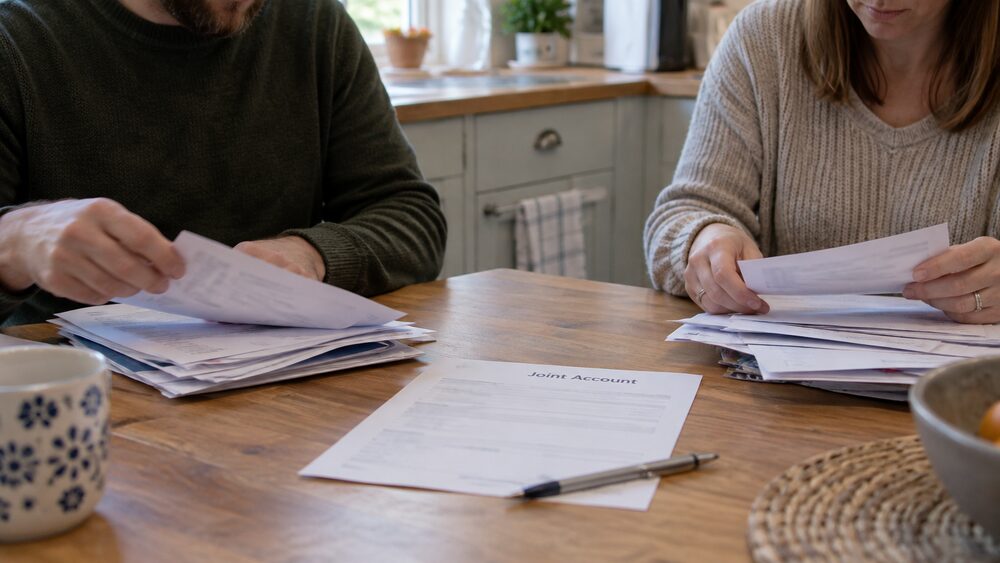
Living together means money stops being purely individual. Rent, energy, food, insurance and eventually mortgages and pensions all have to be organised between two people, and the way a couple arranges that has consequences well beyond convenience. A joint account creates a financial link on both partners' credit files1, and a joint debt makes each person responsible for the whole amount owed, not just their own share2.
None of this requires a particular structure. Some couples run everything through one shared account, some keep everything separate and divide the bills, and many use a mix of the two. What matters is understanding what each arrangement means in practice: who can take money out, who is liable if a payment is missed, and what happens if the relationship ends or one partner dies. This page sets out the options, the rules behind them, and where to get free help.
What managing money as a couple involves
Managing money as a couple is not only about who pays for the food shop. Once two people live together or share financial commitments, outside bodies start treating them as a unit in specific, sometimes surprising ways.
Benefits are the clearest example. For means-tested support, both the claimant's and their partner's capital are taken into account6, and as a member of a couple, the income, savings and hours of work of both partners are counted when working out entitlement7. Universal credit treats a couple as a single household, with payments assessed on joint circumstances. Child maintenance calculations also look beyond the couple itself: the Child Maintenance Service takes into account the number of children the paying parent has to pay maintenance for, including other children living with them and arrangements made directly with an ex-partner8.
The practical upshot is that a partner's finances can affect your own even where you keep accounts entirely separate. A partner's savings can reduce a benefit award; a partner's income can change what you are entitled to. That is one reason many couples find it easier to be open about money from the start rather than discovering the overlap when a claim is assessed.
It also means the decisions in this page, how to structure accounts, how to split bills, whether to take joint credit, are worth making deliberately rather than drifting into. The sections below set out the main options and what each one commits you to.
Joint, separate or both: three ways to organise accounts
Most couples organise their money in one of three ways, and each has different implications for control, liability and what happens if things go wrong.
Everything joint. Both incomes go into one shared account and all spending comes out of it. This is simple and transparent, but it gives each holder full access to the whole balance, and it links your credit files together (see the next section). It suits couples with similar spending habits and full trust in each other's money management.
Everything separate. Each partner keeps their own accounts and pays an agreed share of the shared bills, by transfer, standing order or direct debit from their own account. This keeps finances independent and avoids creating a credit file link, but it needs more administration, and someone has to keep track of who has paid what.
A mix: yours, mine and ours. Each partner keeps a personal account and pays an agreed amount into a joint account used only for shared costs such as rent, bills and food. Guidance on household budgeting notes that it is sometimes easier to cope with paying bills if you open a separate bank account, paying regular amounts into it so that direct debits and standing orders are covered automatically9. This is the structure many couples settle on, because it bounds the joint exposure: the joint account carries the shared spending, and each person's remaining money stays under their own control.
One point worth knowing whichever structure you choose: most joint accounts are set up as "either-to-sign", meaning each account holder can give payment and withdrawal instructions independently10. There is no built-in halfway setting where one partner can only spend with the other's approval.
Savings work slightly differently. Some savings products, including NS&I Income Bonds, can be opened jointly with one other person11, but a cash Isa cannot be held by two account holders, so couples cannot use them to save together12. Where a savings goal is shared, a joint savings account outside an Isa is the usual route.
How a joint account works and what it links you to
A joint account normally allows two or more people to receive payments, pay by debit card, transfer money and manage the account, with the exact features depending on the bank1. Both holders get their own debit card and can set up direct debits. Each account holder can withdraw money without asking the other person13, and everyone named on the account is equally responsible for it, including any overdraft another holder runs up1.
The consequences reach further than the account itself:
- Credit file link. Opening a joint account adds a financial link to the other person, so companies may look at both credit histories when you apply for credit, and a poor history on their side might lower your chances of acceptance1. Guidance on choosing a bank account for benefit payments is blunt: only consider opening a joint bank account with someone you trust, as it could damage your credit score if they have poor credit, and you could be responsible for debt they run up14.
- Tax on interest. Interest earned in a joint account is usually split equally between the holders for tax purposes, with tax only due if a person's share exceeds their annual allowance1.
- Deposit protection. FSCS protection applies per person, per banking licence. The FSCS protection tool assumes a joint account with two holders, each with an equal share11, so a joint balance is treated as split between the holders when working out whether the per person limit is breached.
- Care cost assessments. If one partner is assessed for care at home, jointly held capital such as a joint savings account means each partner is usually treated as having half of the money15.
The credit file link deserves emphasis because it is the one people most often miss. It is not removed by closing the account. Closing a joint account will not remove the link to the other person from your credit file; you can request a "notice of disassociation" from the credit reference agencies, but only if there is no other financial connection between you1. The section on separating below covers how that works.
There are also practical protections worth knowing about. The Current Account Switch Service works for joint accounts, provided you are switching to another joint account and all account holders agree, and you can also switch a sole account to a joint account elsewhere1. And if a partner loses mental capacity, the joint account could be frozen unless there is a power of attorney in place; the bank might freeze it completely or only allow essential payments1.
Splitting bills fairly when incomes differ
Where partners earn different amounts, the question of who pays what has no legal answer for ordinary household bills: it is an agreement between the two of you. The two common approaches are an equal split, where each partner pays half of each shared cost, and a proportional split, where each contributes in proportion to their income, so the higher earner pays a larger share of each bill. A third structure is a fixed contribution: each partner pays the same agreed amount into the joint account, adjusted when bills change.
Some rules elsewhere give a flavour of how institutions treat couples' shared money. Where tax credits were overpaid to a couple, the overpayments are split equally between the two partners16. In the benefits system, the minimum income floor rules for self-employed couples treat a member of a couple as having earned income adjusted by reference to their partner's earnings against the couple threshold17. And in child maintenance, a paying parent can seek a variation for payments they make on a mortgage, loan or insurance policy for the home they and the receiving parent used to share, provided the receiving parent and children still live there and the paying parent has no legal or equitable interest in the home18.
Whatever split you choose, the working tool is a household budget. Working out a household budget shows how much money is coming into the household, how much is going out, how much is left, the best way to deal with any debts, and how to plan future spending9. Where one or both partners have irregular income, for example from self-employment, it is important to set aside money from higher-income periods to cover bills and debts when income is lower9. The guide to how to make a budget covers the mechanics, and budgeting when your income varies each month deals with uneven earnings.
Joint debts: each of you can be liable for the whole amount
Joint borrowing is the area where couples' finances carry the most risk, because of a rule called joint and several liability. You and the other person are both responsible for the whole amount of money owed in a joint debt, not just your own share or "half"3. If one of you cannot pay, the other is liable for the full amount3.
This applies across the main forms of joint borrowing:
- Joint bank account overdrafts. Everyone named on the account is equally responsible, and the bank could ask you to repay overdraft borrowing run up by another holder1.
- Joint loans and credit agreements. You agree to pay back the whole debt if the other person does not pay2. In most cases you are jointly responsible for repaying the debt regardless of who spent the money or what was bought2.
- Joint mortgages. The lender can pursue any one of you for the money if someone fails to pay19.
- Council tax on a shared property. You are liable for council tax debt owed on a shared property even if it is not in your name20.
The rule cuts both ways. Having a good payment history towards joint debts helps both people named on the account and can make it easier to get credit in future2. But it also means a partner's failure to pay becomes your debt in full, not theirs.
What joint and several liability does not do is make you responsible for everything in your partner's name. You are not liable for debts that are only in your partner's name20, and marrying does not change that: if you get married, you will not be responsible for your partner's debts or financial obligations4. The exception to be aware of is household bills: if you lived in the property while the debt built up, you can be held liable for bills such as council tax or energy even if the debt is only in your spouse's name21.
Unmarried couples are in largely the same position. Joint debts taken out by unmarried couples work in the same way20, and unmarried couples are usually treated the same as a husband and wife when a lender works out how much they can borrow19. The guide to loans and the debt section cover joint borrowing and where to get help with it in more detail.
Should you combine savings and pensions?
Savings are relatively straightforward to combine. Joint savings accounts exist outside the Isa wrapper, and as noted above, interest is usually split equally for tax purposes1. A cash Isa cannot have two holders, so couples cannot use them to save together12, though each partner has their own Isa allowance and can save individually. When considering a joint savings account, it is worth considering your partner's credit score too, as a joint account can create a financial link which affects your own score12. The savings and ISAs sections cover the products themselves.
Pensions are different, and the general direction of official guidance is caution. MoneyHelper advises finding out whether transferring or combining pensions is a good idea before doing it, because you could save money or lose valuable benefits22. The Financial Conduct Authority notes that with pension consolidation you can choose which pensions you want to combine and which you would like to keep separate, and you do not have to consolidate them all23.
A pension held by one partner is not automatically shared money, but it can become part of a divorce settlement. Research published in January 2026 found that just four in ten people are aware that pensions can be part of a divorce settlement24, and the Money and Pensions Service encourages people considering or going through a divorce to talk to an expert at MoneyHelper for free about it24. For couples building savings together, the pages on how to start saving each month and emergency funds cover the foundations.
Talking about money: agreeing goals and budgets
Almost every piece of guidance on couples' money starts from the same point: talk about it. MoneyHelper's Talk Money campaign encourages everyone to use it as a time to take one action towards feeling more informed, confident and in control of your money25. That is easier advice to give than to follow, but the practical version is concrete: agree what your shared costs are, agree who pays what, and write it down in a budget you both can see.
A household budget is the shared document that makes the agreement real. It shows what comes in, what goes out and what is left, and it is the basis for affordable offers to creditors if debts are a problem9. If you have problems completing your budget, debt advice organisations can help you with it9. Local councils echo this: Carmarthenshire County Council says it would always recommend speaking to someone for advice on how to manage your money26.
Where children are involved, the conversation extends to them too. Guidance suggests involving children in everyday money activities: saving up for family trips out, holidays and Christmas, trying jam jar budgeting, researching toys and games together, and letting children pay with cash27. MoneyHelper's Talk Learn Do resources are designed to help you teach your children about money by getting them involved in everyday activities25. The teaching children about money page covers this in depth.
For the structure of the conversation itself, the pages on setting financial goals and the 50/30/20 rule for splitting your income give frameworks a couple can apply to a shared budget.
Where joint finances go wrong
The risks in shared finances fall into a few recognisable patterns.
One partner controls all the money. A joint account set up as either-to-sign means either person can withdraw whatever money they want from it2. In a healthy relationship that is convenience; in a controlling one it is a way of restricting a partner's access to money. UK Finance's research on economic abuse notes that financial associations can persist after separation, and it may be possible to break the association after six months, but only where all other shared financial products, such as joint bank accounts, have been closed28. If money is being used to control you, the page on free help if someone pressures you over money lists where to turn.
A partner's credit history affects yours. Your partner's poor credit does not always affect you, even if you are married or in a civil partnership, but it can where you have a joint account, loan or credit card with them29. If you have a joint debt with an ex-partner, for example a mortgage or a loan, your credit files are connected, and how you each manage your debts affects the other when they apply for credit30.
Shared accounts used for the wrong things. Some rules prohibit sharing accounts at all: for student finance support applications, you cannot use the same account as your child or partner31. And in care cost assessments, only your own income and capital is considered, because a local authority cannot assess couples according to their joint resources, though jointly held capital is usually split half and half15.
Capacity and illness. If a partner loses mental capacity, through dementia for example, the joint account could be frozen unless there is a power of attorney in place, and the bank might freeze it completely or only allow essential payments1. Setting up a power of attorney while both partners are well avoids the account becoming unusable at the worst moment.
Separating: untangling joint accounts and debts
When a relationship ends, joint finances do not end automatically, and the untangling has a definite order to it.
The first step is the joint account itself. You can ask the bank to register a dispute and cancel the mandate, which freezes the account until everyone agrees how to split the money1. This matters because either holder can otherwise withdraw the whole balance at any time2.
The second step is joint debts, and this is where people are most often caught out. If any debts are in joint names, you will both continue to be jointly and severally liable for the whole amount21. If you still have a joint debt, there is no way to remove the financial link until the account is closed, repaid in full, or the ex-partner's name is removed; for a loan, only once it is repaid in full; for a bank account, only likely if there is no overdraft to repay21. For a joint mortgage, the options are to pay off the mortgage by selling the property, or to buy out your partner's share if you can afford the repayments alone and can raise the capital10. MoneyHelper's guidance on dividing the family home and mortgage during divorce or dissolution covers this in detail30.
The third step is the credit file. Removal of a financial association can only be done when all joint products have been closed, and the request must be made to the credit reference agencies28. When a joint account is closed you can write to the credit reference agencies to request a disassociation from that individual32. You need to close down any joint financial accounts first29. Where a couple no longer lives together but still shares a joint mortgage, it may be possible to break the association after six months, provided all other shared financial products have been closed28.
The credit link with an ex-partner can only be removed once every joint product is settled and closed.
For married couples and civil partners dividing assets, the tax rules include some help: capital gains tax rules on transfers of assets between separating spouses and civil partners are designed to make the process fairer for those distributing assets between themselves33.
If one of you dies
Joint accounts are one of the few financial products that carry on after a death. If an account holder passes away, the joint account will continue in the remaining names1. If you had a bank account in joint names, you can still usually use the account34. NS&I states that on the death of one joint holder, the surviving holder gets ownership of the account35, and for its Direct Saver, if the last surviving account holder of a joint account dies, no more deposits can be accepted, the balance becomes part of the estate, and the account continues to earn interest36.
There are tax and inheritance wrinkles. Unless you were married to or in a civil partnership with the person who died, you might have to pay tax on some or all of the money in the joint account1.
Scotland has its own rules on how a joint balance is treated. If a joint account was held by spouses or civil partners and both contributed to it, it is presumed the money is held equally, so half the balance on the date of death is presumed to belong to the person who died37. If only one person contributed to the account, the balance would be held to belong to that person37. A surviving joint account holder might have to prove that they paid in all the money in the account for it to be excluded from the estate of the person who has died37.
After a death there is also administration to do. To close or change the details of the person's financial accounts, you need to contact organisations such as banks, mortgage providers, insurance providers, and companies the person had contracts with, like utility companies, landlords or housing associations38. The life events section covers what happens to money after a bereavement more fully.
Where to get free help as a couple
Several services offer free, independent help with shared finances, and none of them charge.
MoneyHelper offers free, impartial money and pension guidance, backed by government5. Its support and guidance are free39, and it includes a free appointment service for people going through a divorce who need to talk about pensions24. Its guidance on joint accounts, budgeting and talking about money underlies much of this page.
In Scotland, the Money Talk Team service offers free money and debt advice40, and the same service is listed among the sources of free money help for families39. The money help in Scotland page lists Scottish-specific support.
Debt advice charities such as StepChange, National Debtline and Business Debtline provide free guidance on joint debts, budgets and separation, including help completing a budget if you have problems with it9. Local councils also signpost free debt advice26.
Citizens Advice helps with benefits, death and estate matters, including how joint accounts are treated after a death in Scotland37.
For the difference between free guidance and regulated financial advice, see financial advice or guidance: what is the difference, and for the wider picture of free services, free money guidance: MoneyHelper, Citizens Advice and money coaching.
Sources40 cited
- Joint accounts MoneyHelper, 2026-09-25
- How joint debts affect me StepChange, 2026-09-25
- Joint debts StepChange, 2026-09-25
- Debt myths: true or false StepChange, 2026-09-25
- What is financial wellbeing Money and Pensions Service, 2026-09-26
- Research briefing on benefits for couples House of Commons Library, 2026-09-26
- Second Adult Reduction for couples EntitledTo, 2026-09-26
- How child maintenance is calculated nidirect, 2026-08-19
- Your business and household budget Business Debtline, 2026-09-26
- Six steps to financially separate from your ex Which?, 2023-05-21
- Check your money is protected FSCS, 2026-09-25
- Should you open a joint savings account? Which?, 2026-02-09
- Dementia and managing money nidirect, 2026-09-03
- Choosing a bank account for your Universal Credit payment MoneyHelper, 2026-09-25
- Paying for non-residential care and support at home Disability Rights UK, 2025-11-04
- Money taken from your Universal Credit payments nidirect, 2026-05-15
- Universal Credit Regulations: gainful self-employment legislation.gov.uk, 2026
- Other financial commitments in child maintenance cases nidirect, 2026-07-27
- Joint mortgages Shelter Cymru, 2026-08-28
- Weddings and getting married StepChange, 2026-09-25
- What happens to debts when you get divorced National Debtline, 2026-09-25
- Make the most of your pension MoneyHelper, 2026-09-27
- Pension transfer: defined contribution Financial Conduct Authority, 2026-09-25
- Just four in ten aware that pensions can be part of a divorce settlement Money and Pensions Service, 2026-01-05
- Talk Money MoneyHelper, 2026-09-27
- Advice and support on debt Carmarthenshire County Council, 2026-08-04
- Telling kids you can't afford something StepChange, 2026-09-25
- From Control to Financial Freedom Report UK Finance, 2024-05
- How to rent with a poor credit history Shelter England, 2026-05-01
- Dividing the family home and mortgage during divorce or dissolution MoneyHelper, 2026-09-25
- Support a child or partner's student finance application GOV.UK, 2026-09-26
- Credit Information Commissioner's Office, 2026-09-25
- Capital Gains Tax: transfers of assets between spouses and civil partners in the process of separating HM Revenue and Customs, 2022-07-20
- Debt when someone dies nidirect, 2026-06-26
- Green Savings Bonds brochure NS&I, 2025-07
- Direct Saver brochure NS&I, 2024-07-01
- After a death: dealing with an estate Citizens Advice Scotland, 2026-09-26
- Report a death without Tell Us Once GOV.UK, 2026-09-28
- Get help with money mygov.scot, 2026-08-10
- Benefits and support mygov.scot, 2026-08-10




 MoneyHelperFree, impartial money and pensions guidance, set up by government
 Citizens AdviceFree advice on money, consumer and legal problems in England and Wales
 StepChangeFree debt advice and solutions from a charity
 Turn2usFree benefits calculator and grants search from a charity
 GOV.UKOfficial information on tax, benefits and government services