
A budget is a list of all the money you have coming in and going out each month1. That is the whole idea: nothing more complicated than writing down your income, writing down your spending, and seeing what is left. StepChange describes it as a way to understand the money coming in each month, the money going out, the savings you can make, and what you can afford to pay towards any debts2. National Debtline puts the same idea in practical terms: a budget shows you your income, your outgoings, whether you can pay your essential bills, and what is available to pay towards debts3.
The reason debt charities put budgeting at the centre of nearly everything they do is that a budget is the starting point for every money decision that follows. Business Debtline calls a business and household budget "an essential tool to help you tackle debt problems"4. Even if you have no debts at all, the same list tells you whether you can afford a holiday, how much you could save each month, and whether a bill has quietly crept up. Making a budget is also described as the first step to dealing with money worries5.
This page walks through the process in order: income first, then spending, then the balance between the two. It covers the different methods people use, the tools available, and what to do when the numbers do not add up.
What a budget does for you
A budget answers four questions at once: how much money comes into your household, how much goes out, how much is left over, and what you can afford to pay towards debts or put into savings4. Business Debtline adds that working out a household budget also helps you plan future spending and work out what offers you can afford to make to creditors if you owe money4. In other words, the same document serves the everyday job of getting through the month and the bigger job of deciding what to do about debts.
The definition is deliberately simple. StepChange's version is that "a budget is a list of all the money you have coming in and going out in a month"1. Because it is only a list, nothing about making one is risky or permanent: you can draw one up in ten minutes with a pen and paper, and refine it over following months as you learn what you actually spend.
What a budget is not is a one-off exercise. The guidance is to keep a copy of your budget so you can keep track of how you spend your money4. A budget drawn up in January and never looked at again goes stale the moment a bill changes or income shifts. The pages on financial goals and financial priorities cover what to do once the budget shows you where you stand.
Start with your income after tax
Begin with what actually lands in your account. For most people that means take-home pay: your wages after tax and National Insurance have been deducted. If you are unsure what the deductions on your payslip mean, the guide to reading your payslip explains gross pay, net pay and deductions.
Before writing any numbers down, Business Debtline suggests a check that many people skip: see if there are ways of increasing your household income first4. That might mean benefits you are entitled to but have not claimed, or, for business owners, ways to increase business income. The same guidance applies on both sides of the household and business budget4.
For people who are employed, income is usually straightforward. For the self-employed, the guidance is more specific. Work out how much money the business has taken over the last three months using your accounts, books and bank statements, then divide the total by three to get an average for each month4. Business Debtline usually advises working out an average monthly income figure based on your last three months of trading figures, unless the business is seasonal7. Once you have worked out your income tax and National Insurance, you can see how much money you can take from the business to add to your household income4.
If your income varies a lot, National Debtline's guidance is to budget for your lowest monthly income, which gives a more accurate picture of where you are and what you need to cover your important bills8. The narrow guide to budgeting on an irregular income develops this. If you are a director of a limited company, include your wages after tax rather than the business's whole income4.
List your spending: fixed bills, regular costs and occasional ones
The outgoings side of a budget is where the real work happens. Business Debtline splits household outgoings into three groups: fixed costs, flexible costs, and savings4. Fixed costs include your mortgage or rent and bills for utilities like water, gas and electricity, along with travel, care and health costs, school costs, pensions and insurances4. National Debtline's budget sheet uses the same split between fixed costs and flexible costs9. The point of the grouping is that fixed bills are the ones you may not have much control over, while flexible spending is where changes are easier to make4.
One rule matters when you first fill in the outgoings: at this stage, do not include any debts, arrears or credit payments4. Debts are dealt with separately once you know what is left over. Filling in the outgoings part of the budget first shows you how much money you need to spend on basic living expenses4.
Some costs do not arrive monthly, and this is where many first budgets go wrong. StepChange's guidance on one-off spending is to think about things like Christmas or a holiday, work out what you spend over the year on them, and divide that amount by 12 to get a monthly figure6. The same approach works for quarterly bills: if you pay your gas and electricity every three months, work out the total cost of your last four bills and divide by 12 to find the monthly cost4.
For energy specifically, it is very important to budget for gas and electricity bills, and your energy company should offer different payment options and budgeting schemes, including weekly, fortnightly or monthly payments4. If you are on a regular payment plan, include the monthly amount in your outgoings4. The narrow guide to budgeting for annual and irregular bills covers this in more detail.
A few practical notes from the guidance:
- If you pay rent quarterly, work out the monthly rent and put that amount aside every month so you can pay the bill when it arrives4.
- Include your full mortgage payments in your outgoings, but write any Loan for Mortgage Interest payments or Universal Credit housing cost payments in the income section instead4.
- The same applies to rent: include your full rent payments, and record Housing Benefit as income4.
- If you belong to a church or other religious group and give a regular contribution, list it under other fixed spending4.
- If you think any of your outgoings might be higher than a typical household, it is important to tell your creditors the reason, in the additional notes section of your budget summary or in the letter you send with it4.
Choosing a method: 50/30/20, zero-based or envelope budgeting
Once you have the raw numbers, you need a way of organising them. The fixed, flexible and savings split described above is the structure most debt charities use, and it maps onto the popular methods people ask about.
The 50/30/20 rule is a way of dividing income into needs, wants and savings. It fits naturally onto the charity budget sheets: the fixed costs section covers needs, flexible costs cover wants, and the savings section covers the rest. The dedicated page on the rule explains the split in full.
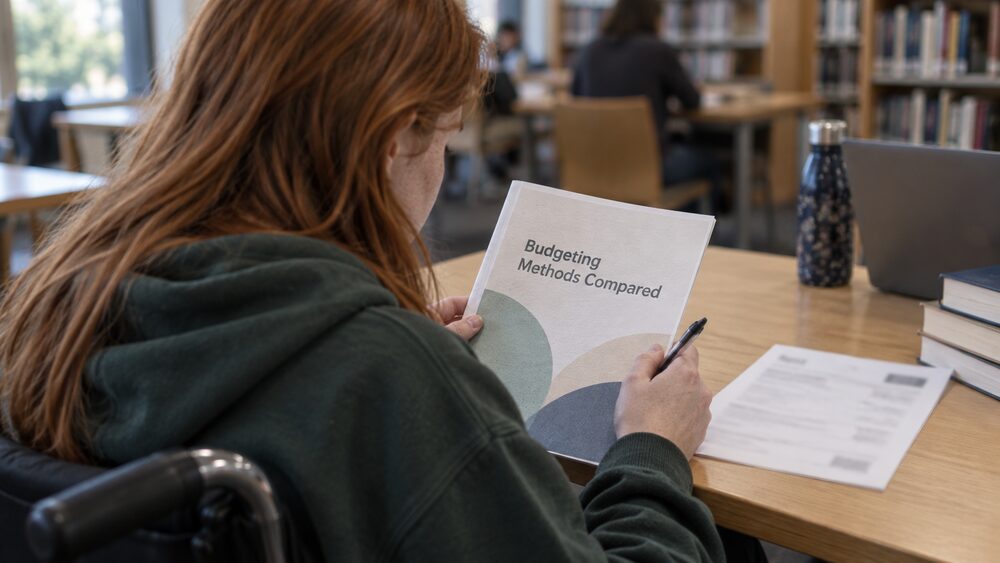
Zero-based budgeting means giving every pound a job at the start of the month, so income minus everything you plan to spend equals zero. Envelope budgeting means dividing cash into separate pots, one for each category of spending, and stopping when a pot is empty. A family version of this appears in StepChange's guidance on managing money as a family, which suggests trying "jam jar budgeting" as a fun way to plan, alongside saving up for things you do as a family like trips out, holidays and Christmas10. The page on budgeting methods compared sets the main methods side by side.
Which method suits you depends on how your money arrives and how you spend. If your income is irregular, budgeting against your lowest month, as National Debtline suggests8, works better with a zero-based approach, because you plan each month afresh. If you mostly spend by card, envelope budgeting needs adapting, for example by using separate accounts or an app. The comparison page on weekly or monthly budgets may also help if you are paid weekly.
Apps, spreadsheets or pen and paper
There is no single right tool. The guidance sources themselves use every format. Tax guidance for the self-employed notes you can use a paper cash book, or a computer spreadsheet or accounting system to keep your records11. Business Debtline offers a budget sheet it can send you, and its advisers can help with filling it in12. One Parent Families Scotland has an online budgeting and debt planner that, once completed, you can save or print out13.
Free tools worth knowing about:
| Tool | What it does | Cost |
|---|---|---|
| My Money Steps (National Debtline) | Creates a budget giving a clear picture of income and expenses, with tailored debt advice | Free14 |
| My Budget (Business Debtline) | Works out your budget; you can complete it in your own time and go back to it as often as you want | Free15 |
| MoneyHelper budget planner | Official free budget planner tool | Free16 |
| CAP money coaching | Includes unlimited access to a mobile-friendly budget worksheet | Free coaching17 |
| Family Fund eLearning guide | Includes a demo of how to use the MoneyHelper Budget Tool | Free18 |
Apps can do things paper cannot. Mencap's guidance suggests using apps that round up your spending, so that small savings build up19. A student budgeting app called Blackbullion is described as using an AI driven coach and personalised budgeting tools20. The page on free budget planners, spending trackers and apps compares the options.
If you use an app that links to your bank account, the same caution applies as with any online service. Which? has guidance on spotting online shopping scams, and notes that using a digital wallet such as Apple Pay, Google Pay, PayPal or Samsung Pay ensures your card details stay private when paying21. One piece of guidance from Business Debtline is relevant if money is tight and you have debts with your bank: set up an account with a bank you do not have any existing debt with12.
Build in savings and an emergency fund
If you have money left over after meeting your essential living costs, it might be a good idea to pay a regular amount into a savings account, or to think about opening a savings account or joining a credit union12. NS&I's guidance is to keep an appropriate amount of cash in a bank or building society so you can access it quickly for any unexpected outgoings or emergencies22. The page on emergency funds covers how to build one.
The guidance on building the habit is specific. NS&I suggests setting up a regular payment into your savings, choosing a point in the month when you usually have money available, putting aside a bit of any extra money you receive, and increasing or reducing what you save as your circumstances change22. The pages on saving regularly and saving on a low income develop this.
Saving a little is also what makes a budget survive bad months. Business Debtline notes that when money is tight, it is very hard to stick to repaying debts when an important bill needs paying or the car or house needs an urgent repair, and that regularly putting a bit of money aside for expenses such as these spreads out the payments and makes budgeting much less stressful12. Even on a long-term debt solution, the guidance is to set aside money every month towards costs like school uniform, because your budget has a section for clothing23.
If you have no savings and an emergency hits before you have built any, there are official options. People on Universal Credit may be able to get a Budgeting Advance to help pay for emergency household costs, or for help getting a job or staying in work24. Budgeting Loans can help pay for things like rent, items you need at home and some debts25. Both are repaid through benefits, and the money is paid straight into your account26. The comparison page on emergency fund or paying off debt first weighs the two uses for spare money.
When your spending is more than your income
If your outgoings are more than your income, the guidance is to look to see if you can increase your income or reduce your outgoings, and if the gap remains after doing both, to contact a debt adviser12. National Debtline calls this a deficit budget: the money you need to spend each month on living costs is higher than the money you receive each month from work and benefits9. StepChange uses the same term, describing a "budget deficit" as spending more money than you have got coming in, and a "budget surplus" as having money left after paying for everything27.
Reducing outgoings starts with the flexible section, since fixed bills are harder to change quickly. Business Debtline suggests you might be able to cut down on some of your household spending by budgeting better or shopping around12. The page on cutting household bills covers the practical steps.
If you have debts, the order matters. Deal with any priority debts before deciding what to do about your other debts, because priority creditors have stronger powers to get their money back12. Mortgages are priority debts, and a lender could repossess your home and sell it to get their money28. If a lender is taking action over mortgage arrears, official guidance in Northern Ireland is to get your adviser's help to prepare a budget of your income and outgoings to work out whether you can afford to pay the mortgage instalment and arrears over a period of time29. Once you know how much you have left over to pay your creditors, you can decide your best option for dealing with your debts12.
Where there is some money for non-priority creditors, divide it between them so each is offered a fair share, worked out on a pro-rata basis, which is how the court would do it12. If there is nothing left, a free debt adviser can talk you through the options. The narrow page on spending more than you earn and the debt section go further.
Keeping a budget going month to month
A budget only works if it lives. The guidance is to keep a copy so you can track how you spend your money12, and to review it whenever circumstances change: a new bill, a pay rise, a child starting school. Business Debtline's My Budget tool is built for this, letting you complete your budget in your own time and go back to it as many times as you want15.
Some costs are predictable enough to plan for in advance. School uniform is the example the debt charities use: set money aside every month towards it rather than finding the whole cost in one go23. The same monthly-set-aside approach works for Christmas, holidays and annual bills6.
A few habits help a budget survive the year:
- Pay regular amounts into a separate account to help you plan ahead and keep up with your regular bills12.
- Set up a regular payment into savings at a point in the month when you usually have money available22.
- If you are paying off credit cards, options include adding a set amount to the monthly minimum payment, or setting up a monthly payment that is the same each month31.
- If your income varies, set aside some of the money from higher months to cover bills and debts in lower ones12.
Budgets also have a family side. StepChange's guidance on managing money as a family suggests researching toys and games together and letting children pay with cash as ways of building the habit early10. If you cannot afford something a child wants, the guidance is to give them pocket money to save up for what they want, pay them to do chores or set academic goals, use a budget template, and help them make a plan with a budget and timeline10. The page on teaching children about money develops this.
Free help with budgeting and debt
Everything in this page can be done alone, but free help exists at every step, and the debt charities are consistent that a budget is the first thing they will help you with. Debt advice services are free32, and the main providers are charities and official bodies, not fee-charging firms.
| Source of help | What it offers |
|---|---|
| National Debtline | My Money Steps, a free budget tool that helps you create a plan and deal with your debt14 |
| Business Debtline | The My Budget online tool, sample letters to send to creditors, and guidance for the self-employed33 |
| StepChange | Online guidance on making and managing a budget, and debt advice2 |
| Christians Against Poverty | Money coaching covering building and balancing a household budget, saving, using credit wisely and navigating unmanageable debt17 |
| Community Money Advice | Free budgeting or debt advice at local centres34 |
| Debt Advice Foundation | Advice that starts by asking about your income, monthly spending, assets and debts35 |
The Debt Advice Foundation describes its process as working out which solution allows you to become debt free in the shortest time possible without adding to your debts and while protecting assets such as your home35. If you have been made redundant or had hours reduced, the guidance is to build a budget and start dealing with debts as soon as possible36. In Scotland, Shelter notes there are free advice services that can help with debt32.
If you would like help filling in a budget, advisers at these services can do it with you12. The pages on free money guidance and on help in Scotland, Wales and Northern Ireland list what is available where you live.
Sources36 cited
- Making a budget StepChange Debt Charity, 2026-09-25
- How to make a budget StepChange Debt Charity, 2026-09-25
- Getting ready for debt advice National Debtline, 2026-09-25
- Your business and household budget Business Debtline, 2026-09-26
- Making money last until payday StepChange Debt Charity, 2026-09-25
- Reduced income guide StepChange Debt Charity, 2026-09-25
- Budgeting, saving and borrowing Business Debtline, 2026-09-26
- Budget planning: a simple guide to managing your money National Debtline, 2026-09-25
- Cost of living: if you can't afford your essential costs National Debtline, 2026-09-25
- Telling kids you can't afford something StepChange Debt Charity, 2026-09-25
- Self-employed or business owner: record keeping TaxAid, 2025-01-24
- Your business and household budget (Scotland) Business Debtline, 2026-09-26
- Budgeting and debt planner One Parent Families Scotland, 2026-01-22
- My Money Steps National Debtline, 2026
- My Budget Business Debtline, 2026
- Make the most of your pension MoneyHelper, 2026-09-27
- Money coaching Christians Against Poverty, 2026-09-26
- Do a budget plan Family Fund, 2026-09-24
- Budgeting and saving money Mencap, 2026
- Student budget planner Which? University, 2026
- How to spot an online shopping scam Which?, 2026-08-03
- Saving without a goal NS&I, 2026-09-18
- How to save money on clothes StepChange Debt Charity, 2026-09-25
- Universal Credit advance payments nidirect, 2026-05-20
- Budgeting Loans mygov.scot, 2026-08-10
- Considering a payday loan StepChange Debt Charity, 2026-09-25
- Know your outgoings StepChange Debt Charity, 2026-09-25
- Mortgage arrears or payment difficulties nidirect, 2025-11-07
- When a lender takes action against you nidirect, 2025-09-05
- Budgeting advances under Universal Credit Shelter England, 2026-06-25
- Dealing with persistent debt StepChange Debt Charity, 2026-09-25
- Debt advice Shelter Scotland, 2026-01-16
- Getting started Business Debtline, 2026-09-26
- Budgeting tips Community Money Advice, 2026-09-26
- Debt solutions Debt Advice Foundation, 2026-04-08
- Unemployment and reduced hours StepChange Debt Charity, 2026-09-25





 MoneyHelperFree, impartial money and pensions guidance, set up by government
 Citizens AdviceFree advice on money, consumer and legal problems in England and Wales
 StepChangeFree debt advice and solutions from a charity
 Turn2usFree benefits calculator and grants search from a charity
 GOV.UKOfficial information on tax, benefits and government services