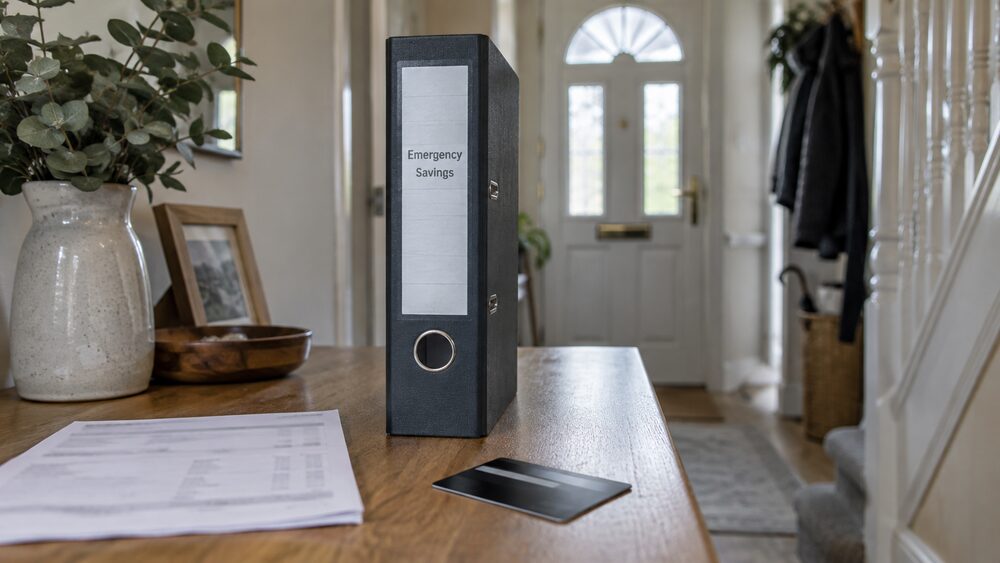
Yes, in most cases it makes sense to keep emergency savings somewhere separate from the account you spend from. The money exists to be reached quickly when something goes wrong, and a separate account keeps it visible, out of your day to day balance and less likely to be spent by accident. One savings provider puts it plainly: open a savings account so you keep savings separate from your spending money1.
Yes, in most cases it makes sense to keep emergency savings somewhere separate from the account you spend from. The money exists to be reached quickly when something goes wrong, and a separate account keeps it visible, out of your day to day balance and less likely to be spent by accident. One savings provider puts it plainly: open a savings account so you keep savings separate from your spending money1.
What the account should be is a different question from where it sits. The usual fit is an easy access account, because the whole point of the money is that you can get at it.
How much goes in is personal. National Savings and Investments says the amount in an emergency fund will be different for everyone and is a personal decision based on what works for you2. One investment company suggests six months of essential spending as a guide3.
Why emergency money is kept apart from other savings
The case for a separate pot is about behaviour as much as interest. Money that sits in the same account as your spending is money you can spend without a decision, and the balance tells you nothing about how much of it is genuinely spare. Independent guidance on self insurance is direct about the method: keep your emergency money in a high interest savings account, ringfenced from other savings, and keep topping it up6.
The same logic runs through ordinary budgeting. A budgeting guide notes that it is sometimes easier to cope with paying bills if you open a separate bank account, paying regular amounts in so that direct debits and standing orders come out automatically7. The account is doing two jobs: holding the money and removing it from the pool you make daily choices with.
There is a wider pattern of separating money by purpose. A payments firm holds client funds in a separate account so they do not get lost if the firm fails8, and a savings provider describes holding funds in a separate client money account for the same reason8. For a household, the purpose is simpler: the emergency fund is not holiday money, and a separate account makes that obvious every time you look at it.
If you are still working out how large the fund should be, emergency funds: what they are and how much to keep covers the sizing question, and how to make a budget is where the monthly figure that feeds it comes from.
Choosing an account that pays interest but allows withdrawals
The account has to do two things at once: earn something while it sits there, and let you out quickly. Easy access accounts are built for that. One provider describes its easy access range as savings you can get to when you need them, with some accounts allowing only a limited number of withdrawals each year in return for a higher rate of interest5.
The types of account on offer split roughly three ways. One investment platform sets out the choice as easy access, fixed term and notice accounts, and notes you can use all three9. A variable rate savings account can also be easy access, meaning you can dip into your savings if needed10.
| Account type | Access | What to watch |
|---|---|---|
| Easy access | Withdraw when you need to | Some limit the number of withdrawals a year5 |
| Notice account | After giving notice | You need to give notice before you take your money out11 |
| Fixed term | At maturity | Changes and top ups happen after the account matures12 |
| Cash ISA | Usually easy access | Tax treatment differs from an ordinary savings account13 |
Notice accounts are the middle ground and the one most often misjudged. One provider states simply that you need to give notice before you take your money out11. That is fine for money you expect to leave alone, and awkward for money you might need this week.
Withdrawal rules to check before you open it
This is the part worth reading properly, because the rules vary far more than the headline rate does. Some accounts allow a set number of withdrawals a year, and some of those pay a higher rate in return5. Others allow immediate withdrawal but charge an interest penalty for it14. A regular saver may allow withdrawals and early closures outright15, while another provider's regular saver does not permit withdrawals at all, though you can close it early without paying a penalty if you need the money15.
Some accounts are built around a single escape hatch. One credit union's Smart Saver offers one withdrawal if needed16. Another offers an additional savings account for money you may wish to access at short notice, operated alongside your main saving and loan account, with the balance excluded from the calculation of any future loans17.
A few rules catch people out for reasons that have nothing to do with the rate. Where an account is held under a power of attorney, one building society requires a Your Saver account to be closed and a different savings account opened instead18. Where a joint account is involved, one provider lets you choose whether either person can withdraw or both must sign in19. And a cash ISA cannot have two account holders, so couples cannot use one to save together20.
A balance transfer moves the debt, not the interest rate
The same principle applies to emergency money: moving it somewhere else does not change what it is for. If you are weighing up whether to hold cash at all while you still owe money, emergency fund or paying off debt first sets out the trade off, and how to start saving each month covers the mechanics of getting a regular amount moving.
Keeping the fund topped up after you use it
Using the fund is not a failure, it is the fund working. The question is what happens next. Independent guidance is to keep an appropriate amount of cash in a bank or building society so you can access it quickly for unexpected outgoings or emergencies21, which implies replacing what you take out rather than leaving the pot short.
The practical method is a standing arrangement. One building society suggests setting up a monthly standing order to transfer money into the emergency fund without having to think about it22. A budgeting guide makes the same point in general terms: if you have money left over after meeting your essential living costs, it might be a good idea to pay a regular amount into a savings account7.
There is a useful comparison in how emergency credit works elsewhere. With a prepayment meter, emergency credit is paid off the next time you top up23, and the same rule is stated for the Scottish scheme: you will need to pay it back next time you top up24. A pension sidecar works on a similar rhythm, where withdrawals restart saving into the sidecar until the cap is reached again25. The pattern is the same in each case: the pot refills from the next regular payment, not from a one off effort.
If your income varies, budgeting when your income varies each month covers how to keep a regular amount going when the amount coming in is not regular.
Does keeping emergency savings separate stop me spending them?
Partly, and it is worth being honest about the limit. A separate account removes the money from your everyday balance and gives it a label, which is the main practical benefit. It does not lock it away. If you want a firmer barrier, the accounts with limited withdrawals or notice periods provide one, and you accept slower access in exchange5.
There is a second reason to keep the fund visible and separate: it counts. Investments should normally be included as savings when your capital is assessed26, and savings in Help to Save accounts are the subject of a recommendation that they be disregarded from capital rules27. Keeping the emergency pot in its own account makes it clear what it is and what it is for.
Should I invest my emergency fund instead of saving it?
The guidance on this is unusually consistent. Another states the same rule and adds a target: build up an emergency cash savings pot to cover six months of essential living expenses28.
The reason is the nature of the two things. Investment trusts are described as more risky than bank savings accounts, though they offer the chance of a growing income and potentially capital growth too29. Funds come in several forms, including investment trusts, unit trusts and exchange traded funds30. None of them is designed to be sold at short notice at a predictable price, which is exactly what an emergency fund has to do.
"Before you invest, make sure you have some 'rainy day' money."
If you have the emergency fund in place and want to look further, investing: a complete guide covers the options, and ISAs: a complete guide explains the tax wrappers.
Where the money can go wrong
Two situations are worth knowing about in advance. That is a reason to know exactly where your emergency fund sits and how quickly you can reach it.
The second is access from outside the UK. If you need emergency money while abroad, some banks will arrange for cash to reach you to keep you going until you get home31. That is a service to check for before you travel, not something to assume.
Sources31 cited
- Budgeting and saving money Mencap, 2026
- Emergency fund guide National Savings and Investments, 2026-09-18
- Investing versus cash savings Bestinvest, 2026
- How to build an emergency fund Teachers Building Society, 2026-09-25
- Easy access savings Skipton Building Society, 2026-09-26
- Is self insurance ever a good idea? Which?, 2026-02-25
- Your business and household budget Business Debtline, 2026-09-26
- Appropriateness test guide Kuflink, 2026-09-18
- Range of accounts Charles Stanley Direct, 2026-09-26
- Fixed rate vs variable rate explained HSBC UK, 2025-10-21
- Notice savings accounts Aviva, 2026-09-26
- Savings terms and conditions NatWest, 2026-09-25
- What is a cash ISA? Skipton Building Society, 2026-09-25
- Types of savings accounts The Nottingham, 2026-09-26
- Regular saver accounts Skipton Building Society, 2026-09-26
- Savings first direct, 2026
- Fixed term savings Enterprise Credit Union, 2026-02-26
- Third party access Cambridge Building Society, 2026-09-26
- Joint savings accounts explained Yorkshire Building Society, 2026-09-26
- Should you open a joint savings account? Which?, 2026-02-09
- Risk vs rewards The Association of Investment Companies, 2026
- How to build an emergency fund Teachers Building Society, 2026-09-26
- Prepayment meters Shelter Cymru, 2026-08-28
- Emergency credit mygov.scot, 2026-02-04
- Two account model for pension saving House of Commons Library, 2026-07-08
- Investments Entitledto, 2026-09-26
- Saving penalties Resolution Foundation, 2025-04-24
- 10 insights from 10,000 coaching sessions Bestinvest, 2026-04-29
- Your guide to investment companies The Association of Investment Companies, 2026
- Consumer guides The Association of Investment Companies, 2026
- Managing your money while travelling HSBC UK, 2026






 MoneyHelperFree, impartial money and pensions guidance, set up by government
 Citizens AdviceFree advice on money, consumer and legal problems in England and Wales
 StepChangeFree debt advice and solutions from a charity
 Turn2usFree benefits calculator and grants search from a charity
 GOV.UKOfficial information on tax, benefits and government services