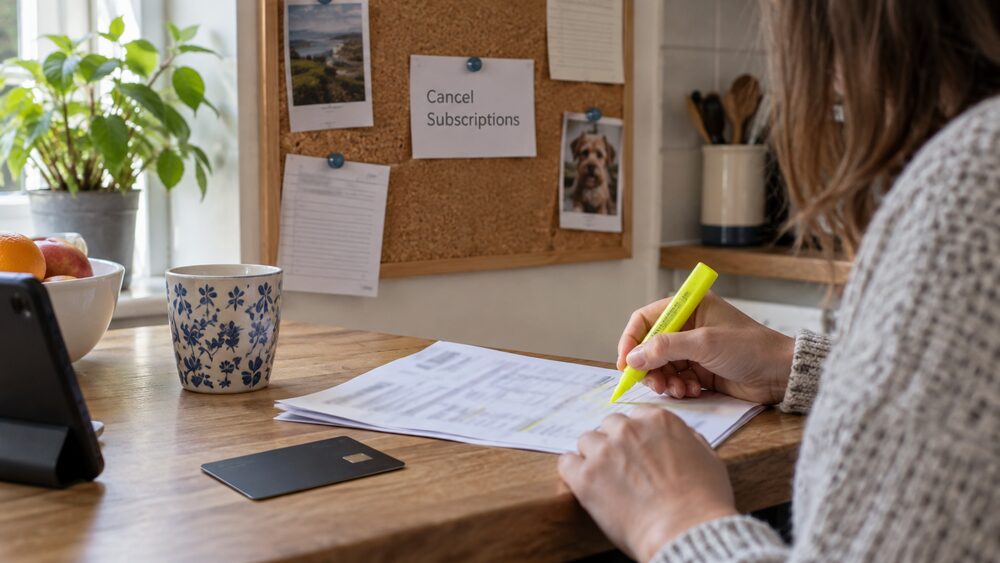
Unwanted subscriptions are one of the quietest leaks in a household budget. They are small, they arrive on a card or a direct debit, and nothing about them looks unusual on a statement. The first job is finding them; the second is stopping them, and those are two different tasks with two different sets of rules.
Unwanted subscriptions are one of the quietest leaks in a household budget. They are small, they arrive on a card or a direct debit, and nothing about them looks unusual on a statement. The first job is finding them; the second is stopping them, and those are two different tasks with two different sets of rules.
The good news is that you have more control than most people realise. A direct debit can be cancelled at any time by contacting your bank or building society, and a recurring card payment can be stopped by asking your card issuer, which must stop the payments even if you have not contacted the business1. The catch is that stopping the money is not the same as ending the contract, and that distinction is where most of the trouble starts.
This page covers how to trace what you are paying for, how cancellation works through app stores, websites, direct debits and card payments, what happens when a free trial rolls over into a paid plan, and what to do when a company will not let you go.
Finding every subscription you pay for
Start with the accounts the money leaves from, not with your memory. A current account statement or transaction list will show every direct debit and every recurring card payment, and most banking apps group these under a heading such as regular payments or scheduled payments. That single screen is usually the fastest inventory you will get.
Look for three patterns. Direct debits are the ones with a company name and a variable or fixed amount, collected under the Direct Debit Guarantee. Recurring card payments, also called continuous payment authorities, look like ordinary card purchases but repeat every month, and they are the ones people most often forget because they were set up inside an app or on a website. Standing orders are payments you set up yourself, and they are not covered by the same cancellation rules as direct debits.
It also helps to check the places subscriptions hide. App store subscriptions are billed by Apple or Google rather than by the company, so they appear as a single line on your statement and are managed in your account settings. Free trials you signed up for months ago may have converted without any notification you noticed. And if you are hunting for something older, such as a forgotten account, the My Lost Account service is free, and Gretel is a completely free way to trace all types of financial assets including lost pensions8.
How to cancel: app stores, websites and direct debits
The route you use depends on how the payment was set up, and using the wrong one is the most common reason a cancellation fails.
For anything bought inside a phone app, the subscription belongs to the app store. You cancel it in your Apple or Google account settings, not on the company's website, and deleting the app does not cancel it. For everything else, the starting point is the provider: to cancel a subscription, contact the provider and they will be able to cancel it for you, usually on their website or app10. Many services make this straightforward. Disney+, for example, asks you to go to Profile, then Account, select your subscription, click Cancel Subscription and follow the steps11.
Direct debits are different, because you can act without the company's cooperation. You can cancel a direct debit at any time by contacting your bank or building society, and written confirmation may be required; the organisation should also be notified3. The Direct Debit Guarantee says the same thing: cancel at any time by contacting your bank or building society, and tell the payee company too4. Once cancelled, your bank should ensure that no payments are taken, whether or not you owe the company money3.
In practice most banks let you do it in the app. Halifax asks you to select Regular payments, choose the direct debit and select Delete, then confirm; in online banking you select Direct debits and standing orders, then Manage direct debits, find the direct debit and select Cancel, then re-enter your password12. Lloyds Bank uses the same Regular Payments route, with a Delete button next to the payment13. AJ Bell asks you to log in, open the Regular payments screen and click the recycling bin icon14. Coutts asks you to select Payments, tap scheduled payments, then Direct Debits, choose the payment, select Cancel Direct Debit and confirm15. Zempler Bank asks you to select the direct debit in-app or in online banking under Payments and transfers, then click cancel and confirm16. Starling's summary is simpler still: you can cancel a Direct Debit at any time17.
Is cancelling a direct debit the same as cancelling the subscription?
No, and treating them as the same thing is how people end up with debt collectors writing to them. Cancelling the direct debit stops the money leaving your account. It does not end your contract, and it does not cancel what you owe.
The Direct Debit Guarantee is explicit that the payee company should also be notified4. RBS puts the same point the other way round: contact your contract provider to cancel the Direct Debit and stop future payments being collected from your account18. In other words, the bank instruction and the contract are two separate things, and a well-handled cancellation deals with both.
There is one clear exception where the two happen together. If you pay vehicle tax by Direct Debit and you tell the DVLA you no longer own the vehicle, the Direct Debit will be cancelled automatically19. That is a specific rule for a specific payment, not a general principle.
Continuous payment authorities: stopping card payments at your bank
A continuous payment authority, sometimes called a recurring card payment, is an arrangement that lets a company take money from your debit or credit card on a repeating basis. It is the mechanism behind most app subscriptions, streaming services, gym memberships and payday loan repayments.
The important point is that you can cut it off at the card end. Under the Payment Services Regulations 2017, your bank or card provider must cancel the payment authority21. You can cancel by contacting the company taking the payment, or cancel directly with your card issuer, and once you have done this it must stop payments immediately22. The regulator's own wording is blunt: once you have asked them to, your card issuer must stop the payments, even if you have not contacted the business2.
The practical route is usually a message or letter. Debt advice services advise that you will need to write to your card issuer asking for this payment to be stopped, and sample letters are available, including one to withdraw your continuous payment authority from your card issuer and one aimed at a payday loan company23. The letter's purpose is simply to tell your card issuer that you are withdrawing your authority for payments to be debited from your card26.
If you were misled or tricked into agreeing to a continuous payment authority, you have rights under the Payment Services Regulations 201728. That matters for the subscription traps that advertise a cheap trial and bury the recurring charge in the small print.
Free trials that turn into paid subscriptions
A free trial is a subscription with a delay on the first payment. If you sign up for a free trial, it may automatically convert into a paid subscription, and a company will often automatically start taking a monthly payment once the free trial has expired5. Nothing illegal happens here; the terms were in the sign-up flow, even if they were not in the part you read.
The practical defence is timing. Keep an eye on any free trials you sign up for and make sure you cancel the ones you do not want before you start paying for them10. Put the end date in your calendar on the day you sign up, not the day before it ends.
If a trial has already rolled over and taken money you did not intend to spend, you have two routes. Ask the company for a refund first, since some will give one. If that fails, dispute it through your bank and ask them to recall the money and block further payments30. The same advice applies to products bought from a fake advert: contact your card provider, ask about getting the payment back, and cancel any repeating payment31.
When a company will not let you cancel: refunds, chargebacks and complaints
Some companies make cancellation deliberately awkward: no cancel button, a phone line that is always busy, or a requirement to give notice in writing. You still have options, and they run in a rough order.
First, cancel in writing and keep a copy. A dated email or letter that says you are ending the contract is evidence, and it is what an ombudsman will ask for later.
Second, stop the payment at your end. For a recurring card payment, contact either the business or your card provider33. For a direct debit, cancel it with your bank and tell the company3. Santander's guidance is the same: cancel your subscription with the company to stop being charged, which might be through their website or support team34.
Third, if money has been taken that should not have been, look at chargeback. A chargeback claim can be made where the travel company is the one who failed to supply you with services, not where you choose not to travel or are unable to travel35. The circumstances that qualify include goods or services not received, including if the company has gone out of business; faulty, counterfeit or defective goods; the wrong amount charged or charged twice by mistake; and being charged for a repeat payment after cancelling a subscription6. That last one is the route that fits most unwanted subscriptions.
Fourth, complain. Firms must disclose in good time before or immediately after you are bound, in a durable medium, the existence of the right to cancel or withdraw, its duration, the conditions for exercising it, the amount you may have to pay, the consequences of not exercising it and practical instructions for doing so, including the address to send the cancellation to36. For general insurance contracts, a firm must provide information on the right to cancel a policy covering the same ground37. Where a firm offers to facilitate payment of adviser charges, it must say whether any refund will include an adviser charge or consultancy charge, and that you may be liable to pay outstanding adviser charges38.
If the company still will not budge, the Financial Ombudsman Service can look at complaints about regular payments33. Refund outcomes vary by product. With a single-premium PPI policy cancelled early, the consumer usually receives a refund, but the refund is usually much less than pro rata, especially if the policy was cancelled early and after the initial cooling-off period39. Where a holiday contract is void for mistake, you are entitled to a refund but not compensation, and not to the holiday at the lower price35.
Does cancelling a subscription affect my credit score?
Cancelling a subscription does not, by itself, put anything on your credit report. There is no marker for "cancelled a streaming service". The risk is indirect, and it comes from what happens next if you stop paying something you are contractually obliged to pay.
Missed payments and defaults are what damage a credit file. Experian says that receiving a CCJ will knock 250 points off your score, and defaulting on an account will mean a 350-point reduction40. A payment break can affect your credit score41. So the question is not whether cancelling is harmful, but whether the thing you are cancelling is a subscription or a credit agreement. Cancelling a direct debit for a loan, a car finance agreement or an energy account you still owe money on can turn a manageable bill into a missed payment.
There is a related point about joint finances. If you cancel a subscription that sits in a joint account, or end a financial association with someone, the credit files on both sides can be affected. Ending a financial association is free to do42.
Sources44 cited
- Think before you click: how online ads mask millions of subscription traps Which?
- Recurring card payments Financial Conduct Authority
- Direct debits and standing orders explained Which?
- Safer ways to pay Consumer Council
- Subscription payments Lloyds Bank
- Guide to credit cards Ulster Bank
- Consumer protection: subscription contracts legislation.gov.uk
- Do I need a solicitor and accountant to write my will? Which?
- Tracing old pensions Age UK
- Subscriptions first direct
- Subscriptions Danske Bank
- View or cancel a Direct Debit Halifax
- Cancel a Direct Debit Lloyds Bank
- How do I cancel a Direct Debit AJ Bell
- Direct Debit Coutts
- Direct Debits Zempler Bank
- What are Direct Debits and standing orders? Starling Bank
- Why has a cancelled Direct Debit been claimed from my account? RBS
- Vehicle tax refund GOV.UK
- Cost of living: making the most of your money National Debtline
- Consumer advice: other problems Isle of Anglesey County Council
- Buy now pay later Business Debtline
- Making the most of your money Business Debtline
- Costs of living: making the most of your money Business Debtline
- Payday loans Business Debtline
- Withdraw your continuous payment authority from your card issuer National Debtline
- Withdraw your continuous payment authority from your card issuer Business Debtline
- Consumer advice: other problems Isle of Anglesey County Council
- Continuous payment authority Danske Bank
- Rights guide: digital content Resolver
- Unrecognised transaction Handelsbanken
- Scam watch: I was sent a one-time passcode from my bank Which?
- Regular payments Financial Ombudsman Service
- Future dated card payments Santander
- I've been told the price bargain holiday I booked was a mistake ABTA
- COBS 15: Cancellation FCA Handbook
- ICOBS 6: Cancellation FCA Handbook
- COBS 15.2: The right to cancel FCA Handbook
- The ombudsman's approach to PPI mis-sale complaints Financial Ombudsman Service
- How to improve your credit score Which?
- How to deal with missed mortgage payments Shelter England
- Credit score and joint accounts Monzo
- Making the most of your money guide National Debtline
- Cancelling a service you've arranged Citizens Advice



 MoneyHelperFree, impartial money and pensions guidance, set up by government
 Citizens AdviceFree advice on money, consumer and legal problems in England and Wales
 StepChangeFree debt advice and solutions from a charity
 Turn2usFree benefits calculator and grants search from a charity
 GOV.UKOfficial information on tax, benefits and government services