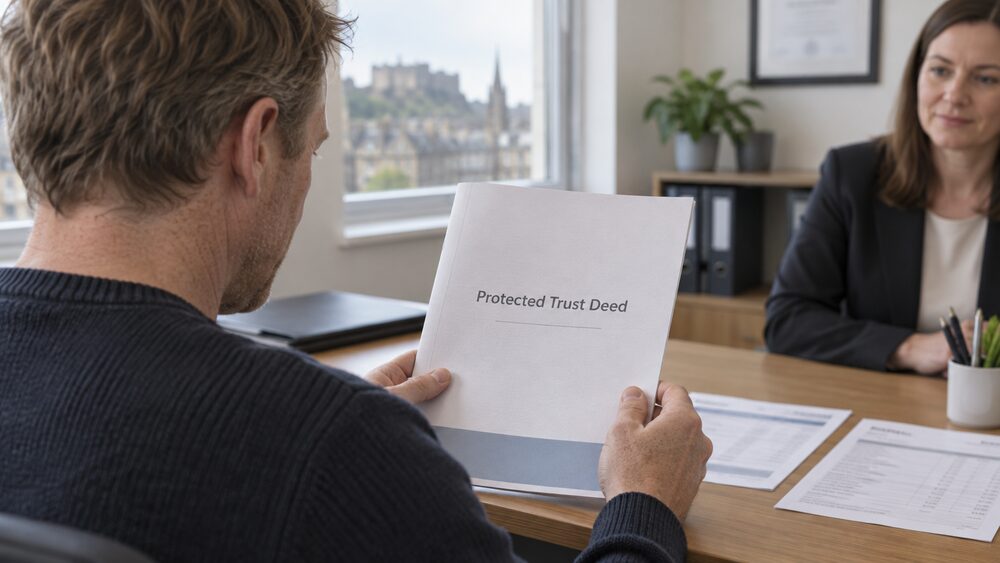
A protected trust deed is a formal agreement under Scottish law between you and the people you owe money to. You pay an agreed amount each month, based on what you can afford, for a fixed period, normally four years, and at the end any remaining included debts are written off1. It exists only in Scotland: in the rest of the UK the comparable solution is an individual voluntary arrangement (IVA), which works on a similar principle but with different rules, benefits and fees3.
The word "protected" is the part that matters most. A trust deed on its own is not binding on your creditors at first. It becomes a protected trust deed when enough of them agree, and from that point they cannot take further action to recover their money, add interest and charges, or pursue court action against you, as long as you keep to the terms4. In 2025-26, 5,087 trust deeds were advertised in Scotland and around 91.2% became protected eventually5. Protected trust deeds are used at scale: 1,273 were recorded across the UK's individual insolvency statistics for the quarter to June 2026, alongside 730 bankruptcies6.
How a protected trust deed works
A protected trust deed is a legally binding agreement that passes what you own and what you can pay to a trustee, who manages it for the benefit of your creditors10. The Accountant in Bankruptcy, Scotland's insolvency service, describes it as a formal agreement with the people you owe money to, to repay what is owed over an extended period1. You make reduced payments based on what you can afford, and the debts included are written off at the end4.
The legal basis is section 167(3) of the Bankruptcy (Scotland) Act 201611. Under that Act, a trust deed has protected status if the conditions in sections 164, 165, 166(2) where it applies, and 167 to 170 are met, and the deed is registered in the Register of Insolvencies. It has that status from the date of registration, which the legislation calls the "date of protection"12. The same rule appears in the regulations: a trust deed has protected status, if the conditions in regulations 4 to 10 are met, from the date the Accountant records it in the register13.
Once protected, the effect is significant. Creditors cannot add interest and charges to your debts, and cannot take further action such as court action while the trust deed runs, provided you keep to its terms3. A trust deed also stops court action where diligence, the Scottish enforcement process, has not started yet; if diligence has not started, no further enforcement action can be taken15. If your situation changes, creditors might agree to a lump sum payment covering what you owe instead3. The trade-offs are real too: the deed is listed on a public register, it stays on your credit file for six years, and you may have to sell valuable assets3.
Who can get one: £5,000 of debt and a link to Scotland
The basic threshold is debt of at least £5,000 owed to all your creditors7. Some insolvency practitioners set their own minimum debt level higher than £5,000, so a firm may decline a case even though the law's floor is met16. There is also a practical test the other way: if you can repay your debts in full within four years or less, you will not be able to set up a protected trust deed17.
Trust deeds are available to residents of Scotland18. The statutory connection test, added by regulations in 2024, requires a living individual debtor to have been habitually resident in Scotland at any time in the year immediately before the trust deed is granted, or to have had an established place of business in Scotland within that period19. A firm can also enter into a trust deed, and it is treated in the same way as an individual or sole trader trust deed17.
Eligibility is not only about debt and residence. You cannot enter a trust deed while a debt payment programme under the Debt Arrangement Scheme is approved for you20, and DAS rules likewise require that an applicant is not a party to a protected trust deed unless discharged from it21. A debtor whose estate has been sequestrated, whose trustee in that sequestration has not been discharged, is also barred under the protected trust deed regulations22. Before deciding, it is worth comparing the other Scottish options, including sequestration and informal payment arrangements, and getting free debt advice first.
Which debts are included and which are not
A trust deed includes most unsecured debts: credit card debts, overdrafts and personal loans15. These are the non-priority debts most people carry, and they are also the kind covered by Scotland's five-year limitation rules on old debts23. Secured debts, such as a mortgage or a secured loan, are treated differently: the creditor whose debt is secured on your property is not covered in the same way, and the letter of discharge does not affect a secured creditor's rights22.
Several categories of debt cannot be included17:
- fines, penalties, compensation and forfeiture orders imposed by any court
- any debt incurred through fraud
- student loans
- maintenance to an ex-spouse under a court order (not Child Support Agency or Child Maintenance Service arrears)
- secured debts, such as a mortgage or secured loan
- limited company debts, unless you signed a personal guarantee
The official list of debts that never qualify for discharge in insolvency is longer still, and includes non-eligible business debt, confiscation orders, family proceedings obligations, crisis or budgeting loan repayments, damages for death or personal injury, payments on account of universal credit, and most council tax and non-domestic rates liabilities for a financial year24. The practical point is that a trust deed writes off the included debts at the end, but the excluded ones remain yours to pay, and the discharge does not cover liabilities that arise after the trust deed was granted22. If much of what you owe falls in the excluded list, a trust deed may do little for you, and other routes, such as council tax arrears arrangements or benefit overpayment negotiations, may matter more.
How creditors agree and the deed becomes protected
Your trust deed becomes a protected trust deed when your creditors agree15. The threshold is agreement from at least half of your creditors in number, who are owed at least two thirds of your total debt9. Another way sources describe the same test: half of the people you owe must agree, or those owed at least two thirds of your debt4. StepChange puts a third angle on it: you need agreement from creditors adding up to a third of your total debt balance not to object3. These are different framings of the same objection process rather than different rules.
The mechanics work through a notice period. Creditors who have not objected in writing within five weeks of the date of the notice of your trust deed are treated as having accepted it7. The deed can still become protected if only some object; whether it does depends on how many object and how much money is owed to the objecting creditors25. Under the regulations, protected status is prevented if, within the relevant period, the trustee receives written objection from a majority in number, or from creditors owed at least one third in value, of the notified creditors22.
Once the threshold is passed and the deed is registered, the protection binds everyone notified, including creditors who did not respond. If most of your creditors agree, they must also follow the trust deed's terms, which stops them from trying to collect the debt2. This prevents creditors from taking further action against you to get their money back, as long as you stick to the terms17. The Accountant in Bankruptcy's debt advice package puts the same point plainly:
"If enough of your creditors agree to the terms of your trust deed, it can become protected. As long as you keep to what you have agreed, your creditors are not allowed to take further action against you."26
Trustee fees come out of your monthly payments
A trust deed is not free, but the fees are built into the payments rather than charged on top. The trustee charges fees for managing the protected trust deed, and those fees come from your monthly payments; they do not affect what you must pay or for how long2. Trustees take their fees directly from your payments15, and the charge comes out of the trust deed fund, which is made up of your monthly payments, any assets included and any equity included3. There are no upfront fees: your trustee cannot charge you anything before the trust deed is set up27.
The scale of the fees is worth knowing. They are usually about £4,000 or more17. For trust deeds set up on or after 28 November 2013, fees are paid out of the monthly instalments you pay, or through the sale of any assets you have27. The structure is set by the regulations: the trustee is entitled to remuneration consisting only of a fixed fee set out in the Form 3, an additional fee based on a percentage of the total assets and contributions realised by the trustee, and outlays incurred22. The Accountant in Bankruptcy's guidance describes the same structure: a fixed fee for the full administration of the protected trust deed, plus an additional fee based on a percentage of the total assets and contributions realised28.
The key reassurance is that the fees do not increase what leaves your pocket. The amount you and your trustee agree you can afford to repay each month, plus any equity if applicable, is the only amount you will ever be asked to pay, and you are not expected to find additional money to cover the trust deed's cost29. Free debt advice charities do not charge for advice; payments go to the trustee once the trust deed is in progress15. The site's guide to what debt solutions cost compares these fees with those of other options.
Your home, car and other assets
This is the section that decides whether a trust deed is workable for many people. Any non-essential assets you own will be included in the deed and could be sold, including your home25. If you own valuable items, like a house or car, you might need to sell them to pay your debts; essential items such as household goods are not affected2. You normally have to sell any asset worth more than £1,00015.
There are limits and exceptions. You can usually keep one vehicle worth less than £3,0003, and you may have to sell assets apart from one car worth less than £3,00015. You may not have to sell a property with less than £20,000 equity in it15. Homeowners may be expected to pay some or all of their equity towards their debts3, and the trustee will look to release any available equity through remortgage, or, if you cannot remortgage, by selling your home30. Where equity is an issue, the options are typically to release equity on your home or to extend your trust deed by a year15.
A section 10 trust deed works differently for property: your home will not be treated as an asset as long as you stick to the terms of the trust deed27. This is a specific arrangement where a secured creditor, such as your mortgage lender, agrees at your request not to claim under the trust deed for that debt, and the home is excluded from the estate conveyed to the trustee31. Items on hire purchase agreements may be affected, and you may have to return them3. At the conclusion of the trust deed, any assets not disposed of are returned to you30.
How long it lasts: four years, sometimes longer
The normal period to discharge is 48 months: a debtor in a protected trust deed is normally discharged after 48 months8, and the official guidance says a protected trust deed usually lasts four years, though it can be longer if you have valuable property2. The legislation sets the payment period as a minimum of 48 months beginning with the date the trust deed was granted, or a shorter or longer period as determined or agreed by the trustee22. The Scottish Parliament's research briefing describes the same minimum of four years during which your assets are managed by a trustee for the benefit of creditors32.
Some independent guides state that protected trust deeds usually last five years16. You will usually be discharged after four years, but some trust deeds can last for longer17.
Extension is not rare. A trust deed can last longer if you own a home with equity and do not remortgage within four years, or if you take a payment break during the term3. The length is agreed at the outset, so ask the trustee to explain what would trigger an extension before signing. When the trust deed ends, all remaining included debts are written off3, and any debts you still have are written off after discharge15.
Setting up a trust deed with an insolvency practitioner
You can only apply for a trust deed with the help of an insolvency practitioner25. The trustee must be a qualified insolvency practitioner, regulated by law and a member of an approved governing body4. The process normally starts with free advice and an online debt help tool, after which you choose an insolvency practitioner to be your trustee, and they put together and submit the application3.
The information duties before signing have been strengthened. For trust deeds granted after 20 January 2025, the insolvency practitioner must provide the debtor with specified material and adequate time to consider its contents11. The trustee must provide you with a copy of a debt advice and information package and a copy of a trust deed information document14. These documents matter: a trust deed cannot be cancelled once signed15, so the reading stage is the only point at which you can still walk away freely.
A numbered summary of the process:
- Get free advice and check your options, including debt management plans and the Debt Arrangement Scheme, and work out a budget.
- Choose a qualified insolvency practitioner to act as your trustee.
- Receive and consider the debt advice and information package and the trust deed information document.
- Sign the trust deed, which passes your estate to the trustee.
- The trustee notifies your creditors, who have five weeks to object in writing7.
- If the thresholds are met, the deed is registered in the Register of Insolvencies and becomes protected from that date12.
Advice itself should cost nothing. Free help is available from charities including StepChange, National Debtline, Business Debtline and Christians Against Poverty, and the site's guide to free debt advice lists where to get it. Be alert to firms that charge for arranging a trust deed or cold-call: the guide to legitimate debt advisers explains how to check.
Credit file and Register of Insolvencies: six years and five years
A protected trust deed leaves two separate public traces. On your credit file, a trust deed shows for six years3, and credit reference agencies hold information about trust deeds and protected trust deeds for six years17. The official guidance is the same: a protected trust deed will lower your credit score and will stay on your credit report for six years2. For comparison, bankruptcy also appears on a credit file for six years15.
On the Register of Insolvencies, the public register, the listing lasts five years4. Your name and address will be listed3, and the entry is publicly available online until one year after your trust deed ends3. Anyone can search it, including employers in some sectors and lenders.
The practical consequences run beyond the records themselves. You might find it harder to get credit4, and there is a positive disclosure duty: you must tell lenders about your trust deed if you apply to borrow more than £2,000, whether alone or with someone else3. A trust deed also prevents you from declaring yourself bankrupt or from entering the Debt Arrangement Scheme while it runs30. Some positions cannot be held while on a protected trust deed, often where you are in control of other people's money, such as solicitors and many financial services roles3, and you cannot continue as a director of a limited company unless your trustee agrees and the company's rules allow it17.
What happens if a trust deed fails
A trust deed fails when you cannot keep to its terms, most often because the payments have become unaffordable. The consequences are severe. If the trust deed fails, you must pay back all your debts, and creditors can backdate interest and charges3. You are no longer protected from the people you owe, and they can take action to collect the money you owe15.
The risk then escalates. Your creditors or your trustee can apply to make you bankrupt3; if the trust deed fails, there is a risk of bankruptcy4. Your trustee could apply to make you bankrupt if they think it is in the best interests of the people you owe15. Even if a trust deed has been granted protected status, the trustee or creditors can still petition for sequestration if they can prove it would be more beneficial to your creditors34. If you fail to maintain the payments according to the terms of the trust deed, the result may be bankruptcy34.
A trust deed can also fail before it starts, if creditors do not accept it: the same bankruptcy risk applies3. The objection rules mean a deed is blocked where a majority in number, or creditors owed at least a third in value, object in writing within the relevant period22.
Complaints, and where the protection stops
If something goes wrong with how the trust deed is run, there is a route to challenge it. Insolvency practitioners are regulated by law and must be members of an approved governing body4, so a first step is a complaint to the trustee's firm and, where relevant, to that governing body. The guide to complaining about an insolvency practitioner sets this out in detail. Beyond that, if you are dissatisfied with the actions of your trustee, you can ask a sheriff to look into the matter, and your local sheriff court can explain how to make the application35.
The protection a trust deed gives also has edges worth knowing in advance:
- It binds only the creditors who were notified. Creditors not told about the deed are not bound by it.
- It does not cover excluded debts, such as fines, student loans, fraud debts and court-ordered maintenance17.
- It does not affect secured creditors' rights, so your mortgage and any secured loans must still be paid22.
- It stops court action only where diligence has not started; enforcement already underway is a different position to check with the trustee15.
- It prevents you from entering sequestration or the Debt Arrangement Scheme while it runs30.
Where a trust deed is not the right fit, the comparison pages set out the Scottish alternatives side by side: protected trust deed or sequestration and sequestration or the Debt Arrangement Scheme.
Alternatives in Scotland
A protected trust deed is one of several routes, and the right one depends on what you owe, what you can pay and what you own. In the rest of the UK an IVA is the similar solution, with different benefits, risks and fees3; in Scotland a protected trust deed is the comparable arrangement36. The main Scottish alternatives:
| Option | What it is | Who it tends to suit |
|---|---|---|
| Sequestration | Scottish bankruptcy; assets handled by a trustee | People who cannot make meaningful payments |
| Debt Arrangement Scheme | A debt payment programme protecting assets while repaying in full | Homeowners who can pay over a longer period |
| Debt management plan | Informal reduced payments, no write-off | People with smaller debts or who may recover |
| Payment arrangements | Informal offers direct to creditors | Debts that can be cleared without a formal solution |
A trust deed suits people who can afford a monthly payment for four years or more, who have unsecured debts of at least £5,000, and who cannot repay in full within four years7. It does not suit people whose debts are mostly excluded ones, or whose income cannot support a contribution. Free, impartial advice is available from MoneyHelper and from debt charities including StepChange, National Debtline and Business Debtline, and the debt solutions overview compares every formal and informal option across the UK.
Sources36 cited
- Are you in debt Accountant in Bankruptcy
- Protected trust deed information document Accountant in Bankruptcy, 2024-12-19
- Trust deed in Scotland StepChange
- Trust deed StepChange
- Scottish statutory debt solutions annual statistics 2024-25 Accountant in Bankruptcy, 2025-26
- Individual insolvencies June 2026 commentary The Insolvency Service, 2026-06
- Bankruptcy in Scotland Business Debtline
- Scottish statutory debt solutions statistics April to June 2025 Accountant in Bankruptcy, 2026-07-22
- Bankruptcy in Scotland National Debtline
- Money jargon A to Z Citizens Advice Scotland
- Protected trust deeds Accountant in Bankruptcy, 2024-01-31
- Bankruptcy (Scotland) Act 2016, protected trust deeds legislation.gov.uk, 2026
- The Protected Trust Deeds (Scotland) Regulations 2008 legislation.gov.uk, 2008-03-28
- Bankruptcy and Diligence etc. (Scotland) Act 2024 legislation.gov.uk, 2024-07-15
- Debt counselling StepChange
- Ways to clear your debt in Scotland National Debtline
- Trust deeds Business Debtline
- Trust deeds Debt Advice Foundation
- Bankruptcy (Scotland) Act 2016 (Modification of Section 164) Regulations 2024 legislation.gov.uk, 2024-06-27
- The Debt Arrangement Scheme (Scotland) Regulations 2004 legislation.gov.uk, 2004-11-01
- DAS client eligibility Accountant in Bankruptcy
- The Protected Trust Deeds (Scotland) Regulations 2013 legislation.gov.uk, 2013-11-06
- Statute barred debts in Scotland National Debtline
- Debt Respite Scheme (Excluded Debts) Regulations 2020 legislation.gov.uk, 2020-11-17
- Debt help and advice in Scotland National Debtline
- Debt advice and information package Accountant in Bankruptcy, 2024-02-09
- Trust deeds National Debtline
- Notes for guidance: fee payable to the trustee Accountant in Bankruptcy, 2016-11-30
- How much are trust deed fees Debt Advice Foundation, 2020-06-04
- What is a protected trust deed Debt Advice Foundation, 2020-06-04
- Bankruptcy (Scotland) Act 2010 legislation.gov.uk, 2010-03-18
- Protected trust deeds research briefing Scottish Parliament, 2023-08-29
- Ways to clear your debt Business Debtline
- What are the disadvantages of a trust deed Debt Advice Foundation, 2020-06-04
- What if I am unhappy with the way my bankruptcy is being managed Accountant in Bankruptcy, 2024-03-26
- IVA costs, fees and charges StepChange




 StepChangeFree debt advice and solutions from a charity
 National DebtlineFree debt advice by phone, webchat and online
 MoneyHelperFree, impartial money and pensions guidance, set up by government
 Citizens AdviceFree advice on money, consumer and legal problems in England and Wales
 Citizens Advice ScotlandFree advice across Scotland