
A junior saver account at a credit union is a savings account opened by an adult on behalf of a child. At most credit unions the account is available from birth, and the child can usually stay in it until their 16th birthday, though some credit unions keep junior members until 181. An adult, normally a parent, guardian or other relative, opens the account and acts as the signatory, and the money belongs to the child.
The accounts are generally free. Many credit unions state that junior membership costs nothing, that there are no fees to open or use the account, and that there is no minimum balance requirement2. Instead of interest, credit unions normally pay a dividend on savings once a year, and the amount depends on how much has been saved and how much profit the credit union has made, so it is never guaranteed3.
Because credit unions are local or workplace organisations, the exact rules vary from one to another. This page sets out what is common across credit unions that offer junior accounts, where the rules differ, and what to check before opening one. To find a credit union your family can join, see finding a credit union you can join, and for how credit union savings work generally, see credit union savings accounts.
Who can open one: from birth to 16, with an adult signatory
Most credit unions that offer a junior account make it available from birth. Just Credit Union, for example, states its Junior Member Young Saver Accounts are available for children from birth up to the age of 16 years, and that adults can open them on behalf of their children, grandchildren, nephews, nieces "or any other special young person they choose"1. Capital Credit Union's terms say a Junior Saver Account can be opened for any child up to the age of 16, who then becomes a Junior Member2. Orchard Credit Union describes its Junior Account as available to everyone from birth until their 16th birthday3, and Omagh Credit Union likewise takes junior savings accounts from birth to 16 years old6.
Not every credit union stops at 16. Gleniffer Credit Union's children's savings account is for anyone under the age of eighteen, opened by a relative as trustee until the child reaches 184. Enterprise Credit Union's Young Savers Account is open to the family of its members, up to the age of 18, and is opened by adult members on behalf of the young person7. So the upper age limit is one of the first things to check with your local credit union, because it shapes what happens later, as covered under what happens at 16 or 18.
Some credit unions attach a residency or membership condition. HertSavers says anyone under the age of 16 who lives in Hertfordshire is eligible to open a Junior Saver's Account, but an existing adult member is needed to endorse the opening of an account5. RMT Credit Union's junior depositors accounts are opened by an existing adult member for any child living at the same address, from birth up to the age of 16, with an original birth certificate produced8. Capital Credit Union notes its junior accounts can likewise be opened by adult members on behalf of under-16s9. This is the credit union common bond at work: each credit union defines who can join it, by area, employer or association, and a child's eligibility usually follows the family's. If you are not yet a member yourself, the joining process is covered in how to join a credit union, and family membership in can your family join too?.
Who controls the money, and when the child takes over
A junior account is controlled by the adult who opens it. Capital Credit Union's terms are explicit: the Adult Signatory is responsible for the account and its operation until the child reaches the age of 16, at which point the junior member becomes solely responsible2. Darlington Credit Union's Young Savers page says the parent or guardian who opens the account will manage it up to the age of 1110, an earlier handover than most.
Where the money is held in trust, the arrangement lasts longer. Gleniffer Credit Union describes the opening relative as "the trustee of the account until the child reaches 18 years old"4. The same principle applies to the Junior ISA offered by Capital Credit Union: the account is opened and managed by the parent or guardian on behalf of the child, and "It becomes theirs at 18"11. Official guidance on ISAs takes the same line: a parent or guardian manages a Junior ISA for a child while they are under 16, and once the child reaches 16 they can choose to manage their own account12.
In practice this means the adult signatory decides how the account is run during childhood: when money is paid in, when it is taken out, and what it is used for. The child's own role grows with age, and the withdrawal signing rules in the next section show how some credit unions build the child into the process well before the formal handover. The exact age at which control passes, and whether anything needs to be signed at that point, is set out in each credit union's own terms.
Getting money out: withdrawals and who signs
Withdrawal rules are set by each credit union, and they differ in both who signs and from what age. Riverside Credit Union's rules are split by age: under the age of 12, the share withdrawal must be signed for by a parent or guardian, and over the age of 12 the child must sign for themselves. Withdrawals there are paid into a bank account13. Camlin Credit Union takes a different approach: withdrawals can only be made from the child's account on the written approval of the parent or guardian who opened the account, and both signatures are required if the child is 7 years old or over14.
The two schemes show the range. At Camlin, the parent stays involved in every withdrawal throughout the account's life, with the child co-signing from age 7. At Riverside, the child signs alone from 12, which means a child of 12 or over can withdraw their own savings without a parent's signature. Neither approach is better in itself, but a family opening an account should know in advance which one applies, because it determines who can actually get the money out during the teenage years.
Some credit unions also place practical conditions on how withdrawals are made, such as paying the money to a bank account rather than handing over cash13. If the savings are meant to be locked away for a particular purpose, or if the family wants the child to be able to spend small amounts themselves, the withdrawal rules are the part of the terms most worth reading. For how withdrawals work across credit union savings generally, see getting your money out.
No fees to open or use, and a small minimum balance
The consistent message across credit unions is that junior accounts are free. Just Credit Union states "Membership is FREE for Junior accounts"1. Capital Credit Union's terms say "There is no charge associated with becoming a Junior Member of the creditunion"2. Cranhill Credit Union says junior members are free to open15, Dundonald Credit Union says opening a Junior account is free16, and St Machar's Credit Union states there are no fees to open or use its Young Saver account17. Al Birr Credit Union states there is no minimum balance requirement on its Junior Savers Account18.
This is worth comparing with adult membership. Just Credit Union's savings terms describe a one-off adult membership fee of £4 plus a minimum of £1 to open the account19, so at some credit unions the adult pays a small joining fee while the child does not. Camlin Credit Union says of its savings accounts generally that there is no minimum payment required and no commitment to save on a regular basis20. Free basic banking of this kind is also a feature of basic bank accounts more widely, which Citizens Advice Scotland notes "don't have to pay any fees"21.
Minimum saving rules vary where they exist. Capital Credit Union requires all members to save a minimum of £3 per week, £15 per month or equivalent9. Pennyburn Credit Union gives the example that "Saving just £1 per week over 16 years can grow to more than £800!"22, which shows how far small, regular amounts go over a childhood. HertSavers caps junior savings at £5,0005. Where documents disagree on a minimum, as they do at some credit unions whose pages quote both a £1 and a higher figure, the figure in the account terms at the time of opening is the one that counts.
Opening an account: ID, proof of address and the child's birth certificate
Opening a junior account needs documents for two people: the adult and the child. Just Credit Union asks the adult opening the account to provide one item as proof of identification, such as a passport or driving licence, and one separate item as proof of current address, such as a tenancy agreement, benefit entitlement letter or recent utility bill. For the young person it requires two forms of identification, with examples including a birth certificate, passport or NHS medical card1.
Other credit unions set out similar lists. Pennyburn Credit Union needs the child's long-form birth certificate or legal paperwork, and the parent or guardian opening the account must also bring photo ID and proof of address23. Slemish n tha Braid Credit Union asks parents or legal guardians to open the account, bringing the child's birth certificate plus the adult ID requirements24. Capital Credit Union's terms require the Adult Signatory to provide two forms of identification, one showing a current home address, and one form of identification for the Junior Member, such as a birth certificate or passport, under Know Your Customer requirements2. Camlin Credit Union requires two forms of ID for the child, which can be a passport or birth certificate together with the parent's utility bill or bank statement, and the parent must also provide two forms of identification if they are not already a member14. Dumbarton Credit Union keeps it simple: all it needs is a birth certificate of the child and identification for the adult opening the account, unless the adult is already a member25.
The common pattern is that the child's birth certificate is the key document, and the adult needs the same kind of ID they would use to open an account for themselves. If the adult is already a member of the credit union, the process is usually shorter, because their identification is already on file25. Some credit unions now also offer online joining forms for junior accounts, which can make the process quicker, though the documents still have to be provided.
What each credit union typically asks for, and in what order.
Paying in, including Child Benefit
Money can usually be paid in however the credit union accepts deposits: in person, by standing order, by payroll deduction where the adult's employer offers it, or by benefit payment. How benefits and pensions are paid into accounts is set out in official guidance from GOV.UK and, for Northern Ireland, nidirect26. Some credit unions specifically encourage Child Benefit as the funding route. The Young Saver Account page at one credit union states: "You can save with your Child Benefit paid directly to your credit union account"28, and its Regular Saver page says that once you have your credit union membership number you can save by having your Child Benefit paid directly to your savings29.
There are two rules worth knowing. First, official guidance is clear that "The Child Benefit Office can only pay Child Benefit into one account. This can be a joint account you share with your child"26. So Child Benefit cannot be split across several accounts, and a family using it to fund a junior account is channelling all of it there. Second, the same credit union pages state that "We are not able to have DWP or HMRC payments made to your credit union account, other than child benefit"28. Other benefits, such as Universal Credit or tax credits, generally cannot be paid into a credit union account at the credit unions that state this rule, so a family relying on those payments needs a bank or building society account as well.
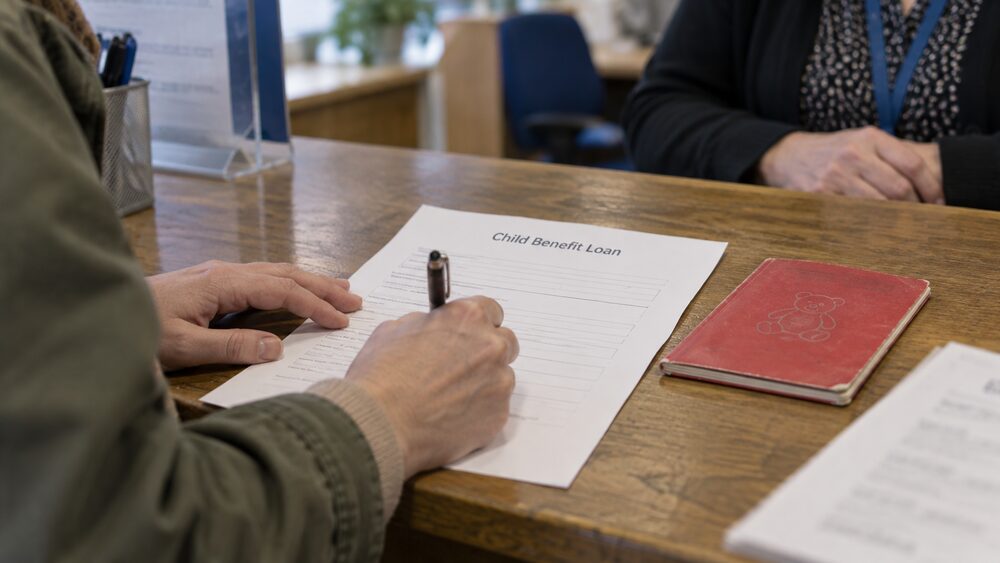
Child Benefit is also used as the repayment route for a specific credit union product: the family loan. Falkirk Credit Union's family loan page states that "Child Benefit payments need to be paid directly into your credit union account" as a condition of that loan30. That is a borrowing product rather than a savings one, and it is covered in Child Benefit loans. For benefits and credit union accounts generally, see can benefits be paid into your account?, and for the ways to pay money in, how to pay money into your account.
Dividends: usually yearly, never guaranteed
Credit unions pay a dividend rather than interest, and junior accounts are no exception. Plane Saver Credit Union's Junior Saver page advertises an annual dividend31. The Building Societies Association's consumer factsheet on credit unions explains the general position: "You will normally receive a dividend on your savings, this is usually paid annually"32. Business Debtline's guidance adds the crucial qualification: a credit union will normally pay out a dividend once a year, and "The amount you get depends on how much you have saved and how much profit the credit union has made"3.
That last point is what separates a dividend from an interest rate. A bank or building society savings account quotes a rate that is contractually paid. A credit union dividend is a share of what the credit union can afford to distribute after its own costs and reserves, so it rises in good years and falls in lean ones. A dividend quoted for last year, at one credit union or another, tells a family what happened, not what will happen next year. Some credit unions note on their junior pages that dividends are not guaranteed, and that is the right way to read any past figure.
For a child's account this has a practical upshot. The reliable part of the saving is the money paid in: Pennyburn's example of £1 a week growing to more than £800 over 16 years is deposits alone22. The dividend is a top-up that varies. Families comparing a junior credit union account with a children's account at a bank or building society should compare on the whole picture: access, minimums, the local relationship, and the fact that a dividend is discretionary while a savings rate is not. The wider comparison is in credit union or bank: which suits your money.
What happens at 16 or 18: moving to an adult account
Every junior account ends in the same way: the child grows up and the account becomes an adult one. What differs is the age and whether the change is automatic. At many credit unions the switch happens at 16. Pennyburn Credit Union tells junior members that "Once they turn 16, they'll transition to an adult account with even more benefits"23. HertSavers says that upon the young person's 16th birthday, their account will be transferred to full adult membership with voting rights5. Cranhill Credit Union updates the account to an adult account when the holder turns 1615, Bacup Credit Union transfers junior members automatically to the adult section at the 16th birthday33, and Camlin transfers junior members automatically to adult membership on their sixteenth birthday, when they are asked to sign a new Adult Membership form and update their identification14. Plane Saver's Junior Saver simply states the account matures at age 1631.
At other credit unions the change comes at 18. Enterprise Credit Union's Young Savers account automatically transfers to an adult members account when the holder reaches 187. Riverside Credit Union lets the young person apply at 18 to become a full member and change the junior account to an adult one13. GMB Credit Union converts its Young Saver to an adult Member Saver account at 1834.
The age of transfer matters for two reasons. First, it fixes when the child takes full control of the money, as described earlier. Second, it fixes when the young person becomes a full member of the credit union, with the voting rights that membership carries5. In most cases nothing needs to be done: the transfer is automatic, though at Camlin a new membership form and updated identification are required14. A family saving towards an 18th birthday should check which age their credit union uses, because a 16 year old with an adult account can already access the money themselves at credit unions that transfer at 16.
The ages at which the rules change, as set by individual credit unions.
Junior account or Junior ISA: how each one behaves
A credit union junior account is not the only way to save for a child, and the two behave very differently on access. A junior credit union account allows withdrawals, with signing rules as described above. A Junior ISA does not: official statistics on savings explain that "Unlike an Adult ISA, the savings in a Junior ISA account cannot be withdrawn until the child reaches 18"35. NS&I, which offers its own Junior ISA, puts the same rule in product terms: no withdrawals until the child turns 18, with exceptions only if the child dies or has a terminal illness36. NS&I's ISA guidance adds that "The child can't access their money until they turn 18"12.
Management also differs. A junior credit union account is run by an adult signatory until 16 or 18 depending on the credit union2. A Junior ISA is opened and managed by the parent or guardian on behalf of the child, and becomes the child's at 1811; from 16 the child can choose to manage the account themselves12. Capital Credit Union offers both products, which makes the contrast easy to see within one provider: its junior savings account runs to 16 under an adult signatory, while its Junior ISA runs to 18 with the money locked in11.
Which tends to suit depends on what the money is for. A junior credit union account suits a family that wants the child to learn to save, watch the balance grow and, at the right age, take out small amounts, because the money stays accessible under the adult's supervision. A Junior ISA suits money that is meant to stay put until adulthood, such as a lump sum being built for an 18th birthday, precisely because neither the child nor the parent can dip into it. Some families use both: an accessible credit union account for the child's own saving, and a Junior ISA for longer-term money. The tax wrapper side of Junior ISAs is covered in ISAs: a complete guide.
The two accounts answer different needs: access and habit, or a locked-away pot for adulthood.
Protection and where to get help
The protections around a junior credit union account come from three directions. The first is the account terms: the rules on who signs, when the account transfers, and what the minimum saving is are contractual, and the credit union must apply them as written. Capital Credit Union's terms, for example, bind the Adult Signatory until the child reaches 162. If a credit union does not follow its own terms, a complaint can be made to the credit union first and then escalated to the Financial Ombudsman Service, the free independent body that rules on complaints about financial firms.
The second is the nature of the dividend. Because a dividend depends on the credit union's profit3, a family should not treat any quoted past return as a promise. The third is the product structure itself: a junior credit union account keeps the money accessible under adult supervision, while a Junior ISA locks it until 1835, and that lock is a protection as well as a restriction, since neither the child nor anyone else can spend it early.
Where to go for help depends on the question. For anything about a specific account, the credit union itself is the first stop, and its terms and junior account page set out the rules it works to. For finding a credit union to join, see finding a credit union you can join and the credit union directory. For the wider rules on credit union savings, see credit union savings accounts, and for consumer rights across financial services, consumer protection. Free, impartial money guidance is available from MoneyHelper, the government-backed service, for families weighing up how to save for a child.
Sources36 cited
- Junior Savings Account Just Credit Union, 2026-06-24
- Savings Account Terms Capital Credit Union, 2026
- Budgeting, saving and borrowing Business Debtline, 2026-09-26
- Savings Gleniffer Credit Union, 2026-09-26
- Junior Savings Account HertSavers Credit Union, 2026-09-26
- Savings Omagh Credit Union, 2025-11-30
- FAQ Enterprise Credit Union, 2026-09-26
- Frequently Asked Questions RMT Credit Union, 2026-09-26
- Junior Savers Capital Credit Union, 2026
- Young Savers Darlington Credit Union, 2026-09-26
- Junior ISA Capital Credit Union, 2026
- ISA Basics NS&I, 2026-09-01
- Frequently Asked Questions Riverside Credit Union, 2026-09-21
- Membership Camlin Credit Union, 2025-10-23
- Services Cranhill Credit Union, 2026-09-26
- Savings Dundonald Credit Union, 2026-09-26
- Young Saver St Machar's Credit Union, 2026-04-13
- Junior Product Al Birr Credit Union, 2026-08-29
- Savings Terms and Conditions Just Credit Union, 2025-10-28
- Savings Camlin Credit Union, 2025-10-16
- Getting a bank account Citizens Advice Scotland, 2026-09-26
- Savings Accounts Pennyburn Credit Union, 2025-05-27
- Become a Member Pennyburn Credit Union, 2026-05-01
- Membership Slemish n tha Braid Credit Union, 2026-09-26
- Savings Dumbarton Credit Union, 2023-10-24
- Claim Child Benefit on behalf of someone else GOV.UK, 2026-09-27
- How benefits and pensions are paid nidirect, 2026
- Young Saver Account Credit Union, 2025-08-04
- Regular Saver Credit Union, 2025-08-04
- Family Loan Falkirk Credit Union, 2025-11-13
- Junior Saver Plane Saver Credit Union, 2026-09-26
- Credit unions consumer factsheet Building Societies Association, 2026-09-15
- Savings Bacup Credit Union, 2026-04-16
- Young Saver GMB Credit Union, 2026-07-14
- Annual Savings Statistics 2025: background and methodology GOV.UK, 2025-09-18
- Junior ISA NS&I, 2026-09-24




 MoneyHelperFree, impartial money and pensions guidance, set up by government
 FSCSProtects your money if a bank, insurer or investment firm fails
 Financial Ombudsman ServiceFree, independent help when a complaint about a firm is not put right
 StepChangeFree debt advice and solutions from a charity
 Citizens AdviceFree advice on money, consumer and legal problems in England and Wales