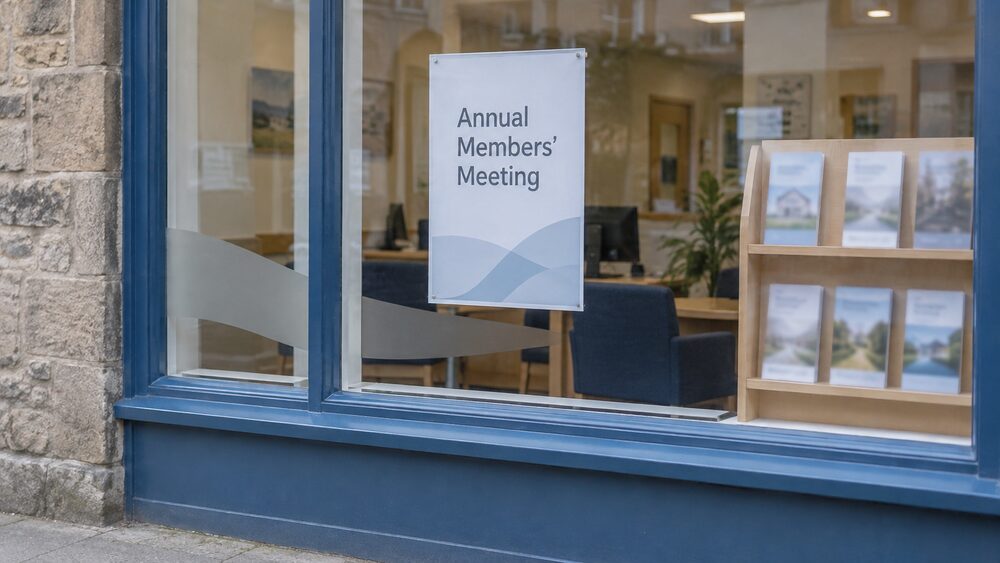
A building society is run for the benefit of its members, instead of shareholders1. When you open a savings account, or take out a mortgage with a building society, you become a member, and that membership carries real rights: to receive information about the society, to attend and vote at its annual general meeting, and to have a say in how it is run1. Unlike a bank customer, a building society member is part owner of the business, and the society operates on the principle of one member, one vote2.
There are 42 building societies in the UK, operating through approximately 1,300 branches, and together with mutual-owned banks they hold residential mortgages of £499.1 billion, 29% of the total outstanding in the UK3. Membership is not automatic for every customer, though. Some account types make you a member, others do not, and joint accounts, small balances and dormant accounts each affect your rights in different ways. This page explains what membership gives you, where it stops, and how it compares with membership of a credit union.
Owned by members, not shareholders
A building society is a mutual. Building societies are referred to as mutuals because they are owned by their members, the people who save with them or borrow from them, and they operate solely for the mutual benefit of those members and their communities5. There are no outside shareholders expecting a dividend. Instead of paying a dividend to shareholders, building societies can focus on growing members' savings and investing in their communities5.
That structure is what gives membership its substance. As the Building Societies Association's members' rights guidance puts it, as a member of a building society you are more than just a customer; unlike a depositor with, or borrower from, a bank, you have rights to receive information and to voice your opinions on the way your building society is run6. The money the society makes is either retained for the business or returned to members through rates and benefits rather than paid out to investors. The BSA reported that in 2024/25 members received an extra £4 billion in additional benefits compared with the rates and benefits offered by banks7.
Membership is a legal share in the society, not just a label. The legislation behind dormant account transfers recognises that a member holds a share in the building society, and after a transfer of balances the member is treated as having whatever share and rights, including distribution rights, they would have had if the transfer had not happened8. In practice this means your membership, and the rights attached to it, survive events such as the movement of your account between systems or schemes.
Who counts as a member and who does not
The general rule is simple: you become a member when you open a savings account, or take out a mortgage with a building society1. Coventry Building Society puts the same rule in concrete terms: when you open your first savings account or mortgage with the society, you automatically become a member9.
The detail sits in the type of account. Societies distinguish between share accounts and deposit accounts. Market Harborough Building Society's savings terms state that holders of share accounts are members of the Society and bound by its Rules10. Holders of deposit accounts are not members, even though they are still bound by the rules10. So two customers of the same society, each holding savings, can stand on completely different footings: one is a member with voting rights, the other is simply a depositor.
Mortgage borrowers are members too. Yorkshire Building Society's mortgage conditions state that borrowers are members of the society with membership rights unless the mortgage offer says otherwise11. There are a couple of further edge cases worth knowing:
- Permanent Interest Bearing Shares (PIBS). Holders of PIBS are members of the issuing building society, just like savers and borrowers, and are consequently entitled to voting rights12.
- Subsidiaries. Customers of a subsidiary of a building society are not members of the society2. If the brand you deal with is a separate company owned by the society, holding an account with it does not make you a member of the society itself.
If you are unsure whether you are a member, the society's terms and conditions or its rules will say which account types carry membership. You can also ask the society directly, and members are entitled to a copy of the rules on request2.
Depositors are not members and have no member rights
Deposit accounts are the clearest case of a customer who is not a member. Market Harborough Building Society's terms spell out the consequences: holders of deposit accounts are not members of the Society, and depositors have no entitlement to attend or vote at meetings of the Society, or receive windfall benefits10. The society's earlier terms state the same position13.
The BSA's guidance for consumers is broader: depositors are not members of the society and have no say in its running14. Because depositors are not entitled to attend the annual general meeting or vote on matters under consideration, they need not even be notified that the meeting is happening14. The members' rights leaflet makes the same point in one line: depositors are not members and have no member rights2.
This matters most when a society is considering something that affects its future, such as a merger or a transfer of business, where members vote and may be entitled to windfall benefits. A depositor has no place in that vote and no claim on those benefits. Depositors are not automatically sent a copy of the summary financial statement either, although copies are generally available from societies on request14.
The distinction is not a reason to avoid deposit accounts, which are simply a different product. But if having a say in the society matters to you, check that the account you are opening is a share account rather than a deposit account before you rely on membership rights.
Joint accounts: the first-named holder has the full rights
Where a savings account is in more than one name, only the first named saver on the account is entitled to membership rights, such as the right to receive notices of, and to attend and vote at, meetings of the Society10. The BSA's guidance states the same rule across the sector: where there are joint holders of a share account, only the first-named account holder is entitled to all of the members' rights, while the second or subsequent named holders are entitled to fewer rights, mainly regarding obtaining information14.
Individual societies apply the rule with small variations. Coventry Building Society allows every named account holder of a joint account to attend the AGM, but only the first named account holder can vote9. Yorkshire Building Society's mortgage conditions take the same approach for borrowers: joint account holders are all members, but only the first person named on the account is eligible to vote at the annual general meeting11.
The position of the second named holder is therefore worth understanding before the account is opened, because the order of names is usually fixed at that point:
- The first named holder receives notices of meetings, can attend, can vote, and can take part in the other rights of membership14.
- The other named holders are entitled mainly to information, and cannot vote in that capacity14.
- Either holder can still operate the account itself: official guidance on joint accounts confirms that each account holder can withdraw money without asking the other person, and that each is liable for the other's debts15.
If both of you want a vote, the practical answer is for each person to hold an account in their own sole name, since membership follows the account. Nothing in the rules prevents two people in the same household from being members of the same society through separate accounts.
Your information rights as a member
Membership carries a specific set of rights to information. Members are entitled to receive a range of documents, including a copy of the society's rules and memorandum on request, a copy of the annual summary financial statement on the society's business, which is sent to members before the AGM and also when an account is first opened, a copy of the detailed annual report and accounts, and notice of the AGM2.
The BSA's factsheet on the difference between a shareholder and a depositor confirms that shareholders, as members, have the right to receive information on the activity of the society, including the summary financial statement, and notification of the annual general meeting and any special general meeting14. Societies set out where these rights live: Coventry Building Society states that membership rights are fully explained in its rules, which it publishes9.
Alongside your member rights, you keep the general data rights everyone has. You have a right, by law, to know what personal information is held about you by organisations, and it is enforced by the Information Commissioner16. So a member can ask a building society both for the society's documents, as a right of membership, and for the personal data the society holds about them, as a legal right that applies whatever kind of customer you are.
Voting and having your say on how the society is run
Building societies operate on the principle of one member, one vote2. Your vote does not depend on how much you have saved or how much you have borrowed: a member with £150 in a savings account has the same vote as a member with a large mortgage. If you are both a saver and a borrower with a society, you will still normally have just one vote, except when asked to vote on a conversion or merger, when two separate votes are given2.
The vote is used for the decisions that shape the society. Shareholders can vote in elections for the board of directors, attend annual general and other meetings and, providing the correct procedures are followed, propose motions or stand for election themselves14. Members will usually have the chance to attend annual general meetings, ask questions and vote on decisions5. Coventry describes the same package of rights: voting on decisions about how the Society is run and asking questions at the Annual General Meeting9.
There are some boundaries on what a member vote can do:
- Any resolution must be submitted to the society before the end of the financial year for discussion at the following AGM2.
- Only the board can put forward a binding resolution to transfer the society's business to a company2. Members cannot force a conversion to a bank by themselves.
- Most societies now also hold an advisory vote on the directors' remuneration report, which gives details of how much directors earn and how their remuneration is determined, at the AGM, although this is not required by law2.
- If you cannot attend, you may appoint a proxy to vote for you, and this person does not have to be a member2.
Where member rights are restricted: balances or mortgages under £100
Not every member has the full set of rights. Saving members with less than £100 in their account, borrowing members with a mortgage of less than £100, and members under the age of 18 have restricted rights, allowing them only to receive information on request2. They cannot vote, nominate directors or speak at AGMs, for example2.
The £100 thresholds are low, and most savers and borrowers will be well above them, but the rule has real effects at the edges. A junior account holder is a member but cannot vote or speak at meetings until they turn 18. A saver whose balance has been almost withdrawn, leaving a small residual amount, moves from full membership to restricted membership without doing anything other than moving money out. The position is not permanent: the restriction follows the current balance, so a member whose savings rise above £100, or who reaches 18, moves back into full rights.
Dormant accounts: membership rights are kept
A dormant account does not end your membership or your claim on your money. Societies define dormancy in their terms: Market Harborough Building Society treats an account as heading towards dormancy where for a period of three years there has been no customer initiated activity on the account10. Some societies may take part in the Alternative Scheme for smaller institutions under the Dormant Bank and Building Society Accounts Act10.
The law behind these schemes is built around protecting the customer. The purpose of the Act is to set up a framework under which money in dormant bank and building society accounts can be distributed for the benefit of the community, whilst ensuring the right of owners to reclaim their money is protected17. Even after money has been transferred out of a dormant account, the customer is entitled to the same right to repayment as they would have against their bank or building society had the transfer not taken place17.
The framework has been updated over time. The Dormant Assets Act 2022 repealed some provisions of the 2008 Act, including the section on customers' rights preserved on insolvency, the disclosure of information section and the review and report to Parliament section18, with the substance of customer protection carried forward. A government review has examined how banks and building societies have transferred dormant account money to the Reclaim Fund Ltd, how much money has been transferred and how promptly19.
If you think you have an old account you have lost track of, the BSA publishes a factsheet on lost savings accounts, and it covers all UK building societies20. The practical steps are to contact the society, prove your identity, and ask for the account to be traced and reactivated. Credit union members have a parallel process, described in dormant accounts and getting them back.
Building societies in the UK: 42 societies and around 1,300 branches
The sector is substantial. The Building Societies Association represents all 42 UK building societies, including both mutual-owned banks3. Building societies and mutual-owned banks have total assets of almost £670 billion, hold residential mortgages of £499.1 billion, 29% of the total outstanding in the UK, and hold £502.2 billion of retail deposits, accounting for 23% of all such deposits in the UK3. They account for 46% of all cash ISA balances3.
On the high street, building societies operate through approximately 1,300 branches, holding a 35% share of branches across the UK3, and they employ around 52,300 full and part-time staff7. The BSA's 2023 factsheet recorded almost 1,300 building society branches across the UK, a figure that has held steady across successive BSA publications21. For savers and borrowers, this branch presence is one of the practical differences between building societies and banks that operate mainly online.
The BSA itself is the trade association representing mutual lenders and deposit takers, including all of the UK's building societies2. It is the body to turn to for sector-wide consumer factsheets, including its guidance on your rights as a building society member6.
Building society and credit union members compared
Building societies and credit unions are both mutuals, and in both cases the customer is a member rather than an outsider, but membership works differently. A building society member becomes one by opening a share savings account or taking a mortgage, and the sector operates on one member, one vote2. Credit union membership instead rests on a common bond: members share something such as where they live, where they work or an organisation they belong to, and joining means becoming a member of that specific community.
The two sectors are connected at the representative level. The BSA represents all 42 building societies, as well as 7 larger credit unions22, and it has welcomed changes to credit union rules on the grounds that they will help more people to access affordable loans and savings23. The BSA's factsheet on building societies and credit unions, published in 2023, covers both sectors together21.
For a consumer weighing the two, the practical differences are these:
| Building society member | Credit union member | |
|---|---|---|
| How you join | Open a savings account or take a mortgage1 | Fall within the credit union's common bond and open an account |
| Your say | One member, one vote at the AGM2 | A say as a member of a mutual run for its members |
| What they offer | Savings, mortgages and, in some societies, current accounts | Savings, loans and, in many unions, current accounts and cards |
| Scale | 42 societies, around 1,300 branches3 | Local or employment-based organisations |
The comparison page on credit union or building society sets out which tends to suit which circumstances, and the guide to what credit unions offer covers their accounts in detail.
FSCS protection: up to £120,000 per person
Membership of a building society does not change your deposit protection, but it is worth knowing what that protection is. FSCS protection for banks, building societies and credit unions is up to £120,000 per person per banking licence4. The Financial Services Compensation Scheme compensates eligible depositors automatically: it states that it will automatically compensate you up to £120,000 per eligible person, per bank, building society or credit union, for failures after 30 November 202524. Which? summarises the same limit as £120,000 per person, per financial institution25.
Two points about how the limit works matter in practice:
- The limit is per person, per authorised firm, not per account. All your accounts with the same society count together4.
- Where several brands share one banking licence, money held across those brands also counts together towards one £120,000 limit4.
If a society fails, FSCS steps in, and its guidance explains what happens when a bank goes out of business25. If you cannot find a society on FSCS's list of protected firms, FSCS provides a tool for checking firms that cannot be found26. Protection of this kind applies to credit union savings as well, which is covered in the guide to credit union savings accounts.
Where to get help
Your first stop for any question about your membership is the society itself. Members are entitled to ask for the society's rules, and societies such as Coventry publish their rules and explain members' rights on their member support pages9. The BSA's factsheet on your rights as a building society member is the sector-wide reference, covering the rights to receive information and to voice your opinions on the way your society is run6.
Beyond the society:
- Lost or dormant accounts: the BSA's lost savings account factsheet covers all UK building societies and explains how to trace an account20.
- Your personal data: your right to know what personal information an organisation holds about you is enforced by the Information Commissioner16.
- Deposit protection and failed firms: FSCS explains what is covered and provides a check for firms you cannot find26.
- Complaints: a society's complaints process is set out in its rules and terms, and unresolved complaints about financial services can be taken to the Financial Ombudsman Service, as described in the guide to consumer protection in UK financial services.
For anything about the mutual alternative, the credit union guide covers joining, saving and borrowing, and the directory lists credit unions you may be able to join.
Sources26 cited
- What is a building society Yorkshire Building Society, 2026
- Your rights as a building society member leaflet Building Societies Association, 2012
- Access to mortgage finance improves, but affordability still holding buyers back Building Societies Association, 2026
- Banking licences and FSCS protection FSCS, 2026
- The benefits of saving with a building society Building Societies Association, 2024
- Your rights as a building society member Building Societies Association, 2014
- Building society sector continues to grow as consumers seek better value Building Societies Association, 2025
- Dormant Bank and Building Society Accounts Act 2008 legislation.gov.uk, 2022
- Member rights Coventry Building Society, 2026
- Savings terms and conditions Market Harborough Building Society, 2025
- Mortgage conditions 2026 Yorkshire Building Society, 2026
- What are PIBS Building Societies Association, 2014
- General savings terms and conditions 2024 Market Harborough Building Society, 2024
- The difference between a shareholder and a depositor Building Societies Association, 2022
- Dementia and managing money nidirect, 2026
- Benefit fraud nidirect, 2026
- Explanatory notes to the Dormant Bank and Building Society Accounts Act 2008 legislation.gov.uk, 2008
- Dormant Assets Act 2022 legislation.gov.uk, 2022
- Review of the Dormant Bank and Building Society Accounts Act 2008 HM Government, 2014
- Lost a savings account Building Societies Association, 2025
- For People Not Shareholders factsheet Building Societies Association, 2023
- The mutual difference Building Societies Association, 2026
- Credit union changes will help more people to access affordable loans and savings Building Societies Association, 2026
- What we cover: banks, building societies and credit unions FSCS, 2025
- What to do if your bank goes out of business Which?, 2025
- Can't find a firm on our list FSCS, 2026






 MoneyHelperFree, impartial money and pensions guidance, set up by government
 FSCSProtects your money if a bank, insurer or investment firm fails
 Financial Ombudsman ServiceFree, independent help when a complaint about a firm is not put right
 StepChangeFree debt advice and solutions from a charity
 Citizens AdviceFree advice on money, consumer and legal problems in England and Wales