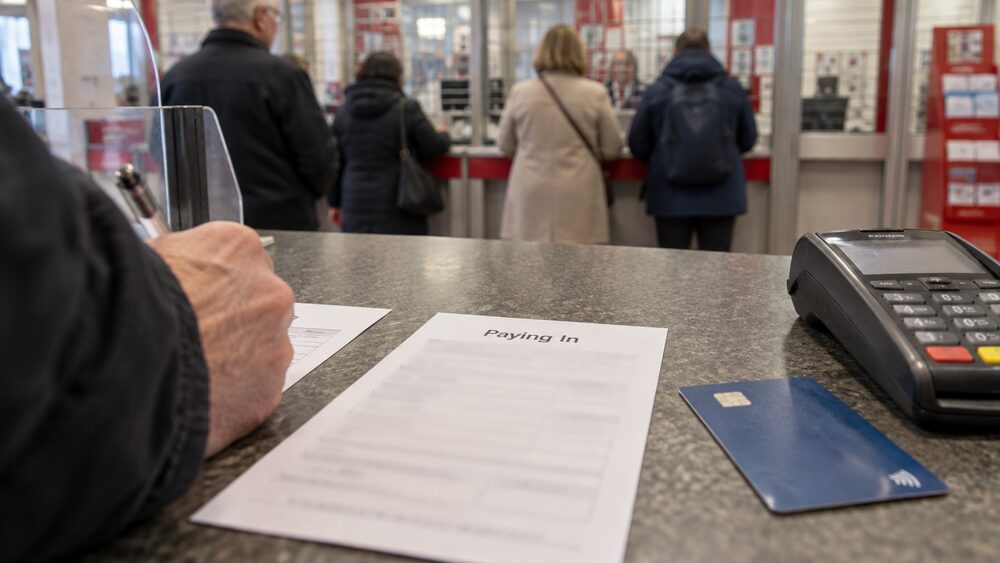
Paying into a credit union is usually a choice between three habits: money taken from your wages before it reaches your bank account, a standing order or Direct Debit from an account you already have, or cash and card payments at the credit union itself. Most credit unions offer several of these at once, and you can mix them.
Paying into a credit union is usually a choice between three habits: money taken from your wages before it reaches your bank account, a standing order or Direct Debit from an account you already have, or cash and card payments at the credit union itself. Most credit unions offer several of these at once, and you can mix them.
The one thing that comes first is membership. Money paid in goes into your own savings account, so you have to be a member before you can pay anything in1. Joining means proving your identity and address, usually with two recent documents such as a passport, driving licence, bank statement or energy bill1. Some credit unions also let you join through your employer, with savings taken from your pay2.
What it costs to pay in is usually nothing beyond the one-off membership fee. One credit union charges a £4 membership fee plus a minimum of £1 to open the account3. The amount you can pay in afterwards is set by your credit union, not by a national rule.
Ways to pay into a credit union account
The methods fall into four groups, and most credit unions offer more than one. Payroll deduction takes money from your wages. Standing orders, Direct Debits and bank transfers move money from another account you hold. Cash, cheque and debit card payments happen at the credit union's office or counter. Benefit payments can be directed straight to the credit union.
Individual credit unions publish their own lists. One accepts standing orders, cash, cheque or debit card in branches, debit card payments by telephone, and payments online through its website or member area7. Another takes cash, cheque, standing order, Direct Debit or a transfer from your bank8. A third lists standing order, card payment by telephone, or paying in at the office9. A fourth adds online debit card payments through its member hub, Direct Debit weekly, fortnightly, four-weekly or monthly, and pension or social security benefits10.
Across the sector, the same picture appears: members can pay in by payroll deduction or through benefit direct accounts, through retail payment networks such as PayPoint and PayZone, by standing order or Direct Debit, or in cash at local offices and collection points11. Which of these your credit union offers depends on its size and where it is.
Payroll deduction: saving straight from your wages
Payroll deduction is the method credit unions promote hardest, because the money never passes through your hands. Your employer takes an agreed amount from your pay on payday and sends it to your credit union account12. One credit union describes its scheme as letting you save regularly, direct from your pay and before it reaches your bank account13. Another puts it plainly: the money is deducted from your wages every pay day and goes straight to your credit union account14.
The practical effect is that saving happens automatically. One credit union describes the arrangement as saving automatically with payroll deduction, with the money growing without you having to act each month15. You can also become a member through your employer, who then deducts your savings or loan repayments from payroll2.
Two things are worth knowing before you sign up. The first is that payroll deduction depends on your employer offering it, so it is not available to everyone. The second is privacy: the deduction appears in payroll records, which is a question worth asking your credit union about if it matters to you. If you would rather keep the arrangement entirely between you and the credit union, a standing order from your bank achieves the same regular saving without your employer being involved.
Payroll deduction is also used to repay loans, not just to build savings, and some credit unions run schemes where a single deduction covers both. If you change jobs, the deduction stops, and you would need to move to a standing order or another method to keep the payments going.
Direct Debit, standing order and benefit payments
A standing order is an instruction you give your own bank to send a fixed amount to the credit union on a set date. A Direct Debit lets the credit union collect an agreed amount, and the amount can be varied. Both move money from an account you already hold, and both can be set up for weekly, fortnightly, four-weekly or monthly payments depending on what the credit union supports10.
Bank transfers work too. One credit union suggests setting the credit union up as a beneficiary in your online banking and sending money that way16. Another accepts BACS transfers alongside Direct Debit, payroll deduction and standing order17.
Benefits can be paid in directly. Benefits are usually paid straight into your bank, building society or credit union account4. Child Benefit can be paid directly to a credit union account, and one credit union's young saver account is built around exactly that18. A family loan product requires Child Benefit to be paid directly into the credit union account as a condition19. If you claim Universal Credit with a partner, it is usually paid as a single monthly payment into one account, so a couple cannot split it between two credit unions20.
Tax-Free Childcare works differently: once you have a childcare account, you pay money in by Direct Debit, standing order or bank transfer21. That is a government account rather than a credit union one, but the payment methods are the same.
Paying in cash at an office or collection point
Cash remains the most direct route, and for members who deal in cash it is often the only one that fits. One credit union accepts cash, cheque or debit card in the office, debit card over the phone, or a standing order from another bank account22. Another takes cash, cheque or debit card in the office, or a regular standing order from elsewhere23. A third accepts cash at the counter or cheque, or an online transfer from your bank or building society16.
Some credit unions go further and use retail payment networks. Members can pay in through PayPoint and PayZone as well as at local offices and collection points11. That matters if your credit union has no branch near you: a local shop counter can stand in for an office.
Opening hours are the practical limit. Counter payments and telephone card payments happen during the credit union's opening hours, which for smaller credit unions can be short. If your credit union offers online card payments through a member area, that route is not tied to the counter being open10.
How your savings are protected: FSCS cover up to £120,000
Savings held with a credit union are protected by the Financial Services Compensation Scheme, in the same way as money in a bank. The scheme protects up to £120,000 in total across all accounts you hold with the credit union5. The same £120,000 limit applies per eligible depositor for all banks, building societies and credit unions authorised by the Prudential Regulation Authority and the Financial Conduct Authority24. MoneyHelper puts it the same way: just like most banks, up to £120,000 per person is protected in a credit union account1.
Some credit unions still publish the older £85,000 figure on their own pages25. Where a credit union's page and the scheme's own guidance disagree, the scheme's current limit is the one that applies, and the £120,000 figure is the one to plan around. If you hold more than the limit across accounts with one credit union, the excess is not covered.
Protection covers savings and loans, and it applies whether you pay in by payroll deduction, standing order, cash or benefit payment. It does not depend on how the money arrived. If a credit union fails, the scheme steps in rather than you losing the balance.
What you need before you can pay in
Membership comes first, and membership means identification. You will usually need to provide two recent documents to prove your identity and address, for example a passport, driving licence, student or work ID card, bus pass, birth certificate, bank statement or energy bill1. To become a member, you need to visit or call your chosen credit union to confirm what information it needs11.
Eligibility rests on the common bond: members share a link such as living, working, studying or volunteering in a certain area, working in the same industry or for certain employers, or belonging to the same trade union1. Credit unions are not-for-profit financial providers owned by their members, and each member holds a £1 share with one vote regardless of how much is saved26. Any surplus is paid back to members as a dividend26.
Family members can often join on the back of one person's membership. As long as one member of a family meets the common bond requirements and has joined the credit union, other family members living at the same address can usually join too6. Each then has their own account and pays in separately.
If you are not sure which credit union covers you, the finders are listed separately for England, Scotland and Wales, and for Northern Ireland1. You can also read more about who can join a credit union and how joining works.
What happens to your money once it is in
Money paid in becomes your savings, held as shares in the credit union. You will normally receive a dividend on your savings, usually paid annually6. A dividend is a share of surplus, not a fixed rate, so the amount can vary and is not guaranteed. Any surplus funds generated are paid back to the members as a dividend26.
Taking money out is the mirror image of paying in. Options include cashing a cheque at a local Post Office, taking cash from the credit union office, having money paid directly into a bank account, or using a debit card at a cash machine if the credit union operates a current account6. Some credit unions apply notice periods to savings withdrawals, so it is worth checking your own terms before you need the money.
One rule catches people out. If you miss payments on a loan, the credit union may be able to use your savings to repay the loan27. The same point appears in debt advice for Scotland and for England and Wales28. In practice this means savings pledged alongside a loan are not freely available while the loan runs. If you are struggling with repayments, the credit union is the first place to raise it, and free debt advice is available from MoneyHelper and from debt advice charities.
Credit unions are not-for-profit community lenders providing affordable loans and savings, and they consider affordability when assessing loan applications30. Most of the loans they provide are specifically exempt from the Financial Conduct Authority's Consumer Credit sourcebook31. If a complaint about a credit union cannot be resolved with the credit union itself, the Financial Ombudsman Service can look at it32.
Sources32 cited
- Credit union current accounts MoneyHelper, 2026-09-25
- Become a member SCVO Credit Union, 2026-09-26
- Savings terms and conditions Just Credit Union, 2025-10-28
- How to have your benefits paid GOV.UK, 2026-09-26
- Deposit protection for credit unions Financial Services Compensation Scheme, 2026-09-25
- Credit unions Building Societies Association, 2026-09-15
- Savings Omagh Credit Union, 2025-11-30
- Savings Pennyburn Credit Union, 2024-11-08
- Services Cranhill Credit Union, 2026-09-26
- Savings Camlin Credit Union, 2025-10-16
- About credit unions Find Your Credit Union, 2026-09-26
- Save SCVO Credit Union, 2026-09-26
- Payroll deduction SaveEasy Credit Union, 2026-09-26
- Payroll for employees Kernow Credit Union, 2026
- Savings Riverside Credit Union, 2026-01-28
- Savings Beragh Credit Union, 2026-09-26
- FAQs SCVO Credit Union, 2026-09-26
- Young saver account The Co-operative Credit Union, 2025-08-04
- Family loan Falkirk Credit Union, 2025-11-13
- Moving from ESA to Universal Credit Shelter England, 2026-05-18
- Tax-Free Childcare GOV.UK, 2026-09-25
- Savings Dundonald Credit Union, 2026-09-26
- Savings Newtownards Credit Union, 2026-09-26
- Can't find your provider Financial Services Compensation Scheme, 2026-09-25
- Savings Drumchapel Credit Union, 2026-09-26
- What is a credit union? Capital Credit Union, 2026
- Debt consolidation (England and Wales) National Debtline, 2026-09-25
- Debt consolidation (Scotland) National Debtline, 2026-09-25
- Debt consolidation (Scotland) Business Debtline, 2026-09-26
- Save, bank or borrow with a credit union Welsh Government, 2026
- Unaffordable lending Financial Ombudsman Service, 2026-09-26
- Credit unions House of Commons Library, 2026-07-08











 MoneyHelperFree, impartial money and pensions guidance, set up by government
 FSCSProtects your money if a bank, insurer or investment firm fails
 Financial Ombudsman ServiceFree, independent help when a complaint about a firm is not put right
 StepChangeFree debt advice and solutions from a charity
 Citizens AdviceFree advice on money, consumer and legal problems in England and Wales