
A current account is the account most people use to manage money day to day: paying bills, receiving money such as a salary or benefits, and keeping track of spending1. Not everyone can open one with a bank, and not everyone wants to. Some credit unions now offer their own current accounts, run by not-for-profit organisations, and these accounts work in much the same way as a bank current account: MoneyHelper notes they usually let you pay in or take out cash at the credit union, have money such as wages, benefits and pensions paid in, bank online, by mobile or by telephone, and get budgeting advice and support2. Where a credit union offers a full current account, it comes with its own account number and sort code3.
That last point is what makes a credit union current account different from the traditional credit union savings account. A savings account with a credit union is about putting money aside and taking it out when you need it, whereas a current account is designed to receive your income and pay your bills from it. A bank or current account usually lets you receive your benefits and wages, spend in shops, withdraw cash at a cash machine, manage the account online or by mobile app, and set up Direct Debits and standing orders4. Some credit union current accounts also offer access to borrow money using an overdraft, normally with daily interest up to 42.6%2.
Not every credit union has a current account. Credit unions have historically focused on savings and affordable loans, with members paying in by payroll deduction, Direct Debit or standing order, in cash at the credit union office or a collection point, or by having State benefits paid in directly5. Most local areas have a credit union, but you need to have a "common bond" to open an account with one, which usually means living or working in its area6. Many credit unions have broadened what they offer, and some now provide prepaid debit cards alongside savings and loans7.
What a credit union current account offers
A current account, wherever it is held, is the account for everyday money: receiving income, paying bills and tracking spending1. Credit union current accounts bring that day-to-day banking inside the credit union, alongside the savings accounts and loans that credit unions have always offered. Credit unions offer a range of savings accounts, including instant access accounts and ISAs10, and a current account can sit beside them, with wages or benefits paid into the current account and regular saving into the savings account.
What is in the account varies by credit union, but the core features are consistent. MoneyHelper describes the free elements as paying in or taking out cash at the credit union, having money paid in such as wages, benefits and pensions, online, mobile or telephone banking, and budgeting advice and support2. Where the account is a full current account, it has an account number and sort code, so it can receive payments directly and support Direct Debits and standing orders3. Some accounts add a contactless Visa debit card with paid accounts, and Google Pay and Apple Pay support3.
The appeal for many members is the combination of everyday banking with the credit union's other services. Members can pay in directly by payroll deduction or through benefit direct accounts, through retail payment networks such as PayPoint and PayZone, by standing order or Direct Debit, or in cash at local offices and collection points7. Where a credit union operates a current account, members can also withdraw using a debit card at a cash machine; otherwise withdrawals are made by cashing a cheque at a local Post Office, taking cash from the local credit union office, or having money paid directly into a bank account5.
If you are moving from a bank account, the Current Account Switch Service simplifies changing accounts, with the Current Account Switch Guarantee providing protection if something goes wrong11. It is a free service that can automatically switch your current account to another bank or building society1. Whether a particular credit union current account takes part in the switching service is something to check with the credit union before you open.
Debit card, contactless and Google Pay or Apple Pay
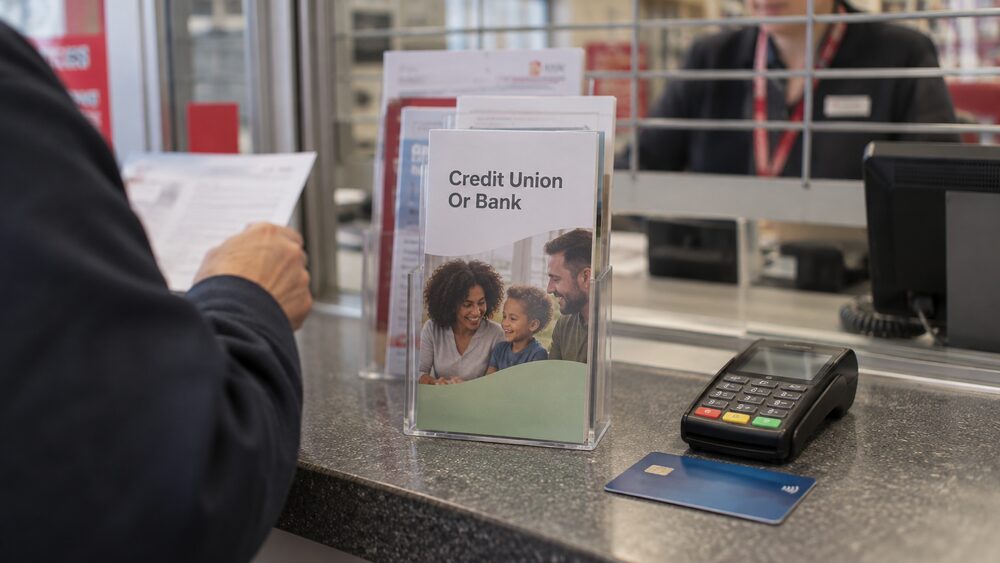
The debit card is the part of a current account most people use most. With a credit union current account, the card is typically a contactless Visa debit card, offered with paid accounts3. Because it is a debit card rather than a credit card, when you buy something you are using money which is already in your account, not borrowing12. The same applies to prepaid cards, where purchases use money loaded onto the card12.
Contactless means you can pay by tapping the card for smaller amounts rather than entering a PIN. Some credit union current accounts also support mobile payments, with Google Pay and Apple Pay now offered3. That lets you add the card to a phone or other device and pay with that instead of the physical card.
Not every credit union account includes a card. Traditional credit union savings accounts do not come with a debit card, and withdrawals are arranged through the credit union itself, by cheque, in cash, or by transfer to a bank account5. If having a card for shops and cash machines matters to you, check that the credit union's account is a full current account with a debit card before joining, rather than a savings account with payment features.
Fees and charges: why some accounts have a monthly fee
Credit union current accounts are run by not-for-profit organisations, but you might pay a monthly fee to get one13. MoneyHelper is more specific about what the fee covers: you will often need to pay a monthly account fee for a debit card for spending or using cash machines, setting up regular payments such as Direct Debits, and overdraft access2. The fee is the credit union's way of covering the cost of running a full banking service, which is more expensive to operate than a savings account.
This is not unique to credit unions. With current accounts generally, you might have to pay a certain amount of money into the account each month, or pay a monthly fee14. Packaged accounts from banks and building societies may charge a fee, or require a minimum monthly payment, to qualify for the benefits15. The difference is that credit unions do not run the account for profit, and the fee is weighed against what the account offers rather than against rewards or perks.
Alongside any monthly fee, joining a credit union normally means becoming a member, which can mean being asked to pay a small fee, for example £2, or to save a certain amount, such as £102. Membership is explained in more detail in how to join a credit union.
Who can open one: usually no credit check and no overdraft
Some credit unions offer current accounts, usually with no credit check or overdraft4. This is the feature that makes the accounts useful to people who struggle to open a standard bank account. You usually will not have to pass a credit check, even if you apply for an overdraft, because credit unions normally use manual checks to decide whether to lend2. Where a credit union states that a declined application carries no risk to your credit history, that is because no credit check footprint is left3.
Who the accounts suit is similar to the market for fee-free basic bank accounts. A basic bank account is designed for people who may not be able to open a standard current account, for example because of a low credit score16. Many of the main banks and building societies offer these, often called fee-free accounts, with no overdraft and no charges for being overdrawn17. Opening a basic bank account should not normally involve a credit check18. Accounts with no overdraft or fees normally have no fees or overdraft19.
The limits are the mirror image of the benefits. If you are bankrupt or have a record of fraud, you will not usually be allowed to open a bank account, and a poor credit rating may lead to refusal for a current account1. A credit union current account without an overdraft cannot be spent into the red, which removes the risk of overdraft charges but also means a payment will fail if the money is not there. Bounced Direct Debits and standing orders can leave you facing heavy bank charges, so make sure there is enough money in your account20.
Eligibility to join a credit union is separate from the account itself. You need a common bond, and some credit unions require you to live in a certain area or work in a certain type of job16. Credit unions also offer accounts to people with a poor credit rating6. The rules on joining are covered in the common bond and finding a credit union you can join.
Prepaid cards as an alternative to a current account
Where a credit union does not offer a current account, or where you cannot open one, a prepaid card account is the other main alternative. MoneyHelper sets the two side by side: a credit union current account is run by not-for-profit organisations but you might pay a monthly fee, while a prepaid card account does not usually require ID but cannot usually be used to set up payments21. That last point is the decisive difference: a prepaid card holds money you have loaded onto it, but it does not normally support Direct Debits or standing orders, so it cannot run a household's bills.
Prepaid cards are used for other purposes too. A prepaid card can be loaded up with foreign currency before you travel, and prepaid cards can often avoid cash machine withdrawal charges and other bank card charges22. There is no need for a credit check to get one23. Some government support is paid this way: Best Start Foods in Scotland is paid using a pre-loaded payment card that works like a regular bank card24. As with debit cards, purchases use money already loaded onto the card rather than credit12.
Some credit unions offer prepaid cards among their additional products, alongside junior savings accounts, Christmas savings accounts, insurance products, cash ISAs and in some cases mortgages7. The terms vary by provider: Darlington Credit Union's prepaid card terms, for example, set out how claims for authorised Direct Debits or payments initiated by a payee without an exact amount specified must be made within 8 weeks from the date the funds were deducted from your available balance25.
If you lose a prepaid card the money is protected, but you may have to pay for a replacement card22. That protection is not the same as the protection on a bank current account, and a prepaid card cannot receive your wages or run your Direct Debits in the way a full current account can. For a comparison of the two routes more broadly, see credit union or bank: which suits your money.
Direct Debits and standing orders on a credit union account
Direct Debits and standing orders are the two ways to make regular payments from an account, and they work differently. You set up a standing order yourself, instructing your bank to pay a fixed amount on a fixed date, whereas a Direct Debit is set up by a company, using your sort code and account number, and the amount can vary26. Setting up Direct Debits or standing orders means regular payments you have to make can be taken out of your account automatically27. Accounts that support them let you set up both28.
A credit union current account with its own sort code and account number3 can do both jobs: a company can collect a Direct Debit from it, and you can instruct standing orders from it. This matters for bill paying because Direct Debits also give you more consumer protection under the Direct Debit Guarantee26, explained in the next section. It also matters for budgeting: one approach to managing an overdraft or a tight budget is to change your Direct Debits and standing orders to go out at the same time, soon after income arrives29.
The risk to watch is failed payments. Bounced Direct Debits and standing orders can leave you facing heavy bank charges, so make sure there is enough money in your account20. On an account with no overdraft, a payment that fails simply does not go out, and the company you were paying may treat the bill as unpaid. Timing payments for just after your wages or benefits arrive reduces the chance of that happening29.
Direct Debit Guarantee: a full and immediate refund for payment errors
Direct Debits are covered by the Direct Debit Guarantee. If the bank, or an organisation you are paying, makes a mistake, your bank must refund the payment to you8. The Guarantee applies to all banks and building societies taking part in the direct debit scheme26, which includes a credit union current account that supports Direct Debits.
The core rule is a full and immediate refund. If a payment error is made by the payee company, or your bank or building society, you are entitled to a full and immediate refund of the amount paid30. Which? puts it the same way: if the originator or the bank or building society makes an error, you are guaranteed a full and immediate refund of the amount paid26. The Guarantee also requires advance notice: if there are any changes to the amount, date or frequency of your Direct Debit, the payee company must notify you in advance30, and the business must always notify you before making any changes to payments8. This is normally 10 working days before the payment is due9, and official guidance on payments abroad describes the same 10 working days' notice before your account is debited31. Research on flexible payments for low-income consumers records the same expectation of at least 10 days' notice for changing a Direct Debit date32.
Cancelling works the same way. A Direct Debit can be cancelled at any time by contacting your bank or building society, written confirmation may be required, and the payee company is normally notified as well30. Once a Direct Debit has been cancelled, the bank must ensure that no further payments are taken, whether or not money is owed to the company26. The Financial Ombudsman Service has dealt with cases where a bank failed to cancel a Direct Debit and reminded the bank of its responsibilities under the Direct Debit Guarantee scheme, which covers exactly that sort of situation33.
The refund process under the Direct Debit Guarantee.
The Guarantee also means your bank should refund disputed payments without question, pending further investigation26. You do not need to pay anyone to claim this for you: the refund is yours to request directly, and anyone charging a fee to do it is charging for something you are already entitled to. If a refund is refused, the Financial Ombudsman Service handles complaints about banking and payments, including regular payments8.
Where the Direct Debit Guarantee does not apply
The Guarantee covers Direct Debits only. The most common trap is the recurring card payment, sometimes called a continuous payment authority, which is what you set up when you give a company your card number for a subscription or a payday loan. Recurring card payments are not covered by the Direct Debit Guarantee35. Payments made by a continuous payment authority are not covered by the Direct Debit Guarantee, but the law offers you similar protections36, and nidirect notes of CPAs that "It doesn't have the same guarantee"37. Because the payment comes from your card rather than your account, cancelling the card with the company does not always stop it, and cancelling with the company does not always stop it either. StepChange's guidance on cancelling recurring payments explains the steps36.
The other limits are about how the payment was made rather than what it was for. With push payment scams, where you transfer money yourself to a fraudster, your money is not protected unless you pay by credit card or Direct Debit38. That is one reason to pay large or unfamiliar bills by a method that carries protection.
There are also rules that apply to banks but not to credit unions. The FCA's rulebook chapter on tools for personal current account customers, BCOBS 8, does not apply to a credit union, nor to a private bank, nor to an account which may be used for a currency other than a currency of the United Kingdom39. The same exclusion appears in the FCA's rules on credit products for current accounts: CONC 5D does not apply to a credit union40. These chapters set out requirements such as alerts and information for personal current account customers and related credit; a credit union current account sits outside them, so those specific protections do not carry over. The Direct Debit Guarantee itself is a scheme rule rather than an FCA chapter, and it applies to any bank or building society taking part in the direct debit scheme26.
Where to get free help
Free, independent help is available at every stage. MoneyHelper, the government-backed money guidance service, publishes guidance on credit union current accounts, on choosing the right bank account, and on basic bank accounts as an alternative2. Citizens Advice covers getting a bank account, including what to do if you are refused one1, and its Scottish site covers the same ground for Scotland34. StepChange, a debt advice charity, explains credit unions and your rights over regular payments6.
For specific situations, further free guidance exists. Surviving Economic Abuse explains how to open a new bank account safely and how banks can help if you are leaving a relationship where money has been controlled16. Independent Age covers making the most of your bank account in later life15, Macmillan covers managing money when you have cancer9, Scope covers managing money for someone else19, and Business Debt Line covers safe bank accounts and household budgeting for the self-employed28. If a complaint about your account or a payment is not resolved by the credit union, the Financial Ombudsman Service can look at it, including complaints about regular payments8.
To find a credit union that offers a current account, start with finding a credit union you can join and the credit union directory, then check with the credit union what its account includes and what it charges.
Sources40 cited
- Getting a bank account Citizens Advice, 2026-09-25
- Credit union current accounts MoneyHelper, 2026-09-25
- Credit union current account product page Credit Union, 2026-08-13
- Choosing a bank account for your Universal Credit payment MoneyHelper, 2026-09-25
- Credit unions consumer factsheet Building Societies Association, 2026-09-15
- Credit unions StepChange, 2026-09-25
- About credit unions Find Your Credit Union, 2026-09-26
- Regular payments complaints Financial Ombudsman Service, 2026-09-26
- Managing money when you have cancer Macmillan Cancer Support, 2022-11-01
- Savings accounts Consumer Council Northern Ireland, 2026
- Bank branch closures Consumer Council Northern Ireland, 2026
- Plastic cards Citizens Advice, 2026-09-25
- How to choose the right bank account MoneyHelper, 2026-09-25
- Overdraft debt StepChange, 2026-09-25
- Making the most of your bank account Independent Age, 2026-09-26
- Opening a new bank account safely Surviving Economic Abuse, 2023-11
- How banks can help Surviving Economic Abuse, 2023-11
- Your non-priority debts Business Debt Line, 2026-09-26
- Managing money for someone else Scope, 2025-11-27
- Make your money easier to manage by yourself MoneyHelper, 2026-09-25
- Basic bank accounts MoneyHelper, 2026-09-25
- Travel money ABTA, 2026
- Spending abroad: the 4 dos and 5 don'ts Which?, 2024-07-26
- Best Start Foods Scottish Government, 2026-09-26
- Darlington Credit Union terms and conditions Darlington Credit Union, 2025-04
- Direct debits and standing orders explained Which?, 2026-03-05
- Your business and household budget Business Debt Line, 2026-09-26
- Safe bank accounts Business Debt Line, 2026-09-26
- How can I stop living in my overdraft StepChange, 2026-09-25
- Safer ways to pay Consumer Council Northern Ireland, 2026
- Guidance on social security abroad NI38 HM Government, 2026-07-07
- Flexible payments for low-income consumers University of Bristol, 2024-10
- Customer complains bank failing to cancel direct debit Financial Ombudsman Service, 2026-09-26
- The Direct Debit Guarantee Together
- Recurring card payments Financial Conduct Authority, 2025-06-23
- Cancelling recurring payments or CPA StepChange, 2026-09-25
- Payday loans nidirect, 2026-02-25
- How to spot, avoid and report scams StepChange, 2026-09-25
- BCOBS 8: tools for personal current account customers FCA Handbook, 2026-09-25
- CONC 5D.1 purpose and application FCA Handbook, 2024-11-04




 MoneyHelperFree, impartial money and pensions guidance, set up by government
 FSCSProtects your money if a bank, insurer or investment firm fails
 Financial Ombudsman ServiceFree, independent help when a complaint about a firm is not put right
 StepChangeFree debt advice and solutions from a charity
 Citizens AdviceFree advice on money, consumer and legal problems in England and Wales