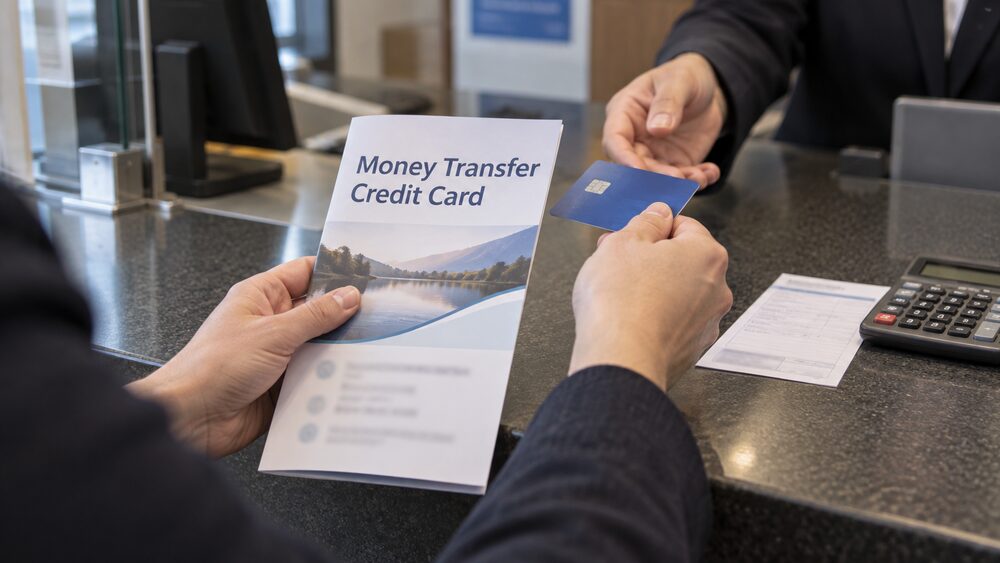
A money transfer credit card does something a normal credit card cannot: it pays money from your credit limit straight into your own current account, where you can spend it as cash. Which? describes it as a card that "allows you to shift money from your card to your current account to spend as cash, usually" for a fee of around 4%1. That makes it a way to borrow a fixed sum at, often, 0% interest for a promotional period, and to use it for things a card cannot normally pay for directly, such as clearing an overdraft or paying a tradesman who only takes bank transfer.
The trade-offs are important. The transfer itself costs a fee, typically a few percent of the amount moved, and the 0% offer lasts only for a set number of months. Once the offer ends, the rate rises sharply on whatever is still owed. And because the money arrives in your bank account rather than being spent on the card, you lose the purchase protection that credit cards are known for: Lloyds states that "any purchases you make with the transferred money aren't covered by Section 75 protection"2.
This page explains how money transfer cards work, what the fees and rules are, how they compare with balance transfers, cash withdrawals and personal loans, and what to watch so the 0% deal is not lost.
A money transfer card pays credit into your own current account
A money transfer is a feature some credit cards offer alongside ordinary spending. Instead of buying something with the card, you ask the card company to move part of your credit limit into your bank account. The amount is added to your card balance, together with the transfer fee, and you repay it through your normal credit card bill. Which? gives the example of an 18-month 0% money transfer card with a limit of £2,000, on which you could request a £1,000 money transfer to your current account1.
The receiving account has to be your own. Lloyds, one of the card providers that offers money transfers, requires that "the account you're transferring to is in your name" and that "it should also be registered at the same address as your credit card"2. That rule exists because a money transfer is a way of turning credit into cash, and providers restrict where the cash can go. You cannot use one to pay money into a friend's account or a joint account in someone else's name.
What the money is then used for is up to you, and that is the point of the product: it suits costs that cannot be put on a card, such as paying off an overdraft, a bill that only accepts bank transfer, or a private purchase from someone who does not take cards. But the flexibility has a cost beyond the fee. Purchases made directly on a credit card come with Section 75 protection, which applies only to credit card purchases and not to debit card purchases5. Once the money has been transferred into a current account and spent from there, that link to the card is broken, and Lloyds confirms purchases made with transferred money are not covered2. If purchase protection matters for a particular payment, paying with the card directly is what triggers it.
Money transfer fees: usually around 4%
The fee is the main upfront cost. Which? puts the typical money transfer fee at "usually around 4%" of the amount transferred1. Providers set their own percentages, and they differ from card to card: Lloyds gives an example using a promotional 0% money transfer rate lasting 12 months with a 3% fee2, while a long 0% money transfer card from MBNA was reported as charging 5% to transfer money6. The pattern across the market is that longer or more generous offers tend to carry higher fees, so the headline 0% is never free.
It helps to compare the fee with what other card features cost, because they are all one-off percentages of the amount moved:
| Type of transfer or withdrawal | Typical fee | Notes |
|---|---|---|
| Money transfer to your own account | usually around 4%1 | Some cards charge 3%2, others up to 5%6 |
| Balance transfer between cards | around 2% to 3%3 | Some providers charge a flat fee instead7 |
| Cash withdrawal from a machine | around 2% of the amount withdrawn3 | Plus interest from day one, at a higher rate3 |
The fee is added to the card balance immediately, so it is borrowed along with the transfer and accrues the same treatment. On a £1,000 transfer at a 4% fee, the fee is £40 and the balance becomes £1,040. Whether that is good value depends on what the alternative would cost: a £40 one-off fee on money that is repaid within a 0% period can be far cheaper than months of overdraft or loan interest, but if the debt is still there when the offer ends, the standard rate takes over and the comparison changes completely. The dedicated guide to money transfer fees breaks down how the fee is charged and worked out.
How the 0% period works and what happens when it ends
Most money transfer cards are sold on a promotional 0% rate that lasts for a set number of months from the date of the transfer. During that window, the promotional offer "freeze[s] the interest for a set period, giving you time to clear the debt without worrying about interest"9. You still have to make at least the minimum payment every month, but nothing is added in interest to the transferred amount, so every pound repaid reduces the debt itself.
Offer lengths vary by product and change over time. For comparison, the longest 0% balance transfer deals on the market were 38 months as of September 20261, and the best interest-free credit cards were offering 0% periods of up to 25 months on purchases as of February 202610. Money transfer offers tend to be shorter than the longest balance transfer offers, and the fee is usually higher, which reflects that the provider is handing over cash rather than taking over existing card debt.
The end of the offer is the moment that matters. Introductory rates work by starting "you off paying a low rate of interest or none at all", after which "the rate then increases after a certain amount of time"11. When the 0% period ends, the remaining balance is charged interest at the card's standard rate, and card interest rates have been rising: Which? reported average credit card interest hitting a record high, with the longest balance transfer deals typically carrying fees of around 3% to 3.5%12. Where a rate increase is imposed on a card, the cardholder has 60 days to reject the increase and pay off the balance at the existing rate13.
The practical implication is simple: the 0% period is the whole deal. Work out before transferring whether the debt can realistically be cleared within it, and if not, what the balance would cost at the standard rate afterwards. Guidance from disability charity Scope suggests considering switching to a new card once any promotional period is over15, and the page on when a 0% offer ends covers what rate you move to and your options at that point.
Money transfer or balance transfer: what each one does
The two are easy to confuse because both move debt onto a card at a promotional rate, but they do different jobs. A balance transfer moves existing credit card debt from one card to another: the card companies involved charge a fee to take over the unpaid debt, which "can be charged as a flat fee or it may depend on the amount that you are transferring"7. A money transfer moves fresh cash into your bank account. A balance transfer cannot pay off an overdraft or a bill; a money transfer can.
The costs differ too. Balance transfer fees are typically around 2% to 3% of the amount moved3, and some providers offer 0% transfer fees as an incentive to apply16, though the longest deals usually carry fees of around 3% to 3.5%12. Money transfer fees are usually around 4%1, and can reach 5% on some cards6. In general, moving cash costs more than moving card debt, because the provider is giving you money it has less visibility over.
Interest rates also work differently depending on what the balance is. StepChange sets out the three rate types on a card: the purchase rate applies when you use the card to buy things, the balance transfer rate when you move what you owe from one card to another, and the cash transaction rate when you take money out of a cash machine or get cashback at a till17. A money transfer sits under its own promotional terms, and once those end, the rate that applies afterwards is set out in the card's terms.
Choosing between them comes down to what the debt is. If the debt is already on a credit card, a balance transfer is the matching tool and usually the cheaper one. If the money is needed somewhere a card cannot reach, such as an overdraft on a current account, a money transfer is the only one of the two that works. The comparison page on balance transfer vs money transfer sets the two side by side, and balance transfer credit cards are covered in their own guide.
Money transfer, cash withdrawal or personal loan
A money transfer is not the only way to get cash from a credit line, and it is usually the cheapest of the card-based options, but a personal loan can beat both for large, planned borrowing.
Withdrawing cash on a credit card is the expensive alternative. Cash withdrawals "attract a withdrawal fee, as well as a higher APR, and don't enjoy the interest-free period available" on purchases1. Citizens Advice warns that "when you take cash out on your credit card, interest is added to your account straight away, even if you pay off the balance by the due date"3, and StepChange is blunter still: "cash transactions will always charge interest"8. The interest is "usually charged immediately, even if you repay your balance in full"18, and the cash advance rate is usually higher than the purchase rate3. A money transfer at 0%, by contrast, carries only the one-off fee if you keep to the terms.
A personal loan suits different circumstances. Loans are typically for larger amounts repaid over fixed monthly instalments, and the interest rate is fixed at the outset. For scale, Which? worked out that borrowing £5,000 on a credit card at the lowest card rate would cost £709 in interest over three years10, and a loan quote can be compared directly against that kind of figure. A money transfer card gives flexibility, a defined 0% window and no obligation to borrow the whole amount at once, but it demands discipline: there is no fixed instalment beyond the minimum, and the rate after the offer is a card rate, not a loan rate.
| Option | Upfront cost | Interest | Best suited to |
|---|---|---|---|
| Money transfer card | Fee usually around 4%1 | 0% during the offer, then the card's standard rate | Cash needed somewhere a card cannot pay, repayable within the offer |
| Cash withdrawal | Fee around 2% of the amount3 | From day one, at a higher rate3 | Genuine emergencies only |
| Personal loan | Arrangement depends on the lender | Fixed rate, fixed monthly payments | Larger planned borrowing over several years |
The guides on credit card or personal loan and withdrawing cash on a credit card cover each comparison in more detail.
Who can get one: credit checks and eligibility
Money transfer cards are credit cards, and the entry requirements are the same as for any credit card. You must be 18 or older7, and the provider will run a credit check before deciding whether to lend. That check tells the provider "whether you are a good payer and about any court orders you have had in the last six years"11. Cards are issued by banks, finance companies and larger supermarket and store chains19, so the market is wider than the big four banks.
Applications themselves leave a trace. Citizens Advice notes that "applying for too many cards or regularly switching cards can affect your credit rating"11, so it is worth spacing applications rather than making several in quick succession. Providers also have to be transparent about price: all credit card companies have to quote an APR7, and the interest rate should be clearly displayed on any application form and promotional material7. Some cards charge an annual fee, which is added to the amount due11, so it is worth checking the credit agreement for that as well as the transfer fee.
Eligibility for the promotional offer is separate from eligibility for the card. The 0% money transfer rate is typically available only on transfers made within a set window of opening the account, and only up to a share of your credit limit. The credit limit itself depends on the provider's assessment of your circumstances, and going over it can trigger a fee19. The guides on applying for a credit card and credit card limits cover both stages in detail.
How to make a money transfer
The process is done through the card provider, not through your bank's payment system. Lloyds describes its own route: once signed in to the app or online banking, you select your credit card in the summary space, then choose "Balance and money transfers" from the account menu; customers who do not bank online can call instead2. Other providers use similar menu options in their own apps.
- Check the offer terms first: the promotional rate, the fee percentage, and the deadline for making transfers at that rate2.
- Confirm the receiving account is your own, in your name, and registered at the same address as the card where the provider requires it2.
- Request the transfer in the provider's app or online banking, or by phone, for an amount between the minimum and the maximum allowed2.
- Wait for the provider to approve the transfer. Lloyds states that "once we approve your money transfer, it should arrive on the next working day"2.
- Check the money has arrived and that the balance and fee appear correctly on your card account.
Timing is worth knowing. Ordinary bank transfers sent using Faster Payments through online banking or a smartphone app reach the recipient's account within 2 hours, and sometimes immediately20, but a money transfer is a lending decision as well as a payment, so the card company's approval step comes first. Lloyds' next-working-day timescale is a typical example2.
Two small points of hygiene: sign your card as soon as it arrives, as anti-fraud guidance recommends21, and never respond to unsolicited calls or messages asking you to move money, whoever they claim to be. The fraud and unauthorised payments guide covers the warning signs.
What can cost you the 0% deal
The promotional rate is conditional, and the conditions are about how you run the account. The most common way to lose a 0% offer is missing a payment or going over the credit limit. Charges of more than £12 for missing a credit card repayment may be seen as unfair3, but the charge itself is the smaller problem: the provider can also withdraw the promotional rate, moving the whole balance to the standard rate at once. The page on missing a payment on a 0% deal covers this in detail.
Other charges can creep in alongside the transfer. You will usually be charged for going over your credit limit, for using the card abroad and for late payments11, and some providers charge an annual fee11. Interest can also arise in places people do not expect: if you do not pay off the full amount every month on a credit card, you are charged interest on the whole lot, not just the unpaid amount7. On a card holding a 0% money transfer, new spending is charged at the purchase rate unless it also has a 0% purchase offer, and the repayment order matters: "the most expensive debt on your credit card will always be paid off first"13, so payments go to the cheapest debt, not the dearest, unless the provider's terms say otherwise.
The way to protect the offer is a standing order or direct debit for at least the minimum payment, set up as soon as the card is opened, with a plan to clear the balance before the promotional period ends. The guides on paying your credit card bill and minimum payments explain the mechanics.
Where the limits and rules apply
Money transfers are capped in two directions. At the bottom, Lloyds sets the minimum amount you can usually transfer at £1002. At the top, "you can only transfer up to 93% of your credit limit, including your existing balance"2, which leaves room for the fee and stops the transfer itself from pushing the account over its limit. Other providers set their own percentages, so the usable amount depends on the individual card's terms.
The receiving-account rules are strict. The account must be in your own name, and with Lloyds it must also be registered at the same address as your credit card2. There is no route to someone else's account: sending money abroad is a separate product, defined as a transfer that "allows people to send funds from a UK account to another account in different country"22, and it is not what a money transfer card does. If you use the card itself abroad, most credit cards add a foreign transaction fee of around 3% on non-sterling purchases and cash withdrawals1, typically up to 2.99% each time you use the card23.
On protections, the position is the reverse of a normal card purchase. Section 75 is "the protection offered when you buy things with a credit card"5 and applies only to credit card purchases, not debit card purchases5. Money transferred to your account and then spent does not qualify: Lloyds states that "any purchases you make with the transferred money aren't covered by Section 75 protection"2. The card itself still carries the usual protections when used directly, and the Section 75 guide explains what is covered and what is not.
Finally, the ordinary rules of credit cards continue to apply to the account: you cannot be charged extra simply for using a credit or debit card, though exceptions remain where a bank is outside the European Economic Area or for business cards13, and the card cannot be in joint names, with only one person liable for the debt3. The credit card fees and charges guide collects the full list.
If you are struggling with credit card debt
A money transfer card is a borrowing product, and if the debt becomes unmanageable, the earlier it is addressed the more options remain. StepChange's first piece of advice is to "stop using the credit card you want to pay off", because it means "the amount you owe stops growing, making it quicker to repay"4. The same applies to a card holding a money transfer: new spending at the standard rate makes the balance harder to clear before the offer ends.
There are also rules that work in the borrower's favour. Credit card companies must help you if you have been in credit card debt for more than 18 months24, a duty that sits alongside the persistent-debt rules that require providers to intervene when customers are not reducing their balances. If payments are missed, the consequences escalate: unpaid card debt can affect your credit rating and "can be passed on to a debt collection agency"25. Complaints about credit cards are common, with the Financial Ombudsman recording 6,600 new credit card complaints in a single quarter, of which 25% were upheld26, so escalating a dispute to the ombudsman is a realistic route if a provider has not followed the rules.
Free, impartial help is available and costs nothing:
- StepChange offers free debt advice, including on credit card debt and consolidation options16.
- Citizens Advice can check whether a financial service has followed the rules and advise on debt24.
- Shelter Cymru and similar bodies in Scotland and Northern Ireland advise where debt threatens the home25.
The debt section of this site sets out the full range of options, from informal repayment plans to formal debt solutions, and the nation-specific pages cover credit card debt in Scotland and Northern Ireland, where some debt remedies differ.
Sources26 cited
- Should I get a credit card? Which?, 2026-09-18
- What is a money transfer? Lloyds Bank, 2026-09-27
- The costs and charges of credit cards Citizens Advice, 2026-09-25
- Paying off credit card debt StepChange, 2026-09-25
- Consumer Credit Act Which?, 2025-06-18
- Nine ways to tackle your debts in 2022 Which?, 2022-01-09
- Credit cards and debt nidirect, 2025-11-06
- Understanding interest charges StepChange, 2026-09-25
- Credit card repayment calculator Which?, 2026-05-11
- How to pay for home improvements in 2026 Which?, 2026-02-14
- Choosing and applying for a credit card Citizens Advice, 2026-09-25
- Average credit card interest hits record high Which?, 2026-05-16
- The costs and charges of credit cards (Scotland) Citizens Advice Scotland, 2026-09-25
- Money transfer credit cards Experian, 2026
- Budgeting: stay out of debt Scope, 2025-10-13
- Free debt consolidation StepChange, 2026-09-25
- Credit card debt StepChange, 2026-09-25
- Credit card interest explained Which?, 2026-09-18
- Types of borrowing: plastic cards Citizens Advice, 2026-09-25
- Online money transfers Age UK, 2026-03-23
- Protect yourself from card fraud Take Five to Stop Fraud, 2026-09-26
- Sending money abroad Financial Ombudsman Service, 2026-09-26
- Spending abroad: the 4 dos and 5 don'ts Which?, 2024-07-26
- Check if a financial service has followed the rules Citizens Advice, 2026-09-25
- Credit card debt Shelter Cymru, 2026-08-30
- Quarterly complaints data Q1 2025/26 Financial Ombudsman Service, 2025-08-07




 MoneyHelperFree, impartial money and pensions guidance, set up by government
 StepChangeFree debt advice and solutions from a charity
 National DebtlineFree debt advice by phone, webchat and online
 Financial Ombudsman ServiceFree, independent help when a complaint about a firm is not put right
 Citizens AdviceFree advice on money, consumer and legal problems in England and Wales