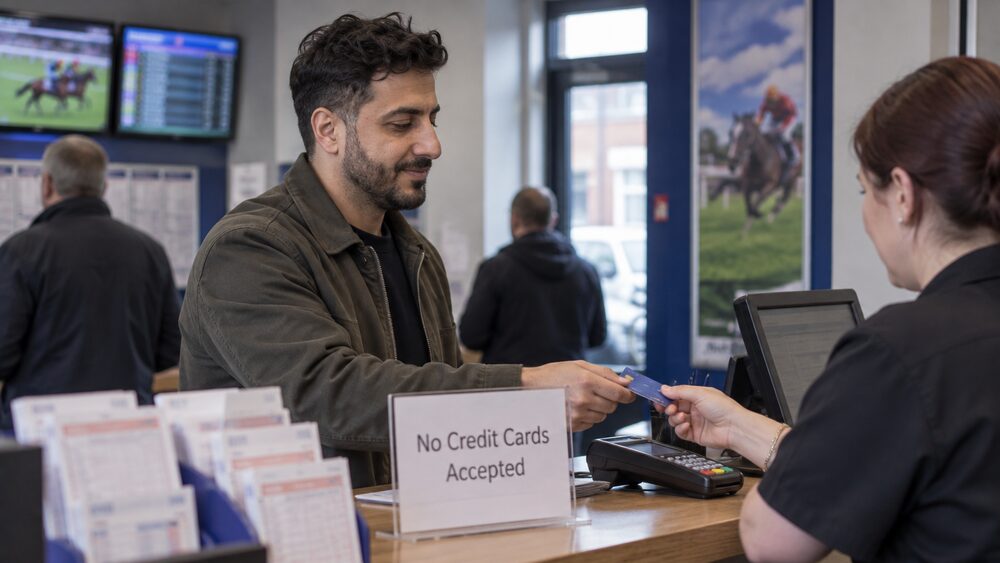
No, you cannot gamble with a credit card at any gambling business licensed in Great Britain. The Gambling Commission has banned gambling businesses from allowing consumers in Great Britain to use credit cards to gamble1. The ban covers betting, gaming and lottery play, and it applies whether you are gambling online, in a betting shop or anywhere else a licensed operator takes payment. It was brought in because gambling with borrowed money creates a specific risk: the debt can grow quickly, with interest, at exactly the time a person can least afford it.
The ban does not mean gambling itself is off limits. Debit cards can still be used, and the ban does not reach every operator or every way of getting credit. It also does nothing, on its own, about debts already run up. This page explains what the ban covers, where it stops, what happens to operators that break the rules, and where free help is available, both for gambling itself and for the money problems that often come with it.
What the credit card gambling ban does
The ban stops gambling businesses licensed by the Gambling Commission from accepting credit card payments from consumers in Great Britain1. In practice this means that when you try to pay a licensed operator with a credit card, the payment should be refused. The rule sits alongside a wider legal treatment of gambling in consumer law: contracts for gambling within the meaning of the Gambling Act 2005, which includes gaming, betting and participating in a lottery, are treated differently from ordinary purchases2. The Consumer Contracts Regulations, for example, exclude contracts for gambling, betting, gaming or lawfully participating in a lottery in Northern Ireland, or participating in a lottery forming part of the National Lottery3.
The reason for treating credit cards differently from debit cards is the borrowing. A debit card payment comes from money you already have; a credit card payment creates a debt. The Financial Ombudsman Service, which handles complaints involving gambling-related harm, sees cases about every financial product, including loans, mortgage extensions, pensions used for gambling, high-risk investments and general banking4. Credit card debt is one of the most common forms of borrowing, and official statistics show that households with credit card debt span the whole income range, not just the lowest9.
The ban also closed off a route that made gambling debt worse. Before it, some card terms treated gambling transactions as cash withdrawals, which the Financial Conduct Authority found were not always adequately highlighted in pre-contractual information, meaning customers could face unexpected costs on top of the stake10. If you want to understand how borrowing on a card works in general, see how credit cards work and how credit card interest is charged.
Where the ban applies: licensed operators in Great Britain
The ban applies to gambling businesses licensed by the Gambling Commission, for consumers in Great Britain1. That covers the licensed online sector and the licensed land-based sector: betting shops, casinos and other premises run by Commission-licensed operators all come within it, because the rule is about what the business may accept, not about where you are standing when you pay. The Gambling Commission is named in legislation as the competent authority in relation to the area for which it has regulatory responsibility11.
The geographical limit matters. The ban protects consumers in Great Britain, that is England, Scotland and Wales. Northern Ireland has its own gambling legislation, and the consumer rules there also treat gambling distinctly: the Consumer Contracts Regulations carve out gambling, betting, gaming and lawfully participating in a lottery in Northern Ireland, as well as participating in the National Lottery3. Credit cards themselves are regulated across the UK under the Consumer Credit Act 1974, the Payment Services Regulations and the FCA's Consumer Credit Sourcebook12, so the card side of the picture is the same everywhere; it is the gambling operator's obligations that depend on where they are licensed and where their customer is.
The ban works at two levels. The gambling operator must not accept the credit card, and card providers may also block credit card transactions they know or suspect are for gambling. If you are concerned about card use generally, you can ask for your credit limit to be reduced, and some banks let you set a maximum cash machine withdrawal limit in their app, which can prevent criminals taking large sums if your card is stolen13.
What happens to operators that break the rules
When gambling operators are found to have broken the rules set by their regulator, the Gambling Commission, they are made to pay a financial penalty14. That is the Commission's main sanction against licensed businesses that fail to comply with their licence conditions, including the credit card ban.
For a consumer, the more practical question is what happens when money has already moved. Here the ordinary card protections apply, with their limits:
| Protection | What it does | Where it stops |
|---|---|---|
| Section 75 | Makes your card provider jointly liable with the retailer for breach of contract or misrepresentation15 | Credit card purchases over £100 and not more than £30,00016; not charge cards or debit cards15 |
| Unauthorised transactions | Liability capped before the issuer is notified where the card is lost or stolen12 | The Payment Services Regulations allow banks to hold you responsible for the first £35 of any unauthorised card fraud17 |
| Recurring card payments | If you did not consent, your card issuer should stop the payments and give you your money back18 | Depends on the payments not being consented to |
Section 75 makes the card provider as responsible as the trader for a breach of contract or a misrepresentation15, and it applies to credit card payments over £100 and not more than £30,00016. But gambling purchases are not ordinary purchases, and gambling contracts are excluded from parts of consumer law2, so a claim about a bet that simply lost will not get far. Where a payment was taken without your consent, the position is different: your card issuer should stop the payments and give you your money back18. If your card provider will not give you your money back, you can report them to Trading Standards19. Complaints about financial firms that cannot be resolved with the firm can go to the Financial Ombudsman Service, whose consumer helpline is 0300 123 9 12320.
Where the ban stops: what the Gambling Commission does not oversee
The ban is wide, but it is not total, and it is worth being clear about its edges. The Gambling Commission itself has said that overseeing financial risks, which are akin to those which exist within financial markets, is not within its mandate or field of expertise21. Its job is regulating gambling businesses, not regulating credit or the wider financial system, which is the Financial Conduct Authority's territory.
The practical gaps for a consumer are these:
- Unlicensed operators. The Commission can only act against businesses it licenses. An operator outside its licensing system is not bound by the ban in the same way, and dealing with one removes most protections.
- Debit cards and other payment routes. The ban is about credit cards. Debit cards can still be used, and they carry weaker protection: there is no legal safety net when you use a debit card, only voluntary schemes such as chargeback22.
- Other forms of credit. The ban stops credit card payments to licensed operators, but it does not stop a person borrowing elsewhere and then gambling with the cash. Virtual cards, for instance, cannot be used for gambling purchases, cash withdrawals, cryptocurrency exchanges or money transfers23, but that is a product restriction, not a gambling rule.
- Financial products outside the card rules. The Ombudsman's own coverage has edges too: it has historically not covered American Express cards, because the company that issues them is not a bank and was not regulated by the FSA, nor point-of-sale credit such as store cards provided by a retailer24.
None of this makes the ban meaningless, but it means the ban is one layer, not a complete wall. The other layers are the ones you build yourself, covered in the tools section below, and the support available when gambling has already caused harm.
Gambling and debt: a common link
Gambling and problem debt travel together, and the link is well documented. Research into gambling and problem debt found that clients interviewed had generally reduced or stopped gambling before or around the time of seeking debt advice, and that addressing harmful gambling seems often to be a prerequisite for successful and sustainable debt resolution5. In other words, sorting out the debt and sorting out the gambling usually have to happen together, with the gambling addressed first.
The same research found that debts linked to gambling are often more complicated than ordinary credit card debt. The factors that make them harder include the length of time over which debts built up, the sheer number of different types of debts, the high value of the debt, secrecy, co-occurring issues such as substance misuse and mental health problems, borrowing from family members, and gambling-related crime5. People close to the gambler face their own barriers: being unable to talk to creditors about debts in a partner's name, being the victim of gambling-related fraud by a partner or ex-partner, and being wholly or partly unaware of the gambling problem and the gambling debt5.
If gambling has left you with credit card debt, the practical starting points are straightforward:
- Stop using the credit card you want to pay off, so the amount you owe stops growing25.
- Stop using credit cards or adding to credit card debt more generally, especially if your income has fallen26.
- Be aware that missing payments or making reduced payments will affect your credit rating, making it harder to get credit again in the future27.
- Remember that you cannot go to prison for simply not paying a credit card debt6.
Card lenders also have the ability to suspend your card to stop you from borrowing28, and if you are struggling, free debt advice is available: see help with credit card debt and the wider guide to debt. Gambling can also appear in insolvency rules: a debt relief restrictions order can be made on grounds including carrying on gambling, rash and hazardous speculation or unreasonable extravagance that contributed materially to the debtor's inability to meet debts29. If money problems are affecting your mental health, or mental health is affecting your money, tips on managing money with mental health problems are available from independent sources30.
GamCare: free support 24 hours a day, 7 days a week
Support for gambling itself is free and available at any hour. GamCare runs the National Gambling Helpline, which offers gambling harm support4, and people affected by gambling can get information, advice and support, including help finding face-to-face counselling in their area, with free tools available in minutes31. Advisers are available 24 hours a day31. GamCare can also be reached by online chat at gamcare.org.uk and by WhatsApp on 020 3031 888131.
Help is not limited to the person gambling. Citizens Advice offers a free service, including for help with gambling problems4. Gam-Anon runs regular peer support groups for the friends and family of gamblers, and Gordon Moody provides support for friends or family of people with gambling problems31. The NHS provides gambling treatment services via the National Centre for Behavioural Addictions33. If debts have been run up with an illegal lender, help is available 24 hours a day from illegal money lending teams34. And if gambling has overlapped with scams, MoneyHelper runs a Financial Crimes and Scams Unit on 0800 015 440235.
Tools to limit gambling yourself
The ban removes one route to gambling with borrowed money, but you can add further limits yourself, on the gambling side and on the card side.
On the card side:
- Ask for a lower credit limit. You can ask for your credit limit to be reduced so you are not tempted to spend more than you can budget for36. See refusing a limit increase or asking for a lower limit for how this works.
- Keep to one card. If you have several credit cards, it can be difficult to manage your spending, so limiting yourself to one credit card might help30.
- Consider a card with a low limit. Credit-builder credit cards, aimed at people building or repairing a credit history, come with lower spending limits37, which caps how much can be borrowed on that card. See credit-builder credit cards.
- Set withdrawal limits. Some banks allow you to set a maximum cash machine withdrawal limit through your banking app, which can prevent criminals taking large sums if your card is stolen13.
- Know the lender's powers. Card lenders have the ability to suspend your card to stop you from borrowing28.
On the gambling side, the National Gambling Helpline can talk you through the tools operators offer, and GamCare provides free tools and support in a matter of minutes31. Blocking gambling transactions on a card is separate from self-exclusion from gambling businesses, and both can be worth doing: a card block stops the payment route, while self-exclusion stops the account.
If debt has already built up, free advice is available whatever the cause. Debt advice about the liquidation of a debt due under a credit agreement is itself a regulated activity under FCA rules38, so it matters to get it from a regulated or free independent source rather than a fee-charging one. Start with help with credit card debt, the guide to debt, or the National Gambling Helpline on 0808 8020 133, 24 hours a day.
Sources38 cited
- Consumer asked for help after running up credit card debt through gambling during a period of ill health Financial Ombudsman Service, 2026-09-26
- Consumer Rights (Payment Surcharges) Regulations 2012, Regulation 5 legislation.gov.uk, 2012
- Consumer Contracts (Information, Cancellation and Additional Charges) Regulations 2013 legislation.gov.uk, 2013-12-11
- Complaints that involve gambling-related harm Financial Ombudsman Service, 2026-09-26
- Gambling and problem debt research report StepChange, 2026-09-25
- Credit card debt StepChange, 2026-09-25
- Credit card gambling restrictions first direct, 2026
- Credit card gambling restrictions Nationwide, 2026
- Households with credit card debt by household annual net equivalised income deciles ONS, 2017-04-03
- Credit Card Market Study Annex 8 FCA, 2015-11
- Payment Systems Regulators (Consequential Amendments) Regulations 2015 legislation.gov.uk, 2015-03-16
- Credit Card Market Study Annex 2 FCA, 2015-11
- Cash machine fraud: how to protect yourself Take Five to Stop Fraud, 2026-09-26
- Gambling harms Money and Mental Health, 2025-03-06
- Consumer advice: other problems Anglesey County Council, 2025-10
- Credit card market study interim report FCA, 2014-11
- Contactless £100 cap ending: how to protect yourself from fraud Which?, 2026-03-13
- Recurring card payments FCA, 2025-06-23
- Your payment card was used without your permission Citizens Advice Scotland, 2026-09-28
- Financial Ombudsman Service annual review Financial Ombudsman Service, 2014-05
- Treasury Committee report on the gambling industry Treasury Committee, 2023-07-20
- Fraud victims who pay the wrong way could be left with nothing Which?, 2024-10-16
- What are virtual debit cards and should you use one? Which?, 2026-05-27
- Financial Ombudsman Service jurisdiction guidance Financial Ombudsman Service, 2004-04
- Paying off credit card debt StepChange, 2026-09-25
- Unemployment and reduced hours StepChange, 2026-09-25
- Negotiating reduced payments to your debts Mental Health and Money Advice, 2021-07-21
- Credit card interest rates on the rise: 5 ways to cut the cost of your debt Which?, 2023-11-07
- Debt Relief (Northern Ireland) Order 2010 legislation.gov.uk, 2010-12-15
- Tips for managing money with mental health problems Mental Health and Money Advice, 2018-10-19
- Gambling debt StepChange, 2026-09-25
- Managing your gambling Ulster Bank, 2026-09-25
- Get help Money and Mental Health, 2026-07-13
- Owing money to loan sharks StepChange, 2026-09-25
- Types of scam MoneyHelper, 2026-09-25
- Credit card debt Shelter Cymru, 2026-08-30
- Credit cards and a bad credit score StepChange, 2026-09-25
- PERG 17: Debt counselling FCA, 2014-04-01


 MoneyHelperFree, impartial money and pensions guidance, set up by government
 StepChangeFree debt advice and solutions from a charity
 National DebtlineFree debt advice by phone, webchat and online
 Financial Ombudsman ServiceFree, independent help when a complaint about a firm is not put right
 Citizens AdviceFree advice on money, consumer and legal problems in England and Wales