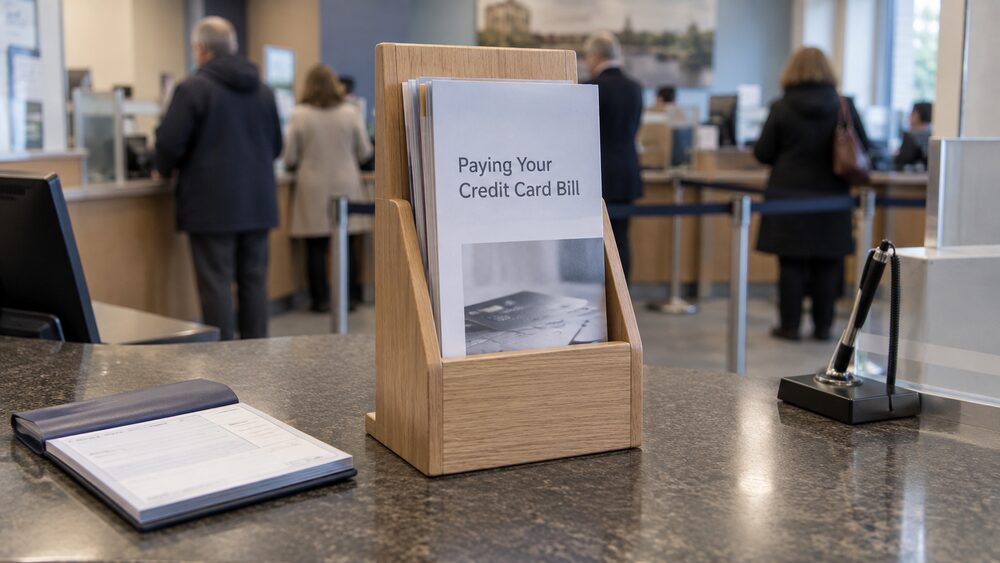
A credit card bill can be paid in more ways than almost any other bill you will receive. Depending on your provider, you can pay by Direct Debit, bank transfer from a current account, debit card, in an app, online, by phone, by cheque in the post, with cash at a branch, or even from an overseas bank account using international payment details1. The one rule that never changes: pay at least the minimum amount shown on your statement by the payment due date, or you will be charged a late payment fee1.
The cheapest habit is to clear the whole balance every month. If you pay off the total amount by the due date, you will not be charged interest on your purchases2. If you do not, interest is charged on the whole lot, not just the unpaid amount3, and it keeps running until the balance is cleared.
Ways to pay a credit card bill
Most card providers offer a wide menu of payment routes. Lloyds Bank, for example, accepts payments by online banking, mobile app, Direct Debit, debit card, a payment from another bank, cheque by post, cash at a branch, phone, and BIC or SWIFT payments from overseas banks1. Other providers offer a similar spread, though the exact list varies, so check your provider's app or website for what is available to you.
A Direct Debit is the route most people settle on, because it removes the need to remember the due date. Lloyds Bank lets a Direct Debit be set for one of three monthly amounts: just the minimum payment due (plus any instalment plan payment), the full statement balance, or an amount you set yourself1. Setting the Direct Debit to the full balance means the whole bill is cleared automatically each month, which is the pattern debt charities recommend for cards being used to build a credit rating: set the balance to be paid in full each month, and pay on time to keep any promotional offer9.
Paying by debit card, app or online banking is usually the fastest option when you want to make a one-off payment or clear extra off the balance. Cash at a branch and cheque by post still work where the provider accepts them, but they are the slowest routes and leave the least evidence of when you paid.
The minimum payment: typically around 3% or £5
If you do not pay off the balance each month, you will be asked to repay a minimum amount. This is typically around 3% of the balance due or £5, whichever is higher4. The exact percentage is set by your card provider and shown on your statement.
The size of the minimum matters because of what it covers. Minimum payments usually only cover the interest and charges on a debt10, so the balance itself falls only slowly. On a card where the minimum is 3%, someone owing £1,000 would be asked to pay back at least £30 a month11. In a worked example used by National Debtline, a credit card balance of £3,200 at 28% interest carried a minimum payment of £9912.
Paying the minimum keeps the account in good order, but it is the most expensive way to borrow over the long run. Citizens Advice suggests always trying to pay at least 10% of your balance every month on your credit cards13, and the dedicated pages on credit card minimum payments and how long paying only the minimum takes show the difference this makes.
Clearing times and paying from another bank
How long a payment takes to reach your card depends on how you send it. App, online and debit card payments are usually credited quickly, often the same day. Bank transfers sent by Bacs, and cheques sent in the post, are slower: paying by Bacs or by cheque in the post can take around three days14. That gap matters most near a due date, because a payment that has not cleared by the due date can still count as late.
Paying from another bank's account is straightforward. You use your card provider as the payee, with the account details shown on your statement or in its app, and the payment arrives as a normal bank transfer. If you bank with the same group as your card, the payment may show immediately in the app.
If you are abroad, or paying from an overseas account, providers that accept international payments publish a BIC or SWIFT reference for the card account1. Allow extra time for these to arrive. Separately, remember that using the card itself abroad is different from paying the bill: most credit card companies charge a commission when you use the card abroad, and withdrawing cash abroad can add a foreign transaction fee on top of the usual cash advance fee5. The page on using a credit card abroad covers those charges.
If money has been paid into your account and you need your bank to send specific payments out of it, there are template letters you can use to ask your bank to pay particular bills from money you have paid in15.
Your payment goes to the highest-interest balance first
When you make a payment towards your credit card bill, your provider allocates it to the most expensive debt first6. The most expensive debt on your credit card will always be paid off first5. This rule, sometimes called positive order of payment, works in your favour: it means any payment above the minimum chips away at the part of the balance costing you most.
Providers apply the rule in their own order of steps. Lloyds Bank applies payments first to overdue amounts from previous statements, then to that month's minimum payment, then to instalment plan payments (highest interest rate plan first, oldest first where rates are equal or 0%), then to the rest of the main balance from the latest statement, then to the rest of the instalment plan balance, and finally to amounts not yet included on a statement1.
The same logic can be applied by hand across several debts. The "avalanche" method of clearing debt works the same way: pay the minimum on all your credit debts, then use any spare money to pay off the debt with the highest interest rate16. Because your card provider already does this within a single card, the method matters most when you owe money on several cards or loans at once.
Interest runs until the whole balance is cleared
The interest-free period on purchases is conditional: if you pay off the whole amount owed on the card by the due date, you will not be charged interest on your purchases5. If you do not pay it off, you may be charged interest on the amount outstanding2.
The part that surprises many people is how much interest is charged once you miss paying in full. If you do not pay off the full amount every month, you will be charged interest on the whole lot, not just the unpaid amount3. So a card with a £1,000 balance of which you pay £900 still accrues interest on the full £1,000, not the £100 left over, until the balance is cleared.
Interest is added daily, so the sooner a payment lands, the less interest is added before it. This is why paying something mid-month, rather than waiting for the due date, reduces the cost of a balance you cannot clear. The page on how credit card interest is charged explains how the daily rate is worked out.
What a missed or late payment can cost
Missing a payment triggers costs on several fronts. Extra charges are added if you miss payments10, and you will usually be charged for going over your credit limit, for using the card abroad and for late payments4. There is a ceiling of sorts on the late charge itself: charges of more than £12 for missing a credit card repayment may be seen as unfair5.
The wider cost is to your credit record. If you do not pay a bill on time, this could affect your credit rating and will appear on your credit file17. A missed payment can also cost you a promotional rate: on a 0% deal, missing a payment can end the offer early, as the page on missing a payment on a 0% deal explains.
If you are struggling, the first practical step is to stop using the card you want to pay off, so the amount you owe stops growing and becomes quicker to repay10. Free help is available: the pages on help with credit card debt and missing a credit card payment set out the options, and charities such as StepChange and National Debtline advise for free.
Continuous payment authority or Direct Debit: how each one works
A continuous payment authority (CPA), also called a recurring card payment or future card payment, is a type of regular payment made using your debit or credit card. It is set up when you give your card details to a company so it can take payments from you7. The FCA describes these as recurring card payments, sometimes called continuous payment authorities18.
A Direct Debit is different in kind: it is set up against your current account, and the company collects through the Direct Debit scheme. A recurring card payment is set up by a company using your debit or credit card details, instead of your current account details17. Both can be used for the same sort of bill, and payday lenders, for example, may ask you to set up either a Direct Debit or a continuous payment authority for repayments19.
The practical difference shows up when something goes wrong. A Direct Debit is covered by the Direct Debit Guarantee, which gives you an immediate refund from your bank for a payment taken in error. A continuous payment authority does not have the same guarantee19. Payments made by CPA are not covered by the Direct Debit guarantee, but the law offers you similar protections7, which the next section sets out.
Where a continuous payment authority offers less protection
The main gap is the guarantee itself. A continuous payment authority is not covered by any bank guarantee, and historically could only be cancelled directly with the business that held the authority20. The law has since strengthened your position: your bank or card provider must cancel the payment authority when you ask21, and you have the right to cancel directly with your card issuer, who must then stop payments immediately22.
There are also limits on how often a company can retry a failed CPA. A CPA must not be used more than twice to recover money from your bank account19. The FCA's Consumer Credit sourcebook goes further for customers in financial difficulty: a firm must not request payment on a continuous payment authority more than twice on the same agreement once it has already been refused22.
If money is taken after you cancel, you have a right to a refund. Your card issuer should give you a refund, including any interest or charges added to your account because the payment was taken22. You must report it as soon as possible or, in any event, within 13 months of the date the unauthorised payment was made8. The Financial Ombudsman has dealt with cases where banks cancelled the card rather than the authority itself, leaving payments still being taken23.
One separate trap worth knowing: paying by credit card through PayPal often means you do not get Section 75 protection on the purchase24. The pages on Section 75 and PayPal and Section 75 explain when purchase protection applies.
Stopping or changing a regular card payment
To cancel a recurring payment, you need to contact either the business or your card provider23. Contacting the business is the tidy route, because it also ends whatever service you are paying for. But you do not have to rely on it: you can cancel directly with your card issuer, and once you have done this it must stop payments immediately22.
A numbered approach:
- Contact the company taking the payment and ask it to cancel the authority. Keep a note of the date and who you spoke to.
- Contact your card provider as well, and ask it to cancel the authority on the card. It must stop payments immediately once you have done this22.
- Check your next statements. If a payment is still taken after you cancelled, this is an unauthorised transaction.
- Ask your card issuer for a refund of the payment and any related charges caused by the money leaving your account7, reporting it within 13 months at the latest8.
- If the issuer refuses, complain to it, and then to the Financial Ombudsman if the complaint is not resolved.
Changing the amount or the card behind a CPA means telling the company, because the authority follows the card details you originally gave. If you switch bank accounts, the Current Account Switch Service transfers Direct Debits and standing orders, moves your balance and redirects incoming payments such as salaries or benefits25, but a CPA tied to a card does not move with it in the same way, so give the company your new details before the old card stops working.
When the payment cannot be made
If a Direct Debit fails or you cannot make a payment, act early rather than waiting for the next statement. Speak to your lender first: you can request a payment holiday, and the provider then makes a decision based on your situation, possibly asking for evidence of your financial difficulty and an affordability test26. Be clear about the cost: with a payment holiday you stop making payments for a short time but are charged extra interest once you start making them again13.
Providers also have obligations when customers persistently pay less than is needed to clear the debt. Under FCA rules, where a customer does not respond to a firm's request to consider paying more, the firm must, at the end of the period specified in the request, suspend or cancel the customer's use of the credit card27. The pages on persistent debt rules and when you cannot afford to pay more explain your rights in that process.
If a payment has gone missing or a bank's systems have delayed it, complain to the provider first. For a complaint about a card payment or direct debit, the business must look into things and get back to you within 15 days, and send you its final response within 35 days28. If you are unhappy with the outcome, the Financial Ombudsman can review it for free.
Where money has arrived in your account and you need it routed to specific bills, a bank can be asked in writing to pay particular bills out of the money you have paid in, and template letters exist for exactly this situation15. Free debt advice, from charities such as StepChange and National Debtline or from MoneyHelper, can help you prioritise which bills to pay first, and the debt section of this site sets out all the free options.
Sources28 cited
- Ways to pay your credit card, Lloyds Bank Lloyds Bank, 2026-09-27
- Plastic cards, Citizens Advice Citizens Advice, 2026-09-25
- Credit cards and debt, nidirect nidirect, 2025-11-06
- Choosing and applying for a credit card, Citizens Advice Citizens Advice, 2026-09-25
- The costs and charges of credit cards, Citizens Advice Scotland Citizens Advice, 2026-09-25
- Credit card interest explained, Which? Which?, 2026-09-18
- Cancelling recurring payments or CPA, StepChange StepChange, 2026-09-25
- Consumer advice on payment problems, Anglesey County Council Anglesey County Council, 2025-10
- Credit cards and a bad credit score, StepChange StepChange, 2026-09-25
- Paying off credit card debt, StepChange StepChange, 2026-09-25
- Credit card debt, StepChange StepChange, 2026-09-25
- What is the debt avalanche method, National Debtline National Debtline, 2026-09-25
- Top tips for borrowing, Citizens Advice Citizens Advice, 2026-09-25
- Self-employed tax deadline: how to avoid interest charges, Which? Which?, 2024-07-20
- Ask your bank to pay particular bills, Business Debtline Business Debtline, 2026-09-26
- Becoming debt free, National Debtline National Debtline, 2026-09-25
- Direct debits and standing orders explained, Which? Which?, 2026-03-05
- Recurring card payments, FCA Financial Conduct Authority, 2025-06-23
- Payday loans, nidirect nidirect, 2026-02-25
- Report on the consumer credit market, Parliament Parliament, 2012-03-07
- Consumer advice on cancelling card payments, Anglesey County Council Anglesey County Council, 2025-10
- Payday loans guide, National Debtline National Debtline, 2026-09-25
- Regular payments, Financial Ombudsman Service Financial Ombudsman Service, 2026-09-26
- Shop safely online, MoneyHelper MoneyHelper, 2026-09-25
- How to open, switch or close your bank account, MoneyHelper MoneyHelper, 2026-09-25
- Credit card payment holidays, StepChange StepChange, 2026-09-25
- Policy Statement PS18/4, FCA Financial Conduct Authority, 2018-02
- IT problems at banks, Financial Ombudsman Service Financial Ombudsman Service, 2026-09-25


 MoneyHelperFree, impartial money and pensions guidance, set up by government
 StepChangeFree debt advice and solutions from a charity
 National DebtlineFree debt advice by phone, webchat and online
 Financial Ombudsman ServiceFree, independent help when a complaint about a firm is not put right
 Citizens AdviceFree advice on money, consumer and legal problems in England and Wales