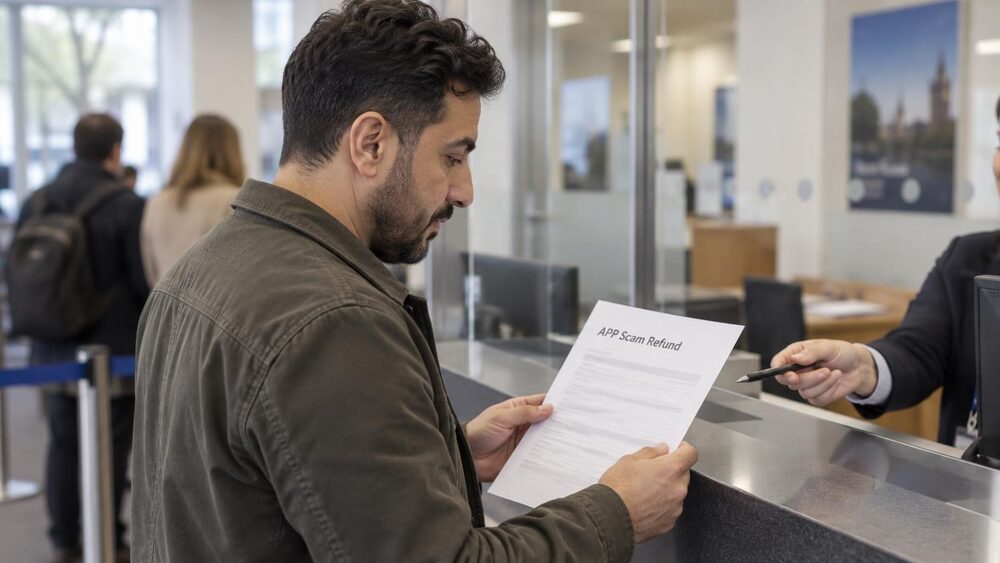
If you were tricked into making a bank transfer yourself, by someone pretending to be your bank, a government body, a seller or anyone else you believed was legitimate, you can claim a refund from your bank under rules that have applied since 7 October 2024. The rules require payment firms to reimburse victims in all but exceptional cases, up to a maximum of £85,000 per claim, and the bank normally has to pay within five UK business days of a valid claim1.
This kind of fraud is called an authorised push payment (APP) scam, because you authorised the payment yourself, even though you were deceived into doing it. It is the most common form of payment fraud complaint people bring to the Financial Ombudsman Service: in the first quarter of 2025/26, around half of fraud and scams complaints opened with the ombudsman, some 3,400 of them, were about APP scams3.
The claim process is free, and you make it to your own bank, the one that sent the money. This page explains what is covered, what the bank can ask of you, the deadlines on both sides, and what to do if the answer is no. If you have only just realised you have been scammed, the page on what to do straight away covers the immediate steps, which include contacting your bank as quickly as possible.
What counts as an authorised push payment scam
An authorised push payment scam happens when someone is tricked into instructing their bank to transfer money to a fraudster9. The key word is "authorised": from the bank's point of view the payment looked genuine, because you, the account holder, asked for it. That is what makes APP fraud different from unauthorised fraud, where a thief takes money without your involvement, and the two have different refund routes, as the comparison of authorised and unauthorised payments explains.
The deception usually involves the scammer posing as someone trustworthy. The Consumer Council describes the typical pattern: a person is persuaded to transfer money by a scammer pretending to be from their financial institution or another legitimate organisation1. Common examples include fake bank staff telling you to move money to a "safe account", safe account scams being a well known pattern, fraudsters posing as HMRC or your bank's fraud team, invoice redirection where a genuine bill's bank details have been swapped, and romance scams where a person you have met online asks for money. The common thread is that the payment instruction came from you.
Since 7 October 2024, all financial institutions within the scope of the rules must refund customers who have been a victim of this kind of fraud, subject to a small number of conditions1. Before that date the position was weaker, and older scams are dealt with differently, as explained below. The scale of the problem is significant enough that the Payment Systems Regulator (PSR), which wrote the rules, introduced them specifically to make reimbursement consistent across the industry rather than depending on which bank you happen to use2.
Which payments are covered: Faster Payments and CHAPS within the UK
The rules cover payments made through two UK payment systems: Faster Payments, the system behind almost all everyday bank transfers, and CHAPS, used for large same-day transfers such as house purchases. The PSR states that everyone making a payment via Faster Payments or CHAPS from one UK bank account to another is covered4. The requirement applies to payments sent and received by payment providers in the UK, including transactions made through a payment initiation service, where you use a third-party app or website to instruct the payment8.
The rules apply to all payment service providers in scope, which includes high-street banks and building societies as well as smaller payment firms2. The legal basis is a set of directions issued by the PSR under the Financial Services (Banking Reform) Act 2013, and the CHAPS element was added by a separate direction published in September 20242.
What is not covered matters just as much. Payments made outside these systems, or outside the UK, fall outside the rules:
- Payments sent to an account abroad are not covered. The rules apply to payments made within the UK only5.
- Payments made using cash, a cheque, or a credit, debit or prepaid card are excluded, because they do not travel through Faster Payments or CHAPS5.
- Payments to accounts you control yourself, payments that were themselves unlawful, and payments to and from credit union, municipal bank or National Savings bank accounts are also excluded5.
- Civil disputes, where you got what you paid for but are unhappy with it, are not scams under these rules5.
If you paid by card rather than transfer, different protections may apply, and the comparison of bank transfer and card payments sets out how they differ. If the money went abroad, the page on overseas payments explains the position in more detail.
Refund limit: up to £85,000 per claim
The maximum amount you can claim under the rules is £85,0006. This is a cap per claim, not a lifetime allowance, and it applies to the value of the payments that make up the claim. The PSR's own data reporting works on the same basis, counting the value of APP scams below the £100 excess, above the £85,000 maximum cap, and certain other transactions separately11.
For most victims the cap is not the binding constraint, because most APP scam losses are well below £85,000. Where a loss is larger, the amount above the cap is not reimbursable under the rules, though nothing stops you asking the bank to consider the balance as a goodwill payment, and the ombudsman can look at the whole complaint. The page on losses over £85,000 covers that situation.
It is worth being clear about what the £85,000 is not. It is not the same as the Financial Services Compensation Scheme (FSCS) deposit protection limit, which has been £120,000 per person per banking licence since 1 December 2025, and which protects deposits when a bank fails. The two figures protect against different things, and the comparison of FSCS protection and APP reimbursement explains the difference.
The £100 excess and when it does not apply
A bank may apply an excess of up to £100 per claim, which it deducts from the refund before paying you7. The excess is per claim rather than per payment, so if a scam involved several transfers that form one claim, only one £100 is deducted.
The excess is not automatic. The sending bank can decide whether to apply a full £100 excess, a lower excess, or no excess at all to a reimbursable claim8, and some banks choose not to apply it12. The PSR's data reporting treats the value of scams below the £100 excess as a separate category, which reflects that small claims can be reduced to very little once the excess is taken off11.
There are two important exceptions. First, if you are considered vulnerable under the rules, the excess must not be applied to you13. Second, there is no minimum claim amount: the PSR confirmed it no longer requires any minimum threshold for claims to be valid, so a small loss can still be claimed even if the excess reduces what comes back2. The narrow page on the £100 excess covers the detail.
How to make a claim with your bank
You make the claim to your own bank, the one that sent the payment, not to the bank that received it. The Consumer Council's guidance is straightforward: contact your financial institution if you have been the victim of a scam1. Do this as soon as you realise what has happened, because speed matters both for the chance of recalling the money and for the claim deadline described below. If you are unsure whether a message really came from your bank, the page on checking your bank is really contacting you explains how to verify it, and the 159 service lets you reach your bank safely on a known number.
When you contact the bank, tell it that you want to claim a refund for an APP scam. Give it the facts it needs to identify the payments and the deception:
- The date, amount, and account details of each payment you made to the scammer.
- Copies of the messages, emails, adverts or call notes that tricked you, as evidence of how the scam worked.
- What you were told, by whom, and why you believed the payment was genuine.
- Whether you have reported the scam to the police, through Action Fraud in England, Wales and Northern Ireland or to Police Scotland, which the bank may ask about.
The bank may come back to you for more information, and it is worth responding promptly, because the clock on its decision deadline can be stopped while it gathers what it needs6. You do not have to prove you were careful, beyond giving an honest account: the rules place the burden of proving carelessness on the bank, not on you14. The bank cannot demand that you prove the scam beyond doubt, but the more evidence of the scammer's approach you can give it, the more smoothly the assessment goes.
Behind the scenes, the cost is shared. Once your bank has reimbursed you, it can require the bank that received the payment to pay 50% of the reimbursement amount back to it8. The PSR's policy shares the cost of reimbursing victims 50:50 between sending and receiving payment firms2, which is designed to give both banks an incentive to prevent fraud. This does not affect you: your claim, your refund and any complaint all stay with your own bank.
Deadlines: 13 months to claim, five business days to refund
Both sides of the claim are governed by time limits, and they are different things. The limit on you is the claim deadline: a bank can refuse an APP scam claim submitted more than 13 months after the final payment in that claim8. The clock starts from the last payment, not the first, which matters for scams that unfold over weeks or months, such as romance or investment frauds where several transfers were made. A claim made close to the deadline can still be recorded by the bank.
The limits on the bank are about speed. A valid claim must be reimbursed within five UK business days, unless the bank needs to gather more information6. If it does stop the clock, it must arrive at an outcome within 35 business days6. The 35-business-day timescale is the PSR's clarified deadline for the sending bank to make its decision on whether to reimburse8. The bank is expected to tell you what information it is waiting for and keep you updated.
These deadlines sit alongside the general complaints framework. If you complain to your bank about the outcome, it has eight weeks to investigate and give you its final response17. The five and 35 business day limits apply to the reimbursement decision itself, while the eight-week limit covers the complaint process if you remain unhappy. The narrow page on how to complain to your bank about a scam refund goes through the complaint route.
Where a refund can be refused
The rules require reimbursement in all but exceptional cases18, and the exceptions are narrow and defined. The FCA summarises the two main ones: you might not get a refund if your payment provider can prove you were not careful enough when you made the payment, or that you were involved in the fraud19.
The "not careful enough" test is the consumer standard of caution, often described as gross negligence. It is a high bar: you would need to have shown a significant degree of carelessness when making the payment6. And the burden runs the right way: if your bank or payment provider turns down your claim, it must show that you acted with gross negligence, and it is up to the provider to prove it14. The narrow page on gross negligence and the core page on the consumer standard of caution cover what this test involves.
The other grounds for refusal are specific. A claim can be refused where the customer was involved in the fraud, where the claimant is fraudulent, where the payment was to an account the customer controls, where the payment was unlawful, or where the payment falls outside the covered systems or territory described above5. A bank can also refuse a claim simply because it arrived more than 13 months after the final payment8.
Extra protection for vulnerable customers
The rules build in additional protections for vulnerable customers2. What this means in practice is that if you were particularly vulnerable to the specific type of APP scam, because your personal circumstances made you especially susceptible to harm, the bank must reimburse you, and the standard of caution and the £100 excess must not be applied to you13.
The PSR's policy statement is explicit that the customer standard of caution and claim excess must not be applied to vulnerable customers20. Which? summarises the same point: customers deemed to be vulnerable to a specific type of APP fraud are not subject to the gross negligence test or the claim excess13. So a person who was targeted through circumstances that made the scam especially effective on them, for example a bereavement, a health condition or a reliance on the caller, does not lose part of the refund or face the carelessness test at all.
Vulnerability has a broad definition, outlined by the Financial Conduct Authority, and a consumer who may be considered vulnerable would not face any excess charge13. If vulnerability applies to you or to the person you are helping, it can be raised when making the claim, with the relevant background given to the bank. The narrow page on extra refund protection if you are vulnerable covers this in more detail, and the page on helping an older relative or someone else who has been targeted may help if you are supporting someone else through a claim.
Older scams: the voluntary code before 7 October 2024
The mandatory rules apply to payments made from 7 October 202421. For bank transfer scams before that date, the voluntary Contingent Reimbursement Model (CRM) Code applies22. Under the Code, signatory payment service providers voluntarily reimbursed APP scam victims23, which meant the outcome depended on whether your bank had signed and how it judged your case.
The Code began in 2019, when the Financial Ombudsman Service noted that from the end of May that year a new voluntary code would provide a mechanism for many victims of APP fraud to get their money back24. If your scam happened before 7 October 2024, you can still ask for a refund under the FPS Reimbursement Rules if the payment was made using Faster Payments, or the CHAPS Reimbursement Rules if it was made using CHAPS25, and the ombudsman can still look at how the bank handled your case. The core page on the CRM Code explains the voluntary scheme and how claims under it work.
Refunds since the rules began
The evidence since the rules took effect is that they have moved money back to victims. The House of Commons Library reports that since the law was changed, the reimbursement rate has increased from around 54% to 65%26. The PSR's own position is that its policy ensures victims of APP scams are reimbursed in all but exceptional cases27.
The PSR publishes a reimbursement dashboard of data on APP scams and how payment firms reimburse victims, which is the place to see how the market as a whole is behaving11. Voluntary reimbursements, payments banks made outside the requirement, are excluded from the requirement data, though they were included in the reporting of APP scams before the requirement came into effect28.
These are market-wide figures, not a prediction for any individual claim. A particular claim's outcome depends on the facts: whether the payment was in scope, whether it was made in time, and whether any exception genuinely applies. But the direction of travel since October 2024 has been towards more victims getting their money back, and the ombudsman's complaint volumes show that where banks get it wrong, the mechanism to challenge them is being used3.
If your bank says no: taking it to the Financial Ombudsman
If your bank refuses the claim, or offers less than you expected, or simply does not respond, you can complain. The PSR's guidance for consumers is that if you are unhappy with the bank's response, you can take the matter further by referring it to the Financial Ombudsman Service15. The ombudsman can look at complaints about how a payment provider assessed an APP scam claim under the PSR's policy8, so both the decision itself and the way it was reached are open to review.
The process is free. First complain to the bank directly and give it the chance to respond, which it has eight weeks to do17. If you are still unhappy, take the case to the ombudsman. Which?'s guidance on what to do if your bank will not refund you after a scam notes that customers deemed vulnerable are not subject to the gross negligence test or claim excess, which is worth restating in a complaint if it applies13. The narrow page on taking a refused scam refund to the ombudsman walks through the referral step by step.
The ombudsman has real powers. In payment cases it may ask the bank to refund payments, refund charges and interest the bank has applied, compensate for money lost, and pay compensation for distress or inconvenience29. Its decisions are binding on the bank if you accept them, and if you do not accept a decision you can still go to court instead30.
If money is tight while a claim is pending, free debt advice is available from Business Debtline and National Debtline, both of which publish guidance on dealing with fraud7, and MoneyHelper offers free, impartial help with everyday money questions17.
Sources30 cited
- How to stop, avoid and report scams Consumer Council Northern Ireland, 2026
- PS23/4: APP scams reimbursement policy statement Payment Systems Regulator, December 2023
- Quarterly complaints data Q1 2025/26 Financial Ombudsman Service, 7 August 2025
- APP scams: our work Payment Systems Regulator, 2026
- APP guide Take Five to Stop Fraud, 26 September 2026
- What to do if you're the victim of a bank transfer (APP) scam Which?, 12 May 2026
- Dealing with fraud Business Debtline, 2026
- PS25/5: APP scams reimbursement consolidated policy statement Payment Systems Regulator, May 2025
- Scams glossary Which?, 22 July 2026
- Specific Direction 21: CHAPS APP scam reimbursement requirement Payment Systems Regulator, 6 September 2024
- APP scams reimbursement dashboard Payment Systems Regulator, 30 July 2026
- Dealing with fraud National Debtline, 25 September 2026
- What to do if your bank won't refund you after a scam Which?, 12 May 2026
- Scams: you've been tricked into making a payment Financial Ombudsman Service, 27 September 2026
- If you've fallen victim to a scam Payment Systems Regulator, 25 September 2026
- PS23/4 APP scams policy statement Payment Systems Regulator, December 2023
- Shop safely online MoneyHelper, 25 September 2026
- CP22/4: APP scams requiring reimbursement Payment Systems Regulator, 2026
- Fraudulent payments Financial Conduct Authority, 16 April 2016
- PS23/3: APP fraud reimbursement policy statement final Payment Systems Regulator, June 2023
- PS25/5: APP scams reimbursement requirement Payment Systems Regulator, 2026
- Advance loan fee fraud and scams Which?, 27 September 2026
- Government approach to authorised push payment scam reimbursement HM Government, 10 May 2022
- Annual review Financial Ombudsman Service, 2019
- Dealing with fraud Business Debtline, 26 September 2026
- Research briefing CBP-8545 House of Commons Library, 26 September 2026
- PS25/3: Publication of 2024 APP scams data Payment Systems Regulator, 2026
- PS25/3: Publication of 2024 APP scams data Payment Systems Regulator, March 2025
- Regular payments Financial Ombudsman Service, 26 September 2026
- Alternative dispute resolution Financial Ombudsman Service, 27 September 2026


 FCA Warning ListCheck whether a firm is authorised before you deal with it
 Financial Ombudsman ServiceFree, independent help when a complaint about a firm is not put right
 Citizens AdviceFree advice on money, consumer and legal problems in England and Wales
 MoneyHelperFree, impartial money and pensions guidance, set up by government