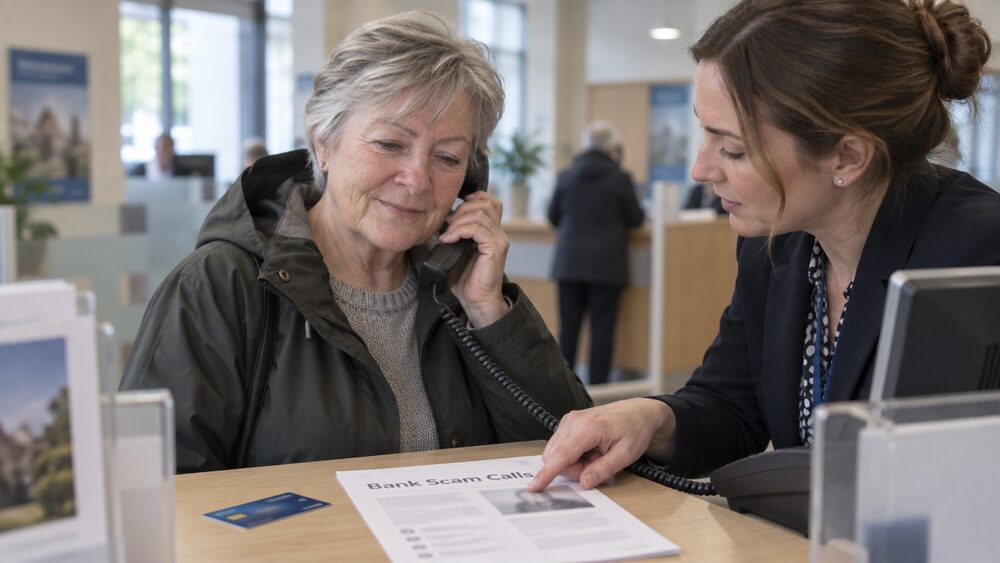
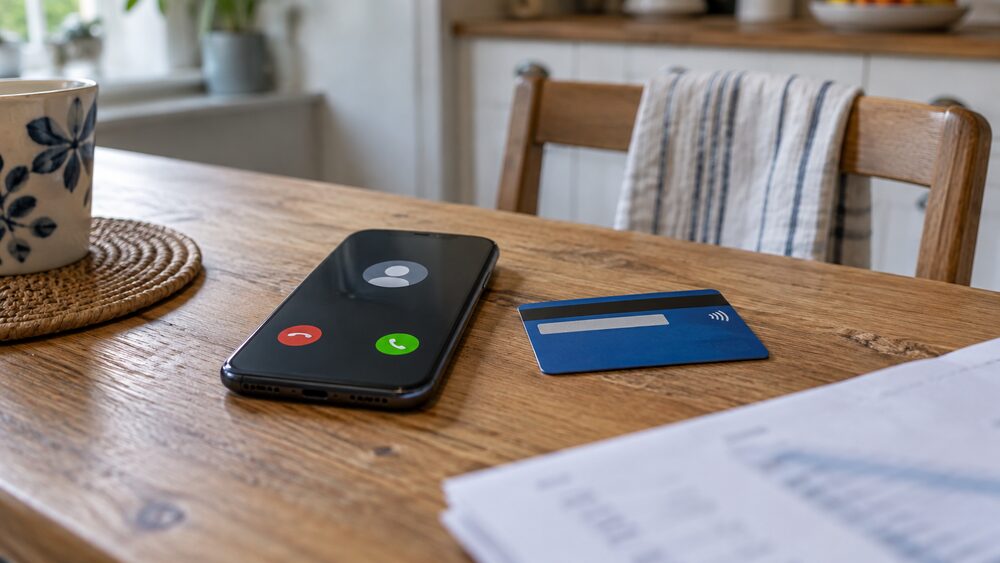
If your phone rings and the person on the other end says they are from your bank, the safest thing you can do is hang up and ring your bank yourself on a number you already trust. Since 2021 there has been a short number for exactly that: 159. Dial it and you are put through to your bank's genuine customer service line, so you can check whether the call was real without ringing the scammer back1.
If your phone rings and the person on the other end says they are from your bank, the safest thing you can do is hang up and ring your bank yourself on a number you already trust. Since 2021 there has been a short number for exactly that: 159. Dial it and you are put through to your bank's genuine customer service line, so you can check whether the call was real without ringing the scammer back1.
159 is run by Stop Scams UK and works in the same way as 101 for the police or 111 for the NHS. Because it is a short number rather than a long one, it cannot be spoofed or impersonated3. It is available 24 hours a day, seven days a week4.
Two conditions decide whether it works for you. Your bank has to be signed up to the scheme, and so does your phone network. If either is missing, 159 will not connect you, and the number on the back of your card is the fallback2.
What 159 does: a direct line to your bank
159 exists to solve one problem. A scammer can make their number look like your bank's number, so ringing back the number that just called you proves nothing. A short number like 159 cannot be faked in the same way, so dialling it takes you somewhere the scammer does not control3.
When you call, you are put through to your bank's genuine customer service line, provided your bank is signed up to the service1. MoneyHelper describes the destination as your bank's fraud department8. Santander tells customers that if a call is from the bank, they should dial 159, describing it as a safe and secure number that connects straight through9. Bank of Ireland UK calls it "the memorable, secure number that connects you directly to your bank if you think you're being scammed"10.
The service is not only for calls. It is also there when a scammer is trying to talk you into moving money to a so-called "safe account", or is asking for personal details5. Starling Bank tells customers to call 159 if a payment request could be a scam11. TSB points customers to 159 if they are in doubt about a call12.
Banks handle the calls themselves; Stop Scams UK runs the number1. Since its launch in September 2021, more than 700,000 potential scam victims have called 159 to speak to their bank, and Stop Scams UK says over a million calls have been made in total3.
159 will never call you
This is the single most useful thing to know about 159. It is an outbound number. Stop Scams UK states plainly that 159 "can't be faked so 159 will never call you"6.
Anyone who rings you claiming to be from 159 is a scammer. The same logic applies to your bank more broadly: your bank will never phone you out of the blue, ask for your PIN or password, or ask you to move money into a different account13. First Direct puts the same rule to its customers: your bank will never ask for your PIN or password14.
Public bodies follow the rule too. HM Courts and Tribunals Service says it will never telephone you to ask for your bank details15. If a caller claims to be from a court, a bailiff or the police and wants your bank details, that is not how those organisations work.
Banks you can reach on 159
The list of banks signed up has grown since launch. Stop Scams UK's own list of brands reachable through 159 runs to 27 names: Bank of Ireland UK, Bank of Scotland, Barclays, Cater Allen Private Bank, Chase, Co-operative Bank, Danske Bank, First Direct, Halifax, HSBC, Lloyds, Metro Bank, Modulr, Monzo, Nationwide Building Society, NatWest, Revolut, Royal Bank of Scotland, Santander, Spring, Starling Bank, Tide, True Potential, TSB, Ulster Bank, Virgin Money and Zempler Bank6.
Which? lists a shorter set of banks involved in the scheme: Barclays, Bank of Scotland, Co-operative, First Direct, Halifax, HSBC, Lloyds, Metro Bank, Nationwide, NatWest, Royal Bank of Scotland, Santander, Starling Bank, Tide, TSB, Monzo and Ulster Bank2. The two lists differ because they were published at different times and count different things, with Stop Scams UK's including brands that route through a partner rather than holding their own banking licence.
If your bank is not on either list, 159 will not reach it. The alternative is the number printed on the back of your card, or the contact route inside your banking app16.
Can I call 159 from any mobile or landline?
No. Your phone network has to carry the service as well as your bank. The networks signed up are BT (including EE and Plusnet), Gamma, O2 (including giffgaff), Sky, Three, Vodafone, TalkTalk and Virgin Media2.
If your contract is with a provider outside that group, dialling 159 will not connect you. That is a gap in coverage rather than a fault in your phone, and it is the reason the number on the back of your card remains the reliable fallback for everyone.
Stop Scams UK says it is working towards making 159 a universal number offered by all telephone providers, similar to 101, 111 or 9996. Until that happens, whether 159 works for you depends on two separate companies: your bank and your network.
What a call to 159 costs
Calls to 159 are usually charged at the national rate, and the exact cost depends on your provider5. Stop Scams UK puts it the same way: the cost varies according to your phone provider, and in many cases it will be the same as a national rate call6.
In practice that means the call is not free in the way 999 or 101 is. If your contract includes calls to standard UK numbers, you may pay nothing extra. If you pay per minute, you will pay your network's national rate. The charge comes from your phone company, not from your bank or from Stop Scams UK.
That cost is worth weighing against what is at stake. A scam call typically aims at a bank transfer or a card payment, and the sums involved are far larger than a phone call. If you are worried about the cost, the number on the back of your card reaches the same place and is covered by whatever your contract already includes.
How to use 159 if you think a call is a scam
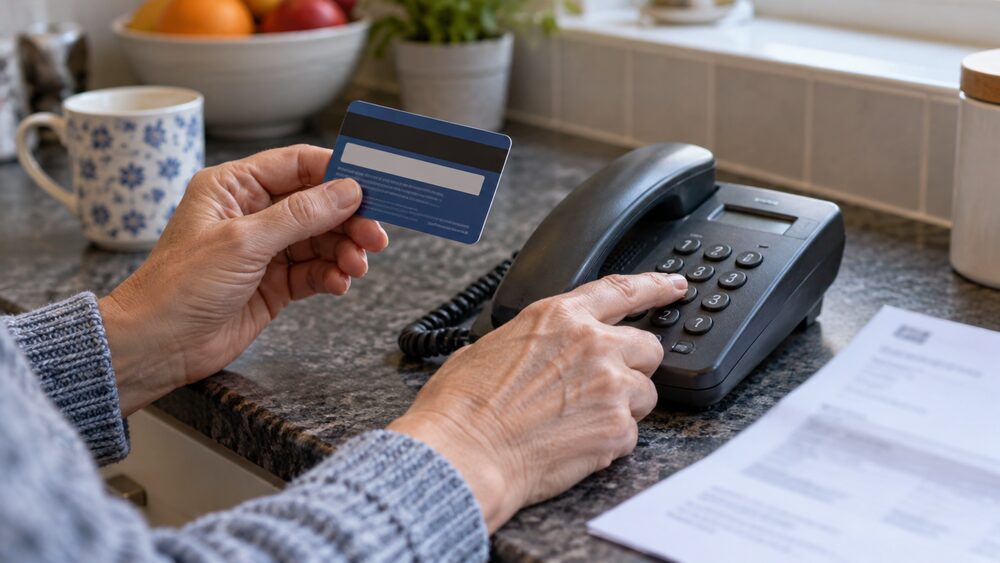
The sequence matters as much as the number. Some scammers stay on the line after you hang up, so a straight redial can put you back through to them.
- Hang up on the caller.
- Wait at least 15 minutes before ringing your bank on the same phone, or use a different phone7.
- Dial 159, or the number on the back of your card, or use your banking app16.
- Tell your bank what the caller said and ask them to confirm whether the call was genuine4.
- If you have already lost money, contact your bank immediately, and report it to Action Fraud, or call the police on 101 if you are in Scotland18.
"If you contact your bank immediately after a scam call, wait at least 15 minutes before calling your bank using the same phone, or use a different phone."
Waiting is not a technicality. It is the step that stops a scammer holding the line open and answering as your bank when you dial.
What if my bank is not part of the 159 scheme?
You still have a safe route, just a longer one. Hang up, wait at least 15 minutes, then ring the number printed on the back of your bank card, or open your banking app and use the contact details there16. Take Five gives the same instruction for courier fraud: contact your bank using a trusted route such as the number on the back of your card, your banking app or 159, and never a number the caller gave you16.
If you have already sent money, ring your bank straight away. Investment fraud guidance is blunt about the first step: do not send any more money, and contact your bank immediately using a trusted number such as the one on the back of your card, or by calling 15920. Recovery scams, where someone offers to get your lost money back for a fee, are a second wave of the same fraud, so treat any approach about recovering money with the same caution19.
For free, impartial help after a scam, MoneyHelper and the debt advice charities offer guidance, and the Financial Ombudsman Service can look at a complaint if your bank refuses a refund and you are unhappy with how it handled it. If you are in Scotland, the reporting route differs: Police Scotland on 101 rather than Action Fraud18.
Sources20 cited
- 159 phone number Stop Scams UK, 2026-09-15
- Phone scams Which?, 2025-12-22
- What to do if you receive a scam call Zempler Bank, 2026-09-25
- Fraud and security Nationwide Building Society, 2026
- Banking security and fraud Citizens Advice, 2021-03-18
- Get help now Stop Scams UK, 2025-06-23
- Dealing with fraud (England and Wales) National Debtline, 2026-09-25
- Types of scam MoneyHelper, 2026-09-25
- Spotting fraud or scams Santander, 2026
- Security and fraud Bank of Ireland UK, 2026-09-25
- Mobile banking security Starling Bank, 2026
- How to recognise fraud TSB, 2026
- Online banking Age UK, 2026-03-23
- Phone scams first direct, 2026
- Guidance on HMCTS related suspicious phone calls, emails and text messages GOV.UK, 2026-09-17
- Courier fraud Take Five, 2026-09-26
- Scam watch: I was sent a one-time passcode from my bank Which?, 2026-05-04
- Watch out for fake energy support scams Which?, 2025-07-02
- What is a recovery scam and why should you know about them Which?, 2026-09-10
- Investment fraud Take Five, 2026-09-26

 FCA Warning ListCheck whether a firm is authorised before you deal with it
 Financial Ombudsman ServiceFree, independent help when a complaint about a firm is not put right
 Citizens AdviceFree advice on money, consumer and legal problems in England and Wales
 MoneyHelperFree, impartial money and pensions guidance, set up by government