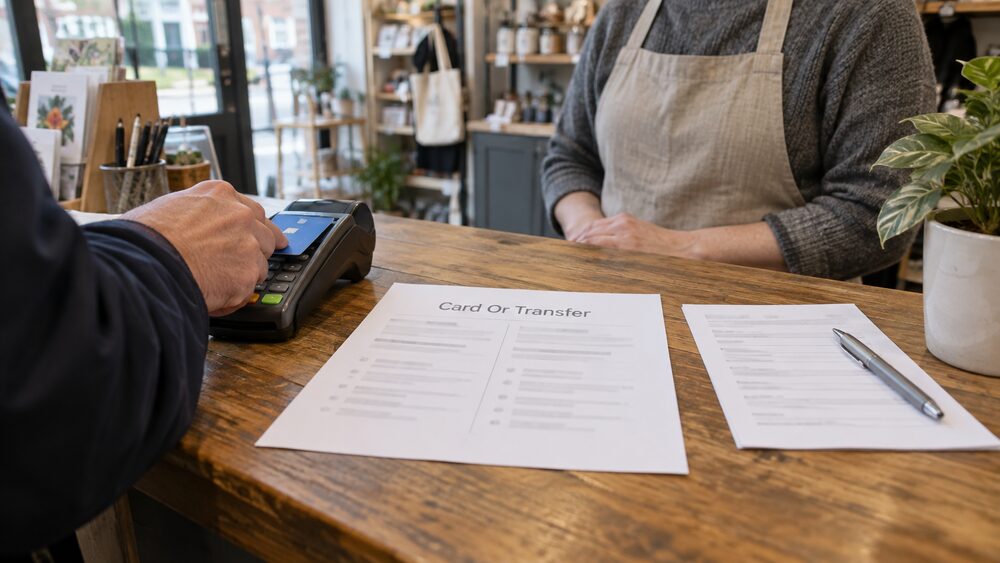
How you pay decides what happens if something goes wrong. Pay a business by credit card and the card provider is as responsible as the trader for a breach of contract or a misrepresentation, under Section 75 of the Consumer Credit Act 1974, as long as the cash price of what you bought is more than £100 but not more than £30,0001. Pay by debit card and you have no Section 75 rights at all, though chargeback may help1. Pay by bank transfer and you are relying on the scam reimbursement rules, which cap what your bank has to pay at £85,000 and exclude several kinds of payment4.
The gap matters most for the purchases people ask about: holidays, cars, building work, anything paid for in advance. MoneyHelper's own guidance is blunt about the difference, telling shoppers to pay by credit card if the amount is more than £100, or by debit card or PayPal, rather than bank transfer, because there is more protection6. A bank transfer is not a card payment and does not inherit a card's protections.
This page sets out what each route covers, what it costs you in protection when you choose it, how to claim, and where to go when a claim is refused.
Card or bank transfer: how each one protects you
A card payment runs through a network with rules attached. A bank transfer is simply money moving from one account to another, and once it has arrived the money is the recipient's. That is the whole difference, and it explains why the protections are so uneven.
Section 75 makes the credit card provider jointly and severally liable with the supplier for misrepresentation or breach of contract claims10. In practice that means if a trader takes your money and does not deliver, you can pursue the card provider rather than only the trader. The protection attaches to the transaction, not to how much of it you put on the card.
Bank transfers have no equivalent. The Faster Payments scheme, which carries most UK bank transfers, had no explicit requirement for banks to reimburse victims when a payment turned out to be to a fraudster, unlike many other payment methods such as cards11. That changed with the reimbursement rules that came into force in 2024, but the rules are narrower than Section 75: they cover scams rather than breaches of contract, they apply only to certain payments, and they carry a maximum4.
There is also a practical warning sign. MoneyHelper notes that if someone is asking you to pay by bank transfer, it could be a sign that it is a scam, precisely because it is harder to get your money back and you have much less protection if something goes wrong1.
Section 75: credit card purchases from £100 to £30,000
Section 75 of the Consumer Credit Act 1974 gives you a claim against your credit card provider when a supplier breaches its contract with you or misrepresents something to you8. The card provider is as responsible as the trader7. The rules are specific about when it applies.
The cash price of the goods or services must be more than £100 but not more than £30,0002. That range appears consistently across official and independent guidance1. Crucially, the protection covers the whole purchase even if you only paid part of it on the credit card, and recovery is not limited to the deposit8. So a small deposit on a credit card can bring a much larger transaction within Section 75.
The claim must relate to a breach of contract or a misrepresentation. Section 75 rights are only available where the provider has misrepresented something to you or breached its contract with you8. A change of mind is not a Section 75 matter.
There are conditions on who can claim and how the purchase was made. Generally the cardholder named must correspond to the person named in the contract, though a cardholder booking for themselves and their family can claim8. Section 75 usually only applies when the payment is made directly to the merchant providing the service, though a travel agent may have taken payment as agent for the supplier, and where a travel agent sells a package they put together, the agent is a party to the contract8.
"the cash price of the goods or services is more than £100 but not more than £30,000"
Where Section 75 does not apply
Section 75 does not apply to charge cards or debit cards1. That single exclusion rules out the most common way people pay. If you paid by debit card, you cannot make a Section 75 claim14.
There are further limits that catch people out on travel and on cancelled arrangements. If you accept a replacement flight, package holiday, voucher or credit note, that may settle the current claim; if the provider then fails to honour the alternative booking, or the voucher expires unused, chargeback and Section 75 rights may become available again8. If a rebooked holiday is cancelled because of a future government-imposed restriction, there may be no breach of contract if the terms and conditions allow cancellation in those cases, which can affect your ability to claim8.
Consequential losses are treated separately. If a flight paid on the card was cancelled, hotel costs may be claimable as consequential losses so long as they were reasonably anticipated and recovery has not been excluded by the contract terms8. But there is no Section 75 or chargeback claim for accommodation if the hotel is still open and able to honour the original booking, because the hotel has not broken its contract8.
One more exclusion is worth knowing for anyone holding a packaged bank account. The rule on payment protection contracts does not apply to payment protection contracts arranged as part of a packaged bank account15.
Chargeback: the route for debit cards and smaller purchases
Chargeback is the fallback when Section 75 does not reach. It exists for both credit and debit card purchases8. It applies to all debit card transactions, including goods costing less than £100, although the exact rules may vary between the American Express, Maestro and Visa networks3. It also applies to credit card transactions where the goods cost less than £100, so Section 75 does not apply3.
The important difference is that chargeback is not law. It is not legal protection: American Express, Mastercard and Visa run their own schemes17. That means the outcome depends on the scheme rules and on your bank's willingness to act. If you paid with a debit or credit card, you can still ask for chargeback, but your bank or credit provider might not agree to do it14.
To start a chargeback, you generally need evidence of a breach of contract, for example goods not delivered or a service not carried out, and you then ask your card provider to attempt to recover the payment18. Mobile card payments are covered by chargeback at any value, regardless of whether a credit or a debit card was used17.
Buy now, pay later sits awkwardly here. If you used a debit or credit card to make payments to a buy now, pay later account, you might be able to start a chargeback on that card, but your bank or credit provider might not agree to it19. Deferred payment credit agreements do carry Section 75 protection, so you may be able to get a refund from the lender if something goes wrong with what you have bought19.
Bank transfers and scams: reimbursement up to £85,000
If you are tricked into sending money by bank transfer, the reimbursement rules are what stand between you and the loss. They require banks and other payment service providers to reimburse you up to a maximum of £85,000 if you are the victim of an authorised push payment scam12. The maximum the bank has to pay is £85,0004.
The rules cover most transfers between UK bank and other accounts12. They apply to payments sent across the Faster Payments System where both the sending and receiving accounts are held in the UK20. The Bank of England, as operator of CHAPS, has also set the maximum level for CHAPS APP scams at £85,00021.
Timing matters. Your bank should provide the refund within five business days of you making the claim5. The rules apply to payments made on or after 7 October 20245.
The design of the scheme spreads the cost. The reimbursement requirement shares the cost of reimbursing victims 50:50 between sending and receiving payment firms22. It also requires payment firms to reimburse all in-scope customers who fall victim to APP fraud in most cases, and to provide additional protections for vulnerable customers22. If the rules apply and you were particularly vulnerable to the specific type of APP scam, your bank or payment service provider must reimburse you12.
What the scam reimbursement rules exclude
The exclusions are where most refused claims live. The rules do not cover a payment made by an internal transfer within the same bank or banking group, and they do not cover payments made before 7 October 20245. They also do not apply to international payments, because the rules only apply to UK bank transfers23.
The mandatory scheme does not apply to debit or credit card payments, international transfers or cryptocurrency transactions24. Accounts provided by credit unions, municipal banks and national savings banks are outside the requirement20. And the reimbursement protections apply to UK Faster Payments only; they do not apply to international transfers, debit, credit card or crypto payments4.
There is a £100 excess built into the scheme, which the payment firm can deduct from a refund4. The £85,000 figure is a cap, not a promise: the dashboard data explicitly counts the value of APP scams below the £100 excess and above the maximum cap of £85,000 as outside the metric25.
One firm-specific point is worth flagging for anyone banking with a newer provider. Revolut has no bank transfer fraud protection under the Contingent Reimbursement Model Code26. The CRM Code was the voluntary scheme that preceded the mandatory rules, and it is covered separately on this site at the Contingent Reimbursement Model Code.
How to claim your money back
The route depends on how you paid, and the first step is always to establish what went wrong.
For a card purchase where the trader breached the contract, a Section 75 claim goes to the credit card provider. A model claim letter sets out your address, the company address, the complaint details and card number, the purchase date, the item and retailer, the fault, the sum sought, and the Section 75 legal basis27. The same letter asks the provider to respond within 14 days27.
For a debit card or a purchase under £100, the route is chargeback. If you can provide evidence of a breach of contract, for example goods not delivered or a service not carried out, you can ask your card provider to attempt to recover the payment18. If you paid by debit card, you may be able to make a chargeback claim, which enables you to dispute a card transaction and request your money back for something you have paid for16.
For a bank transfer scam, the claim goes to your own bank. If the account you sent the money to exists, you need to contact your bank to request your money back28. Where a card was used without your permission, the burden is on the bank: if you claim the use of the card was not authorised by you, it is for your bank to prove otherwise29. The bank may be able to cancel the payment or put the money back into your account29.
For unauthorised payments initiated through a third-party provider, your bank must refund you immediately unless it has grounds to suspect fraud or negligence, and if the third party was at fault the bank can recover the funds from them30.
Where to complain if your claim is turned down
Start with the firm. The Financial Conduct Authority expects credit and debit card providers to handle Section 75 and chargeback claims in a reasonable timescale and to explain any delays or a decision to decline clearly, including checking travel insurance cover, including policies held as part of a packaged bank account31.
If that does not resolve it, the Financial Ombudsman Service is free and independent. If you try to use chargeback and you do not get your money back, you can complain to the Financial Ombudsman Service if your card provider says they will not appeal to the trader's bank32. The ombudsman also handles complaints about goods and services bought on credit, and it has set out its position on Section 75, including the point that Section 75 might not apply if a customer used a credit card to put funds into a standard e-money account and then used that account to buy something10.
For a refused bank transfer scam refund, the route is the same: contact your financial provider by phone, and you can also contact the Financial Ombudsman Service if you are still unhappy33. Complaints about a bank refusing a refund can also be reported to Trading Standards34.
There is a wider policy argument running alongside the individual routes. Which? has argued that victims of APP scams do not receive sufficient protection from fraudsters in comparison to other types of payments, such as card payments and direct debits35. The Payment Systems Regulator has consulted on the excess and the maximum reimbursement level for Faster Payments and CHAPS36, and the reimbursement requirement data includes payments to credit cards that were not part of APP scams before the requirement37.
Sources37 cited
- Shopping safely online MoneyHelper, 2026-09-25
- Consumer Credit Act 1974 legislation.gov.uk, 2026
- How to get your money back after a scam Which?, 2026-09-27
- What to do if you're the victim of a bank transfer or APP scam Which?, 2026-05-12
- Authorised push payment scam refund rules Business Debtline, 2026-09-26
- Types of scam MoneyHelper, 2026-09-25
- Section 75 and chargeback Isle of Anglesey County Council, 2025-10
- Chargeback rights and Section 75 UK Finance, 2026
- Dealing with fraud National Debtline, 2026-09-25
- Goods and services bought on credit Financial Ombudsman Service, 2026-09-27
- The psychology of scams Which?, 2022-12-14
- Scams you've been tricked into making payment for Financial Ombudsman Service, 2026-09-27
- Consumer Credit Act Which?, 2025-06-18
- If a company stops trading or goes out of business Citizens Advice, 2026-09-25
- ICOBS 5.1.2 R Financial Conduct Authority, 2012-07-26
- How to complain about a takeaway and get your money back Which?, 2026-06-30
- What is Apple Pay? Which?, 2026-03-05
- Other problems Isle of Anglesey County Council, 2025-10
- Buy now, pay later Financial Conduct Authority, 2026-02-11
- PS25/5: APP scams reimbursement consolidated policy statement Payment Systems Regulator, 2025-05
- PS24/7: Confirming the maximum level of reimbursement Payment Systems Regulator, 2024-10-07
- PS23/3: Fighting authorised push payment fraud Payment Systems Regulator, 2026-09-26
- What to do if you're the victim of a bank transfer or APP scam Which?, 2026-05-12
- How scam refund rules are reducing fraud Which?, 2026-07-02
- APP scams reimbursement dashboard Payment Systems Regulator, 2026-07-30
- Is your money safe with Revolut? Which?, 2024-06-13
- Letter to report a problem with something bought on credit card Which?, 2025-06-18
- How do I get money back that I've sent to the wrong account? Which?, 2026-07-30
- Your payment card was used without your permission Citizens Advice, 2026-09-25
- Open banking: sharing your financial data Which?, 2026-03-06
- Cancellations and refunds: helping consumers with rights and routes to refunds Financial Conduct Authority, 2020-10
- Getting your money back if you paid by card or PayPal Citizens Advice, 2026-09-25
- When you make a payment Payment Systems Regulator, 2026-09-26
- Your payment card was used without your permission (Scotland) Citizens Advice Scotland, 2026-09-28
- Which? authorised push payment super-complaint: our response Payment Systems Regulator, 2026-09-26
- CP23/6: APP fraud excess and maximum reimbursement level Payment Systems Regulator, 2026-09-26
- PS25/3: Publication of 2024 APP scams data Payment Systems Regulator, 2025-03



 FCA Warning ListCheck whether a firm is authorised before you deal with it
 Financial Ombudsman ServiceFree, independent help when a complaint about a firm is not put right
 Citizens AdviceFree advice on money, consumer and legal problems in England and Wales
 MoneyHelperFree, impartial money and pensions guidance, set up by government