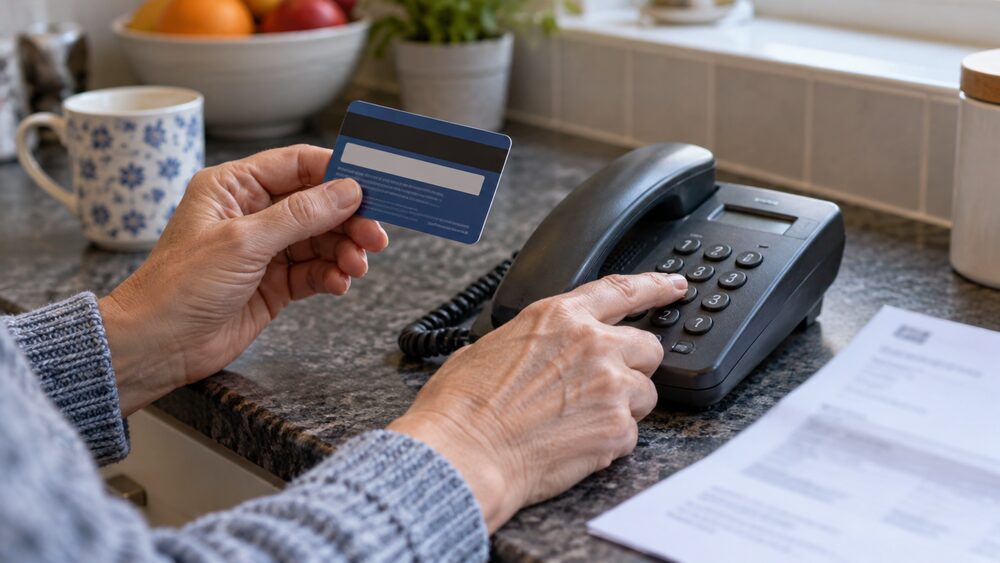
Realising you have paid a fraudster, or handed over your bank details, is a moment to act quickly but calmly. The Payment Systems Regulator's advice is simple: as soon as you realise you have fallen victim to a scam, immediately contact your bank to report it1. The national Take Five campaign says the same, and adds the reporting route: contact your bank immediately, and report the scam to the police at reportfraud.police.uk or by calling 0300 123 20402.
The order matters. Your bank is the only body that can try to stop or recall a payment, freeze a card, block a fraudster's access and, in many cases, refund you, so it comes first. Reporting to the police comes second, and it produces a crime reference number that you may need later, for example if you complain about a refused refund3. Free emotional and practical support, which many victims never realise exists, comes whenever you want it.
Contact your bank first: the steps to take straight away
The bank comes before anything else because it can act on the money while the trail is still warm. If you have lost money, or you spot a transaction you do not recognise, contact your bank immediately using the phone number on the back of your card11. That number is printed on the card itself precisely so you never have to trust a number read out to you by a caller or found in a message.
What you ask the bank to do depends on what happened:
- If you sent money to a scammer, ask the bank to try to recall the payment and to note on your account that you have been a victim of fraud. The bank can also warn the receiving bank.
- If you gave away card details, ask for the card to be frozen and replaced. If you think your credit or debit card, online bank account or cheque book have been stolen or hacked, speak to your bank or building society straight away12.
- If you shared passwords, PINs or one-time passcodes, tell the bank that too. If you think you have shared sensitive information with a scammer, notify your bank13.
- If you gave remote access to your computer, or clicked a link in a message, say so. The bank can watch for unusual logins and payments you did not authorise.
Keep records of all contact and correspondence between you and the scammer, because the Financial Ombudsman Service lists this among the immediate steps alongside contacting your bank and the police10. Screenshots of texts and emails, the scammer's phone number or account details, and the dates and amounts of every payment all help your bank investigate and support any later refund claim. Do not delete the conversation thread, even if it is embarrassing.
The Financial Services Compensation Scheme, which protects customers of failed financial firms, gives the same starting advice: speak to your bank, building society or credit union, because they can protect and reimburse victims of certain types of fraud, and report it to the national fraud reporting service14. In other words, the refund conversation happens with the bank, not with the police or a charity.
159: the short number to your bank's genuine fraud team
Dial 159 and you will be connected to your bank's fraud department8. The service exists for exactly the situation a fresh scam victim is in: you want to reach your bank, but you cannot be sure that the number in front of you is genuine. The Bank of England's own guidance is that if you are unsure about a call from someone who claims to be from your bank, the safe course is to hang up and dial 15915.
The number works because it is short and memorable, and because it routes you to your bank's genuine customer service line rather than to any number a caller may have given you4. It is designed for moments when you think a scammer is trying to trick you into transferring money to a so-called safe account, or is asking for personal details16. Consumer guidance for Northern Ireland puts it plainly: dial 159 to be connected safely to your bank, or 101 for the police17. Official guidance on scam calls and messages says you can also call 159 to check whether you are being targeted by scammers18.
Two practical points about using it:
- Cost. Calls to 159 are usually charged at the national rate, and it depends on your provider19. It is not a premium line, but it is not guaranteed free either, so check your call plan if that matters.
- Coverage. The service works if your phone contract is with BT (including EE and Plusnet), Gamma, O2 (including giffgaff), Sky, Three, Vodafone, TalkTalk or Virgin Media4. If your bank or network does not take part, use the number on the back of your card or your bank's official app.
One timing rule matters if you have just hung up on a suspicious caller. If you contact your bank immediately after a scam call, wait at least 15 minutes before calling your bank using the same phone, or use a different phone6. The reason is that fraudsters can stay on an open landline: you dial the genuine number, but the call never really ended and the scammer is still there. The same advice applies when you hang up and call 159 to verify a call: do it on a different phone line, or after waiting at least 15 minutes20.
The dedicated guide to calling 159 covers the service in more detail, and how to check your bank is really contacting you covers the wider habits that stop impersonation scams in the first place.
Reporting the scam: Report Fraud, or the police on 101 in Scotland
After the bank, report the scam. The national reporting centre is Report Fraud, which was formerly called Action Fraud, and reporting gives you a crime reference number3. You can report online at reportfraud.police.uk or by calling 0300 123 204018. That reference number is worth having: a bank, an insurer or the ombudsman may ask for it, and it is the formal record that the crime was reported.
Where you live changes the phone route:
| Where you are | How to report by phone |
|---|---|
| England, Wales, Northern Ireland | Report Fraud on 0300 123 204018 |
| Scotland | Police Scotland on 1015 |
If you live in Scotland, or the fraud happened there, contact Police Scotland on 1015. This is a genuine difference in the system, not a matter of preference: Scotland has its own police reporting route for fraud, while Report Fraud covers the rest of the UK. Several consumer guides make the same point, that scams are reported to Report Fraud, or by calling the police on 101 if you live in Scotland21.
In an emergency the rules change: if there are people claiming to be from an official body calling at your home, call 101 to report the scammers, or call 999 if you feel unsafe8. A fraud that has already happened is a 101 or online matter; a threat to your safety is a 999 matter.
Reporting does two things for you. First, it creates the paper trail: the ombudsman's immediate steps for scam victims are to contact your bank, contact the police on 101, report the scam to Report Fraud, and keep records of all contact and correspondence with the scammer10. Second, it feeds the national intelligence picture that leads to warnings and investigations. You can report even if you lost no money; an attempt is worth reporting too20.
The full reporting routes for each nation, including online forms and what happens after you report, are on the where to report a scam page.
When your bank calls you: how to check it is really them
The hardest scam to spot is the one that arrives after the first one. Fraudsters impersonating banks currently use spoofed mobile numbers that show a real bank's name, claiming to be from the bank's fraud department and saying your account has been compromised, to coax you into revealing personal and financial details22. Others impersonate the police, HMRC or well-known companies23. The caller knows your name, maybe your recent transactions, and sounds exactly like a bank employee, because in some cases they are watching your account in real time.
The rule that defeats all of these is the same: hang up and call back on a number you choose. If you have any suspicion, put the phone down and call the company or institution back directly, waiting a few minutes first or using a different phone, because scammers can hijack your phone line24. Then call 159, or the number on the back of your card, and ask whether the bank really contacted you20.
Things a genuine bank will never do, and which mark a call as a scam:
- Ask you to move money to a "safe account"16
- Ask you to lie to your bank, for example about the reason for a payment. If someone asks you to lie to your bank, this is a scam: do not engage with them, report them immediately25
- Ask for your full password, PIN or a one-time passcode20
- Ask you to buy a gift card or make a test payment to "catch the fraudster"
One-time passcodes deserve a special mention, because they are where many impersonation scams succeed. A passcode texted to you is meant for you alone; a caller who says "read me the code we just sent" is collecting the last piece they need to get into your account20. The guide to one-time passcodes explains why you get them and why never to share one.
Victim Support: free help for scam victims, 24/7
Losing money to a scammer is not only a financial event. Victim Support, an independent charity that supports victims of crime, provides 24/7 free and confidential support to victims and witnesses of crime in England and Wales7. Its helpline is 0808 16 89 111, free to call and open around the clock3. Fraud is a crime, so people who have been scammed are victims of crime and can use the service.
What that support looks like in practice:
- Someone to talk to, day or night, on the phone, without judgement
- Practical help understanding what has happened and what comes next
- Confidentiality: the service is independent of the police and of your bank27
Victim Support is a specialist charity for victims of crimes, including fraud28. Guidance for people helping an older friend or relative who has been scammed points to it as a free, confidential service to talk things through with29, and guidance for carers says the same30. Independent Age, a charity for older people, describes it as offering free practical and emotional support for scam victims31.
Two other free services sit alongside it. MoneyHelper, the government-backed money guidance service, encourages people affected by scams to talk to an expert for free, non-judgemental, confidential support32, and its Financial Crimes and Scams Unit can be called on 0800 015 44028. The campaigns behind much of this advice, including Take Five, are covered on the Take Five and Stop! Think Fraud page.
The reason this section exists is that many victims never seek help. Research by the Money and Pensions Service found that one in three people would be uncomfortable telling friends they have been scammed33, and shame is the scammer's accomplice long after the call ends. A charity helpline removes that barrier: the person on the other end has heard it all before.
What Victim Support can and cannot do
It helps to be clear about the boundary, so you know where to take each problem.
Victim Support can:
- Listen, and provide emotional support at any hour7
- Give practical help and information about being a victim of crime31
- Support you whether or not the scam has been reported31
Victim Support cannot:
- Return your money or pay compensation. It is a charity, not a refund scheme
- Investigate the fraudster. That is for the police
- Decide your bank's refund decision. That is for your bank, and then the ombudsman
Money back comes through a different route. Under the authorised push payment reimbursement rules, most victims of bank transfer scams are reimbursed, with consistent minimum standards and additional protections for vulnerable customers34. Where a victim submits details of a reimbursable payment, the sending bank must pay the reimbursable amount to the victim35. If you are unhappy with how your bank handled things after you were tricked into making a payment, the Financial Ombudsman Service may be able to help36, and it can also help with disputes about payments you did not authorise that were not part of a scam27. Victims of high-value scams with losses above £85,000 may be able to escalate their complaint to the ombudsman37.
Outcomes vary, and the ombudsman's published case material shows the range: one impersonation scam victim who lost £9,000 was fully reimbursed, a romance scam victim who lost £550 was denied reimbursement, and a purchase scam victim who lost £600 had a reimbursement decision pending38. The pages on APP reimbursement, claiming a refund from your bank and complaining to your bank set out how the refund process works and where it can be refused.
Where Victim Support's service is available
Victim Support's 24/7 helpline on 0808 16 89 111 covers England and Wales7. The charity operates elsewhere in the UK too, but the routes differ by nation, so it is worth knowing what applies where you live.
- England and Wales: the free, 24/7 helpline on 0808 16 89 1113
- Scotland: fraud is reported to Police Scotland on 1015, and Citizens Advice Scotland's guidance points victims to the 159 banking line and to their bank for the money side19
- Northern Ireland: the Consumer Council for Northern Ireland advises using the Stop Scams UK hotline on 159 to get through to your financial institution16
- UK-wide: MoneyHelper's Financial Crimes and Scams Unit on 0800 015 44028
MoneyHelper's scams support is promoted across the nations: people in Wales affected by romance scams are pointed to its free, confidential expert support9, and its warnings about romance scams have been aimed at groups from young single men38 to the general public. After reporting, some victims are also referred to victim care services, such as the Economic Crime Victim Care Unit, which offers advice on how to secure your identity and avoid becoming a victim again28.
That last point matters more than it sounds. Age UK notes that victims of scams can be targeted again, and that support services exist in part to help prevent it happening7, often because their details are still circulating, or because a "recovery" fraudster follows up the first crime with a second. Support services that help you secure your identity are not just comfort; they reduce the chance of the loss repeating. The identity theft page covers what to do if your details have been stolen.
Help is available without reporting the scam first
A question many victims quietly ask is whether they must go to the police before anyone will help them. The answer is no. Victims do not have to have reported the scam to get support from Victim Support31. The helpline is open to you at the moment you realise something is wrong, even if you have not yet called your bank, and even if you never report the crime at all.
This matters because the things that stop people reporting, shame, fear of being blamed, worry that relatives will think them foolish, are strongest in the first hours. One in three people would be uncomfortable telling friends they have been scammed33. A confidential charity line sidesteps that entirely: nothing said there starts a police process, and nothing is shared with your bank.
So the practical order for someone who wants help first is:
- Call Victim Support on 0808 16 89 111, or MoneyHelper's Financial Crimes and Scams Unit on 0800 015 44028, to talk it through
- When you are ready, call your bank on the number on your card or on 1594
- Report the scam to Report Fraud on 0300 123 2040, or to the police on 101 in Scotland5
The bank call is the one that cannot be delayed indefinitely, because the sooner the bank knows, the more it can do to protect your account and to try to recover the money1. But support does not depend on any of it. If you are helping someone else who has been scammed, the supporting a victim page covers how to raise it with them kindly, and the wider scams and fraud guide explains every type of scam and refund route in detail.
Sources38 cited
- If you've fallen victim to a scam, Payment Systems Regulator, 2026 psr.org.uk
- Protect yourself, Take Five to Stop Fraud, 2026 takefive-stopfraud.org.uk
- What to do if your bank won't refund you after a scam, Which?, 2026 which.co.uk
- Phone scams, Which?, 2025 which.co.uk
- Credit and fraud, Information Commissioner's Office, 2026 cy.ico.org.uk
- What is a recovery scam and why should you know about them, Which?, 2026 which.co.uk
- Support for scam victims, Age UK, 2026 ageuk.org.uk
- Types of scam, MoneyHelper, 2026 moneyhelper.org.uk
- How to spot, avoid and report scams StepChange
- Scams involving unauthorised payments and identity theft, Financial Ombudsman Service, 2026 financial-ombudsman.org.uk
- Fake British Gas calls and other energy scams to avoid, Which?, 2026 which.co.uk
- Protect your identity, nidirect, 2025 nidirect.gov.uk
- How to spot a messaging scam, Which?, 2026 which.co.uk
- FSCS podcast episode 46 transcript, Financial Services Compensation Scheme, 2025 fscs.org.uk
- Scams and fraud, Bank of England, 2026 bankofengland.co.uk
- How to stop, avoid and report scams, Consumer Council Northern Ireland, 2026 consumercouncil.org.uk
- AI scams, Age UK, 2026 ageuk.org.uk
- Guidance on HMCTS-related suspicious phone calls, emails and text messages, GOV.UK, 2026 gov.uk
- Banking security and fraud, Citizens Advice Scotland, 2021 cdn.demo.content.citizensadvice.org.uk
- Scam watch: I was sent a one-time passcode from my bank, Which?, 2026 which.co.uk
- 3 phone scams to watch out for right now, Which?, 2026 which.co.uk
- 5 phone scams to know about right now, Which?, 2025 which.co.uk
- Pa fathau o sgamiau a thwyll sy'n bodoli, Mental Health and Money Advice, 2023 mentalhealthandmoneyadvice.org
- Romance fraud, Take Five to Stop Fraud, 2026 takefive-stopfraud.org.uk
- What to do if you're the victim of a bank transfer APP scam, Which?, 2026 which.co.uk
- Warning: fraudsters posing as PSR employees, Payment Systems Regulator, 2026 psr.org.uk
- Fraud and scams, Financial Ombudsman Service, 2026 financial-ombudsman.org.uk
- 4 ways to help a fraud victim, Which?, 2024 which.co.uk
- Keeping safe from scams, Carers UK, 2026 carersuk.org
- How to help someone if you think they're being scammed, Independent Age, 2026 independentage.org
- Scams, nidirect, 2024 nidirect.gov.uk
- Welsh people warned not to fall for romance scams, Money and Pensions Service, 2026 maps.org.uk
- One in three would be uncomfortable telling friends they've been scammed, Money and Pensions Service, 2025 maps.org.uk
- APP scams, Payment Systems Regulator, 2026 psr.org.uk
- APP reimbursement scheme rules for FPS, Payment Systems Regulator, 2023 psr.org.uk
- Scams you've been tricked into making a payment, Financial Ombudsman Service, 2026 financial-ombudsman.org.uk
- The psychology of scams, Which?, 2022 which.co.uk
- Young single men are the most likely group to miss the signs of a romance scam, Money and Pensions Service, 2026 maps.org.uk



 FCA Warning ListCheck whether a firm is authorised before you deal with it
 Financial Ombudsman ServiceFree, independent help when a complaint about a firm is not put right
 Citizens AdviceFree advice on money, consumer and legal problems in England and Wales
 MoneyHelperFree, impartial money and pensions guidance, set up by government