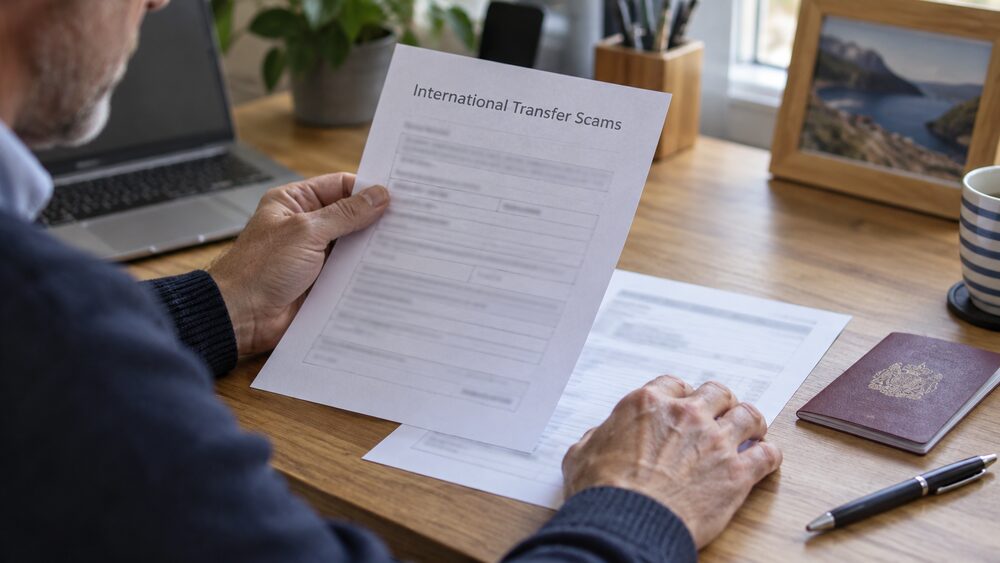
If a scammer persuaded you to send money to an account outside the UK, the bank transfer refund rules do not cover it. Those rules apply only to payments sent to another UK account, so an international payment falls outside them1. That is the short answer, and it is the same whether the money went to a fraudster's account in another country or to an overseas account held by someone posing as a legitimate business.
If a scammer persuaded you to send money to an account outside the UK, the bank transfer refund rules do not cover it. Those rules apply only to payments sent to another UK account, so an international payment falls outside them1. That is the short answer, and it is the same whether the money went to a fraudster's account in another country or to an overseas account held by someone posing as a legitimate business.
What sits outside the rules is not the same as having no route at all. You can still complain to your bank, and the Financial Ombudsman Service can look at complaints about overseas payments where the reimbursement rules do not apply3. The ombudsman's own guidance lists overseas payments among the payment types it can still help with3.
The rules themselves came into force in 2024 and require payment firms to reimburse all in-scope customers who fall victim to authorised push payment fraud in most cases4. The maximum is £85,000 per victim, and a bank can deduct an excess of up to £100 from a claim5. The rest of this page sets out exactly where the boundary sits, what happens to a payment that starts in the UK and ends up abroad, and how a claim works when the rules do apply.
International payments are outside the refund rules
The exclusion is stated plainly across the documents that explain the scheme. One bank's guidance lists "International payments" as a category the rules do not cover7. Another says the rules do not apply where an international payment was made8. A third puts it as a condition of eligibility: the payment must have been sent to another UK account9.
The reason is structural rather than arbitrary. The rules were built around the Faster Payments System, and the regulator's policy statement says protection is provided for payments sent across that system where both the sending and receiving accounts are held in the UK10. A payment that leaves the UK leaves that system, and with it the reimbursement requirement.
Two other exclusions sit alongside the international one and are worth knowing, because they catch people who assume any scam payment is covered. The rules do not apply where the payment was made by an internal transfer within the same bank or banking group, and they do not apply to payments made before 7 October 202411. A transfer between two accounts you hold at the same bank, even if a scammer talked you into it, is not an in-scope payment.
For a payment sent abroad, the practical consequence is that the bank is not obliged to reimburse you under the scheme. It may still choose to, and it may still be found at fault for how it handled the payment, but the automatic entitlement does not arise. That is why the complaint route matters more in these cases, not less.
What the APP scam refund rules do cover: Faster Payments and CHAPS within the UK
The rules cover payments made using Faster Payments and CHAPS12. They apply to payment service providers that offer Faster Payments, which is most UK banks, building societies and e-money firms, and they also apply to firms making CHAPS payments2. In practice that means the bank or building society you hold your current account with is almost certainly in scope.
The regulator describes the coverage as most transfers between UK bank and other accounts3. The eligibility conditions are cumulative: you made a transfer as part of a scam on or after 7 October 2024, you made the transfer to another UK account, and you told your bank or payment provider no more than 13 months after the last payment3. Miss any one of those and the entitlement does not arise.
The scheme is designed to cover CHAPS and Faster Payments within the UK when made under fraudulent or dishonest circumstances leading to a scam13. It applies to any Faster Payment made from one UK account to another, with both accounts in the UK, or any payment made through CHAPS to another CHAPS account in the UK14.
How much you can get back: up to £85,000, minus up to £100
The rules require banks and other payment service providers to reimburse you up to a maximum of £85,000 if you are the victim of an APP scam3. Independent guidance puts the same figure as the maximum amount you can claim back5. The regulator's own reporting refers to the maximum cap of £85,0001.
Against that, a bank that decides to reimburse you may deduct an excess of up to £100 for each scam claim3. The £100 excess appears in the regulator's data definitions alongside the £85,000 cap1. Independent guidance notes that the bank can deduct £100 unless you are considered vulnerable under the rules, and that some banks do not apply it at all6.
The excess is not a minimum loss threshold. There is no minimum amount you must have lost to be within the rules; the £100 is a deduction from whatever is refunded, not a bar to claiming. Where a loss is smaller than the excess, the arithmetic is straightforward and unhelpful, which is one reason some banks waive it.
| Item | Amount | Notes |
|---|---|---|
| Maximum refund | £85,000 per victim | Cap on what the bank must pay5 |
| Excess | Up to £100 per claim | Not deducted from vulnerable customers; some banks do not apply it6 |
| Minimum loss | None set | The £100 is a deduction, not a threshold3 |
Payments that start in the UK but end up abroad
This is where most confusion sits. A payment can begin at a UK bank, be authorised by a UK customer, and still fall outside the rules, because what matters is where the money ends up. The rules require the payment to have been sent from a bank in the UK to another bank in the UK11. Guidance from building societies and banks repeats the same condition: the payment must be made within the UK, and a payment sent overseas is not covered12.
The distinction is not about the app or the branch you used, or about the currency. It is about the destination account. If the receiving account is held outside the UK, the payment is an international payment for these purposes, and the reimbursement requirement does not bite.
That leaves a gap that fraudsters use deliberately. A scammer who cannot receive a Faster Payment into a UK account may instead direct the victim to send the money abroad, where the scheme does not reach. The Take Five campaign, which covers payment scams, advises contacting your bank immediately and reporting to the police at Report Fraud if you think you have been scammed16.
How to claim and how long it takes
A claim under the rules needs three things: a transfer made as part of a scam on or after 7 October 2024, a transfer to another UK account, and notice to your bank or payment provider within 13 months of the last payment3. Claims are subject to that 13-month limit after the last payment sent to the scammer as part of the same scam5.
Once a claim is in, the clock is short. Most APP fraud victims should be reimbursed within five business days4. Independent guidance says scam victims must be reimbursed within five UK business days unless the bank or payment provider needs to gather more information5, and that the bank should provide the refund within five business days of you making the claim6.
Complex cases take longer. One bank's savings terms state that once it can confirm a customer has been scammed, the money usually comes back within five working days, but that its investigation could take up to 35 days if the case is complex17. Another set of terms from the same bank uses the same five working days and 35-day figures18. Those are one provider's stated timescales, not the rule, but they show what a delayed case can look like in practice.
If the bank refuses, or does not decide, the next step is a formal complaint and then the Financial Ombudsman Service. The ombudsman can still help where the reimbursement rules do not apply, including overseas payments3. That is the route that remains open for a payment sent abroad.
Who pays for the refund, my bank or the scammer's bank?
Your bank refunds you; the cost is then shared between firms. The regulator's policy is to share the cost of reimbursing victims 50:50 between sending and receiving payment firms4. In the detailed rules, if claimed by the sending payment provider, a receiving provider must send 50% of the cost of a reimbursement claim to the sending provider, within a deadline set by Pay.UK19.
That matters to a consumer in one practical way: it removes the argument about which bank should pay from your side of the table. You claim from the bank you paid from. What happens between the two firms afterwards is their concern, not a reason for delay in your claim.
The regulator publishes data on how firms perform, covering reimbursement to victims, money sent from victims' accounts, and money received into fraudsters' accounts, drawn from the largest 14 banking groups in Great Britain and Northern Ireland1. That data is where the published reimbursement rates come from. One example from the 2024 figures, before the rules took effect on 7 October 2024, is Nationwide, which fully reimbursed 97% of reported APP scam cases and partially reimbursed 2%1.
When a refund can be refused
The permitted reasons for refusal are narrow. A bank can usually refuse only if it can prove you authorised the payments, if it can prove you were at fault because you acted fraudulently or negligently, or if you told them about the fraud 13 months or more after the payment was taken11. The burden sits with the bank: it has to prove the ground, not simply assert it.
Vulnerability changes the position. The rules include additional protections for vulnerable customers4. Where the rules apply and you were particularly vulnerable to the specific type of APP scam, your bank or payment service provider must reimburse you3. The £100 excess is also not deducted from customers considered vulnerable under the rules6.
On incorrect information, the position is more specific than it first appears. The Financial Ombudsman Service has said that where a consumer gave incorrect information in their application, it would usually not uphold the complaint on that basis alone20. That is a statement about one type of case, and it does not give a bank a free hand to refuse a scam claim because of an unrelated error in a form.
Are the APP scam refund rules changing?
They are under active review. The regulator consulted on requiring reimbursement in all but exceptional cases, so that more victims get their money back21. The current requirement, to reimburse all in-scope customers who fall victim to APP fraud in most cases, came into force in 20244.
The published roadmap sets out what happens next: a formal consultation on policy proposals opens in December 2026, covering policy parameters, data requirements and areas needing further clarity, and the regulator then publishes its decision and revised legal directions in May 2027, confirming the implementation date for changes4. Until those changes take effect, the current rules apply as described on this page.
For anyone dealing with a payment sent abroad, the review is worth watching but does not change the position now. The exclusion for international payments is a feature of the current design, and any alteration to it would come through the consultation and decision process rather than immediately.
Where to get free help
MoneyHelper, the government-backed money guidance service, explains how to open, switch or close a bank account and where to go when something goes wrong22. The Financial Ombudsman Service is free to consumers and can look at complaints about overseas payments where the reimbursement rules do not apply3. National Debtline offers free guidance on dealing with fraud, including the steps to take and the limits on what a bank can refuse6.
If money has already gone, the immediate steps are to contact your bank and report the fraud to the police at Report Fraud16. For a payment sent abroad, the complaint route through your bank and then the ombudsman is the one that remains available, and it is worth starting it early rather than waiting to see whether the bank acts on its own.
Sources22 cited
- APP scams reimbursement dashboard Payment Systems Regulator, 2026
- Authorised push payment scam first direct, 2026
- Scams you've been tricked into making a payment to Financial Ombudsman Service, 2026
- APP scams Payment Systems Regulator, 2026
- What to do if you're the victim of a bank transfer (APP) scam Which?, 2026
- Dealing with fraud (Scotland) National Debtline, 2026
- Authorised push payment (APP) scams: what you need to know Suffolk Building Society, 2026
- Authorised push payment (APP) scams Secure Trust Bank, 2026
- Authorised push payment (APP) scams Redwood Bank, 2026
- PS25/5 APP scams reimbursement consolidated policy statement Payment Systems Regulator, May 2025
- Dealing with fraud (England and Wales) Business Debtline, 2026
- APP scams: a guide Take Five, 2026
- Common scams and how to spot them Danske Bank UK, 2026
- APP fraud reimbursement rules Zempler Bank, 2026
- APP scam Coventry Building Society, 2026
- Holiday fraud Take Five, 2026
- Terms and conditions Virgin Money, 2026
- M Access ISA terms Virgin Money, April 2026
- PS23/4 APP scams policy statement Payment Systems Regulator, December 2023
- The Ombudsman's approach to PPI mis-sale complaints Financial Ombudsman Service, 2026
- CP22/4 APP scams: requiring reimbursement Payment Systems Regulator, 2026
- How to open, switch or close your bank account MoneyHelper, 2026







 FCA Warning ListCheck whether a firm is authorised before you deal with it
 Financial Ombudsman ServiceFree, independent help when a complaint about a firm is not put right
 Citizens AdviceFree advice on money, consumer and legal problems in England and Wales
 MoneyHelperFree, impartial money and pensions guidance, set up by government