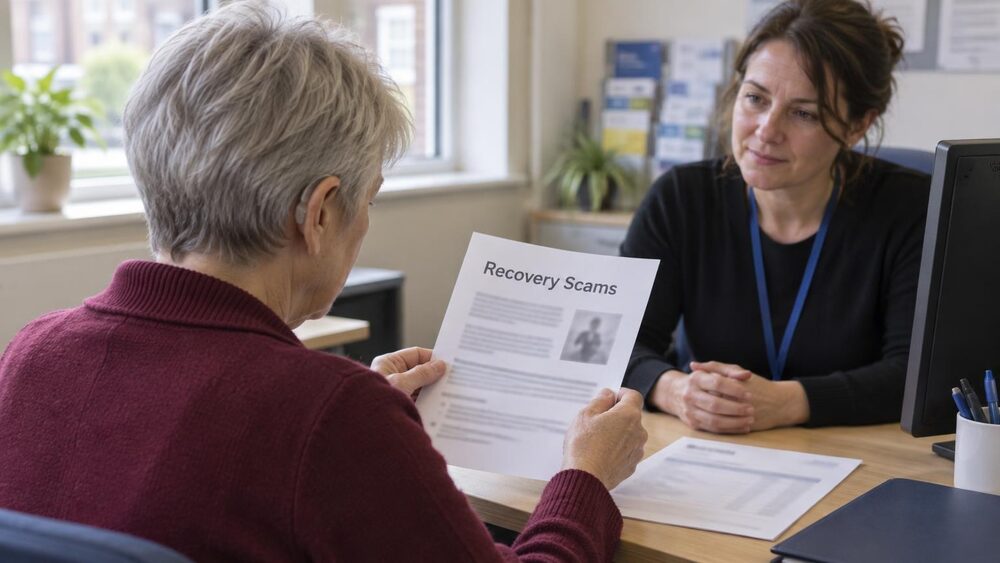
A recovery room scam is a second fraud aimed at someone who has already lost money. Fraudsters approach people who have been scammed, often out of the blue, offering to help them get their money back in exchange for an upfront fee. The Pensions Regulator describes exactly this pattern: "This is where fraudsters approach pension savers who have been scammed, offering to help them get their money back for an upfront fee"1. The original loss might have been an investment scam, a pension scam, a romance scam or any other fraud. The recovery offer is not a rescue; it is the next attack.
The scale is significant. Which? reported that at least £185.4m was stolen by recovery scammers in the year from November 2024 to November 2025, with 5,553 related reports made to Action Fraud in that period2. A Freedom of Information request reported in September 2026 found that 17% of scams reported to the FCA in 2025 mentioned a recovery room scam, with 70% of those linked to cryptocurrency3. The people behind these operations know who has lost money, they know how much, and they know that a person desperate to recover savings is more likely to pay a fee than someone who has never been defrauded.
The single most important fact on this page is this: an unsolicited offer to recover lost money for a fee is not a service. Government guidance on approaches to investors who have lost funds states plainly, "These approaches are always fraudulent"4. There is no legitimate private company that cold calls fraud victims and retrieves their money for an upfront payment. The free routes that do exist, through your bank, the police reporting services and the Financial Ombudsman, are explained at the end of this page.
What a recovery room scam is
The name comes from the fraud world's own vocabulary. A "boiler room" is the original scam: victims are cold called by fake stockbrokers and persuaded to buy shares or bonds in worthless, non-existent or near bankrupt companies6. Once that first fraud has run its course and the victim realises the money is gone, the same criminal networks, or others who have bought the victim's details, move in with the "recovery room": a follow up operation that promises to retrieve what was lost.
Which? defines it simply: "A recovery scam is when fraud victims are targeted by 'professionals' claiming to be able to recover lost money, only to be scammed again"3. The caller may claim to be a lawyer, a claims management company, a government agency or a specialist recovery agent. Which?'s more recent reporting describes the same mechanics: "Typically, recovery scammers promise they can get you your money back for a fee. Unfortunately, they can't, and any money you pay them is lost too"3.
The reason this fraud works is credibility. The caller often knows the name of the company that took your money, the amount you invested, the dates of the transactions and sometimes the name of the person you dealt with. To someone who has not read about recovery rooms, that level of detail sounds like proof of inside knowledge or official standing. It is neither. Details of fraud victims circulate among criminals, and knowing them is itself one of the recognised warning signs3. Scottish Government research describes the same pattern: "fraud victims are targeted by criminals posing as recovery agents, claiming to be able to recover their lost money", with the aim of obtaining personal details and additional money6.
Offers to recover lost money for a fee are always fraudulent
This is the point that most needs saying, because the offer is designed to sound plausible at exactly the moment a person is least able to weigh it up. The government's warning to investors who have lost funds is unambiguous: "These approaches are always fraudulent"4. Not sometimes, not usually. Always. There is no genuine private firm that obtains lists of fraud victims and contacts them with a paid recovery service.
Take Five, the national fraud awareness campaign, makes the same point from the other direction: "Be alert to follow-up scams. Criminals may contact you again pretending they can recover your money for a fee"7. The logic of the scam depends on the victim believing two things at once: that the original money is recoverable, and that the person contacting them is the one who can recover it. Both are false. Money sent to a fraudster is usually moved quickly through multiple accounts or converted into cryptocurrency, which is why 70% of the recovery room scams reported to the FCA in 2025 were linked to cryptocurrency3. No fee paying company can reverse that.
The consequences of paying are straightforward. Any money handed over is added to the loss rather than offsetting it. Which? found six scam reimbursement services purporting to offer legal or claims management services, all of which were dodgy3. The pattern also exposes the victim to identity theft, because the "recovery agent" asks for copies of documents, account details and information about the original fraud, all of which can be used or sold on6.
Who gets targeted: people already scammed or with failed investments
The defining feature of a recovery room scam is that the victim is already a victim. The target list is people who have lost money to an investment scam, a pension scam, a romance scam or a failed investment, and whose details are known to the criminals. A parliamentary research briefing on pension fraud notes that "Pension savings can be an attractive target for fraud because many people do not engage with them until later life and it can be many years before someone realises that they have been scammed"8. The same briefing records that where a pension scam succeeds, "there is no guarantee of the savings being returned and there may be little or no opportunity to rebuild pension savings"8, which is precisely the desperation the recovery room exploits.
Pension savers are a named target group. The Pensions Regulator's threat assessment identifies recovery fraud as a specific threat alongside cloned firms, describing "recovery fraud, where victims are targeted again with false promises of assistance in retrieving their lost funds"9. The Pensions Ombudsman describes the typical pension scam as "a scammer persuading you to transfer your pension savings to a new pension scheme"10, and once that transfer has gone wrong, the recovery room follows. The FSCS has warned that "Scammers are bombarding people aged 55+ with bogus investment opportunities to try to get hold of their pension savings"11.
The targeting is not random in other markets either. People who have lost money in failed investments, boiler room share purchases or cryptocurrency schemes are all on lists that circulate. The Financial Ombudsman's ScamSmart campaign was built around exactly this group, targeting "those most at risk of investment fraud"12. The common thread is that the victim has already shown they will send money to a stranger, and has a specific, large, unrecovered loss that a fake recovery offer can be tailored to match.
How the approach works: cold calls, pressure and an upfront fee
The approach usually begins with contact out of the blue: a phone call, a text, an email, a letter or a message on social media. Cold calling is the classic opening, and Scottish Government guidance on phone scams records the same pattern across fraud types, with scammers approaching by phone, text message and even door to door13. MoneyHelper lists the warning signs that mark out a recovery approach specifically: "You're asked to pay money to get your money back", you are contacted out of the blue after having money stolen, you are rushed to decide in a short timeframe, and the person knows a lot of details about the scam14.
Pressure is a deliberate part of the design. Which?'s guide to investment scam warning signs notes that being "told you need to send money within hours or days or the 'deal' will vanish" is a red flag15, and the same urgency appears in recovery offers: the recovery window is supposedly closing, other victims are supposedly ahead of you in a queue, or a court case or government fund is supposedly about to pay out. The Insolvency Service, whose name is frequently abused in these frauds, describes the fake letters its impersonators send: the letter "says the company is authorised to recover the lost money", asks you to give them your details, and wants you to send more information16.
One tactic deserves its own mention because it defeats caller ID. The government's warning to investors describes "spoofing", where "the caller ID and telephone number seen by an investor is not the scammer's details but are legitimate phone numbers used by Insolvency Service or other organisations"4. A call that appears to come from an official body can therefore be from anyone. The same applies to the recovery room's claims to be acting for the Insolvency Service: the genuine agency does not cold call investors offering recovery for a fee16.
Fees disguised as tax, solicitor or administrative charges
The fee is the whole point of the scam, so it is dressed in words that sound official, unavoidable or refundable. MoneyHelper describes the same trick in related advance fee frauds: "Scammers often describe this fee as a 'deposit', 'insurance' or 'admin fee' and may claim it's '100% refundable'"14. In recovery rooms the fee is commonly presented as a tax that must be paid before a payout can be released, a solicitor's fee for legal work, a court or administrative charge, or a commission on the recovered money.
The tax framing is especially effective because it borrows the language of HMRC. The Financial Ombudsman has recorded scam letters suggesting a refund is due for bank charges, followed by a second letter claiming to be from HMRC confirming a tax refund, as parts of the same scam18. A victim who is told that a £20,000 recovery is ready but blocked until an "unavoidable tax" of a few hundred pounds is paid may find the story internally convincing. It is false. Genuine tax refunds do not require you to pay a fee to a private company first, and genuine recoveries never do either.
The solicitor framing works the same way. Scottish Government guidance describes fake legal services scams: correspondence that looks legitimate "offer[s] legal services in return for a fee or claim[s] that legal action has been taken against you that you must pay to settle", often from fake firms or a fake person at a legitimate firm6. The FSCS has also recorded fraudsters using email addresses designed to imitate its own, "for example" addresses ending @fscsrecovery.org or @fscs.com19. Whatever the label on the fee, the outcome is the same: the money is paid, and nothing comes back.
Fake websites, free email addresses and cloned firm details
Recovery room operators invest in looking real. Take Five confirms the toolkit: "Criminals can clone genuine firms, create fake websites and use convincing documents"7. The Insolvency Service lists what its impersonators' fake letters contain: an official logo, your name and address, a barcode or reference number, the name of a genuine company, the name of the failed company you invested in, a telephone number and an employee's name16. Every one of those details can be faked, and several of them are real, which is what makes the letter convincing.
The small details give these operations away. Which? examined a recovery scammer account on a social media platform and found that "the profile picture was found in more than 100 other places on the internet, but all under different names"3. Free email addresses rather than a company's own domain, websites registered recently, and phone numbers that do not match the official record are all common tells. The FSCS warns that "Scammers can use the name of a legitimate firm and sometimes the FSCS logo to try to get you to part with your money"20, and the same applies to the logos of the Insolvency Service, the FCA, the police and the ombudsman.
Cloning goes further than borrowing a logo. A clone firm takes the name, address and registration details of a real authorised firm and uses them on fake documents and websites, so that a victim who checks the details superficially finds a genuine company. The FSCS's guidance on pension scams states the rule: "A common scam is to pretend to be a genuine FCA authorised firm (called a 'clone firm'). Always use the contact details on the Register, not the details the firm gives you"21. The cloned firm's real registration is proof only that the genuine firm exists, not that the person contacting you is that firm.
Checking a firm: authorisation, clones and contact details
Recovery services that offer to recover money lost to investments or pensions, or to pursue claims for compensation, are carrying out regulated activity, and regulated activity requires FCA authorisation. Which? notes that "If a firm is carrying out regulated activities without authorisation, that's a major red flag and it's likely to be fraudulent"15. The Financial Ombudsman's guidance points consumers to the FCA's firm checker "to confirm the firm is authorised" and to check that the contact details match those listed, precisely to avoid scammers pretending to be a real firm22. Our guide to checking a firm is authorised explains the Financial Services Register step by step, and clone firms covers the cloning tactic in detail.
Two checks catch most recovery rooms. First, search the Financial Services Register for the firm's exact name and use the phone number and address listed there, not the ones in the letter or email. Second, search Companies House: MoneyHelper advises, "Always check the company or organisation contacting you is legitimate by searching for it on Companies House and using the contact details listed there", not the ones provided in the message14. nidirect's guidance for Northern Ireland adds that you can look a company up on Companies House to find out its background and search for reviews online23.
Authorisation matters for more than spotting the fraud. Dealing with an unauthorised firm strips away the protections that exist for consumers of regulated services, as our page on protections you lose by dealing with an unauthorised firm explains. The FSCS can only consider claims where the firm involved was authorised and has since failed: "The adviser must have gone out of business for us to be able to help. It also must have been regulated by the Financial Conduct Authority"24. A review of consumer credit regulation likewise notes that fee related provisions apply only to authorised firms25. Money paid to an unauthorised recovery room sits outside every one of those safety nets.
Where fraud reports go, and where they do not
A claim that recovery rooms rely on is that your case has been referred to them by the police, Action Fraud, the Insolvency Service or another official body. It has not. Action Fraud is "the Police national fraud reporting centre"27; it takes reports of fraud and passes them for policing, and it does not sell or pass victims' details to private recovery companies. The Insolvency Service states that it does not cold call investors about recovering funds, and that anyone claiming to call on its behalf, or impersonating its staff, is a fraudster16. The Payment Systems Regulator has likewise warned of fraudsters posing as its own employees28.
Knowing where reports actually go helps you spot the false claim. In England, Wales and Northern Ireland, fraud is reported through Report Fraud; the ICO's guidance states: "You can do this by contacting Report Fraud about fraud in England, Wales, or Northern Ireland. If you live in Scotland or the fraud happened there, contact Police Scotland on 101"29. Our page on reporting a scam covers the routes in each nation. A POST research briefing notes that "Victims are most likely to report fraud to their bank or account provider, rather than the national reporting service Action Fraud or police"30, which is fine: the bank is the right first call when money has moved.
Reports are shared only through defined official channels. The credit reference agencies "have a special agreement in place which enables them to share information with each other about victims of fraud"31, so that a fraud marker added by one is visible to the others. HMRC's tax fraud reporting service handles tax fraud specifically, and directs other types of fraud, such as identity theft, to Report Fraud32. None of these channels feeds private recovery firms. If a caller says otherwise, that is the scam talking.
What to do if you are contacted or have already paid
If you are contacted, do not pay anything and do not hand over documents or details. The warning signs to weigh are the upfront fee, the unexpected contact, the pressure and the caller's knowledge of your case14. If you want to check the approach, use the official contact details of the body the caller claims to represent, found independently, never the details given to you21. Forward suspicious texts to 7726, as our page on reporting texts explains, and read our general guide to the warning signs of a scam.
If you have already paid, act quickly and in this order:
- Contact your bank or payment provider immediately. NS&I's advice is identical: contact your bank immediately and report to Action Fraud33.
- If the scammer may still be on the line, wait at least 15 minutes before calling your bank on the same phone, or use a different phone; dialling 159 connects you to your bank safely3. Our page on calling 159 explains this route.
- Report it. In England, Wales and Northern Ireland, report through Report Fraud, online or on 0300 123 204029; in Scotland, call the police on 1013. If you have paid money, report the scam to Action Fraud34.
- Keep records of all contact and correspondence between you and the scammer5.
- If your bank will not refund you and you believe it should, complain to the bank first and then to the Financial Ombudsman, which can look at scams involving unauthorised payments5. Our pages on complaining to your bank and the ombudsman set out the process.
Free, impartial help exists. MoneyHelper's Financial Crimes and Scams Unit can be reached on 0800 015 440235, and the FSCS advises victims to speak to their bank, building society or credit union, which can protect and reimburse victims of certain types of fraud, and to report to Action Fraud26. For the wider picture of how bank transfer refunds work after a scam, see authorised push payment reimbursement, and for the first hours after paying a fraudster, what to do straight away.
Sources35 cited
- Our strategy to combat pension scams The Pensions Regulator
- How recovery scammers target recent scam victims on Trustpilot Which?, 2025-11-13
- What is a recovery scam and why should you know about them Which?, 2026-09-10
- Investors warned about approaches to recover lost funds GOV.UK, 2021-03-12
- Scams involving unauthorised payments and identity theft Financial Ombudsman Service, 2026-09-26
- Preventative spend research 2018 Scottish Government, 2021-03-19
- Investment fraud Take Five, 2026-09-26
- Pension scams research briefing CBP-8643 House of Commons Library, 2026-09-26
- Pension scams threat assessment summary The Pensions Regulator, 2022-06-15
- Common topics factsheet: pension scams The Pensions Ombudsman, 2022-02
- Top 5 financial scams FSCS, 2019-09-06
- Ombudsman News issue 135: financial fraud Financial Ombudsman Service
- Common types of scams factsheet Scottish Government, 2021-03-18
- Types of scam MoneyHelper, 2026-09-25
- The 7 signs of an investment scam Which?, 2023-08-23
- Insolvency Service related scams and fraud GOV.UK, 2024-08-21
- 7 pension scams to watch out for Which?, 2022-08-10
- Warning: scammers Financial Ombudsman Service, 2018-01-19
- FSCS podcast episode 46 transcript FSCS, 2025
- Check your money is protected FSCS, 2026-09-25
- Protect yourself from pension scams FSCS, 2018-08-20
- Complaints we can help with: credit and borrowing money Financial Ombudsman Service, 2022-12-23
- Protecting yourself from scams nidirect, 2021-07-02
- DB transfers FSCS, 2026-09-26
- Consumer credit regulation final review HM Treasury, 2022-12
- What if you're a victim of fraud FSCS, 2026-01-07
- APP scams Payment Systems Regulator, 2026-09-26
- Warning: fraudsters posing as PSR employees Payment Systems Regulator, 2026-09-26
- Credit: reporting fraud ICO, 2026-09-25
- POST research briefing PN-0720 Parliamentary Office of Science and Technology, 2026-06-07
- Credit reference agencies and fraud victims ICO, 2026-09-25
- Report tax fraud GOV.UK, 2026-09-25
- Our online security promise NS&I, 2024-02-05
- Warning about bailiff email scam GOV.UK, 2021-09-22
- Young single men most likely to miss the signs of a romance scam Money and Pensions Service, 2026-02-06





 FCA Warning ListCheck whether a firm is authorised before you deal with it
 Financial Ombudsman ServiceFree, independent help when a complaint about a firm is not put right
 Citizens AdviceFree advice on money, consumer and legal problems in England and Wales
 MoneyHelperFree, impartial money and pensions guidance, set up by government