
A debt management plan, or DMP, is an agreement between you and the businesses you owe money to, under which you make one set monthly payment that is shared between your debts1. It is an informal arrangement: there is no court involvement, it is not legally binding on either side, and you repay everything you owe rather than having any of it written off2. The plans are managed by companies known as DMP providers, who negotiate with your creditors and pass on the payments1.
A DMP is used for non-priority debts only, things like credit cards, personal loans, overdrafts and store cards, and it is normally considered where you can afford something towards those debts each month after your essential living costs are covered3. There is no minimum or maximum amount of debt to apply4. Most plans aim to finish within 10 years, and if repaying your debts would take ten years or more, an adviser will usually point you towards a different solution5.
Crucially, a DMP can be set up for free. Debt charities provide the same service as fee-charging companies, handling payments and negotiating with creditors, at no cost6. Some commercial providers charge a management fee, typically between 10% and 15% of your monthly payment, and a few take up to half of it7.
How a debt management plan works
The mechanics are simple. You work out a budget with a debt adviser, subtract your priority bills and living costs, and whatever is left over becomes your monthly DMP payment9. You pay that single amount to the DMP provider, who contacts everyone you owe, agrees reduced payments on your behalf, and sends each creditor a share of your money3. The share is worked out proportionally, so a creditor you owe more to gets a bigger slice of the payment4.
Because the payment is based on your budget rather than your contractual minimums, it is affordable, but it is also lower than what you originally agreed to pay each month. That has consequences covered later in this page: your credit file records the reduced payments, and arrears can build up on the accounts12. In exchange, you get a single payment instead of juggling several, and in many cases creditors stop contacting you once they see regular money arriving1.
A DMP is usually arranged by a third party provider, either a debt charity or a debt management company, though some people self-manage a plan and deal with the people they owe themselves3. Whichever route you take, the plan is voluntary on both sides: you are choosing to repay in full over a longer period, and your creditors are choosing to accept reduced payments rather than hold you to the original schedule10.
Which debts a DMP can include, and which it cannot
A DMP mainly covers non-priority debts: credit cards, personal loans, overdrafts, store cards and buy now pay later agreements13. These are unsecured debts, money that has not been guaranteed against your property1. Priority debts, such as rent arrears, mortgage arrears, council tax arrears and utility arrears, are normally dealt with outside the plan, because the consequences of not paying them are more serious and they need to be paid at the agreed amount13.
| In a DMP | Kept outside a DMP |
|---|---|
| Credit cards and store cards | Mortgage and rent |
| Personal loans and overdrafts | Council tax |
| Buy now pay later agreements | Gas, electricity and water bills |
| Catalogue and mail order debts | Court fines and magistrates' arrears |
| Arrears on non-priority credit | TV licence and benefit overpayments being deducted |
Two rules matter here. First, all of your non-priority debts should be included in the plan, not just the awkward ones: including everything shows your creditors that you are treating them fairly, and leaving debts out can cause problems later14. Second, only the arrears on household bills go anywhere near the plan, and even then priority arrears are usually handled separately; the regular ongoing bill payments are not included in a DMP12.
A DMP does not write off any debt. The aim is to repay the full amount you owe, over a longer period and at a lower monthly rate5. That is what separates it from the formal solutions later in this page, several of which do write off part of what you owe. If your budget shows you cannot afford anything towards your non-priority debts, a DMP is not the right tool, and a debt adviser will look at other options instead.
Fees and charges: free plans and paid providers
Some companies charge a fee for debt management plans while others give their services for free1. This is the single most important cost difference in the market, because the service itself, negotiating with creditors and distributing payments, is the same either way. Free providers such as StepChange, National Debtline and PayPlan can set up a free DMP for you, handling payments and negotiating with the people you owe15. StepChange states that its DMPs are free16.
Fee-charging debt management companies typically take a management fee of between 10% and 15% of your monthly payment7. Over years of payments, that is a substantial amount of money that goes to the company rather than to your debts. Some providers add further costs, such as set-up fees, admin fees, advice fees and maintenance fees, and some take up to half of the monthly payment in fees17.
The practical point is that every pound taken in fees is a pound not going to your creditors, which makes the plan last longer. When weighing up a plan, whether free or fee-charging, the things to consider are how it will affect your credit rating, how much debt you have to repay, and how long repayment will take19. The comparison page on free debt charities or fee-charging companies sets the two side by side.
Interest and charges: creditors are asked to freeze them but do not have to
When a DMP is being set up, creditors will sometimes agree to freeze interest and charges. However, there is no legal requirement for them to do so, and they do not have to accept the plan at all1. Most creditors do accept DMP payments and do agree to stop or reduce interest and charges, which is why the plans work in practice, but this is goodwill and commercial practice, not a right you can enforce20.
There are rules that push in your favour. Creditors should look at stopping or lowering charges and interest on a debt if you tell them you are in financial difficulty21. Payday lenders who are members of the trade associations' customer charter should freeze interest and charges if you make repayments under a reasonable repayment plan, or after a maximum of 60 days of non-payment22. So on some kinds of debt the freeze is close to automatic in practice, even though the underlying obligation does not exist.
The risk is that a creditor refuses, keeps adding interest, and your debt level does not reduce at all over the period23. If that happens, the plan still runs, but more of each payment is eaten by interest and the plan takes longer. This is one of the main reasons an adviser will check whether a DMP is realistic for your situation before recommending one: on large debts with interest still running, a formal solution where interest must stop can sometimes be the better fit. The narrow guide on whether creditors have to freeze interest covers the detail.
How to set up a DMP and make your monthly payment
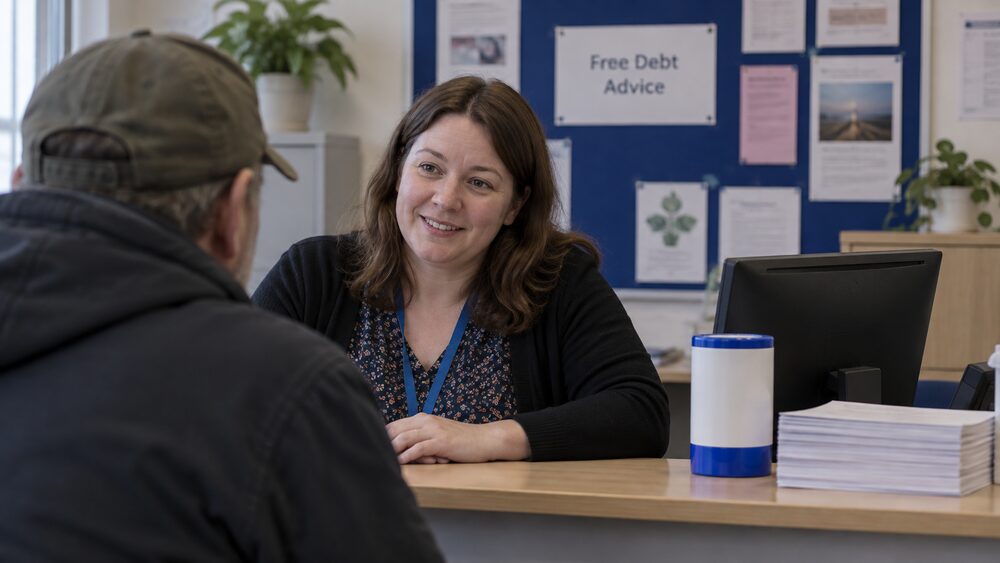
The first step is a full budget with a debt adviser, working out what you can afford after priority bills and living costs. Free advice is available from the charities named above, and the adviser will check whether a DMP is the right solution before setting one up15. You can also set up a DMP yourself, but then you have to manage your own payments, contact everyone you owe yourself, and run the plan on your own24.
To set the plan up, the provider needs some paperwork: a signed DMP agreement, a signed Direct Debit agreement, proof of income, and the account numbers for all of your debts24. The provider then tries to reach an agreement with your creditors on reduced payments, and once the plan is running you make one affordable payment each month, usually by Direct Debit5.
Monthly payments are based on what you can afford towards your debts, not on what the creditors demand25. Some free providers ask that you can afford at least £5 to each of your debts every month26. The provider shares the payment out in proportion to the size of each debt, and the length of each original agreement is reflected in how the debts clear: a debt with a term of five years is paid off before a debt with a term of 10 years27.
You do not need a good credit record to get a DMP; the plan exists for people whose credit is already damaged28. And the plan is flexible: if your income changes, your spending changes, or you have more savings than expected, you can review your budget with your provider and change the payment29.
A DMP is informal: what that means for your home, job and privacy
The word that matters most on this page is "informal". A DMP is an informal arrangement with the people you owe, not legally binding30. Because it is informal, you are not tied into making a fixed payment for a set period, and you can ask for a review whenever your situation changes5. That flexibility is the plan's main advantage over the formal solutions, which lock you into payments that a supervisor or the courts oversee.
The same informality has limits. Your assets, the items of value you own, are not protected under a DMP in the way they can be under a formal solution17. Your creditors can still take court action against you, and in rare cases court action could have an impact on your home31. Nothing is published or registered anywhere: a DMP is completely confidential, and only you, your creditors and your DMP provider need to know about it17. There is no public register, unlike bankruptcy or an IVA, and no restriction on your job or on being a company director.
For many people the privacy is a real benefit. A DMP does not appear in the insolvency register or the Edinburgh Gazette, your employer is not told, and you can continue in any occupation. The trade-off is that everything depends on creditors' goodwill: they can refuse the offer, keep charging interest, or go to court anyway. The formal solutions buy you legal protections, such as stopped interest and protection from enforcement, that a DMP cannot.
How a DMP affects your credit file
A DMP affects your credit rating because you pay less each month than you originally agreed8. The reduced payments are recorded on your credit file, and some creditors record them as partial payments12. Some creditors also add a DMP or "arrangement to pay" marker to your file32. If you miss payments on a credit debt, that is recorded by your creditor whether or not you then set up a DMP, so in many cases the damage to your file has already begun before the plan starts33.
There is one exception: if you pay the full contractual amounts, your DMP will not appear on your credit file32. That is rare, since most people on a plan cannot afford the full amounts, but it shows what drives the record: it is the reduced payment, not the plan itself, that lenders see.
A default stays on your credit file for six years34. Creditors might default your account after a few months of reduced DMP payments, and once that happens the record remains visible to lenders for six years from the default date, after which it drops off34. During that time new credit is harder to get: it is harder to take out a mortgage on a DMP, and lenders are likely to refuse an application or charge higher interest31.
Your DMP only affects people you have joint debts or financial products with32. A partner you share nothing with financially is untouched by your plan; a partner on a joint loan is affected because the debt is theirs too. The guide to joint debts and your partner's debts explains where the lines are.
Where a DMP does not protect you: court action and creditor contact
A DMP does not protect you from further court action35. Your creditors can refuse the DMP offer, pass your debt to a collection agency, start court action, or simply continue to contact you36. They do not have to enter into the plan at all, and they may still contact you asking for immediate repayment1. This is the sharpest edge of the plan's informality: nothing in it stops a determined creditor.
In practice, contact usually eases. The people you owe can call or write to you during your DMP, but it should get less if you stick to the payments37. In many cases people on a plan are no longer contacted by creditors or debt collectors at all1. If a creditor does pressure you to pay more money outside of your DMP, that is unfair practice, and you can make a complaint against them14. The rules on how lenders must treat you when you fall behind and on debt collectors and your rights set out what is acceptable.
If court action does start, the plan does not stop it, but it changes what happens next. A CCJ added during a DMP is treated as a priority debt37. If an attachment of earnings order is made, money comes straight from your wages, and this affects how much is left in your budget for the plan, so it is something a DMP provider takes into account38. The pages on county court judgments and court enforcement cover what happens next.
DMP or IVA, bankruptcy or DRO: how the options differ
A DMP is one of several ways of dealing with problem debt, and an individual may be able to avoid bankruptcy by setting up a debt management plan, an administration order, an individual voluntary arrangement (IVA) or a debt relief order (DRO)39. The choice between them usually turns on three things: whether you can afford to repay anything, how long repayment would take, and whether you need the legal protections that only a formal solution gives.
The core differences are these. A DMP is informal, repays everything you owe, has no fixed term and can be changed or stopped at any time5. An IVA is legally binding, runs for a set period, and writes off part of the debt, but usually requires a regular payment and an insolvency practitioner30. Bankruptcy writes off most debts after a short period, but creditors have to stop adding interest and charges to your balances, and your assets can be used to pay the debt40. A DRO is a lighter formal option for people with low debt, low income and few assets.
| DMP | IVA | Bankruptcy | DRO | |
|---|---|---|---|---|
| Legally binding | No30 | Yes | Yes | Yes |
| Debt written off | None5 | Part | Most | Most |
| Interest frozen | Creditor's choice1 | Yes | Yes40 | Yes |
| Typical length | Until repaid, usually under 10 years6 | Fixed term | Short period | Fixed period |
| Public record | No17 | Yes | Yes | Yes |
In Scotland the picture is different. The Debt Arrangement Scheme (DAS) is a formal, legally binding equivalent of a DMP, with fees included in the plan and paid for by your creditors, and protection against creditors freezing interest and taking action while the plan runs17. A Scottish debtor choosing between the two is choosing between an informal plan and a statutory one, which is a different decision from the one facing someone in England, Wales or Northern Ireland. The page on the Debt Arrangement Scheme covers it fully.
The comparison pages go deeper on each pairing: DMP or IVA, IVA or bankruptcy and DRO or bankruptcy. A debt adviser will look at your full budget before suggesting any of them, and the advice itself is free15.
Keeping a plan on track, and when it can fail
A DMP is not a fire-and-forget arrangement, but it is forgiving. Because it is informal, payments can go up or down when your circumstances change, and the plan can be reviewed at any time5. If your income rises, you may be able to increase your monthly payments or make full and final settlements on individual debts, which can finish the plan early29. If you come into a lump sum, the options are to pay the money into the DMP, pay the people you owe in full if possible, or make partial settlement offers29.
There are things that put a plan at risk. Using credit during the plan is against the terms of some providers' plans and can result in the plan being closed41. Missing payments a lot puts the DMP at risk of being cancelled34. A provider may also have to close a plan if they do not hear from you at a review, though providers describe this as a last resort41. If your provider itself closes, free providers can set up a replacement plan, and any firm contacting you directly to take it over is likely to charge fees15.
If the plan does fail or become unaffordable, that is not the end of the road: the options include changing the payment, switching provider, or moving to a different debt solution. Changing DMP provider is possible, though some agreements carry extra charges, so the terms of the agreement set out what applies8. The narrow guide to missing a payment or no longer affording a DMP covers the steps.
One protection is worth knowing about. Money held by a DMP provider that has not yet been passed to your creditors can be protected by the Financial Services Compensation Scheme if the provider fails, though the FSCS does not cover the debts themselves or the advice42. The wider guide to debt solutions across the UK puts every option in one place, and free debt advice explains where to start.
Sources42 cited
- Debt management plans nidirect, 2025-11-06
- How debt management plans work StepChange Debt Charity, 2026-09-25
- Debt management plan StepChange Debt Charity, 2026-09-25
- Options for dealing with debt Advice NI, 2026
- Debt management plan vs IVA: key differences National Debtline, 2026-09-25
- DMP or bankruptcy StepChange Debt Charity, 2026-09-25
- Debt management plans (England and Wales) National Debtline, 2026-09-25
- What is a DMP StepChange Debt Charity, 2026-09-25
- DMP questions StepChange Debt Charity, 2026-09-25
- Getting a DMP StepChange Debt Charity, 2026-09-25
- Debt management plans (Scotland) National Debtline, 2026-09-25
- Debt management plan: how we help StepChange Debt Charity, 2026-09-25
- What is a debt management plan Debt Advice Foundation, 2024-07-04
- DMP dos and don'ts StepChange Debt Charity, 2026-09-25
- Your debt management plan provider has closed Citizens Advice, 2026-09-25
- Debt advice in Scotland StepChange Debt Charity, 2026-09-25
- Debt Arrangement Scheme or DMP StepChange Debt Charity, 2026-09-25
- Free debt management plans StepChange Debt Charity, 2026-09-25
- Debt management Debt Advice Foundation, 2026
- IVA or DMP StepChange Debt Charity, 2026-09-25
- Freezing interest and charges StepChange Debt Charity, 2026-09-25
- Payday loans Business Debtline, 2026-09-26
- Debt solutions Shelter Cymru, 2026-08-30
- Setting up a debt management plan StepChange Debt Charity, 2026-09-25
- Can I go on holiday on a DMP StepChange Debt Charity, 2026-09-25
- Debt management plans (Scotland) Business Debtline, 2026-09-26
- Creditor payments StepChange Debt Charity, 2026-09-25
- Debt consolidation and debt management StepChange Debt Charity, 2026-09-25
- Can I pay a DMP off early StepChange Debt Charity, 2026-09-25
- DMP and credit score StepChange Debt Charity, 2026-09-25
- DMP, mortgage, home and tenancy StepChange Debt Charity, 2026-09-25
- Managing a DMP StepChange Debt Charity, 2026-09-25
- Interest, creditor contact and DMP StepChange Debt Charity, 2026-09-25
- How a DMP affects me StepChange Debt Charity, 2026-09-25
- Debt Arrangement Scheme StepChange Debt Charity, 2026-09-25
- Insolvency Trading Standards Wales, 2026
- How could my DMP fail StepChange Debt Charity, 2026-09-25
- Attachment of earnings StepChange Debt Charity, 2026-09-25
- Bankruptcy StepChange Debt Charity, 2026-09-25
- Payday loans (Scotland) Business Debtline, 2026-09-26
- Free and face-to-face debt advice: PayPlan StepChange Debt Charity, 2026-09-25
- What we cover: debt management Financial Services Compensation Scheme, 2026-09-25



 StepChangeFree debt advice and solutions from a charity
 National DebtlineFree debt advice by phone, webchat and online
 MoneyHelperFree, impartial money and pensions guidance, set up by government
 Citizens AdviceFree advice on money, consumer and legal problems in England and Wales
 Citizens Advice ScotlandFree advice across Scotland