
A county court judgment, usually called a CCJ, is a court order telling you to pay a debt. It is a civil court order that says you owe the money and sets out how and when it must be repaid1. A creditor applies to the county court for one when other attempts to collect have failed, and the court's decision is then recorded against your name.
The consequences are mostly about your credit record and enforcement. A CCJ stays on the public Register of Judgments, Orders and Fines and on your credit file for six years, and lenders use that register to judge credit applications2. If you do not keep to the judgment, the creditor can ask the court for enforcement steps such as bailiffs, deductions from your wages, or a charging order against your home1.
The most important thing to know is that a claim form is not yet a judgment. You normally have 14 days to respond, and how you respond decides what kind of judgment, if any, is made1. Responding in time keeps your options open: paying, offering instalments, or defending the claim.
What a county court judgment is and when creditors use one
A CCJ is an order from the court to pay back what you owe7. More fully, it is a legal declaration of liability made by the county courts, setting out how much is owed to the claimant, how much should be paid to them and over what period8. The advice on this page applies to residents in England and Wales only; Scotland and Northern Ireland use different court orders, covered in the last section6.
CCJs are often used as a way of recovering non-priority debts, such as credit card debts and payday loans2. Non-priority debts are ones where the consequences of falling behind are less immediate than, say, rent or council tax arrears, which is why the guidance on which debts to pay first matters before a claim ever reaches a court. A creditor may take you to court to recover the money you owe, and that court action could result in a CCJ against you9.
Before court action starts, creditors are expected to send a letter before claim, sometimes called a letter of claim, warning that they intend to sue. In debt cases this letter is usually sent by Northampton County Court3. Replying to that letter is the last easy chance to avoid the claim altogether, and the page on replying to a letter before claim explains how.
A CCJ also unlocks stronger enforcement powers. A lender can only use bailiffs to collect consumer credit debt, such as a personal loan, credit card or mobile phone contract, after they have applied to a court for a CCJ against you10. A charging order, which secures a debt against your home, can only be applied for if the creditor has already got a CCJ for the debt11. So the judgment itself is not the end of the matter: it is the point at which the creditor gains access to enforcement through the court.
You have 14 days to respond to a claim form
When a creditor issues a claim, you receive court forms through the post. You normally have only 14 days from the date the claim is "served" on you to respond, although you may be able to ask for extra time12. The deadline is counted from service, not from when you first notice the form, so it is worth opening court post on the day it arrives.
If you do not reply within 14 days, your creditor can ask the court to enter "judgment in default", and this will affect your credit rating2. A default judgment is made without a hearing and without the court hearing anything from you, which is why the Ministry of Justice has consulted on limiting the circumstances in which an individual can have a judgment made in default against them without their knowledge13. Until the rules change, the protection is in your own hands: respond within the deadline.
The 14 days is not always the whole story. If you disagree with the claim and need more time to prepare your response, you can usually acknowledge service to extend your deadline to file a defence1. Claims issued by Northampton County Court and claims issued by any other county court hearing centre can have different practical deadlines, so check the paperwork that came with your form5. The page on how long you have to reply to a court claim form sets out the detail.
If you suspect the claim relates to a debt you have not heard about for years, it may be statute-barred, meaning the creditor has run out of time to sue. The page on when a debt becomes statute-barred explains the time limits, and getting free advice before the deadline is sensible: free debt advice is available from charities at no cost.
Admit, offer instalments or defend: your response options
Official guidance sets out three ways to respond to a claim form for money: pay the full amount, offer to pay a different amount if you think you owe less than the claim amount, or defend the claim14. Which one fits depends on whether you agree you owe the debt, and whether you can afford to pay it.
The response forms work like this2:
- Form N9A, selecting the option to pay the debt in full, if you accept the claim and can pay it.
- The N9a admission form and the N9b defence form if you agree with some of the claim but not all of it.
- The N9b defence form if you dispute the claim.
If you admit the debt but cannot pay it in one go, you will need to list your income and outgoings on the response form and make an offer for what you can afford after all your essential costs are met2. The guidance on budgeting for repayments explains how that budget is built. The court may agree that you can pay in stages that you can afford15.
If you defend the claim, the court lists a hearing, and the case is decided on the evidence1. If you need more time, acknowledging service usually extends the deadline to file a defence1.
Depending on how you respond, the court can enter judgment by admission if you accept the debt and ask for time to pay, enter judgment in default if you do not respond, or list a hearing if you defend the claim6. You can respond before the creditor takes further action, and doing so keeps the choice of route in your hands15.
How the court decides what you pay
The judgment can say that you must pay the full balance straightaway, which the court calls "forthwith", or in instalments that the court considers affordable for you6. Where you have admitted the claim and offered instalments, the court decides whether the offer is acceptable, and the process is practical: you get blue and white court forms through the post, fill them in offering an affordable monthly repayment amount, then wait for the court's response and keep to what has been agreed16.
The court's decision on affordability is not the last word. If a District Judge decided the original payment rate and you think it is too high, you can ask for a redetermination, and the court will ask you to attend your local County Court hearing centre for a hearing where the new rate of payment is decided17. The page on paying a CCJ in instalments covers this in more detail.
Costs can be added to what you owe. Court fees in money claims are paid by the people you owe and can be added to the judgment owed by you18. If the creditor has to apply to enforce payment, they will have to pay a fee to the County Court for the application, and they will add that fee to your debt too7.
| Court fee | Amount |
|---|---|
| Judgment (acceptance), claim £25 to £5,000 | £4018 |
| Judgment (acceptance), claim over £5,000 | £5518 |
| Judgment in default | £2518 |
| Warrant of control (county court) | £9419 |
If the court orders you to make instalments, it is the creditor's responsibility to collect them, not the court's2. The judgment tells you how much to pay and when, and you pay the creditor directly. If your circumstances change later, you can apply to the court to change the terms of your CCJ2.
Pay within one month and the CCJ can be cancelled
There is one window in which a CCJ can be wiped off the record entirely. If you pay off the full CCJ amount within a month of judgment, you can apply to have the CCJ removed4. The condition for removal from the register is that you pay off the debt within one month of the judgment being entered on the register5, and you then apply to the court for a certificate of cancellation1.
Some sources describe this window as one month from the judgment, others as 30 days from the CCJ being issued; the documents use slightly different wording but describe the same early-payment window20. Whichever measure is used, the practical rule is the same: pay in full as soon as you can after the judgment, then apply to the court with proof of payment.
If you pay after one month has passed, the position changes: you cannot remove it from the register early4. Paying late still matters, because the entry can be marked as satisfied, but the CCJ will remain on the register and your credit file for the full six years6. So the one-month rule is the difference between a CCJ that disappears and one that stays visible to lenders for years.
Certificate of satisfaction: marking a paid CCJ
If you pay the CCJ in full after one calendar month, you can ask for your entry to be marked as "satisfied" if you provide proof of payment, but the CCJ will still stay on your credit reference file7. A certificate of satisfaction shows the CCJ has been paid21, and once it is granted the register will show the CCJ as paid off or "satisfied"4.
The application process is straightforward but requires proof:
- Apply for a certificate of satisfaction from the same County Court hearing centre that issued the judgment4.
- Provide proof of payment, using court form N4434.
- Pay the £15 court fee4.
Once the certificate is granted, a note is made against your entry on the Register to show that the debt has been satisfied, or paid22. You will need the certificate from the court to prove you have paid off the debt, for example when a lender or landlord asks2.
The benefit is real but limited. Marking the CCJ as satisfied makes it easier to apply for credit in the six years before the CCJ drops off your credit file4. It does not remove the entry: the CCJ will still stay on your credit reference file7. The difference between a satisfied CCJ and an unpaid one is visible to every lender that checks, which is why the certificate is worth applying for even though the entry itself remains.
Six years on your credit file and the public register
A CCJ stays on the register and your credit files for six years6. The entry is removed from the public register and your credit file after six years, even if you have not paid it off4. The six years run from the date the CCJ was made7.
The record sits in two places. First, your credit file: all CCJs are listed on your credit file, so checking it with Experian, Equifax or TransUnion is how you find out for sure whether one has been made against you1. Credit reference agencies keep most county court judgments on record for a period of six years5. Second, the public Register of Judgments, Orders and Fines, which lenders use to determine credit suitability8. Anyone can check if you have an outstanding CCJ for a fee of £45.
The practical effects run wider than borrowing. Having a CCJ can affect your credit rating and may make it harder for you to obtain credit in the future2, and it might also be difficult to start renting a home from a private landlord or letting agent if you have a CCJ against you22. Lenders will be able to see that you have a CCJ4. On the mortgage side, if your CCJ was longer than six years ago it will not appear on your credit file, and if you paid the debt within 30 days or successfully disputed it, it might not even appear on your credit history at all20.
A CCJ is removed from the register and your credit file after six years even if you have not paid it23. That removal is automatic, but it is not the same as the debt being written off: the debt itself may still be enforceable after that, although the creditor would usually need the court's permission to take certain steps once six years have passed1.
Set aside or vary: challenging a CCJ after it is made
Two different applications exist for two different problems, and it is worth being clear which one you need.
Setting aside asks the court to cancel the CCJ and reopen the case so you can properly respond. It usually involves a fee and may require a hearing6. If you only found out about a judgment after it was made, perhaps because the papers went to an old address, you may be able to apply to set aside the judgment6. The grounds that tend to succeed are17:
- you were not aware of the CCJ, for example because the court sent the claim form to an old address
- you have a good argument against the CCJ, such as having already paid the debt off
- you acted as soon as you found out about the CCJ
If you never received the CCJ in the first place and it appeared on your file, you need to contact the court where the CCJ was made20. There is also a specific limitation ground: if you think the CCJ was ordered after the six year limitation period, ask the court to set it aside21.
Varying is different. If a judgment has already been made and the payment terms are too high, you can apply to vary the CCJ, which means asking the court to change the order so you pay in affordable instalments6. You will need to provide a detailed budget and there may be a small court fee1. The application is usually made using form N24523. Varying the payment is at the court's discretion, so the court does not have to agree to vary the payment24. You can also apply to the court to change the terms of your CCJ if your circumstances change2.
If you cannot afford the CCJ, ask the court if you can pay in stages21. Free debt advice helps here, because a properly prepared budget is what persuades a court: charities listed on our page about free debt advice will build one with you at no cost.
What happens if you do not pay
If you ignore a CCJ, more court action can be taken against you4. If you do not pay what is owed or make a payment arrangement, further action can include bailiffs visiting you, an attachment of earnings order, a third party debt order, a charging order, or a bankruptcy application23. Ignoring the judgment also means you lose the chance to challenge the CCJ, make a payment plan, or pay it off on terms you can manage23.
The main enforcement routes are:
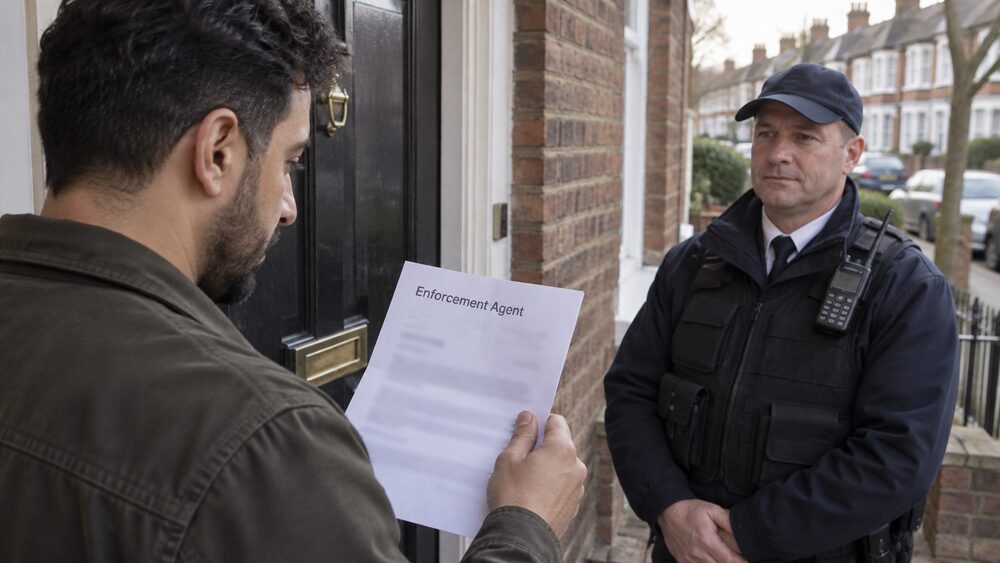
- Bailiffs (enforcement agents) taking control of goods. The courts can give the creditor a warrant of control if you do not pay a CCJ25, and the county court fee for a warrant of control application is £9419.
- An attachment of earnings order, which takes money from your wages.
- A third party debt order, which can take money from your bank account26.
- A charging order, which secures the debt against your home if you own a property27.
- Bankruptcy: if you owe more than £5,000 and do not pay, creditors can apply to make you bankrupt23.
A creditor who wants to use bailiffs or High Court Enforcement Officers on a CCJ that is more than six years old must first get permission from the court28. Within the six years, no such permission is needed.
The creditor may also seek information about your finances. An order to obtain information is an order to go back to court and be questioned under oath or affirmation about your financial circumstances, and creditors can ask for one once they already have a CCJ against you29. You will have at least 14 days' notice of the hearing, and the order contains a penal notice: a warning that if you do not go, you can be sent to prison for disobeying the court order, which is contempt of court29. You must answer the questions on oath or affirmation, and after the questioning you will be asked to sign a written record of the information you have provided29. If you still refuse to answer questions, the judge can order you to be sent to prison for up to 28 days29. If you have very little money, you can ask the creditor to pay your travel expenses to the hearing, but you must do this within seven days of being ordered to attend29.
If you cannot pay, the worst response is silence. You are at risk of enforcement agents being sent to your home, a charging order on your property, or an attachment of earnings order taking money from your wages17. The pages on how creditors enforce a court judgment and bailiffs and your rights explain each step, and the options in debt solutions across the UK remain open to you.
CCJs in debt solutions
A CCJ does not close off your other options for dealing with debt; in most formal solutions it is simply one debt among many.
In an individual voluntary arrangement, a CCJ can and should be included31. Making separate payments through a CCJ while in an IVA is seen as showing preference to one creditor and is against the terms of the arrangement31. The same logic applies to informal plans: a debt management plan can include CCJ debts alongside everything else.
A CCJ can also be included in a debt relief order, but only if you meet the other guidelines for a DRO3. The page on debt relief orders explains the conditions. Bankruptcy likewise covers CCJ debts, and creditors can in any event apply to make you bankrupt if you owe more than £5,000 and do not pay23.
One caution applies throughout: enforcement already underway does not always stop the moment a solution starts. A charging order already secured against your home, for instance, is a debt secured on property rather than an ordinary unsecured debt. Free advice from a charity will tell you how a CCJ interacts with each solution, and our page on free debt advice lists where to get it.
Scotland and Northern Ireland: decrees and money judgments
The rules on this page apply to England and Wales. The other UK nations have their own court orders, and the names matter when you are checking records or responding to papers.
In Scotland, the equivalent order is a decree. Decrees are the Scottish equivalent to money judgments, known as county court judgments or CCJs, in England and Wales32. The consequences of not paying a decree in Scotland can include money being taken from your wages or benefits, and your supply being cut off where the debt is to a utility supplier33. Enforcement in Scotland runs through diligence, the system of arrestment and sheriff officers explained on our page about diligence in Scotland, and the Scottish solutions include the Debt Arrangement Scheme, protected trust deeds and sequestration.
Marking a Scottish decree paid also works differently. In Scotland, it is not the court that issues the certificate of satisfaction34. If the debt has been paid in full, you have to get a letter of satisfaction from the pursuer in the action, or the pursuer's solicitor, explaining that the debt has been paid, then send it to Registry Trust Limited with their administration fee and confirmation of your name and address at the time of the decree32. The letter needs to give the name of the court, the case number, the date of the decree, the amount of the decree, and the date the debt was repaid in full34.
In Northern Ireland, the court order is called a money judgment35. In England, Wales and Northern Ireland the order is a County Court judgment (CCJ), and in Scotland it is a decree36. A CCJ in Northern Ireland counts against you if you apply for credit in the future37. The debt solutions available differ too: see our pages on bankruptcy in Northern Ireland and money in Scotland, Wales and Northern Ireland for how the rules differ where you live.
Sources37 cited
- County court judgments guide National Debtline, 2026
- County court judgments (CCJs) Shelter Cymru, 2026
- County court judgment (CCJ) StepChange, 2026
- How long does a CCJ last? StepChange, 2026
- Credit reference agencies National Debtline, 2026
- CCJs: enforcement, removal and what you need to know National Debtline, 2026
- Replying to a county court claim Business Debtline, 2026
- What is a County Court Judgement (CCJ)? Debt Advice Foundation, 2020
- Credit card debt Shelter Cymru, 2026
- Enforcement agents (bailiffs) Surviving Economic Abuse, 2023
- Charging orders National Debtline, 2026
- Emergency situations National Debtline, 2026
- Default County Court Judgments consultation HM Government, 2017
- Respond to a court claim for money HM Government, 2026
- Cost of living StepChange, 2026
- Self-employed debt advice StepChange, 2026
- Can't pay a CCJ StepChange, 2026
- Court fees StepChange, 2026
- Apply for a warrant of control HM Government, 2026
- How to get a mortgage with CCJs Which?, 2025
- Set aside a CCJ StepChange, 2026
- County court judgments and your credit rating Citizens Advice, 2026
- What happens if you do not pay or ignore a CCJ StepChange, 2026
- Varying a CCJ National Debtline, 2026
- Glossary StepChange, 2026
- Creditor takes money from your bank account Citizens Advice, 2026
- Getting credit card debt written off National Debtline, 2026
- Mortgage shortfalls Business Debtline, 2026
- How a creditor can get information about your finances Citizens Advice, 2026
- Warning about bailiff email scam HM Government, 2021
- Debts included and excluded in an IVA StepChange, 2026
- Money judgments and certificates of satisfaction FAQs Scottish Courts and Tribunals Service, 2026
- What debts to pay first StepChange, 2026
- Money judgments and certificates of satisfaction FAQs Scottish Courts and Tribunals Service, 2026
- DMP and credit score StepChange, 2026
- Debt collection StepChange, 2026
- Overdrafts and other bank debts nidirect, 2025



 StepChangeFree debt advice and solutions from a charity
 National DebtlineFree debt advice by phone, webchat and online
 MoneyHelperFree, impartial money and pensions guidance, set up by government
 Citizens AdviceFree advice on money, consumer and legal problems in England and Wales
 Citizens Advice ScotlandFree advice across Scotland