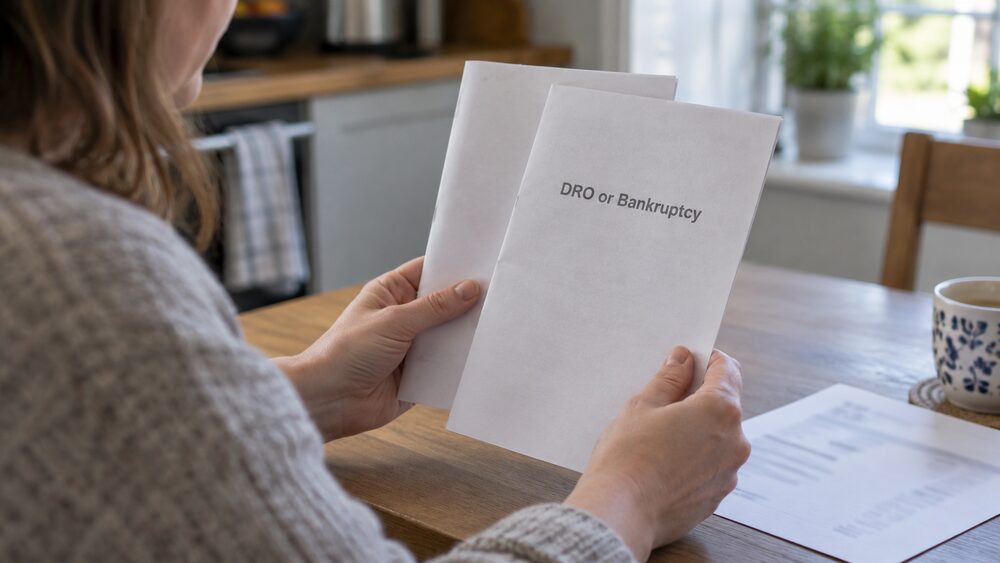
If you cannot pay your debts and have little income or few assets, two formal options can write them off: a debt relief order (DRO) and bankruptcy. A DRO is a form of insolvency and a low cost alternative to bankruptcy, designed for people on a low income with a relatively low level of debt who cannot pay off their debts in a reasonable amount of time1. Bankruptcy is a statutory insolvency procedure designed to help an insolvent individual repay as much of their debt as possible3.
The main practical differences are cost, debt limit and how you apply. Since 6 April 2024 there has been no fee for a DRO in England and Wales, so applying is free4. A DRO helps people with debts of less than £50,0005. Bankruptcy gives protection against action by creditors for a one year period6.
For some people a DRO will be a cheaper alternative to full bankruptcy, and the rules around DROs have changed in ways that could benefit those considering an insolvency solution like bankruptcy7. Which one fits depends on your income, your assets, how much you owe and where in the UK you live.
What each option is and what it does
A DRO is a statutory solution designed for individuals with low value debts, low incomes and few assets as an alternative to bankruptcy3. It is a form of insolvency and a low cost alternative to bankruptcy1. It is made under a partnership between the Insolvency Service and skilled debt advisers, called approved intermediaries, and DROs do not involve the courts10.
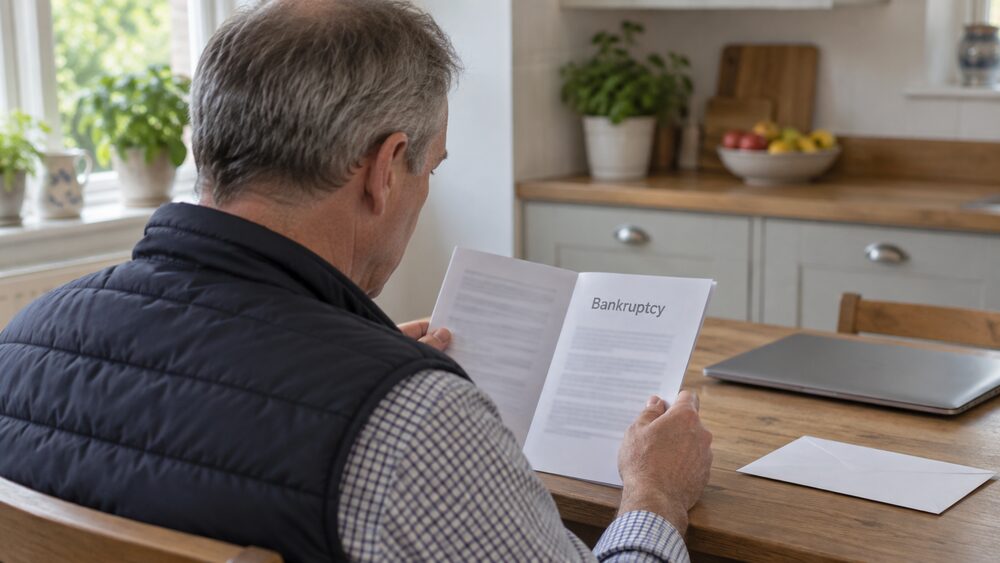
Bankruptcy is a statutory insolvency procedure designed to help an insolvent individual repay as much of their debt as possible3. If a person in debt wants to declare themselves bankrupt, they apply to an Adjudicator in the Insolvency Service by completing an online declaration of assets12.
Both are formal insolvency procedures, and both appear on the public Insolvency Register, which is a public record containing details of bankruptcies, IVAs and debt relief orders in the UK13. That record is searchable by anyone, including lenders.
A DRO has a similar effect to a bankruptcy order made by the court but costs substantially less14. The two are not interchangeable: a DRO suits smaller debts and lower incomes, while bankruptcy has no debt ceiling but carries higher costs and a longer, more public process.
Fees, charges and eligibility
The cost difference is the clearest dividing line. Since 6 April 2024 there has been no fee for a DRO in England and Wales, so applying is free4. A DRO costs substantially less than a bankruptcy order14.
For bankruptcy in England and Wales, you can pay the fee online when you fill in the form with a credit or debit card, and if you pay online you can pay in instalments; you can also pay by cash at a bank without instalments11.
Eligibility for a DRO is tightly drawn. You must be unable to pay your debts, and you must not be involved in another formal insolvency procedure at the time you apply10. You cannot get a DRO if you are already bankrupt, in an individual voluntary arrangement (IVA) or an interim order has been made, subject to a bankruptcy restrictions order or undertaking or a debt relief restrictions order or undertaking, or if a bankruptcy petition is pending unless referred by a court15. The legislation sets the same bar: the debtor is not, on the determination date, an undischarged bankrupt, subject to an interim order or voluntary arrangement, or subject to a bankruptcy restrictions order or a debt relief restrictions order16.
The debt limit is the other key test. A DRO helps people who have relatively small debts, less than £50,0005. Bankruptcy has no equivalent ceiling.
How to apply for each one
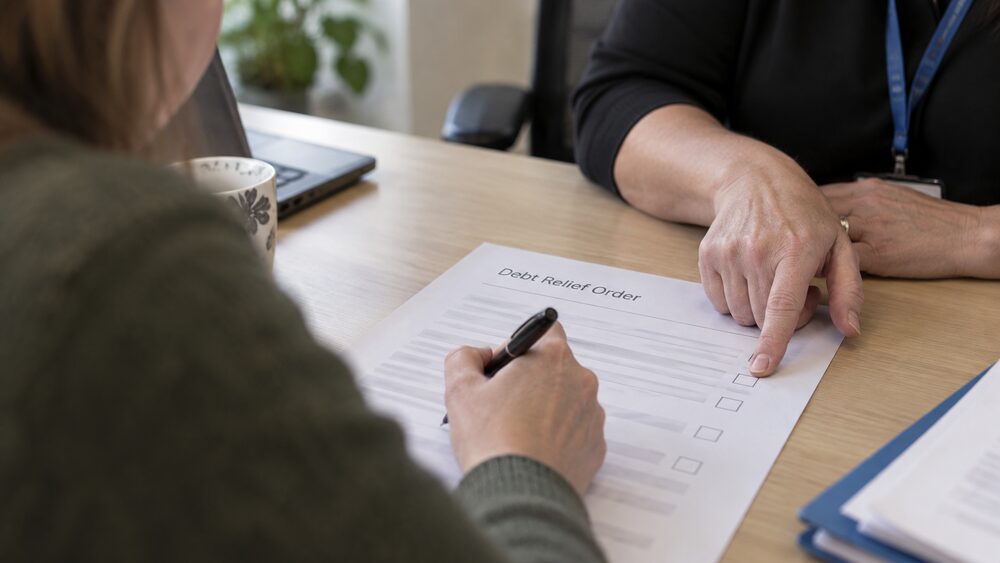
A DRO is not something you apply for on your own. It is made under a partnership between the Insolvency Service and skilled debt advisers, called approved intermediaries10. An approved intermediary helps you apply to the Insolvency Service, and the process does not involve the courts10.
Bankruptcy in England and Wales works differently. If you want to declare yourself bankrupt, you apply to an Adjudicator in the Insolvency Service by completing an online declaration of assets12. You pay the fee online with a credit or debit card, in instalments if you pay online, or by cash at a bank without instalments11.
Before either route, free debt advice is available. StepChange Debt Charity offers free, flexible debt advice based on a comprehensive assessment of your situation and provides practical help and support for however long it is needed17. National Debtline provides free, impartial debt advice to more than 100,000 people each year18. Getting advice will not affect your credit file or impact your credit score19.
Banking during and after insolvency
A bankruptcy or DRO affects your ability to hold a bank account. If you are bankrupt or have a record of fraud, you will not usually be allowed to open a bank account20. A poor credit rating may lead to refusal for a current account, but you may be able to open a basic bank account20.
If banks reject your application because of your bankruptcy, a basic bank account is available11. In Northern Ireland, after the bankruptcy order you may open a new bank or building society account, but the bank must be told you are bankrupt; it may impose conditions and limitations21.
Some savings products are closed to undischarged bankrupts. You are not eligible to open an NS&I Direct Saver account if you are an undischarged bankrupt or do not have legal capacity22.
If you are changing banks, open a new account before closing your old one, cancel or move standing orders and direct debits, return unused cheques and cards cut into pieces, and leave enough money to cover uncleared cheques if transferring a balance23.
Protection from creditors and how long it lasts
A bankruptcy order gives protection against action by creditors for a one year period6. The same one-year protection applies in Northern Ireland24. During that period creditors cannot take enforcement action against you for the debts included in the bankruptcy without the court's permission.
A DRO works differently. It is a form of insolvency that writes off the debts included in it, but it does not involve the courts and is administered through the Insolvency Service and approved intermediaries10. The debts included in a DRO are listed on the Insolvency Register alongside bankruptcies and IVAs13.
Where an administration order is made and a DRO is in force immediately before, the DRO ceases to be in force when the administration order is made16. The reverse also applies: an administration order in force immediately before a DRO is made ceases to be in force when the DRO is made16.
Where the rules differ across the UK
A DRO is available in England, Wales and Northern Ireland2. In Scotland, the equivalent low-income write-off route is the Minimal Asset Process (MAP) bankruptcy, and a DRO is a similar solution available in England, Wales or Northern Ireland with different benefits and risks2.
Bankruptcy itself operates differently in Northern Ireland. The one-year protection against creditor action applies there too24, and after the bankruptcy order you may open a new bank or building society account but should tell them you are bankrupt; they may impose conditions and limitations21.
The DRO framework in Northern Ireland was established by legislation specific to that jurisdiction25. The eligibility rules mirror those in England and Wales: the debtor must not be an undischarged bankrupt, subject to an interim order or voluntary arrangement, or subject to a bankruptcy restrictions order or a debt relief restrictions order16.
For readers in Scotland, the sequestration and Minimal Asset Process page covers the Scottish equivalents, and the Debt Arrangement Scheme is a statutory debt management tool run by the Accountant in Bankruptcy enabling debtors to obtain protected, interest-free time to pay, on condition that the debt is settled in full26.
Other debt solutions to consider first
A DRO and bankruptcy are the two formal write-off options, but they are not the only routes. The main debt solutions advertised include debt management plans (DMPs), individual voluntary arrangements (IVAs), bankruptcy, debt relief orders (DROs) and loan consolidation13.
A DMP is an informal arrangement where you pay what you can afford to your creditors each month. StepChange Debt Charity offers free DMPs with no set-up charges or monthly fees, and if your DMP is free, all the money you pay into it goes towards your debts27. The charity contacts the people you owe, explains your situation and tells them what you will pay through the DMP28.
An IVA is a formal arrangement with your creditors that typically lasts several years. There is no charge for advice and support before you set up an IVA, and you do not pay fees if you do not go ahead with one29.
When setting an offer to creditors, debt advice rules require firms to take full account of a customer's obligations to pay taxes, fines, child support payments and those debts which could result in loss of access to essential goods or services or repossession of, or eviction from, the customer's home30.
Service, complaints and getting help
If you are dissatisfied with how a DRO has been handled, any person may make an application to the High Court if dissatisfied by any act, omission or decision of the official receiver in connection with a debt relief order or an application for such an order6.
For complaints about financial firms, the Financial Ombudsman Service can consider some issues. Where a business being complained about also has a claim in the bankruptcy, it may have a legal right to set off PPI redress against arrears on its debt31.
Free, impartial debt advice is available from several sources. StepChange Debt Charity offers free and confidential debt advice online and over the phone, with referral to a fellow debt advice charity if face to face advice is best32. Its online debt advice is available 24 hours a day32. National Debtline provides free, impartial debt advice and is an independent registered charity authorised and regulated by the Financial Conduct Authority33. Its details will never be shared33.
StepChange Debt Charity has been helping people for over 30 years and has helped more than seven million people32. National Debtline has been helping people in the UK with debt for over 30 years33.
Sources35 cited
- How will a debt relief order affect me? StepChange Debt Charity, 2026-09-25
- Minimal asset process bankruptcy StepChange Debt Charity, 2026-09-25
- Debt relief orders R3, 2026-07-20
- Commentary: individual insolvency statistics, August 2026 The Insolvency Service, 2026-10-01
- Frequently asked questions Advice NI, 2026
- Debt relief orders legislation Northern Ireland Assembly, 2014
- How to go bankrupt StepChange Debt Charity, 2026-09-25
- Voluntary bankruptcy StepChange Debt Charity, 2026-09-25
- Bank accounts after bankruptcy StepChange Debt Charity, 2026-09-25
- Debt relief orders Northern Ireland Department for the Economy, 2026-08-06
- Timeline for bankruptcy Citizens Advice, 2020-12-15
- HM Land Registry bankruptcy enquiry letter B10A HM Land Registry, 2017-06-23
- Debt solutions Debt Advice Foundation, 2026-04-08
- Debt relief orders research paper Northern Ireland Assembly, 2008-11
- Debt relief orders (England and Wales) Business Debtline, 2026-09-26
- Debt relief orders bill (amended) Northern Ireland Assembly, 2014
- Free and face to face debt advice StepChange Debt Charity, 2026-09-25
- Budget planning guide National Debtline, 2026-09-25
- Debt stress StepChange Debt Charity, 2026-09-25
- Getting a bank account Citizens Advice, 2026-09-25
- Bankruptcy restrictions Northern Ireland Department for the Economy, 2019-05-02
- Direct Saver brochure NS&I, 2024-07-01
- Getting a bank account (Scotland) Citizens Advice Scotland, 2026-09-26
- Debt relief orders bill Northern Ireland Assembly, 2009
- Debt relief orders legislation legislation.gov.uk, 2010-12-15
- Difficulties paying your tax bill Revenue Scotland, 2021-06-03
- Credit card debt StepChange Debt Charity, 2026-09-25
- Free debt management plans StepChange Debt Charity, 2026-09-25
- Individual voluntary arrangement StepChange Debt Charity, 2026-09-25
- CONC 8 Debt advice Financial Conduct Authority, 2014-04-01
- Ombudsman approach to PPI redress Financial Ombudsman Service, 2026-09-27
- Worried about someone National Debtline, 2026-09-25
- Dealing with debt problems StepChange Debt Charity, 2026-09-25
- What is debt advice StepChange Debt Charity, 2026-09-25
- Reduced income guide StepChange Debt Charity, 2026-09-25


 StepChangeFree debt advice and solutions from a charity
 National DebtlineFree debt advice by phone, webchat and online
 MoneyHelperFree, impartial money and pensions guidance, set up by government
 Citizens AdviceFree advice on money, consumer and legal problems in England and Wales
 Citizens Advice ScotlandFree advice across Scotland