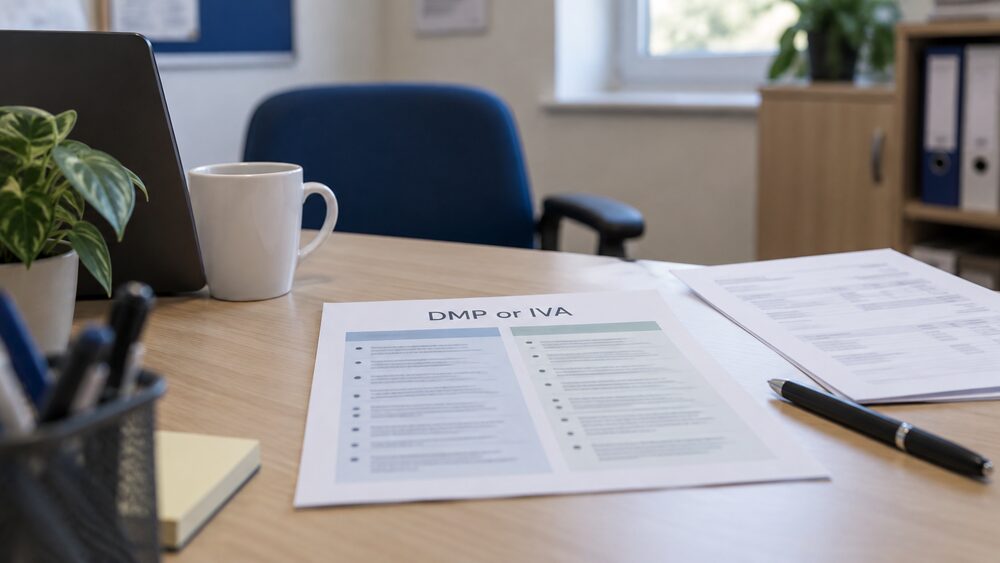
A debt management plan (DMP) and an individual voluntary arrangement (IVA) are both ways to deal with unsecured debts you cannot repay on the original terms, but they are not variations of the same thing. A DMP is an informal arrangement: you make one affordable monthly payment, creditors usually agree to smaller amounts, and interest and charges may be frozen if creditors agree1. An IVA is a formal, legally binding agreement set up through an insolvency practitioner (IP), and you can only get one with the help of an IP2.
The single most important difference is what happens if things go wrong. A DMP does not protect you from enforcement action, from further court action, or protect your assets3. An IVA can stop creditors taking action that affects your home, such as obtaining a charging order or applying for your bankruptcy, and one of its main advantages is that your house is protected4.
The second is cost. A DMP should be free, and charities such as StepChange Debt Charity offer free plans5. Fee-charging DMP providers typically take around 17% of your monthly payment, and one estimate puts the typical extra cost of a fee-charging DMP at £4,0006. An IVA always involves IP fees, taken from the payments you make, and those fees must be approved by your creditors7.
What each one is, and what it offers
A DMP is a debt solution that lets you make affordable payments to your debts10. It mainly covers non-priority debts: things like loans, credit cards, overdrafts and store cards11. The practical features are that you make one monthly payment towards all your debts, deal with fewer creditors, and do not take out further credit. Creditors usually agree you can make smaller payments based on what you can afford, interest and charges may be frozen if creditors agree, and the plan is flexible if your circumstances change1.
An IVA is a formal alternative to bankruptcy. It is one of a group of solutions that also includes DMPs, bankruptcy, debt relief orders (DROs) and loan consolidation11. You can only get an IVA with the help of an insolvency practitioner, and you need an IP to set it up2. Under the IVA Protocol 2025 criteria, one of the conditions is that another solution, such as bankruptcy, a DMP or a lump-sum settlement, does not provide a better return for your creditors9.
The two are not interchangeable, and the choice is not simply about which is cheaper. A DMP is a negotiation you can walk away from, with no legal force behind it. An IVA is a court-recognised arrangement that binds your creditors once approved, and it carries the consequences of a formal insolvency.
Fees, charges and eligibility
Cost is where the two diverge most sharply, and where the marketing around both can mislead.
A DMP should be free5. StepChange Debt Charity's DMPs are free, and National Debtline does not charge for setting up a DMP, nor does the DMP provider it works with6. Advice NI states it will never charge you for your DMP5. But fee-charging debt management companies exist, and they generally charge a fee to arrange a DMP and a monthly fee for as long as you have the DMP. They often keep your first monthly payment as a "deposit", which is used to make the final payment5. The fees charged by for-profit DMP providers vary, and are typically around 17% of your monthly payment6. One estimate puts the typical extra cost of a fee-charging DMP at £4,0006.
There is no extra benefit to paying. All DMPs work in the same way, and there are no extra benefits or protection by choosing a DMP with fees6.
An IVA always costs money. An IP will charge a fee for negotiating with your creditors and managing your IVA13. Most IPs agree to take their fees from the payments you make into the IVA, and an IP that charges an up-front fee can be avoided9. Fees are detailed in your IVA proposal, which an IP will assist in drafting, and any fees have to be approved by creditors8. Because of nominee fees and supervisor fees, what you pay towards your debts can be less than what you pay into your IVA14.
| Debt management plan | IVA | |
|---|---|---|
| Legal status | Informal3 | Legally binding9 |
| Who sets it up | You, or a free charity or a fee-charging company6 | An insolvency practitioner only2 |
| Typical cost | Free from charities; around 17% of monthly payment from fee-charging firms6 | IP fees taken from your payments, approved by creditors7 |
| Can it be converted? | Not into an IVA automatically | Cannot be converted into a DMP9 |
| Protects your home? | No3 | Can stop action affecting your home4 |
Eligibility also differs. For an IVA under the IVA Protocol 2025 criteria, another solution such as bankruptcy, a DMP or a lump-sum settlement must not provide a better return for your creditors9. A DMP has no such test, but it requires your creditors to agree to reduced payments, and it works best where they do.
A balance transfer moves the debt, not the interest rate
That heading belongs to a different subject, and it is worth being clear that neither a DMP nor an IVA is a consolidation loan. A debt consolidation loan is a separate option, and the alternatives to it include a DMP, a DRO, an IVA, and the Debt Arrangement Scheme (Scotland only)11. The main difference is that DMPs do not involve taking out further credit; instead, creditors usually agree you can make smaller payments1.
Taking out more credit while on a DMP is a real risk. Do not take out more credit to support your income, because this might break the terms of your agreement and could cause your DMP to fail15.
Opening an account or switching
Neither solution is something you open like a bank account, but both have a process, and the IVA process is the more demanding of the two.
For an IVA, you need an insolvency practitioner to set it up, and you can only get one with the help of an IP12. The IP drafts the proposal, negotiates with your creditors, and manages the arrangement once approved. Fees are set out in the proposal and must be approved by creditors8.
For a DMP, the process is a budget and an offer. Monthly DMP payments are based on what you can afford towards your debts16. If you use a charity, the plan is set up at no charge; if you use a fee-charging company, expect an arrangement fee and an ongoing monthly fee5.
If your creditors reject an IVA proposal, one route is to enter a long term non-fee charging DMP, particularly where your circumstances are expected to improve17. That is a genuine fallback, not a failure.
Service and complaints
Both routes depend on the firm or charity you deal with, and both have a complaints route if things go wrong.
With a DMP, the risks are structural as well as service-related. For a DMP to be successful, it requires all creditors to agree. Creditors may not agree to freeze interest and charges, the plan could take a long time to repay, the provider may charge a fee, default notices show on your credit record for six years, and creditors could refuse to co-operate or take further action5. A DMP provider should give you information before you sign a contract with them, and any fees they charge should be fair19.
With an IVA, complaints about the IP go to the Insolvency Service. If you complain to the Insolvency Service, you must include the reply you received from your IVA provider, and you will need as much evidence as possible of the poor practice20. There is a separate page on complaining about an insolvency practitioner if that is where you are.
If your complaint is about a financial firm's conduct, the Financial Ombudsman Service can look at complaints involving the cost of living, and it has set out how it treats consumers in an IVA. Unlike bankruptcy, the consumer's assets do not pass to the IVA supervisor when the consumer enters the IVA, and the effect on PPI redress depends on the terms of the IVA21. If a complaint is about both an organisation's customer service and a data protection issue, the Information Commissioner's Office handles the data protection aspect22.
Protection for your money
This is the section that most often decides the choice, and it is worth stating plainly.
A DMP does not protect you from enforcement action3. It does not protect you from further court action3. Your assets, meaning items of value, are not protected under a DMP3. A DMP is informal, so your creditors do not have to accept the reduced offer of payment, and they are not legally stopped from taking further action3.
An IVA is different in this respect. One of the main advantages of an IVA is that your house is protected, and an IVA can stop creditors taking action that affects your home, such as obtaining a charging order or applying for your bankruptcy4. That protection is the reason many homeowners choose an IVA over a DMP, and it is a real, enforceable difference rather than a marketing claim.
It is not unlimited protection. An IVA can fail, and when it does the consequences are serious. Nominee fees and supervisor fees mean what you pay towards your debts can be less than what you pay into your IVA14. If you are in an IVA and receive a windfall, or your income changes, the terms of the arrangement govern what happens.
Where the rules differ across the UK
The DMP and IVA comparison is broadly the same in England, Wales and Northern Ireland, but Scotland has its own formal alternative.
In Scotland, the Debt Arrangement Scheme (DAS) is a statutory debt payment programme. It protects you against enforcement action, which a DMP does not3. It will usually be better to use the Debt Arrangement Scheme instead of having a DMP16. If you live in Scotland, that is the comparison that matters most, and there is a separate page on the Debt Arrangement Scheme.
In Northern Ireland, IVAs are available and are administered under the same broad framework, with nidirect setting out the rules13. There is a separate page on whether you can get an IVA in Northern Ireland.
In England and Wales, both DMPs and IVAs are available, and the Insolvency Service publishes research into IVAs20. The Insolvency Service also handles complaints about IVA providers20.
Where to get free help
Free, impartial debt advice exists, and it is the right starting point before committing to either route.
StepChange Debt Charity offers free and impartial debt advice, and has been helping people for over 30 years23. Its online debt advice is available 24 hours a day, and it offers advice online and over the phone, with referral to a fellow debt advice charity if face to face advice is best23. In Scotland, it has a dedicated team in Glasgow offering free, impartial advice on your options24.
National Debtline does not charge for setting up a DMP, and neither does the DMP provider it works with5. It helps with DMPs, DROs, IVAs and bankruptcy25.
Advice NI will never charge you for your DMP5. Citizens Advice can check whether a financial service has followed the rules19.
If you are in an IVA and it is going wrong, the Insolvency Service is the complaints route, and you must include the reply you received from your IVA provider20. If you are in a DMP and cannot keep up the payments, there is a separate page on missing a payment or no longer affording a DMP.
Sources25 cited
- Debt consolidation StepChange Debt Charity
- IVA or DMP StepChange Debt Charity
- Debt arrangement scheme or DMP StepChange Debt Charity
- What will happen to my house in an IVA Debt Advice Foundation
- Debt management plans National Debtline
- Free debt management plans StepChange Debt Charity
- IVA costs, fees and charges StepChange Debt Charity
- Lump sum IVA StepChange Debt Charity
- Debt management plan vs IVA National Debtline
- Debt management plan StepChange Debt Charity
- Debt solutions Debt Advice Foundation
- Managing a DMP StepChange Debt Charity
- Individual voluntary arrangements (IVAs) nidirect
- How can an IVA fail StepChange Debt Charity
- Redundancy and DMPs StepChange Debt Charity
- Can I go on holiday on DMP StepChange Debt Charity
- What if my creditors don't agree to my IVA proposal Debt Advice Foundation
- Pay off IVA early StepChange Debt Charity
- Check if a financial service has followed the rules Citizens Advice
- Insolvency Service research into individual voluntary arrangements (IVAs) Insolvency Service
- Complaints involving cost of living Financial Ombudsman Service
- Data protection framework Information Commissioner's Office
- Free and face to face debt advice StepChange Debt Charity
- Debt advice Scotland StepChange Debt Charity
- Sheriff officers StepChange Debt Charity





 StepChangeFree debt advice and solutions from a charity
 National DebtlineFree debt advice by phone, webchat and online
 MoneyHelperFree, impartial money and pensions guidance, set up by government
 Citizens AdviceFree advice on money, consumer and legal problems in England and Wales
 Citizens Advice ScotlandFree advice across Scotland