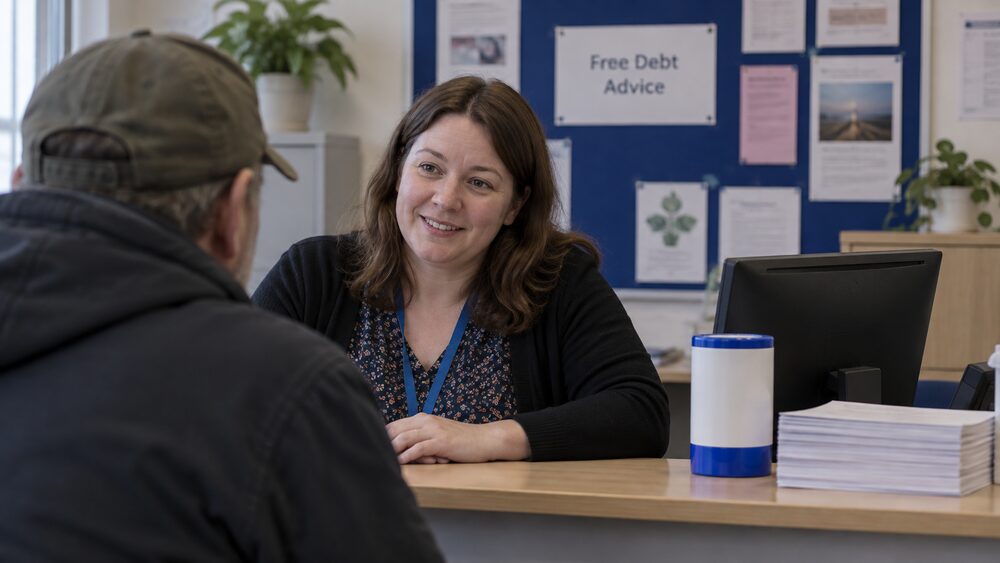
A debt management plan is an agreement between you and the people you owe money to. You make one affordable monthly payment, and it is shared out among your debts1. Some companies charge for running that plan. Others, including the debt charities, do not.
The difference is straightforward. A fee-charging firm typically takes between 10% and 15% of your monthly payment as a management fee2. On a free plan, every penny you pay goes towards your debts3. All plans work in the same way, and there are no extra benefits or protection from choosing one with fees1.
That does not make a paid plan a scam. It makes it a choice with a cost attached, and the cost is money that would otherwise have reduced what you owe. This page sets out what each route involves, who can use a plan, which debts it covers, and what it cannot do.
Free debt management plans: no set-up or monthly fees
StepChange provides free debt management plans and charges no set-up or maintenance fees8. Its plans are completely free, and every penny goes towards your debts9. PayPlan also runs free plans, free to set up and manage, and does not take a percentage of your payment10. National Debtline gives free advice and can set up a free plan, handling payments and negotiating with the people you owe11.
The Debt Advice Foundation says it will only ever recommend free debt management plans where debt management is appropriate for your circumstances12. National Debtline says it only recommends using companies that provide a free service13.
Free plans are not a stripped-back version of a paid one. The Debt Advice Foundation states plainly that all DMPs work in the same way, and that there are no extra benefits or protection by choosing a DMP with fees1. What differs is where your money goes.
A free plan is not the only free option. If creditors reject an IVA proposal and your circumstances are expected to improve, the alternative considered can be a long-term non-fee-charging debt management plan14. DMPs can be provided free of charge15.
Where the money goes when a plan is free
On a free plan, your monthly payment is passed to your creditors in full. PayPlan states that 100% of the money you pay goes towards repaying your debts, and that payments are administered free of charge10. StepChange's plans carry no set-up charges or monthly fees, so all the money you pay goes towards paying off your debts4.
Payments should be passed on within five working days16. Your monthly payment itself is worked out from your budget: it is based on what is left after priority household bills, arrears and other living costs, and any leftover money goes to your monthly DMP payment17.
Some debts will be paid off before others. Those debts drop off the plan when they are paid in full, which frees up more of your payment to go to the remaining debts18. The length of the plan depends on how much you owe and how much you can afford each month, so high debt and low payments mean a longer plan17. Free plans usually require you to be able to repay your debts in less than 10 years16.
Who can use a debt management plan and which debts it covers
A DMP is a debt solution that helps people pay their debt at a rate they can afford19. It is a voluntary agreement between a debtor and some or all of their creditors to repay debts over an extended period20. The plans are managed by companies known as debt management plan operators or providers, who negotiate with creditors and manage payments5.
Eligibility comes down to two things: a regular income, which includes wages, benefits or pension income, and money owed to multiple creditors6. There is no limit to how much debt or how many accounts you can include6.
The debts covered are unsecured ones. A DMP can only be used to pay unsecured debts, meaning money you owe that has not been guaranteed against your property5. In practice that means credit cards, overdrafts, personal loans, catalogues and water bills6. National Debtline describes the scope as non-priority debts only, such as credit cards, overdrafts and personal loans, with priority debts usually paid separately21. Shelter Cymru makes the same point: these plans are set up without involving the courts, but can only help with debts that are not secured on your home22.
Priority debts sit outside the plan. These include mortgages, car hire purchase, current utility bills, and secured loans or second charges6. Hire purchase agreements cannot be included because they are secured against the item being purchased, though a loan taken to buy a car can be6.
You can set up a DMP yourself, but you then have to manage your own payments, contact everyone you owe yourself, and manage the plan yourself23.
What a debt management plan cannot do
A DMP is not a write-off. Your debts must be repaid in full and will not be written off5. If you finish the plan, your unsecured debts will be cleared5, but that is the whole of the debt plus whatever interest and charges creditors applied along the way.
It does not stop creditors taking action. A DMP does not protect you from further court action15, and creditors can still take court action against you24. PayPlan puts it in the same terms: because a DMP is an informal arrangement, creditors may still take legal action, which it says is not common but is possible6.
It does not force an interest freeze. A DMP does not make your creditors stop interest and charges7. There is no legal requirement for creditors to suspend interest payments or charges if you take out one of these plans22. No debt management company, including PayPlan, can guarantee that creditors will freeze interest and charges during your DMP25. Creditors will sometimes agree to freeze interest when a plan is being set up, and may stop other action such as taking you to court, but they do not have to agree to this or to the plan at all5.
It does not cover secured debts. Mortgages and other secured debts are not covered by a debt management plan5, and not all debts can be included in management solutions26.
It affects your credit rating. You make lower payments to your debts, so your plan affects your credit rating15. Paying less than originally agreed can impact your credit file, and missed or reduced payments may already have affected it6.
Getting free debt advice: phone, online chat and WhatsApp
Advice comes before the plan. Get debt advice from a debt charity or debt management company before you choose a debt solution23. Free and independent advice on debt management plans, or any kind of debt problem, is available from organisations such as Advice NI5. If you owe money to HMRC, you can get free, confidential and independent advice from a debt adviser27.
Free debt advice is available online or over the phone28. PayPlan offers support by phone, online chat or WhatsApp, and says an assessment with an adviser can be done over any of those channels29. StepChange offers debt advice over the telephone or online. Shelter Scotland notes that there are free advice services that can help30.
Before you speak to an adviser, basic details are enough: your income, your regular expenses and a list of your debts. Recent bank statements or letters from creditors can be helpful but are not essential at first29. PayPlan says it is required to submit your income and expenditure details to your creditors10.
Once you are in a debt solution, creditors should stop contacting you directly. For some solutions, including DMPs, creditors may still reach out but should respect the terms of your plan if you are meeting your repayment offers29. A managed solution such as a DMP is reviewed with you every year29, and National Debtline says the debt management company should review your plan with you every year and give your creditors regular updates13.
Help if you are vulnerable or facing court action
A DMP offers no protection from court action, so if a creditor is pursuing you, the plan is not a shield. Creditors can take further action against you, such as court action31. If you are in that position, the free advice services cover it: StepChange offers free, flexible debt advice based on a comprehensive assessment of your situation, with practical help and support for however long it is needed32.
Scotland has a separate solution with stronger protection. The Debt Arrangement Scheme can protect you from creditors making you bankrupt, or using court action against you to enforce your debts33. If you keep to the agreed payments, your creditors will not be able to make you bankrupt or use diligence against you, and that protection starts once you have made an application and are waiting for it to be approved34. A DMP is not the same thing, and the difference matters if court action is a live risk.
Water companies are expected to have an approach that protects customers from fraud while allowing properly authorised people or organisations, such as free, independent debt advisers, access to help operate accounts35. If you are in a vulnerable situation, that expectation is what allows an adviser to deal with a supplier on your behalf.
If a provider closes, this does not cancel your debts36. Debt advice is not covered by the Financial Services Compensation Scheme, so payments held by a provider are not protected in the way a bank deposit is37. If you have a complaint about a debt solution or a firm, the Financial Ombudsman Service handles complaints involving cost of living issues32.
Free, impartial help is available from MoneyHelper, from the debt charities named on this page, and from the Financial Ombudsman Service if a complaint needs escalating.
Fixed or free: what the fee actually buys
The choice is not between a good plan and a bad one. It is between paying for administration and not paying for it.
| Free plan | Fee-charging plan | |
|---|---|---|
| Set-up cost | No set-up charges4 | Varies by firm |
| Monthly cost | No monthly fees4 | Typically 10% to 15% of your monthly payment2 |
| Share of payment reaching creditors | All of it4 | The remainder after the fee |
| How the plan works | Same as any DMP1 | Same as any DMP1 |
| Extra protection | None1 | None1 |
The practical effect of a fee is that your debts take longer to clear, because less money reaches them each month. The Debt Advice Foundation's position is that it will only ever recommend free plans where debt management is appropriate12, and National Debtline only recommends companies providing a free service13.
Where a debt management company is involved in an IVA, it is likely to be more expensive because it charges a fee on top of the insolvency practitioner's fees, and getting an IVA without one is usually cheaper38. That is a separate product, but the same principle applies: a fee is money that does not go to your creditors.
If a provider stops trading
A provider closing does not cancel your debts36. What changes is who administers the plan and how your payments are handled.
If this happens, free and independent advice is the starting point. National Debtline and PayPlan both give free advice and can set up a free debt management plan, handling payments and negotiating with the people you owe money to11. Moving to a free provider means the whole of your payment goes to your creditors from that point4.
Your creditors still have to be paid, and the underlying agreements do not change. A DMP is an informal arrangement, so there is no court process to unwind and nothing to remove from a public register6.
Where the rules differ across the UK
A DMP works the same way across the UK, but the alternatives around it do not.
In Scotland, the Debt Arrangement Scheme is a statutory route with protection from bankruptcy and diligence if you keep to the agreed payments34. National Debtline publishes separate guidance on debt help and advice in Scotland39, and Business Debtline has a Scottish version of its ways to clear your debt guide40.
In Wales, Shelter Cymru covers debt solutions and alternatives to bankruptcy, with its pages last updated on 18 September 202641. In Northern Ireland, nidirect sets out debt management plans and the wider debt repayment options available42.
The Insolvency Service publishes monthly individual insolvency statistics for England and Wales, which give the wider picture of how many people are using formal solutions43. StepChange Debt Charity registered 54% of breathing spaces between the start of the scheme in May 2021 and 30 June 202643, and 56% of breathing spaces in England and Wales between May 2021 and 31 July 202644. Those figures show how heavily one charity carries the free advice load, not how any individual should proceed.
Sources44 cited
- What is a DMP? StepChange Debt Charity, 2026-09-25
- Debt management Debt Advice Foundation, 2026
- Debt counselling StepChange Debt Charity, 2026-09-25
- Debt consolidation StepChange Debt Charity, 2026-09-25
- Debt management plans nidirect, 2025-11-06
- A DMP with PayPlan PayPlan, 2026-08-25
- Freezing interest and charges StepChange Debt Charity, 2026-09-25
- Debt solution costs StepChange Debt Charity, 2026-09-25
- Debt consolidation and debt management StepChange Debt Charity, 2026-09-25
- Why choose PayPlan for your DMP PayPlan, 2026-08-25
- Your DMP provider has closed Citizens Advice, 2026-09-25
- Where can I find free debt management? Debt Advice Foundation, 2020-05-26
- Ways to clear your debt National Debtline, 2026-09-25
- What if my creditors don't agree to my IVA proposal? Debt Advice Foundation, 2025-08-15
- How a DMP affects me StepChange Debt Charity, 2026-09-25
- Ways to clear your debt Business Debtline, 2026-09-26
- DMP questions StepChange Debt Charity, 2026-09-25
- Creditor payments StepChange Debt Charity, 2026-09-25
- What is a DMP? Debt Advice Foundation, 2024-07-04
- Debt management plans House of Commons Library, 2026-07-08
- Debt management plan vs IVA National Debtline, 2026-09-25
- Debt solutions Shelter Cymru, 2026-08-30
- Setting up a debt management plan StepChange Debt Charity, 2026-09-25
- Debt arrangement scheme or DMP StepChange Debt Charity, 2026-09-25
- Debt management plan questions PayPlan, 2026
- Consolidation and bad credit StepChange Debt Charity, 2026-09-25
- Find out what to do if you owe money to HMRC GOV.UK, 2025-08-18
- Advice and support on debt Carmarthenshire County Council, 2026-08-04
- Debt info FAQs PayPlan, 2026
- Debt advice Shelter Scotland, 2026-01-16
- Debt arrangement scheme StepChange Debt Charity, 2026-09-25
- Complaints involving cost of living Financial Ombudsman Service, 2026-09-26
- Debt arrangement scheme National Debtline, 2026-09-25
- Council tax arrears Business Debtline, 2026-09-26
- Paying Fair guidelines Ofwat, 2026-09-28
- Your debt management plan provider has closed Citizens Advice, 2026-09-25
- Debt management Financial Services Compensation Scheme, 2026-09-25
- Check what an IVA is Citizens Advice, 2026-09-25
- Debt help and advice in Scotland National Debtline, 2026-09-25
- Ways to clear your debt Business Debtline, 2026-09-26
- Alternatives to bankruptcy Shelter Cymru, 2026-09-18
- Debt repayment options nidirect, 2026
- Individual insolvency statistics, June 2026 Insolvency Service, 2026-06-30
- Individual insolvency statistics, July 2026 Insolvency Service, 2026





 StepChangeFree debt advice and solutions from a charity
 National DebtlineFree debt advice by phone, webchat and online
 MoneyHelperFree, impartial money and pensions guidance, set up by government
 Citizens AdviceFree advice on money, consumer and legal problems in England and Wales
 Citizens Advice ScotlandFree advice across Scotland