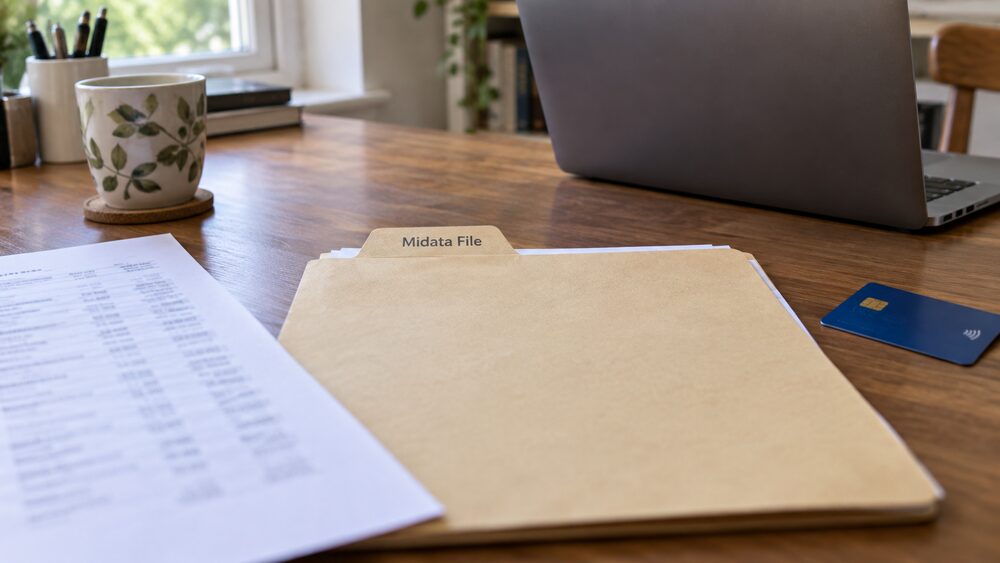
Midata was a scheme that let you download 12 months of your current account transactions as a single file, then upload it to a price comparison website to see which account might suit you better. It was meant to make switching easier by handing your own spending data back to you. It did not work: Which? describes midata as "the government's previous attempt to encourage switching by opening up banking data" that "failed to have any meaningful impact"1.
Midata was a scheme that let you download 12 months of your current account transactions as a single file, then upload it to a price comparison website to see which account might suit you better. It was meant to make switching easier by handing your own spending data back to you. It did not work: Which? describes midata as "the government's previous attempt to encourage switching by opening up banking data" that "failed to have any meaningful impact"1.
The scheme was voluntary rather than compulsory. HSBC says "midata is a voluntary scheme however many of the major UK banks are participating"2. Because it was voluntary, not every bank offered it, and several that did have since withdrawn the download. Open banking, which works differently and is regulated, now covers a wider range of providers and is the route most comparison services use.
If your bank still offers a midata download, it gives you a 12 month transaction history of your personal current account, usable with comparison websites and downloadable in online banking3. The file covers the 12 month period ending 30 days ago, so the most recent month is missing2. This page explains what the file contained, how to download one, where it worked, what it left out, and how to keep it safe.
What midata was: a file of 12 months of your current account spending
A midata file is a 12 month transaction history of your personal current account, which you could use to help choose a new account3. Halifax describes it as showing your previous 12 months spending and banking history, without any information like your name, address or date of birth6. That stripping out of personal identifiers was the point: the file was built to be handed to a comparison site without carrying your identity with it.
The period is not quite the last 12 months. HSBC states that the midata download shows all the transactions on the account for the 12 month period ending 30 days ago2. Santander describes the same service as allowing you to download 12 months of transaction history from your current account4. The two descriptions differ on the exact window, and the documents do not resolve it, so treat the 30 day gap as the figure to expect.
Current account providers and third parties associated with midata committed to a midata Code of Practice2. That code governed how the data was handled once it left your bank. It applied to the firms that signed up, which is one reason the scheme's reach was uneven.
The file was never a full financial picture. It covered one current account, not your savings, credit cards, loans or mortgage. A comparison based on it could tell you how you used that account, and little more.
How to download a midata file from online banking
The download lived inside online banking, not in a branch or over the phone. Santander says you can find the midata file in Online Banking, in your "Download transactions" page4. Nationwide's steps for a Windows or Mac desktop are to select the current account you want to download transactions for, then under Transactions choose Download transactions, then choose Download midata7.
Each bank labelled it slightly differently. Lloyds Bank's route is to log in to online banking, select "More Actions" next to your current account, expand "Account Services", select "Midata Export", choose the account and select "Start download"3. HSBC's route is from "My Accounts", select the current account you wish to download midata for, then select the "Manage" button and "midata download" under the "Documents" section, read the text and select "Download"2. First Direct asks you to select your 1st Account from "My Accounts", then the "download" button at the bottom of the page, read the text, tick the box and select "Download midata"5.
Santander's fuller sequence runs: from the "My Accounts and Transactions" tab, choose the current account you would like to compare; click the "Download transactions" link above the transactions table; in the "Download to" drop-down menu select "midata (CSV)" and click "Download"; read and confirm you are happy with the information displayed; click "Continue" and the file downloads4.
Phone, tablet or computer: where the file works
Midata was built for a desktop. First Direct states that midata has been designed only to be downloaded using a PC or a Mac with internet access5. Nationwide's guidance splits by device: on an Android device you can both view and download your midata file, but on an Apple iPhone or iPad you can only view it, and it cannot be downloaded onto your device7.
That is a narrower position than it first appears. Even where a phone can display the file, the scheme's own design assumed a computer. If you only have a phone or tablet, the download step may not be available to you at all.
The pattern is not unique to midata. Other financial and official processes carry the same restriction: the WCA50 health questionnaire can be downloaded and completed by hand, or saved and completed on a desktop or laptop computer, but cannot be completed by phone or tablet8. ABTA recommends a laptop or PC for navigating its dispute portal and uploading files10. Danske ID runs the other way, working only on a smartphone or tablet and not on a desktop or laptop11.
There is a security argument on both sides. HSBC notes that mobile operating devices are better at protecting users from malicious software than desktop operating systems12. Against that, a midata file is a document you need to store and upload, and that is easier to do carefully on a computer.
What the file leaves out and what comparisons missed
The 30 day gap is the first omission. For fraud prevention purposes, midata will not include any transactions made in the 30 days before you choose to download it5. Anything you spent in the past month is invisible to the comparison.
Transaction descriptions are also trimmed. HSBC says some transaction descriptions may contain asterisks, used to replace information that is not required for personal current account comparison purposes and agreed as the industry standard for midata2. So a payment to a named retailer may appear partly masked. The asterisks are deliberate, not a fault.
The file also carried no identity details. Halifax's description is that it shows your previous 12 months spending and banking history without any information like your name, address or date of birth6. That protects you, but it also means the file cannot be matched to other accounts you hold.
What comparisons built on this data could not see is the wider picture. A current account comparison based on a midata file looked at how money moved through one account. It could not weigh your debts, your savings or your other borrowing, because none of that was in the file. The scheme's own limits, a single account and a year of history, capped what any comparison could conclude.
Keeping your midata file safe, including on joint accounts
A midata file is a year of your spending in one document, so it deserves the same care as a bank statement. The Information Commissioner's Office advises storing documents carrying personal information, such as your driving licence, passport, bank statements, utility bills, in a safe and secure place13. Santander's guidance is to delete your midata from your computer or device, including information stored in back-up files, when you no longer need it4.
Deleting it yourself matters because the law does not do it for you. The ICO states that an organisation may not automatically delete your data after giving it to you or sending it to another organisation, and that deletion may require exercising the right to erasure14. Once a comparison site holds your file, removing it is something you have to ask for.
Joint accounts need a conversation first. Nationwide says either of a joint account's holders is able to download transactions into a midata file7. Santander adds that if you have a joint account and would like to use this service, you must make sure that all other account holders are happy for you to download the file and upload it to a comparison site4. The file will contain the other person's spending too.
If a relationship has ended, the account link can outlast it. MoneyHelper says closing a joint account will not remove the link to the other person from your credit file, and that a "notice of disassociation" can be requested from credit reference agencies if there is no other financial connection15. On the data itself, the Data Protection Act 2018 allows your lender to give you information about payments made by a joint account holder, such as your partner or ex-partner, but it does not force them to do so16.
Why midata failed to get people switching
The scheme's own design worked against it. It was voluntary, so coverage was patchy from the start2. It required a computer, which ruled out phone-only users5. It left out the most recent month, which is often the spending people most want to change5. And it covered one account, so it could never show the whole of someone's finances.
Which? is blunt about the result: midata, "the government's previous attempt to encourage switching by opening up banking data", "failed to have any meaningful impact"1. The Consumer Council's research on banking and borrowing points to a different driver of switching altogether: dissatisfaction with bank service was more likely to be the main reason for booster survey respondents, at 42% compared with other reasons17. People moved banks because they were unhappy, not because a data file told them to.
Open banking took over the role midata was meant to play. It shares financial data through regulated connections rather than a downloaded file, and it does not depend on a bank volunteering to take part. For a reader today, that is the practical difference: midata is a legacy download that some banks still offer, while open banking is the live route most comparison services use.
"Midata, the government's previous attempt to encourage switching by opening up banking data, failed to have any meaningful impact"
If your bank no longer offers a midata download
Not every bank offered midata, and some that did have stopped. Because it was a voluntary scheme, there was no obligation to keep it running2. If the option has disappeared from your online banking, that is a withdrawal of the service rather than a fault on your account.
The alternatives are open banking and the Current Account Switch Service. Open banking lets you share your transaction data with a comparison service through a regulated connection, without downloading and uploading a file yourself. The Current Account Switch Service moves your account, balance, Direct Debits and standing orders to a new bank on a set timetable, and it is free to use.
If you are comparing accounts, the Current Account Switch Service handles the move once you have decided, and open banking is how most comparison services now read your data. If you want to understand what a bank can see about your spending, how a current account works sets out the basics.
For free, impartial help with a current account or a switching decision, MoneyHelper is the government-backed service. If a complaint about a bank or a comparison service is not resolved, the Financial Ombudsman Service can look at it.
Sources17 cited
- Open banking: sharing your financial data Which?, 2026
- Midata FAQs HSBC UK, 2026
- Paper-free statements Lloyds Bank, 2026
- Midata Santander UK, 2026
- Midata first direct, 2026
- Bank account FAQs Halifax, 2026
- About midata Nationwide Building Society, 2026
- The WCA50 questionnaire Turn2us, 2026
- What is the Work Capability Assessment? Mental Health and Money Advice, 2025
- I have a problem after registering a complaint ABTA, 2026
- Danske ID Danske Bank UK, 2026
- What is a digital wallet? HSBC UK, 2026
- Identity theft Information Commissioner's Office, 2026
- Your right to data portability Information Commissioner's Office, 2026
- Joint accounts MoneyHelper, 2026
- Mortgage shortfalls National Debtline, 2026
- Banking to Borrowing Consumer Council for Northern Ireland, 2026





 MoneyHelperFree, impartial money and pensions guidance, set up by government
 FSCSProtects your money if a bank, insurer or investment firm fails
 Financial Ombudsman ServiceFree, independent help when a complaint about a firm is not put right
 Citizens AdviceFree advice on money, consumer and legal problems in England and Wales