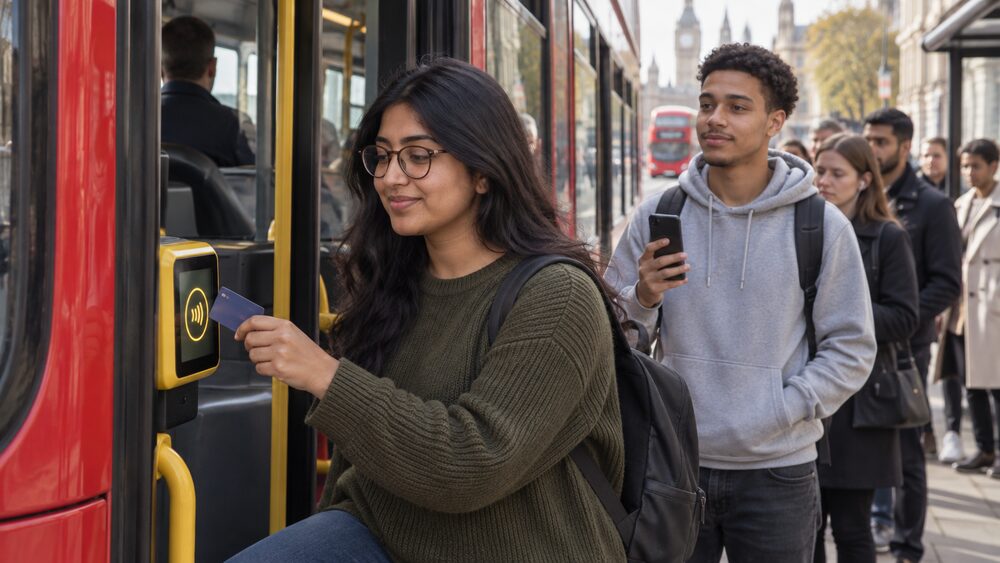
A debit card takes money straight from your bank account when you pay. Under the official definition in UK legislation, a relevant debit card is one whose use results in an account of the holder's at a bank or another institution providing banking services being debited with the payment1. Unlike a credit card, there is no borrowing unless you go into your arranged overdraft, and the card is the everyday tool for paying in shops, online and at cash machines. Debit cards are now the most used way to pay in the UK: in 2025 there were 16.2 billion contactless debit card payments alone2.
Most debit cards come with a current account, including basic bank accounts, which let you use a debit card to pay for items and withdraw money from a cash point3. The card is linked to the account, so anything paid with it, withdrawn with it, or taken from it by a recurring payment comes out of that account's balance. This page explains how debit cards work, the contactless limit and when you are asked for your PIN, what cards cost at home and abroad, how to stop recurring payments, and what protection exists when something goes wrong.
How a debit card works and what it offers
A debit card is a payment card that spends the money in your bank account directly. The legal definition matters because it decides which rules apply: a card counts as a debit card when using it to make a payment results in your account at a bank or other banking institution being debited with the payment1. That covers the standard debit cards issued with current accounts, and it is why debit cards sit under a different set of protections from credit cards.
What a debit card offers in practice is a set of payment routes through one piece of plastic or its digital equivalent in a phone wallet. You can pay in shops by inserting the card and entering your PIN, or by tapping it on a reader for contactless payments of £100 or less4. You can withdraw cash from cash machines, pay online by entering the card details, and set up recurring payments such as subscriptions on the card. Basic bank accounts, which are available to people who may not qualify for a standard account, also come with a debit card to pay for items and withdraw money from a cash point3.
Debit cards differ from the alternatives in one key way: they spend your own money. A credit card borrows from the card issuer and you settle up later, and a prepaid card is loaded with money in advance, with most prepaid cards letting you pay wages, and sometimes benefits, onto the card3. Because a debit card draws on your account, the protections when things go wrong also differ: credit cards give you Section 75 legal protection on purchases over £100, while debit cards rely mainly on the chargeback scheme and the Payment Services Regulations, both covered later on this page.
Contactless limits: up to £100 per payment
The contactless limit is the most a card payment can be without entering a PIN. In the UK the limit is £100 per transaction: Danske Bank, for example, states its cards have a default contactless limit of £100 per transaction4, and the Consumer Council for Northern Ireland describes contactless as letting you make payments up to £100 by touching your card to the reader9. Which? likewise notes there has been a £100 limit for tap and pay contactless credit and debit card purchases, meaning you would be asked for PIN authentication above this10.
The limit has risen over time, and the timeline shows how quickly it has moved:
The £100 figure, in force since 15 October 202111, replaced the £45 limit introduced in March 202012, which itself replaced the £30 limit that applied from December 201813. The limit is a cap on a single transaction, not on total spending: you can make several contactless payments in a row, though banks apply their own security checks, explained in the next section.
Not every card has the full £100 limit. Danske Bank debit and credit cards come with a default contactless limit of £100 per transaction, but customers can select a limit of their own choice from £0 to £100 in the Mobile Banking app14. Barclays debit cardholders can likewise set their contactless limit anywhere between £5 and £100 in the app14. The Consumer Council notes that a bank or building society may be able to reduce the limit, fix a customer's own limit, or remove the contactless option from a card altogether9. If a payment is above the limit, UK Finance explains that the payment will default to a Chip and PIN payment for the card, or, if available, payment via mobile phone11.
Why a contactless payment sometimes asks for your PIN
Even when a payment is under £100, the terminal will sometimes ask for your PIN. This is a security feature, not a fault. Danske Bank states that from time to time you may be asked to enter your PIN for security reasons, for example after a number of contactless transactions or if the transaction is considered higher risk4. UK Finance puts it simply:
"For extra security you may occasionally be asked to enter your PIN."
UK Finance, contactless limit change FAQs11
The checks exist because contactless payments under the limit can otherwise be made without any verification that the person holding the card is its owner. Periodic PIN requests confirm the card is still with its rightful holder, and they break up long runs of small taps that could otherwise run up quickly if a card were stolen. The pattern is not predictable, which is deliberate: you cannot know in advance which payment will trigger it.
If a payment is above the contactless limit, the PIN is always required, or the payment can be made through a phone or watch wallet instead, where the wallet's own security, such as a fingerprint or face check, does the verification11. There is no way to opt out of the periodic PIN checks on a card, and a bank would be unlikely to remove them, since they are part of how contactless stays safe enough to have a £100 limit at all.
Paying by phone, watch and Click to Pay
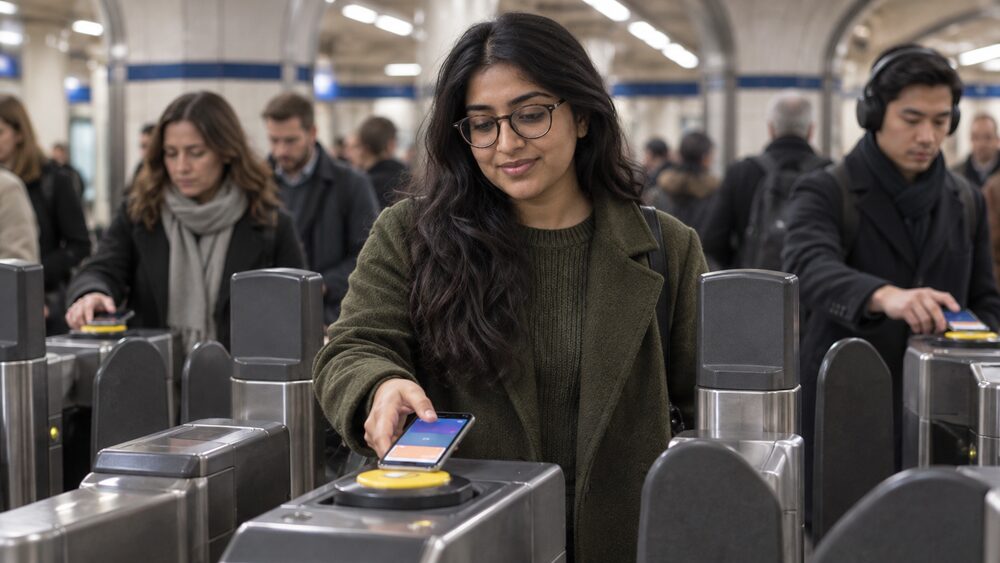
A debit card does not have to stay in your wallet. Mobile wallet services linked to a debit or credit card, such as Apple Pay and Google Pay, have entered the market and provide further payment choices at the checkout15. Instead of tapping the card, you hold your phone or watch near the reader and approve the payment with the device's own security, such as a fingerprint, face recognition or a passcode. The FCA's Financial Lives survey found that 44% of adults who had made contactless payments in the 12 months to May 2024 did so by tapping a mobile device linked to a debit or credit card, up 5 percentage points on the year before5.
Paying by phone behaves slightly differently from paying by card. Because the wallet verifies you before each payment, the contactless card limit does not apply in the same way, and the amount you can spend is set by the bank or the wallet provider rather than the £100 card rule. The dedicated pages on paying with Apple Pay, Google Pay and Samsung Pay and on how much you can spend with Apple Pay or Google Pay cover this in detail.
Online, the equivalent is Click to Pay, a scheme that stores card details securely so a purchase can be completed without typing them in each time. At checkout, the shopper provides an email address or mobile number to find linked cards, confirms their identity and chooses the card to use4. Visa, Mastercard, Discover and American Express cards can be saved and used, and Visa may send a one-time code to a phone or email for security when the service is used4. Danske Bank lets customers enrol a card either in its mobile banking app or at the online checkout when Click to Pay is available4. Barclays has said Click to Pay will be available to its customers from October 2026, with existing Visa Click to Pay profiles for Barclays Visa debit cards moving from Visa to Barclays. Timing and availability of certain features vary by market4.
Fees and charges on debit cards
For everyday use in the UK, a debit card is usually free to spend with. The costs appear at the edges: replacement cards, use abroad, and, invisibly to you, the fees the card system charges retailers.
Replacement cards can carry a fee. Danske Bank charges £4 for a replacement card ordered through its eBanking or Mobile Banking, and £6 if ordered through a branch or by phone4. Those fees may not apply in all circumstances, for example where a card is replaced due to fraud or for bank-initiated security reasons4. Withdrawals from your own bank's cash machines are typically free: Danske Bank states it will not charge for debit card withdrawals from its own cash machines4.
Abroad is where costs build up. MoneyHelper advises that using your debit card abroad can bring a spending or cash machine charge, typically between £1 and £3 each time you use your card, except for euros in the EU6. The FCA's rulebook requires banks to give information about using a debit card to withdraw money in a foreign currency outside the UK, so the charge should be disclosed to you rather than appearing only on your statement16. The section on using your debit card abroad below covers this in full.
Some payments to government bodies are treated differently. HMRC charges a non-refundable fee if you pay a tax bill by corporate credit card or corporate debit card, but no fee if you pay by personal debit card17. And behind the scenes, the cost of the card system itself has been rising: Which?'s response to a payments review noted that debit cards saw scheme fees rise by 28% compared to 2020, which translated into an additional £141 million in costs imposed by card firms onto retailers just to process debit card transactions in 202118. Those costs are paid by retailers, not by you directly, but they feed into prices across the economy.
Daily spending and cash withdrawal limits
Banks can set limits on how much a debit card can spend or withdraw in a day, and how those limits work varies. Danske Bank states that customers who were over 16 when they opened their account have a debit card with no daily spending limit by default4. Spending limits, where they do exist, do not apply to cash withdrawals: Danske Bank states that spending limits don't apply to cash withdrawals4, though separate withdrawal limits can apply to particular cards.
Young people's accounts show how limits are used. Nationwide's FlexOne cash card can only be used to get money from cash machines, capped at £300 a day, and to print mini statements14. Some cards cannot withdraw cash at all: the Best Start Foods card in Scotland lets you check your balance at ATMs but cannot withdraw cash using the card. Age also affects whether a card can be used at all: Danske Bank states that if you are under 16, you cannot use your debit card in shops or online unless your parent or guardian gives consent, and when you turn 16 you will need to tell the bank if you want to use your card in shops or online, so a spending limit can be set, as it will not happen automatically4.
If a limit is causing a problem, for example before a large purchase, the bank can usually adjust it. The page on daily payment and cash withdrawal limits covers the typical limits and how to change them.
Activating a new, renewal or replacement card
A new debit card usually needs to be activated before it works. Danske Bank gives four routes: use it with the correct PIN in a shop's card terminal, at a cash machine or in a Post Office, tap Cards and select Activate card in its app, or log on to eBanking and select Cards and currency then Card overview4. Other banks have their own versions of the same idea, usually an app step or a first PIN use.
Timing depends on why the card is arriving. For a card due to expire, Danske Bank states that the new card arrives by the middle of the month in which it expires4. Replacement cards arrive within 3 business days by first class post, and a PIN letter within 3 to 5 days of receiving the card for customers who do not use mobile banking4. Where a new PIN is issued, it can be viewed in mobile banking the day after the card is ordered4. For renewal cards, and some replacement cards, the PIN stays the same4.
One detail worth knowing: a new card may be set to work in the UK and online only. Danske Bank states that when it sends a new card, it is set to work in the UK and online only4, which matters if you are about to travel, as the next section explains. If a card is blocked, Danske Bank customers can unblock it by calling 0370 850 2481 from the UK or +44 2890 049201 from outside the UK4.
Using your debit card abroad
A debit card can usually be used abroad, but each use can carry a charge. MoneyHelper advises that using your debit card abroad can bring a spending or cash machine charge, typically between £1 and £3 each time you use your card, except for euros in the EU6. The FCA's rulebook requires firms to disclose the position on using a debit card to withdraw money in a foreign currency outside the UK16, so the charge should be stated in your bank's terms before you travel.
Telling the bank first is not always required. Danske Bank tells its customers that when travelling outside the UK, there is no need to tell the bank in advance4. However, some banks issue new cards set to work in the UK and online only, so the first use abroad may need a PIN4. Danske Bank explains that on returning to the UK, the PIN is entered the first time the card is used again, which reactivates it for use in the UK4. The mirror image applies on departure: on some cards, using the PIN once abroad is what switches the card on for foreign use.
Fees are changing at some banks. Barclays has launched fee-free foreign exchange spending on its black Premier debit card, running from 28 September 2026 to 27 September 2027 and applied automatically, and NatWest has said its terms will change from October 2026 to remove foreign transaction fees on Reward debit cards. These are provider-specific changes, so check your own bank's current terms before travelling. The wider guide to money abroad covers travel money, cards and transfers in full.
Recurring card payments: how to stop a continuous payment authority
A recurring card payment, sometimes called a continuous payment authority or CPA, is set up by a company using your debit or credit card details, instead of your current account details19. The FCA describes them plainly: recurring card payments let businesses charge your payment card on a recurring basis without getting your permission each time8. They are the standard method for subscriptions, gym memberships and many payday loan repayments, and they are not the same as a Direct Debit, which comes from your account rather than your card and sits under the Direct Debit Guarantee.
Stopping one is a right, and the process is short:
You can cancel a recurring card payment by contacting the business taking the payment and asking them to stop, or by asking your card issuer to cancel the payment8. The Financial Ombudsman confirms that to cancel a recurring payment, you need to contact either the business or your card provider22. Once you have asked, the rules bite: the FCA states that once you've asked them to, your card issuer must stop the payments, even if you haven't contacted the business8. Under the Payment Services Regulations 2017, your bank or card provider must cancel the payment authority23. If you did not consent to the recurring card payments in the first place, your card issuer should stop the payments and give your money back8.
Two traps catch people out. The first is that cancelling the payment does not end the deal: the FCA states that cancelling a recurring card payment does not necessarily end your contract with a business, and it will still be your responsibility to pay any money that you owe under a contract8. Danske Bank tells its customers the same, that stopping payments with the bank will not cancel the agreement with the merchant, so you may still need to contact them to avoid further charges4. The second trap is timing: Danske Bank asks customers to contact it at least one business day before a payment is due to help prevent the next one being taken4.
Cancelling the card itself is not enough. In an ombudsman case study, a customer named Jade asked her bank to cancel her debit card to stop a payday lender's payments; the bank cancelled her card, but this didn't stop the CPA, so the lender still took the first repayment24. The FCA also notes that if you get a new payment card, your recurring payments may continue, but this is not always the case, and you can contact your card issuer to check8. Which? has reported on subscription traps where consumers struggled to cancel, and notes that your card provider must stop future payments if you are unable to cancel the subscription yourself25.
If a phone call is not working, put it in writing. Business Debtline publishes a sample letter to withdraw a continuous payment authority from your card issuer26, and National Debtline publishes a similar letter for withdrawing authority from a payday loan company27. Business Debtline also advises that you will need to write to your card issuer asking for the payment to be stopped26. Note that these rules are about future payments: the rules about cancelling future card payments do not apply to card purchases for goods or services, such as a one-off payment in a shop or a hotel bill28.
Chargeback: getting money back on a debit card purchase
Chargeback is the main route to recovering money on a debit card purchase that has gone wrong. Citizens Advice explains that if you paid by debit card, you contact your bank and say you want to use the chargeback scheme29. The Financial Ombudsman describes what it does:
"A 'chargeback' lets consumers challenge and try to recover payments made using a debit or credit card, although it only applies in certain circumstances."
Financial Ombudsman Service30
Chargeback applies to debit card purchases, and to credit card purchases where the price of the goods is less than £100, the level at which credit cards gain the stronger legal protection of Section 7531. Grounds for a claim include goods not being delivered, arriving damaged or not as described, or the trader going out of business, in which case you may be able to use chargeback9. Counterfeit goods are another example where Citizens Advice points debit card customers to the scheme29.
The process runs through your bank rather than the retailer. Danske Bank tells customers that before raising a dispute, they should first contact the retailer or service provider to see if it can resolve the issue, then ask the bank, as card provider, to raise a dispute with the retailer's or service provider's bank4. The bank may be able to raise a dispute on your behalf to try and get your money back4. Chargeback is a scheme rather than a legal right, which is why the ombudsman stresses it only applies in certain circumstances30, and it is not guaranteed: the ombudsman has warned, in the context of festival ticket refunds, that a chargeback is not guaranteed and consumers should know their rights30. If the bank refuses a chargeback and you disagree, you can complain to the Financial Ombudsman Service, covered in the final section.
Lost or stolen cards and unauthorised payments
The first step with a lost or stolen card is to stop it. Danske Bank customers can block a lost, stolen or damaged card using eBanking, Mobile Banking, by phone or in a branch4, and should call immediately on 0800 032 4368 for suspected unauthorised transactions or fraud4. Other banks offer the same through their apps and phone lines. If you cannot use a bank account at all, for example if you receive benefits through the Payment Exception Service, the advice is to call its helpline so the card can be blocked and a new one sent out32.
The refund rules are strong once you report. Under the Payment Services Regulations 2017, if your card is lost or stolen and you report unauthorised transactions without undue delay, your debit card provider should refund you immediately7. The provider cannot make any deduction or refuse to refund you if the disputed transaction was made after you had reported the card lost or stolen7. Money taken after you withdraw authority for a payment is likewise unauthorised and should be refunded8.
Banks must also be upfront about replacement times. An FCA rule applies to information about the time it takes a firm to replace a debit card which has been lost, stolen or stopped33, and the time is counted from the earlier of the day the card is reported lost or stolen and the day the firm stopped it for any other reason33. The rulebook's disclosure tables require firms to publish how quickly they replace lost, stolen or stopped debit cards34. Danske Bank's own figure is within 3 business days by first class post4.
One warning on PINs: never give anyone your debit, credit or cash card PIN. Macmillan's guidance is blunt that by giving away your PIN, you are breaking your bank's rules, and if money goes missing the bank could refuse to refund it35. Scammers ask for PINs, and a genuine bank never will. The wider guide to scams and fraud covers how these attacks work and the unauthorised payments page covers refund rights in detail.
Complaints and where to get help
If a dispute with the bank is not resolved, the Financial Ombudsman Service is the free next step. It handles complaints about banking and payments, including recurring payments and disputed card transactions22. Debit cards generate a steady flow of them: the ombudsman's quarterly complaints data recorded 757 complaints about debit cards in Q1 2026/2736.
The ombudsman's case studies show what it can achieve. In one, a customer named Derek had health problems that made it hard to get to a bank branch; the ombudsman's involvement led the bank to reactivate his account and issue a new debit card37. In another, Melanie's current account switch went wrong; the switch offer she wanted required new customers to use their new debit card three times within 30 days of opening the account, and the problems with her switch put that at risk38. Both cases are reminders that the ombudsman looks at the practical outcome for the customer, not just the letter of the terms.
Before going to the ombudsman, give the bank a chance to resolve the complaint first, and keep a note of dates and what was said. Free, impartial help is available along the way: MoneyHelper, the government-backed money guidance service, covers everyday banking questions including how to open, switch or close a bank account6, and Citizens Advice and the debt charities Business Debtline and National Debtline provide sample letters and guidance on stopping payments26. The ombudsman itself publishes plain-language guidance on regular payments and how it handles these complaints22.
Sources38 cited
- The Payment Card Regulations (Amendment) Order 2020 legislation.gov.uk, 2020
- Payment Markets Report 2026 Summary UK Finance, 2026
- Safe bank accounts Business Debtline, 2026
- Debit and credit cards help Danske Bank, 2026
- Financial Lives Survey 2024: Payments Financial Conduct Authority, 2024
- How to open, switch or close your bank account MoneyHelper, 2026
- Payment Services Regulations 2017 Which?, 2025
- Recurring card payments Financial Conduct Authority, 2025
- Safer ways to pay Consumer Council for Northern Ireland, 2026
- What is Apple Pay? Which?, 2026
- Contactless limit change FAQs UK Finance, 2021
- UK's cash infrastructure consumer research Financial Conduct Authority, 2020
- How much is the limit on Apple Pay at Tesco and high street retailers? Which?, 2018
- Children's bank accounts: what options are there in 2025? Which?, 2025
- UK Cash and Cash Machines 2025 UK Finance, 2025
- BCOBS 7.5.5: foreign currency withdrawals and card stopping FCA Handbook, 2018
- What will happen if you do not pay your tax bill GOV.UK, 2021
- Future of Payments Review 2023: Which? response Which?, 2022
- Direct debits and standing orders explained Which?, 2026
- Buy now pay later guide National Debtline, 2026-09-25
- Misled into a continuous payment authority Isle of Anglesey County Council Trading Standards, 2025-10
- Regular payments: complaints the ombudsman can help with Financial Ombudsman Service, 2026
- Consumer advice: continuous payment authorities Anglesey County Council, 2025
- Customer asks bank to cancel continuous payment authority, cancels card Financial Ombudsman Service, 2026
- How online ads mask millions of subscription traps Which?, 2026
- Withdraw your continuous payment authority from your card issuer Business Debtline, 2026
- Withdraw your continuous payment authority from a payday loan company National Debtline, 2026
- Stopping a future payment on your debit or credit card Citizens Advice, 2023
- Report fake or counterfeit goods Citizens Advice, 2026
- Festival refunds not guaranteed, warns Financial Ombudsman Service Financial Ombudsman Service, 2026
- Consumer advice: insolvency and chargeback Trading Standards Wales, 2025
- Choosing a bank account for your Universal Credit payment MoneyHelper, 2026
- BCOBS 7.4.1: replacing lost, stolen or stopped debit cards FCA Handbook, 2018
- BCOBS 7 Annex 1, Table 8 FCA Handbook, 2026
- Bank and building society accounts Macmillan Cancer Support, 2022
- Quarterly complaints data Q1 2026/27 Financial Ombudsman Service, 2026
- Health problems made it hard for Derek to get to a bank branch Financial Ombudsman Service, 2026
- Melanie's current account switch didn't go smoothly Financial Ombudsman Service, 2026

 MoneyHelperFree, impartial money and pensions guidance, set up by government
 FSCSProtects your money if a bank, insurer or investment firm fails
 Financial Ombudsman ServiceFree, independent help when a complaint about a firm is not put right
 Citizens AdviceFree advice on money, consumer and legal problems in England and Wales