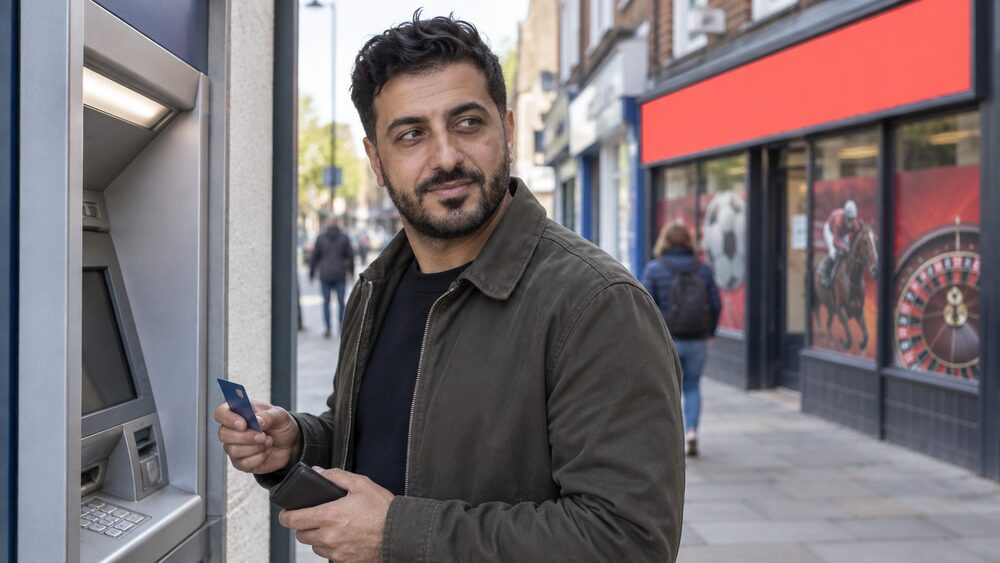
A gambling block is a control you can switch on with your bank that stops payments to gambling businesses going through. Once it is on, any transaction the bank can identify as gambling or betting is declined rather than paid. Starling's account terms, for example, state that "You can choose to block gambling payments being made from your card"1, and AIB (NI) explains that "The block will stop any transactions we are able to identify as gambling and betting from being approved"2. Zempler Bank describes the same effect: applying the block "will automatically disable any gambling-related transactions on your Zempler Bank account"3.
The block is free, it is usually switched on in your banking app in a few taps, and it can be switched off again, though some banks add a delay before it lifts. It is one of several tools banks now offer alongside spending limits, card freezes and welfare calls, and it sits alongside free, round-the-clock support from GamCare's National Gambling Helpline on 0808 8020 133.
What a gambling block on a bank account does
A gambling block works at the payment level. When a card payment is attempted with a merchant the bank identifies as a gambling or betting business, the block means the payment is declined instead of being approved. AIB (NI) puts it plainly: "The block will stop any transactions we are able to identify as gambling and betting from being approved"2. Zempler Bank says the same thing in its own terms: "Applying this block will automatically disable any gambling-related transactions on your Zempler Bank account"3.
The control is offered as a customer choice within the account. Starling's personal account terms state that "You can choose to block gambling payments being made from your card"1, which means the block is something you opt into rather than something imposed. The aim is to put a barrier between a moment of impulse and a payment: by the time the block is in place, attempts to gamble with that card simply fail.
Some accounts have the block applied without the customer asking. Nationwide's FlexOne account, a current account for young people, automatically blocks gambling transactions8. That reflects the fact that under-16s need a parent or guardian's permission to open a bank account8, and that gambling is age-restricted in any case.
The block is not a complete answer on its own. It works on card payments the bank can identify as gambling, so it depends on the merchant being recognised as a gambling business. Payments that are harder to identify, or routes around the card such as cash withdrawals, are better handled by the other controls banks offer, covered later on this page.
Which banks and card providers offer gambling blocks
Gambling blocks are now widespread across UK banks and card providers. Experian notes that "A number of banks and card providers are now supporting customers by allowing them to add 'gambling blocks' to their accounts, including Lloyds Bank, Monzo Bank, Barclays, and Starling"9. Monzo researched, developed and launched its gambling block feature in January 2018, the first of its kind among UK banks.
Many providers describe the block in their own support pages. Here is what a selection of them say:
| Provider | What they offer |
|---|---|
| Starling | A gambling block you can turn on or off in the app, under Cards and Gambling controls10 |
| TSB | Blocks most transactions attempted from UK gambling merchants on your debit card, including gambling or premium-rate websites and gambling phone lines4 |
| Nationwide | A gambling block on debit cards, managed in the app or internet bank5 |
| HSBC UK | Blocks credit card transactions it believes are for gambling, and offers debit card restrictions11 |
| Bank of Ireland UK | A gambling block available on debit cards, including business debit cards12 |
| Danske Bank | A gambling payments block for its personal customers13 |
| Bank of Scotland | Gambling help including blocking support14 |
| Santander | Gambling help and support including transaction blocking15 |
| Tesco Bank | Gambling support including a block on gambling transactions16 |
| Zempler Bank | A block on gambling transactions switched on in online banking3 |
| Ulster Bank | Support for managing your gambling, including blocking17 |
Smaller and specialist institutions offer them too. Arbuthnot Latham, a private bank, publishes gambling support for its clients18, Cambridge Building Society lists blocking debit card payments to gambling retailers among its support options19, and Quilter offers support to customers affected by gambling addiction20. Zempler Bank, an electronic money institution rather than a traditional bank, also lets customers block gambling transactions3.
The detail varies from bank to bank. TSB, for instance, says its block covers "most transactions attempted from UK gambling merchants on your debit card", including gambling or premium-rate websites and gambling phone lines4. Bank of Ireland UK offers the block on business debit cards as well as personal ones, and notes that on a joint account the block applies only to the debit card of the person who asked for it12. If your bank is not listed here, its support or help pages, or a call to its customer service team, will show whether it offers one.
Other controls banks offer: spending limits and support
A gambling block is one of a set of controls banks and building societies make available. Cambridge Building Society lists the main options: blocking debit card payments to gambling retailers (the gambling block), setting a spending limit for gambling retailers, temporarily freezing the debit card, changing the daily cash withdrawal amount, or switching off cash withdrawals altogether19.
Barclays offers category blocks on its debit cards. Its guidance states: "You can also block certain spending categories, like gambling and premium-rate websites"21. The Barclays app can block spending by category, including restaurants, coffee shops, gambling and premium-rate phone lines22.
Banks can also add support around the account itself. In a case study published by the Financial Ombudsman Service, a customer's bank put in place "blocks for gambling websites, a note requesting a welfare call once her spending hit a certain amount, and a reduced limit on the account"23. That shows the range of what a bank can do when a customer asks for help: transaction blocks, a trigger for the bank to call and check in, and a lower limit on what can be spent.
Other payment controls can help too. Most banks set a daily limit on how much you can pay from your account, and you can check yours with your bank24. Some banks and building societies will also remove the current contactless maximum of £100, or raise it, at the customer's request25. Cash withdrawals can be capped or switched off entirely, which closes a route around card-based blocks19.
Where gambling spending is tied to abuse or control by another person, banks have a role as well. Surviving Economic Abuse, a charity, outlines how your bank or building society can support you if a current or former partner has interfered with your money26. The charity Scope likewise advises that "The bank should help if you suspect financial abuse"27. Barclays also publishes guidance on adding a trusted person to help manage money safely21. If this is your situation, the banking help available after domestic abuse is covered in more detail elsewhere on this site.
Credit cards can no longer be used for gambling
Credit cards have been closed off as a gambling payment route by regulation, not just by bank policy. Nationwide explains that "The gambling block does not work for credit cards. The law changed in April 2020 to stop all UK licensed gambling operators from accepting them"5. TSB dates the change precisely: the Gambling Commission put measures in place from 14 April 2020 to stop the use of credit cards for gambling and betting in UK establishments and on UK gambling sites4.
The ban is on the operator side. As Nationwide puts it, "The Gambling Commission doesn't allow UK gambling operators to accept any credit cards"28. In a Financial Ombudsman case study, the ombudsman likewise records that "the Gambling Commission had also banned gambling businesses from allowing consumers in Great Britain to use credit cards to gamble"23.
Banks add a second layer. Nationwide states: "we block any credit card transactions where we know or suspect they are for gambling purposes"28. HSBC UK does the same: "If we believe a transaction on your credit card is for gambling, we'll block it automatically"11.
Newer payment methods are treated similarly. Virtual cards, which some banks and apps issue for online spending, cannot be used for cash withdrawals, gambling purchases, cryptocurrency exchanges or money transfers such as Western Union6. So the main routes to gambling with borrowed money on a card are blocked at both the operator and the bank end.
How to turn on a gambling block
Turning a gambling block on is usually a matter of a few taps in a banking app. The exact route differs by bank, but the pattern is the same: find the card settings, find the gambling option, and switch it on.
For the main providers, the routes are:
- Starling: open the app and select Cards, then Gambling controls, then turn the gambling block on or off10.
- Nationwide (app): choose Manage cards, choose Gambling, turn the gambling block on5.
- Nationwide (internet bank): choose More options, choose Set up gambling controls, select Confirm5.
- TSB: tap Manage Cards in the TSB Mobile Banking App, select the card, click on Gambling block and move the toggle to On. It can also be set up in branch or over the phone4.
- Zempler Bank: in online banking, head to Manage My Account, then Transaction Controls, then Block, select the card and switch Block gambling transactions to ON3.
If your bank is not listed, the same steps usually apply: look in card or account settings for a gambling block, gambling controls or transaction controls option, or ask the bank directly. Several providers, including TSB, will set the block up in branch or by phone if you would rather not use the app4.
One thing to check before switching a block on is how your bank handles switching it off. Some banks apply a delay before a block can be lifted, precisely so that a moment of impulse cannot remove the barrier. The bank's own support page will say how its block behaves, including whether it can be turned off instantly or only after a waiting period.
Blocking software for gambling websites
A bank's gambling block stops card payments. Blocking software works at the other end: it stops gambling websites and apps loading on your devices at all. GamCare's website has information on blocking software which can be installed and used to block gambling websites18.
One widely referenced product is Gamban, described by Bank of Scotland as "gambling blocking software that can be installed on phones, tablets and computers"14. Danske Bank links to the same product as "Gambling blocking software"13.
There are two main types of software to choose between15:
- Gambling-blocking software, which blocks gambling websites and apps specifically.
- Parental control software, which blocks a wider range of websites and online content, including gambling.
Some services are free, while others charge a fee15. The choice between them is mostly about scope: gambling-specific software does one job, while parental control software covers a broader range of content, which matters if the aim is to protect children as well as to block gambling.
Using both layers together is stronger than either alone. A bank block stops the payment; blocking software stops the site or app being used in the first place, including on wifi networks and devices where your card details are already saved.
Getting help: GamCare and the National Gambling Helpline, free and 24 hours
A block is a tool, not treatment. Free, confidential help is available at any hour. GamCare runs the National Gambling Helpline, which the Financial Ombudsman Service describes as offering "gambling harm support"29. The helpline is free to call on 0808 8020 133 and is open 24 hours a day, every day of the year5. You can also reach GamCare by WhatsApp on 020 3031 88816, or through online chat at gamcare.org.uk30.
The helpline offers more than a listening ear. People affected by gambling can get information, advice and support, and GamCare can help find face-to-face counselling in your area, along with free tools and support available in minutes30. Tesco Bank describes the helpline as "24-hour support for anyone affected by gambling"16, and Equals Money notes that it "provides free and confidential advice, support, and information on problem gambling"31. Advisers are available 24 hours a day30.
Support is not limited to the person gambling. Gam-Anon runs regular peer support groups for the friends and family of gamblers30, and the addiction helplines can offer advice and support to friends or family as well32. Gordon Moody offers support specifically for friends and family of people with gambling problems33.
NHS treatment also exists. The NHS provides gambling treatment services through the National Centre for Behavioural Addictions and the National Problem Gambling Clinic, supporting anyone experiencing gambling-related harm33. Primary Care Gambling Services is another NHS service supporting anyone affected by gambling harm33.
MoneyHelper, the free government-backed money guidance service, can also be reached by WhatsApp, phone, email or live chat34. And Citizens Advice offers a free service, including help with gambling problems29.
"You can get free and confidential support 24 hours a day, every day of the year. You can: call 0808 8020 133"
Gambling and debt: support for money worries
Gambling harm and debt often arrive together, and the Financial Ombudsman Service sees cases involving compulsive spending or gambling harm across nearly every financial product: loans, mortgage extensions, pensions used for gambling, high-risk investments, and general banking including account support29.
StepChange, the debt charity, has researched how the two interact. Its research found that clients interviewed had generally reduced or stopped gambling before or around the time of seeking debt advice, and that addressing harmful gambling seems often to be a prerequisite for successful and sustainable debt resolution7. In other words, dealing with the gambling and dealing with the debt usually have to happen together.
The same research identified what makes gambling debt harder to resolve: the length of time over which debts built up, the number of different types of debts, the high value of the debt, secrecy, co-occurring issues such as substance misuse and mental health problems, borrowing from family members, and gambling-related crime7. It also found barriers affecting people around the gambler, including being unable to talk to creditors about debts in a partner's name, being the victim of gambling-related fraud by a partner or ex-partner, and being wholly or partly unaware of the gambling problem and the gambling debt7.
Free debt help is available:
- StepChange provides free debt advice and has specific guidance on gambling debt30 and on addictions and debt problems more generally32.
- National Debtline can be called free on 0808 808 4000 for free professional help from its advisers35.
- Citizens Advice is a free service that can help with gambling problems29.
- MoneyHelper offers free money guidance by WhatsApp, phone, email or live chat34.
If you have complained to a bank about how it handled your account while gambling harm was involved and the bank did not put things right, the Financial Ombudsman Service can look at complaints involving gambling-related harm29. Its consumer helpline is on 0300 123 9 12337.
One further point worth knowing: gambling can affect formal debt solutions. Under insolvency legislation, a debt relief restrictions order can be made on grounds including "carrying on any gambling, rash and hazardous speculation or unreasonable extravagance which may have materially contributed" to the insolvency, or failing to co-operate with the official receiver38. That is a matter for the official receiver and the courts, but it is one way gambling can follow a person into a debt solution.
Finally, the links between gambling and mental health are well documented. The Money and Mental Health Policy Institute's research, "Know the odds: the links between mental health problems and gambling", published on 21 November 2017, reviewed the academic literature and undertook new qualitative research with its Research Community39. Its Get Help page signposts support for anyone struggling with both33. Talking about money is itself a hurdle: research published in 2025 found just four in ten adults feel comfortable talking to friends about money33. The services listed above exist precisely so that there is somewhere to talk, free and at any hour.
Sources39 cited
- Starling personal account general terms Starling Bank, May 2026
- Worried about gambling AIB (NI)
- Gambling transactions Zempler Bank
- Gambling support TSB
- Gambling support Nationwide
- Gambling debt StepChange
- Gambling and problem debt research report StepChange
- Children's bank accounts: what options are there in 2025 Which?, 2025
- Gambling credit protection Experian
- Gambling help and support Starling Bank
- Gambling restrictions HSBC UK
- Gambling support Bank of Ireland UK
- Block gambling payments Danske Bank
- Help with gambling Bank of Scotland
- Gambling help Santander
- Here to help: gambling Tesco Bank
- Available support Zempler Bank
- Gambling support Arbuthnot Latham
- Gambling support Cambridge Building Society
- Gambling addiction support Quilter
- Trusted person and fraud Barclays
- Stay in control with the app Barclays
- Case study: credit card debt, gambling and ill health Financial Ombudsman Service
- Safer ways to pay Consumer Council Northern Ireland
- Banking support Surviving Economic Abuse
- Managing money for someone else Scope
- Gambling restrictions on credit cards Nationwide
- What are virtual debit cards Which?, 27 May 2026
- Complaints that involve gambling-related harm Financial Ombudsman Service
- Addictions and debt problems StepChange
- Customer vulnerability Equals Money
- Get help Money and Mental Health Policy Institute
- Just four in ten adults feel comfortable talking to friends about money Money and Pensions Service, 3 November 2025
- Types of scam MoneyHelper
- National Debtline guidance National Debtline
- Managing your gambling Ulster Bank
- Annual report 2014 Financial Ombudsman Service
- Debt Relief Order (Northern Ireland) 2010 legislation.gov.uk, 15 December 2010
- Know the odds: the links between mental health problems and gambling Money and Mental Health Policy Institute, 21 November 2017



 MoneyHelperFree, impartial money and pensions guidance, set up by government
 FSCSProtects your money if a bank, insurer or investment firm fails
 Financial Ombudsman ServiceFree, independent help when a complaint about a firm is not put right
 Citizens AdviceFree advice on money, consumer and legal problems in England and Wales