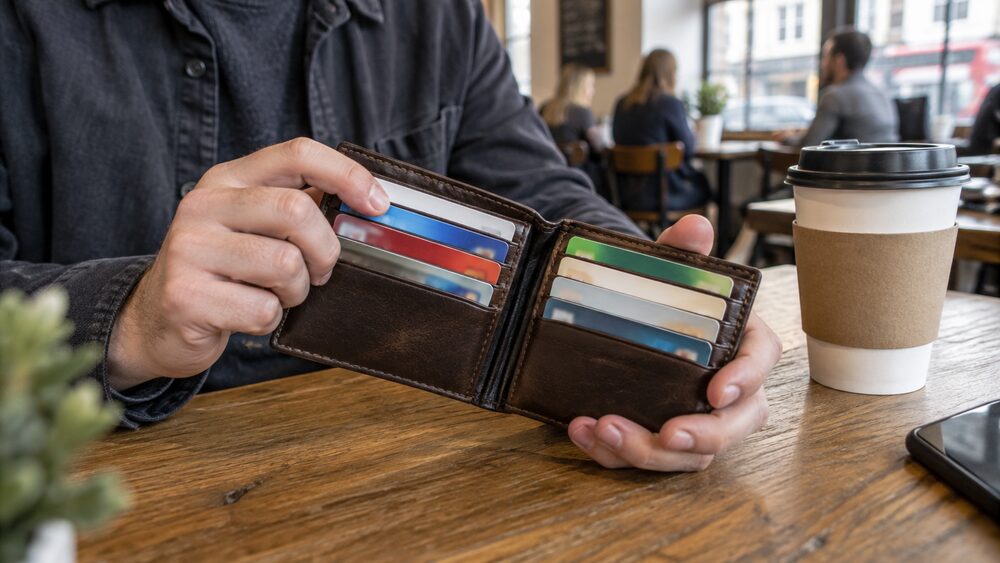
Credit cards in the UK are issued by a surprisingly small number of firms, and an even smaller number of them hold most of the debt. The Financial Conduct Authority (FCA) counted 33 issuers in October 2014, offering more than 200 credit card products, with 59 million cards in issue and around 30 million cardholders who together accounted for an estimated £56.9 billion of outstanding debt1. A year later, counted at group level, 24 firms were issuing credit cards in the UK, and four of them held approximately two-thirds of all credit card balances2.
That concentration matters to a consumer in one practical way: most cards on the market, whatever their brand, come from a handful of lenders. The brands on the card are often supermarkets, airlines or app-based banks, but the firms behind them, and the rules that govern them, are shared across many products. This page explains who issues cards in the UK, what the different types offer, what they cost to use at home and abroad, how buy now pay later now fits into the same rules, and where to get help when a card goes wrong.
The UK credit card market: 33 issuers and a few large lenders
The UK credit card market began in 1966 with just two cards, and by the time of the FCA's review of the Consumer Credit Act it had grown to over 180 products6. In its 2014 market study the FCA described a market with 33 issuers, more than 200 credit card products available for consumers to choose from, and approximately 60% of the UK adult population owning a credit card1. The FCA's final findings in 2015 put the number of cardholders at over 30 million7, a figure repeated in later FCA research, which also noted £70 billion held in outstanding debt across over 30 million card holders8.
The market is not evenly spread. The FCA's interim report found a small number of large providers, with four firms holding approximately two-thirds of all credit card balances, alongside a tail of smaller issuers2. The same report noted that five firms had begun issuing their own credit cards in recent years: Metro Bank, Sainsbury's Bank, Tesco Bank, TSB and Virgin Money2. So while the number of brands a shopper sees is large, the number of firms actually lending the money is much smaller, and the biggest four dominate.
One historical change still shapes how cards work today. Until 1976, when the government allowed cards to offer extended credit, customers were required to pay their card balances in full each month1. The option to carry a balance from month to month, paying interest on it, is what turned the credit card from a convenience into a borrowing product, and it is the feature behind most of the costs and risks covered later on this page. The FCA's market study found that 11% of consumers holding multiple cards, around 1.6 million people, were in potentially problematic debt on more than one credit card7.
Banks, digital banks and specialist lenders: who issues cards
Credit cards are issued by several kinds of firm. Citizens Advice notes that you can get a credit card from banks, finance companies and larger supermarket and store chains11. Behind the brand on the plastic, every card is connected to a payment scheme: Mastercard and Visa Europe connect issuers of credit and debit cards with acquirers and the merchants and retailers that accept card payments in the UK12. The scheme decides where the card is accepted; the issuer decides the credit limit, the interest rate and the fees.
The Bank of England publishes consumer credit data broken down by type of lender and product, including credit card lending, overdrafts and other loans, which is how the official picture of who is lending is tracked13. In its statistics the Bank groups non-bank credit grantors and specialist lenders into a category of "other consumer credit lenders", reflecting the fact that a significant slice of lending comes from firms that are not high street banks.
As of 2024, 65% of UK adults held a credit card3, up from the roughly 60% the FCA recorded in 20141. The practical implication for a consumer choosing a card is that the brand rarely tells you who the lender is: a supermarket card may be issued by the supermarket's own bank, by a specialist finance company, or by one of the large banks under an agreement. The dedicated guide to who issues your credit card sets out the brands and the lenders behind them, and the types of credit card page explains what each type is for.
Rewards, cashback and air miles
Many issuers offer cards that pay something back on spending. The two main forms are cashback, where a percentage of what you spend is returned as money, and points or air miles, where spending earns rewards that can be put towards flights, upgrades or goods. Which? rates air mile credit cards by customer score, and in its September 2026 review several American Express and British Airways cards scored 80%14.
The earning structures differ from card to card. Which?'s review found the American Express Rewards Credit Card earns 1 Membership Rewards point per £1, the British Airways American Express Credit Card earns 1 Avios point per £1, and the British Airways American Express Premium Plus Credit Card earns 1.5 Avios points per £114. The American Express Preferred Rewards Gold Credit Card earns 1 Membership Rewards point per £1 on everyday spending, 3 points per £1 on Amex Travel and 2 points per £1 with airlines14.
Two things determine whether a rewards card is worth having: the annual fee and whether the balance is paid in full. Citizens Advice notes that some providers charge an annual fee11, which has to be earned back before the rewards are a benefit. And because rewards cards typically charge interest on balances carried past the payment date, a card that rewards spending only works as intended for someone who clears the balance each month. The comparison of cashback vs points reward cards and the guide to rewards and cashback credit cards go through the arithmetic. Purchases on an air mile credit card between £100 and £30,000 carry the same Section 75 protection as any other credit card14.
Spending abroad: foreign transaction and cash fees
Using a credit card outside the UK can trigger fees that do not apply at home. Halifax states that for cash withdrawals at an ATM or branch outside the UK, in addition to any service provider charges, a foreign currency transaction and purchase fee might apply15. Foreign transaction fees vary between providers, and some issuers waive them for limited periods on their own cards; the terms of the individual card set what applies.
There is also a cost behind the scenes that consumers do not see directly. The UK Interchange Fee Regulation caps the interchange fees that card schemes charge on consumer debit and credit card transactions where the merchant, acquirer and card issuer are all within the UK16. Those caps apply to UK transactions; spending abroad sits outside them, which is part of why foreign use is priced differently.
For comparison, when using a debit card abroad, MoneyHelper notes a spending or cash machine charge typically between £1 and £3 each time you use your card, except for euros in the EU17. Credit card cash withdrawals abroad are usually more expensive still, because a cash fee and interest from the day of withdrawal can both apply. The guides to using a credit card abroad, withdrawing cash on a credit card and paying in pounds or local currency at the till cover the details, and the credit card fees and charges page lists the fees to check before travelling.
Buy now pay later is now regulated
Buy now pay later (BNPL) moved fully into the regulated credit system in 2026. Parliament approved plans to regulate unregulated buy now pay later credit in July 202510, and the FCA started regulating Deferred Payment Credit, often known as Buy Now Pay Later, on 15 July 20264. The legislation provides for certain buy now pay later agreements, previously exempt under article 60F(2) of the Regulated Activities Order, to become regulated credit agreements18. The government's consultation on the draft legislation ran from October 2024 and was last updated on 16 June 202519.
The change brings BNPL under rules consumers already know from credit cards. StepChange explains that Buy Now Pay Later now has similar protections to credit cards, which are covered under the Consumer Credit Act22. For anything bought using BNPL, a lender will carry out a credit check to make sure the borrower can afford the repayments22. BNPL is offered through many providers including Klarna, Clearpay, PayPal and Amazon22.
The most significant protection is joint liability. StepChange sets out that the BNPL provider and the retailer are both jointly responsible if anything goes wrong, meaning a partial or full refund can be claimed if goods do not arrive, are faulty, or the retailer stops trading22. This mirrors Section 75 of the Consumer Credit Act 1974, under which a credit card provider can be held equally liable with the trader for a breach of contract or misrepresentation on purchases over £100 and under £30,0005. Complaints about BNPL firms can now go to the Financial Ombudsman Service. The credit card instalment plans and cardless credit pages cover the products that sit alongside BNPL.
Paying off a credit card balance
A credit card balance can be paid off in full each month, or carried over and paid down gradually with interest. The FCA's review of credit card literature found that 60% of credit card holders report paying off their balances monthly, in contrast to only 54% who pay the balance in full in the data it examined23. Those who pay in full avoid interest entirely, subject to the card's terms; those who do not enter the interest-charging system explained in how credit card interest is charged.
For borrowers carrying debt, the FCA's market study found that 0% balance transfer offers accounted for a quarter of outstanding balances7. Balance transfers move a debt to a new card, usually for a fee, and the guides to balance transfer credit cards, balance transfer fees and what happens when a 0% offer ends cover how they work and what they cost.
The risk sits with borrowers who only pay the minimum. The FCA found that the average balance of those making systematic minimum repayments is over £5,000, though 15% of this group carry average balances below that level7. Minimum payments are set low, so debt can persist for years: the pages on credit card minimum payments and how long paying only the minimum takes show the effect. The FCA has also reported that 3 million customers were struggling with card debt24, and its persistent debt rules require firms to help customers who are paying more in interest, fees and charges than they are repaying of the balance; the persistent credit card debt rules page explains those rights.
Purchases are protected while a balance exists. Section 75 applies to credit card purchases over £100 and not more than £30,000, making the issuer jointly and severally liable for any breach of contract or misrepresentation by the trader1. Chargeback, a scheme rule rather than a legal right, has no upper or lower limit, though card issuers have their own specific rules25. The comparison of Section 75 or chargeback explains which to use. The Office for National Statistics has tracked households with an outstanding credit card balance across Great Britain from July 2006 to June 201626, and free help with problem debt is covered on the help with credit card debt page.
Card fraud: phishing and stolen card details
Card fraud most often begins with stolen details rather than a stolen card. Phishing emails, fake websites and data breaches all put card numbers into the hands of criminals, and the first many people know is an unfamiliar transaction on a statement. The Information Commissioner's Office (ICO) advises victims to report all lost or stolen documents containing personal information, such as passports, driving licences, credit cards and cheque books, to the organisation that issued them27.
After reporting the loss, the ICO recommends a series of protective steps: check bank statements and your credit report, watch out for phishing, use strong passwords and multifactor authentication, and consider applying for Cifas protective registration28. Regularly checking credit card and bank statements for suspicious activity and monitoring your credit report reduces the risk that fraud goes unnoticed27.
If money has been taken, the Financial Ombudsman Service advises scam victims to contact their bank or payment services provider immediately, contact the police on 101, report the scam to Report Fraud, and keep records of all contact and correspondence with the scammer29. In Northern Ireland, nidirect advises speaking to your bank or building society straight away if you think your card, online bank account or cheque book have been stolen or hacked30. Reporting routes differ across the UK: fraud in England, Wales and Northern Ireland goes through Report Fraud, with separate arrangements in Scotland27.
Liability for card fraud generally favours the cardholder. UK Finance states that if the correct PIN is entered, the card issuer will usually bear liability for fraud committed by the person using the card, though if the cardholder disclosed their PIN, responsibility may shift31. The pages on credit card fraud and unauthorised payments, Section 75 claims and complaining about a credit card provider set out the full process, and the scams and fraud section covers the wider picture.
Accessible cards and new ways to pay
Cards are the most popular way for consumers to pay for goods and services in the UK32, and the industry has been working to make them usable by everyone. UK Finance, the leading card payments trade association, launched the Accessible Cards Code of Practice in March 2026, following its 2025 Enhancing Accessibility in Card Payments Discussion Paper31. The Payment Systems Regulator has confirmed the sector has now issued the Code, which represents a world-leading standard for flat printed cards, and has said firms should continue to adopt it voluntarily and at pace31. The Code is voluntary but strongly encouraged, setting standards for retailers and card issuers on card design and terminal accessibility31.
For individuals, the practical options are concrete. MoneyHelper notes that banks can provide chip and signature cards for customers who are unable to memorise a PIN33. Gov.uk sets out disability-related financial support more broadly, including Blue Badge parking, a disabled persons bus pass or railcard, and help to buy or lease a car through the Motability Scheme34.
The wider payments landscape is also changing. The Payment Systems Regulator's stated aim is to support cash access, including widespread geographic access, which meets the needs of UK consumers who need or want to use cash35, so cards sit alongside cash rather than replacing it for those who rely on it. UK Finance has said it plans to discuss biometric cards and the challenges of rolling them out with its members in 202631. For anyone who finds PINs, touchscreens or standard cards difficult, the guide to paying when you cannot use a PIN or touchscreen and MoneyHelper's guidance on making money easier to manage yourself set out the adjustments to ask a provider for.
Sources35 cited
- Credit card market study: interim report Financial Conduct Authority, November 2014
- Credit card market study interim report Financial Conduct Authority, October 2015
- Financial Lives 2024: payments Financial Conduct Authority, May 2024
- Buy now pay later Financial Conduct Authority, July 2026
- Consumer advice: Section 75 claims Anglesey County Council, March 2025
- Review of retained provisions of the Consumer Credit Act: final report Financial Conduct Authority, March 2019
- Credit card market study: final findings report Financial Conduct Authority, July 2016
- Helping credit card users repay their debt: summary of experimental research Financial Conduct Authority, July 2018
- The Woolard Review Financial Conduct Authority, February 2021
- Regulation of buy now pay later: Commons research briefing UK Parliament, July 2026
- Plastic cards Citizens Advice, September 2026
- When you make a payment Payment Systems Regulator, September 2026
- Consumer credit including student loans Bank of England, January 2023
- Best air mile credit cards Which?, September 2026
- Credit cards vs debit cards Halifax, September 2026
- The Interchange Fee Regulation Payment Systems Regulator, September 2026
- How to open, switch or close your bank account MoneyHelper, September 2026
- The Deferred Payment Credit Regulations 2025 legislation.gov.uk, July 2025
- Regulation of buy now pay later: consultation on draft legislation HM Treasury, June 2025
- Buy now pay later Consumer Council for Northern Ireland, July 2026
- New rules for buy now pay later schemes Which?, 11 February 2026
- Buy now pay later StepChange Debt Charity, September 2026
- Review of credit card literature Financial Conduct Authority, October 2015
- Credit card market study: thematic review of firms' treatment of customers in financial difficulty Financial Conduct Authority, December 2016
- Festival refunds not guaranteed, warns Financial Ombudsman Service Financial Ombudsman Service, June 2026
- Households with an outstanding credit card balance, Great Britain, July 2006 to June 2016 Office for National Statistics, June 2018
- Identity theft Information Commissioner's Office, September 2026
- What steps can I take if I've been affected by a personal data breach? Information Commissioner's Office, September 2026
- Scams involving unauthorised payments and identity theft Financial Ombudsman Service, September 2026
- Protect your identity nidirect, October 2025
- Enhancing Accessibility in Card Payments Report UK Finance, June 2026
- Market review of card scheme and processing fees: final report Payment Systems Regulator, September 2026
- Make your money easier to manage by yourself MoneyHelper, September 2026
- Financial help if you're disabled GOV.UK, September 2026
- First annual review of Specific Direction 8 Payment Systems Regulator, September 2026




 MoneyHelperFree, impartial money and pensions guidance, set up by government
 StepChangeFree debt advice and solutions from a charity
 National DebtlineFree debt advice by phone, webchat and online
 Financial Ombudsman ServiceFree, independent help when a complaint about a firm is not put right
 Citizens AdviceFree advice on money, consumer and legal problems in England and Wales