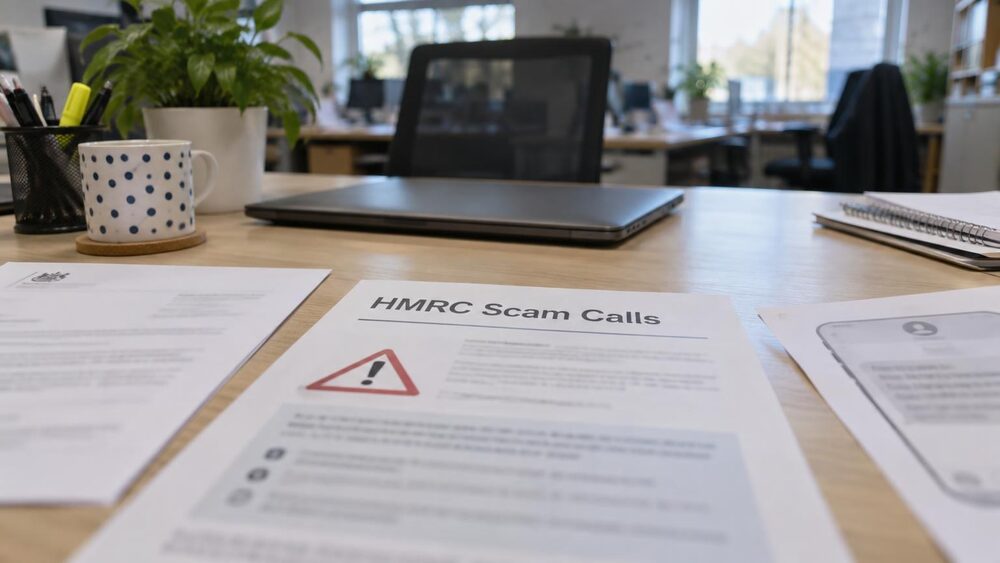
HMRC does send real text messages, and it does call people about tax. That is exactly what makes fake ones work. The reliable test is not the sender name on your screen, which can be faked, but what the message asks you to do. HMRC says it will never ask for personal or financial information when it sends a text message1.
HMRC does send real text messages, and it does call people about tax. That is exactly what makes fake ones work. The reliable test is not the sender name on your screen, which can be faked, but what the message asks you to do. HMRC says it will never ask for personal or financial information when it sends a text message1.
So a text offering a tax refund in exchange for your details is not from HMRC, however official it looks. HMRC's own advice is blunt: do not open any links or reply to a text claiming to be from HMRC that offers you a tax refund in exchange for personal or financial details1. The same rule covers emails and calls. Genuine banks and HMRC will not ask you to reveal your PIN or banking password in full2.
If you have already replied, clicked or paid, act now rather than later. Contact your bank immediately and report the scam to Action Fraud3. The faster a payment is reported, the better the chance of recalling it.
How HMRC scam texts, emails and calls reach you
Impersonation scams work by pretending to be someone you already trust. Take Five, the national anti-fraud campaign, lists the identities scammers use most: your bank, the police, HMRC, or even a friend or family member7. HMRC is a favourite because almost everyone has some contact with it, whether through PAYE, Self Assessment or Child Benefit.
The approaches come in three main forms. Ulster Bank and NatWest both describe the same pattern: fake emails and texts that look like they are from HMRC and ask for your personal details, fake phone calls, and fake websites8. The fake website matters as much as the message, because a link in a convincing email can take you to a page built to look like the official HMRC site so it can steal your information8.
Volume is high. HMRC received 57,579 reports of SMS fraud in 2019, up from 36,950 in 20186. Those are reports, not losses, and they show how widely these messages are sent.
The timing is not random. HMRC has issued warnings around Self Assessment deadlines, when people are expecting contact and are more likely to respond10. It has also warned about gift card scams, where a caller claiming to be from HMRC asks for payment in iTunes vouchers11. HMRC says it works with law enforcement agencies, Apple and campaign groups to make sure the public know how to spot these approaches11.
Warning signs that a message is not from HMRC
The strongest signal is a request for information or money. HMRC will never ask for personal details, like your bank information, through email or text8. Independent Age puts it the same way: HMRC will never ask for your personal or financial information via email, or email you a link to a log-in page asking for this information12.
Genuine HMRC texts have a recognisable shape. They show HM Revenue and Customs as the sender and contain the verified sender's information1. If your device cannot receive a Rich Communication Services (RCS) message, the branded message will appear as a standard text message instead1, so a plain-looking text is not automatically fake.
Watch the wording. NatWest's guidance points to bad grammar, spelling mistakes, or greetings like "Dear Customer", noting that official messages are usually personalised with your details9. Which? found the same in a scam email example: the greeting addresses the recipient as a "customer", there are grammatical errors such as random capitalised words and full stops, and the website address differs from the official HMRC one13.
A familiar number or name proves nothing: how spoofing works
Your phone's caller ID is not evidence. Scammers use identity masking technology to change the name displayed as the sender, known as number spoofing14. Which? notes that scammers sometimes use number spoofing to make your phone display "HMRC" as the sender, instead of a phone number4.
The same trick works on calls. Monzo's guidance is direct: ignore the display name, because scammers can spoof phone numbers to make it look like they are calling from HMRC or Monzo, so do not always trust your caller ID15. The Insolvency Service has described the same technique in investment scams, where the caller ID and telephone number seen by an investor is not the scammer's details but legitimate phone numbers used by the Insolvency Service or other organisations16.
Spoofing can be reduced but not eliminated. HMRC reported a 94 per cent reduction of phone scams spoofing its 0300 helpline numbers after action against the practice6. That is a fall in one specific type of spoofing, not a guarantee that any call showing an HMRC number is real.
How to check with HMRC directly
Go to HMRC yourself rather than following the message. Skipton Building Society's guidance is to check what you owe directly with HMRC on the GOV.UK website before paying, and to seek clarity from HMRC directly to confirm a contact is genuine17. Monzo adds that real officials will never pressure you to pay over the phone, and that you can check HMRC online services if you have an account, to see if your tax is up to date15.
There is plenty you can check without calling anyone. You can use the PAYE section of HMRC online services or the HMRC app to check your employers, estimated income and tax codes18. If your details are wrong or missing, the same services let you update employer details, add a missing employer, tell HMRC when an employment ended, or update estimated income18. The HMRC app is free to download19.
Your tax code is a useful cross-check. You can check it online on GOV.UK or on the HMRC app, and let HMRC know if it still does not look right20.
If you owe money, GOV.UK sets out what to do, covering payment, disagreement with a decision or penalty, and what happens if you cannot pay on time21. If HMRC is checking your tax affairs, its compliance guidance explains the process and how to ask for the check to stop22. Simple Assessment uses information from employers, pension providers, banks and building societies23, so a genuine query about your tax position will usually trace back to a document you have already received.
No genuine organisation asks you to move money or share a PIN
This is the rule that survives every disguise. HSBC states that genuine banks will never ask you to transfer funds or share PINs or passwords24. Its fuller list covers telling anyone the card's 4-digit PIN, sharing a QR code or one-time passcode, transferring money anywhere including to a "safe" account, or sending the card, cheque book or cash25. Experian's guidance is the same: no bank or any other genuine organisation will ask you to reveal your PIN or banking password in full2.
HMRC applies the same standard to itself. NatWest's guidance records that HMRC will never ask for personal details, like your bank information, through email or text9. HMRC's own text message guidance says the same, and adds that genuine texts will not ask for personal or financial information or link directly to websites in the cases it lists1.
The "safe account" request deserves its own warning. A caller who says your money is at risk and must be moved to a protected account is running a scam, and the account is the fraudster's. If you are unsure whether a bank is really contacting you, hang up and call back on a number you have looked up yourself.
If you have already replied, clicked or paid
Speed matters more than anything else now. Contact your bank immediately and report the scam to Action Fraud3. If you gave away card details, your bank can block the card. If you gave away enough information to allow identity theft, Experian's guidance covers what to do after a data breach2.
If you authorised a bank transfer to a scammer, your refund depends on the bank transfer reimbursement rules, which have their own limits and conditions. There is a maximum refund for authorised push payment fraud, and an excess applies to claims. If a bank refuses a claim, the Financial Ombudsman Service can look at it. Free, impartial help is available from MoneyHelper.
Report the message itself as well. HMRC asks customers to report suspicious activity at phishing@hmrc.gov.uk, by sending a text to 60599, or by reporting phone scams online on GOV.UK10. Which? gives the same two routes: forward suspicious emails claiming to be from HMRC to phishing@hmrc.gov.uk and texts to 605994. Text messages sent to 60599 are charged at your network rate4. Forwarding suspicious texts to 7726 is a free alternative4.
There is a second wave to watch for. Recovery room schemes target people who have already lost money, offering to get it back. The Insolvency Service has warned that in these schemes the caller ID and telephone number seen by an investor is not the scammer's details but legitimate phone numbers used by the Insolvency Service or other organisations16. Anyone who contacts you out of the blue offering to recover lost funds, for a fee, is worth treating with the same suspicion as the original scam.
Sources25 cited
- Check if a text message you've received from HMRC is genuine GOV.UK, 2026-09-18
- What to do after a data breach Experian, 2026
- HMRC issues scam warning: how to spot a dodgy email or phone call Which?, 2023-06-06
- How to spot HMRC phone, text and email tax scams Which?, 2026-01-19
- UK Finance Fraud Report 2026 UK Finance, 2026-06
- How to spot the biggest HMRC tax scam tactics Which?, 2020-01-25
- Impersonation fraud Take Five, 2026-09-26
- HMRC scams Ulster Bank, 2026-09-25
- HMRC scams NatWest, 2026-09-25
- Self Assessment customers warned about scammers posing as HMRC GOV.UK, 2020-11-17
- HMRC issues Christmas warning about iTunes gift card scam GOV.UK, 2017-12-20
- Making Tax Digital for Income Tax Which?, 2026-07-27
- How to spot an email scam Which?, 2026-08-11
- How to spot a messaging scam Which?, 2026-06-29
- Understanding impersonation scams Monzo, 2026-09-25
- Investors warned about approaches to recover lost funds GOV.UK, 2021-03-12
- Impersonating HMRC Skipton Building Society, 2026-09-26
- Tell HMRC if you have a new job or more than one job GOV.UK, 2025-01-16
- Almost 7 million adults in the dark about their state pension GOV.UK, 2026-09-14
- Tax code changes GOV.UK, 2026-08-05
- Find out what to do if you owe money to HMRC GOV.UK, 2025-08-18
- HMRC compliance checks: help and support GOV.UK, 2021-03-05
- Understand Simple Assessment GOV.UK, 2026-09-25
- Cyber security: how to bank safely HSBC UK, 2026-09-14
- Fraud guide HSBC UK, 2026






 FCA Warning ListCheck whether a firm is authorised before you deal with it
 Financial Ombudsman ServiceFree, independent help when a complaint about a firm is not put right
 Citizens AdviceFree advice on money, consumer and legal problems in England and Wales
 MoneyHelperFree, impartial money and pensions guidance, set up by government