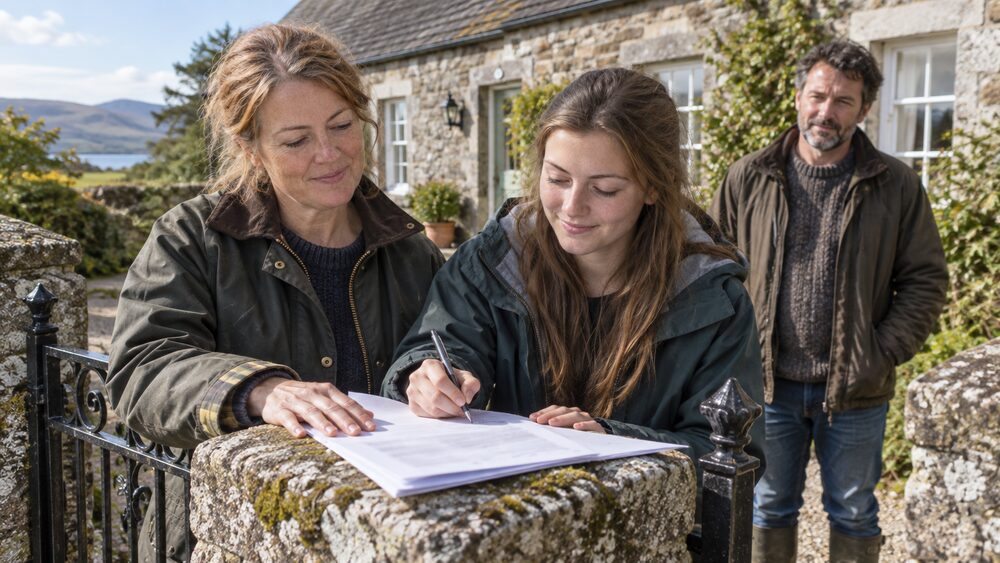
Scotland has its own law of succession, and it differs from the rest of the UK in ways that change what a will can and cannot do. Two differences matter most. First, the formalities are lighter: a Scottish will needs only one witness aged 16 or over, and the person making it must sign every page, compared with two independent witnesses aged 18 or over in England, Wales and Northern Ireland1. Second, a Scottish will cannot fully disinherit a spouse, civil partner or children, because they have "legal rights" to a share of the estate that override whatever the will says2.
Marriage is treated differently too. In England, Wales and Northern Ireland, getting married or entering a civil partnership automatically revokes an existing will1. In Scotland, marriage does not revoke a will, but it does give the new spouse legal rights to part of the estate1. So a will made before a wedding survives in Scotland, but its effect can still change.
Most UK adults have never made a will at all: a 2025 report found over half of UK adults do not have one3. If you die without a will in Scotland, the law of intestacy decides who inherits, in stages that begin with a surviving spouse or civil partner's "prior rights" to the home, its contents and a cash sum4. The general process of making a will is covered in making a will: options, costs and what makes it valid; this page deals with what is different north of the border.
What makes a will valid in Scotland
A will in Scotland must be signed and formally witnessed, and it should be kept somewhere safe where the people dealing with your estate can find it5. The witnessing rule is the clearest difference from the rest of the UK. In Scotland you only require one witness aged 16 or over, but you, the testator, must sign the will on every page1. In England, Wales and Northern Ireland a will must instead be signed in the presence of two independent witnesses who are 18 or over1.
Getting this right is not a formality. Independent guidance is blunt that when writing your own will, it is crucial the document is witnessed correctly and includes all major assets1. A will that fails on witnessing can be invalid, which means the estate falls into intestacy as if no will had been made at all, and the people the will was meant to provide for may get nothing or a share decided by the rules described later on this page.
The witness should be someone who does not benefit from the will, and the same practical care applies to the document itself. Guidance on storing wills recommends the document be securely bound, for example using a single staple in the top left hand corner, and warns against removing staples or using a paperclip1. A loose or altered document invites questions after death that no one is there to answer.
A will also needs to be clear about what it covers. It should identify the executors who will administer the estate, set out who inherits what, and deal with major assets such as the home. Where a home is owned jointly, how it is owned matters as much as the will: a survivorship destination on a Scottish property means the surviving owner inherits automatically, outside the will, and the guide to survivorship destinations on Scottish property explains how that works. The general rules on witnessing are covered in witness rules for a valid will.
Legal rights: what a spouse, civil partner or children can claim
This is the biggest difference between Scottish succession law and the law elsewhere in the UK. In Scotland, a spouse, civil partner or children of the person who died can challenge the will if they do not agree with what it says, by exercising their "legal rights"2. Legal rights are a claim on the moveable estate, meaning money and possessions rather than land and buildings, and they exist whatever the will says. You cannot write a will in Scotland that fully excludes a spouse or children from a share of that part of the estate.
The shares depend on who survives. Where there is a surviving spouse or civil partner and children, the spouse receives a third of the remaining estate and the children receive a third, shared equally between them4. Where there is a surviving spouse and no children, the spouse receives half of the remaining estate4. Where there are surviving children and no spouse or civil partner, the children receive half of the remaining estate, shared equally between them4.
| Who survives | Legal rights share |
|---|---|
| Spouse or civil partner, no children | Half of the estate4 |
| Children, no spouse or civil partner | Half of the estate, shared equally4 |
| Spouse or civil partner and children | A third to the spouse, a third to the children, shared equally [3 |
Legal rights matter even in cases that seem purely administrative. HMRC guidance on excepted estates states that in Scotland the Spouse or Civil Partner Exemption and any Charity Exemption must be calculated on the basis that any entitlement to legitim, the children's legal rights claim, will be claimed in full6. In other words, the tax treatment assumes children claim what the law gives them, not what the will leaves them.
A person entitled to legal rights has a choice: they can take their legal rights, or they can accept what the will leaves them, but the claim has to be considered before the estate can be wound up with confidence. That is one reason executors must normally wait at least 6 months from the date of death before distributing the estate2. The detailed rules are covered in prior rights and legal rights in Scotland.
Unmarried partners have no automatic right to inherit
An unmarried partner has no automatic inheritance rights in Scotland, however long the relationship lasted2. A cohabiting partner is not a spouse for the purposes of intestacy or legal rights, so a will that names them is the only straightforward way to provide for them. Without a will, and without a claim, they can be left with nothing from the estate.
There is a limited safety net. A surviving cohabiting partner may be able to apply to the court for a share of the estate2. This is a court application, not an automatic entitlement, and it has to be made before the estate is distributed, which is why the 6 month waiting period before distribution matters here too2. A claim is not the same as a right: the court decides what, if anything, is fair in the circumstances.
The practical conclusion is that for unmarried couples the will does work that the law does for married couples. The same applies to other arrangements that matter financially: a jointly owned home may pass by survivorship regardless of the will, and the page on unmarried couples: money rights when you split or die covers the wider picture, including joint accounts and property ownership.
If there is no will: prior rights and the intestacy order
If you die without making a will, the law of intestacy sets out who should inherit your estate5. In Scotland the estate is normally distributed in stages2. First come prior rights, then legal rights, and then the remaining estate passes under the intestacy order to relatives in a fixed order2.
Prior rights belong to a surviving spouse or civil partner and come off the top of the estate. They cover the home up to its value, the contents of the home up to a value of £29,000, and a cash sum4. The cash sum is £50,000 where there are surviving children, and £89,000 where there are none4.
After prior rights and legal rights, the remaining estate passes to relatives under the intestacy order. If no surviving relatives can be found, the estate will be passed to the Crown4. A surviving spouse's entitlement on intestacy, where the person died without a will, includes the home, the contents and part of the remaining estate2.
Where there is no will, an administrator takes over the estate, usually a relative or friend and/or a solicitor7. In Scotland the terminology is different from England and Wales: the persons appointed to administer the estate are known as executors, regardless of whether there is a valid will8. The rules for England and Wales are covered in dying without a will in England and Wales.
One further point affects every estate, with or without a will. If there is not enough money in the estate to pay all debts, the estate may be insolvent, and creditors must be paid in a legal order of priority; executors are advised to get legal advice before making payments2. Debts are paid before legacies, and the page on what happens to debts when someone dies explains the order of priority.
Choosing executors
Every estate needs an executor, and if there is not one, the court will appoint one2. An executor is usually named in the will, and there can be more than one, in which case they have to agree about how to deal with the estate2. The role is to deal with your money and assets after you die, so the choice is of a trusted person or people9.
If there is no will, or no executor has been appointed, the sheriff court can appoint one, and the court will normally appoint someone who has an interest in the estate, in many cases a surviving spouse or civil partner2. Where the court has to appoint the executor, they might need special insurance to act, called a Bond of Caution2. A bond of caution is not needed if the deceased's spouse or civil partner inherits the whole estate, or if it is a small estate worth less than £36,000 where the sheriff clerk helps with the inventory4. The page on bond of caution for Scottish executors covers this in detail.
The role carries personal risk. An executor must make a list of all the property and possessions, called an inventory, and then apply for confirmation2. If you make a mistake and miss out some details about the property, money and belongings owned by the person who died, you could be held liable and have to pay a financial penalty2. The duties are set out in being an executor: duties and responsibilities.
A will can also do more than name executors. It can set up trusts9, which may matter where there are children, a disabled family member or a second family. The comparisons of will trust or lifetime trust and disabled person's trust or discretionary trust explain the options.
Confirmation is Scotland's version of probate
Confirmation is the legal authority allowing an executor to collect and distribute assets belonging to the person who died2. It is the Scottish equivalent of the grant of representation: in Scotland the grant is a grant of confirmation6, the document elsewhere called probate10. In England and Wales the grant is called a grant of probate where the deceased left a will, and a grant of letters of administration where they did not6.
Sorting out an estate in Scotland involves four steps: valuing the property and possessions, paying debts due from the estate, paying inheritance tax and filling in tax forms, and applying for confirmation2. If you think the total value of the estate is more than £36,000, there are specific forms to fill in to apply for confirmation: form C1, also called the confirmation form or the inventory form, and form IHT400 if there is inheritance tax to pay or if the estate does not qualify as an excepted estate2. If an executor later needs an "Eik to Confirmation" for additional assets or to amend an estate, they fill in form C4(S), the Corrective Inventory and Account11.
For small estates, the process is lighter. You can go to the sheriff court to apply for confirmation, making an appointment with the sheriff clerk, who helps draw up the list of belongings, valuables and money2. You must take all the relevant information with you, including the original death certificate, the names and addresses of the executors, the original will and any related papers such as codicils, bank and building society account details with statements and balances, details of property owned, cash found in the home, furniture and personal effects listed with an estimated value, insurance policies and other savings2. The page on small estate confirmation in Scotland covers this route, and confirmation: dealing with an estate in Scotland explains the full process.
Cost of making a will, including Free Wills Month
The cost of making a will in Scotland ranges from nothing to a few hundred pounds, depending on who writes it. Writing your own will costs nothing1. Will-writing firms typically start at around £1001. Those who used a lawyer to write their will paid on average £328, but it can cost much more1.
| Option | Typical cost |
|---|---|
| Write it yourself | £01 |
| Will-writing firm | from around £1001 |
| Solicitor | £328 on average, but it can cost much more1 |
| National Will Register | £30 fee1 |
Free Wills Month is worth knowing about, but check where it runs. The October 2026 Free Wills Month lets people aged 55 and over in England, Northern Ireland and Wales have simple wills written or updated free by participating solicitors12. Scotland is not among the countries covered, so a Scottish reader cannot rely on that particular scheme, though solicitors in Scotland may run their own offers, and it is worth asking locally.
The cheapest option is not always the cheapest in the end. A will that is invalid, or that misses assets or fails to deal with legal rights, can cost the estate far more in disputes and administration than the saving on drafting. The average solicitor figure of £328 comes from a UK population survey of people who used a lawyer to write their will1, so it reflects what people actually paid rather than a quoted price list.
DIY, solicitor or will-writing service: how each one works
There are three main routes. You can make a will yourself or see a solicitor, and you can buy a "will pack" to fill in yourself, but these are only suitable if your will is going to be very simple9. A will-writing firm sits between the two: cheaper than a solicitor, typically from around £1001, but not the same as qualified legal advice.
The DIY route costs nothing1 and suits straightforward circumstances: a simple estate, clear beneficiaries, no complications over legal rights, cohabitation, property ownership or trusts. The risk is the one described earlier: the document must be witnessed correctly and include all major assets1, and in Scotland it must be signed on every page before one witness aged 16 or over1. If those requirements are not met, the will fails and the intestacy rules take over.
A solicitor costs more, £328 on average according to the survey figure1, but brings the law of Scotland to bear on the specific estate: how legal rights will affect the plan, how jointly owned property passes, whether a trust is needed, and how the wording will stand up. For estates that are not simple, a will pack is expressly not suitable9. The trade offs are compared in writing your own will or using a solicitor.
Whatever route is chosen, the will can also deal with wider planning, such as setting up trusts9, and it should be reviewed alongside other arrangements. A power of attorney, for example, is a separate document dealing with lifetime decisions rather than death, and in Scotland it must be registered with the Office of the Public Guardian and can be revoked after registration by giving notice in writing to the Scottish OPG13. The two documents are often done together, but one does not create the other.
Storing, registering and updating your will
A will must be signed and formally witnessed, and it should be kept in a safe place where others can find it5. Options include storing it at your bank, at your solicitors, at a company that offers the storage of wills, or with HM Courts and Tribunals Service; they may charge a fee to store it9. A will can also be registered with the National Will Register for a £30 fee1.
The physical document matters. Guidance recommends the will be securely bound, for example using a single staple in the top left hand corner, and avoiding removing staples or using a paperclip1. Damage or alteration to the document can raise questions about its validity at exactly the point when the person who could explain them has died.
Updating matters as much as storing. In Scotland, marriage does not revoke a will1, so a will made years earlier can remain valid long after the family circumstances it was written for have changed. Events that should prompt a review include marriage or civil partnership, which gives a spouse legal rights to part of the estate1, separation or divorce, the birth of children, buying or selling a home, and any change in who you would want as executor or guardian. The pages on marriage and civil partnership: what changes with your money and dividing money and property on divorce in Scotland cover the surrounding issues. Where the family home is affected, guidance on divorce notes that a home is matrimonial property if it was bought after the marriage or civil partnership, or bought before it specifically for use as a family home14.
Where to get help with a will in Scotland
Help is available at every stage, and much of it is free. For general money guidance, mygov.scot signposts ways to find details of agencies that give independent financial advice, including Money Advice Scotland15. The mygov.scot pages on what to do after a death in Scotland cover the practical steps, including that a death in Scotland must be registered within 8 days of the date of death16.
For the estate itself, Citizens Advice Scotland publishes guidance on dealing with an estate after a death, covering the four steps from valuation to confirmation, the forms needed, and the help available from the sheriff clerk for small estates2. Where money is tight after a bereavement, you can apply for a Funeral Support Payment to help towards funeral costs17, covered in Funeral Support Payment in Scotland, and the wider checklist is in what to do when someone dies and registering a death in Scotland.
For making the will itself, the options are as set out above: DIY, a will-writing firm, or a solicitor9. Free Wills Month in October 2026 covers England, Northern Ireland and Wales only12, so in Scotland the free or low cost routes are DIY, will packs for simple estates, and any offers individual Scottish solicitors run themselves. Whatever route is chosen, the two requirements that decide whether the document works are the ones to get right: one witness aged 16 or over, your signature on every page, and a will that takes account of the legal rights a spouse, civil partner or children will have whatever it says1.
Sources17 cited
- How to make a will Which?, 2026-02-26
- Dealing with an estate after a death in Scotland Citizens Advice Scotland, 2026-09-26
- Over half of UK adults don't have a will Money and Pensions Service, 2025
- Intestacy rules Which?, 2026-07-28
- Dementia and managing money nidirect, 2026-09-03
- IHT400 Notes 2026 HM Revenue and Customs, 2026
- Debt when someone dies nidirect, 2026-06-26
- Complaining to TPO on behalf of a deceased's estate The Pensions Ombudsman, 2021-01
- How do I make a will? Mental Health and Money Advice, 2024-02-13
- Applying for a grant on credit for inheritance tax GOV.UK, 2024-04-01
- IHT400 2021 notes HM Revenue and Customs, 2021
- Free Wills Month MoneyMagpie, 2026-10
- What is power of attorney? Which?, 2026-02-26
- Dividing the family home and mortgage during divorce or dissolution MoneyHelper, 2026-09-25
- Scottish Welfare Fund: more help with money problems mygov.scot, 2025-06-04
- Help when your partner dies mygov.scot, 2022-05-13
- Funeral costs mygov.scot, 2026-09-07

 MoneyHelperFree, impartial money and pensions guidance, set up by government
 Citizens AdviceFree advice on money, consumer and legal problems in England and Wales
 Turn2usFree benefits calculator and grants search from a charity
 GOV.UKOfficial information on tax, benefits and government services