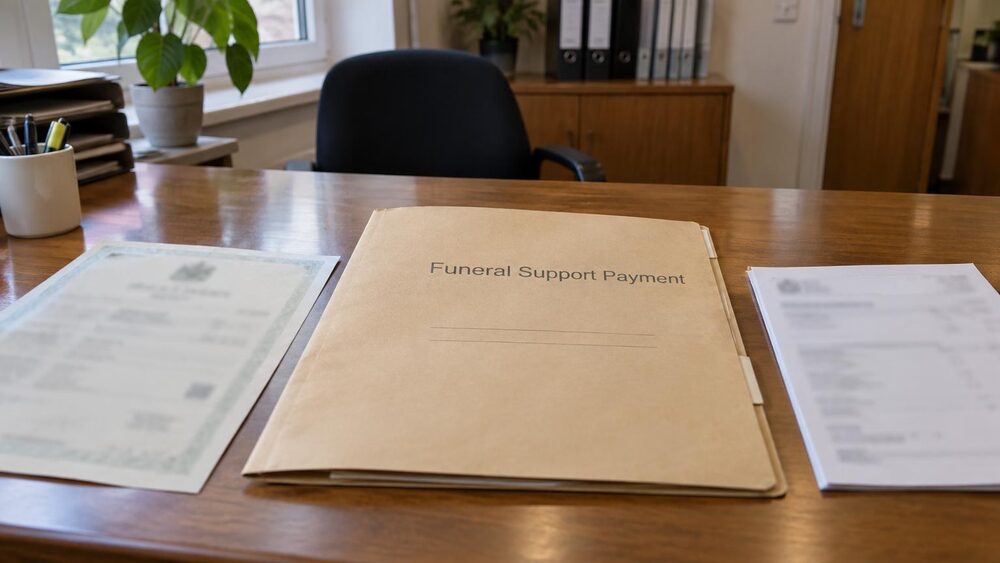
Funeral Support Payment is a one-off grant from Social Security Scotland that helps people on a low income meet the cost of a funeral1. It replaced the UK Government's Funeral Expenses Payment for residents in Scotland, which the Department for Work and Pensions ceased to deliver there when the new payment launched on 16 September 20191. It is not designed to cover every cost: Social Security Scotland states plainly that the payment will not cover all of the costs of a funeral1.
The payment is made up of several parts: the burial, cremation or alkaline hydrolysis costs; travel and transport costs; documentation costs; and a flat rate payment towards other funeral expenses1. For 2026/27 the flat rate payment is £1,327.75 where there was no funeral plan, or £162.05 where the person who died was 18 or over and had a pre-paid funeral plan4. The figures increase with inflation each year1.
To qualify you must normally live in Scotland and you, or your partner, must be receiving at least one qualifying benefit, and you must have accepted responsibility for the funeral5. You can apply online, by phone on 0800 182 2222, or by paper form, and you have six months from the date of the funeral to apply1.
What Funeral Support Payment covers
A funeral, for the purposes of this payment, means the burial, cremation or alkaline hydrolysis of the person who died1. The payment is built from the actual costs of that funeral rather than being a single fixed sum for everything. Social Security Scotland breaks it into four parts: the burial, cremation or alkaline hydrolysis costs; travel and transport costs; documentation costs; and a flat rate payment towards other funeral expenses1.
The flat rate element generally covers the items that fall under a funeral director's fees, or, if you are making the arrangements yourself, costs such as the coffin2. Travel help covers one return journey either to the place where you are arranging the funeral or to the funeral location, and there is also help with the cost of certain medical procedures needed before the funeral can go ahead9. Documentation costs, such as death certificates needed to release money belonging to the person who died, are covered for the Funeral Expenses Payment elsewhere in the UK, and the Scottish payment covers documentation costs on the same principle1.
Two limits matter. First, the payment will not cover all of the costs of a funeral, so it should be treated as a contribution rather than full funding1. Second, the payment is one of several possible sources of money for a funeral: the funeral can also be paid for from a financial scheme the person had, such as a pre-paid funeral plan or an insurance policy, by you or by other family members or friends, or with money from the person's estate, such as savings they had11. Our guide to paying for a funeral sets out these options side by side, and pre-paid funeral plans explains how those work and what protection applies to them.
The flat rate payment: £1,327.75 towards other funeral expenses
The flat rate payment towards other funeral expenses is £1,327.75 for the 2026/27 benefit year4. Where the person who died was 18 or over and had a pre-paid funeral plan paid for in full before their death, the flat rate payment is reduced to £162.054. These figures are set in legislation: the Funeral Support Payment regulations were amended so that £1,327.75 was substituted for the previous figure of £1,279.15 from 1 April 202612.
The amount is uprated each April. For applications made on and after 1 April 2025 to 31 March 2026 the standard flat rate payment was £1,279.15, following a 1.7% uprating of the relevant figures3. Earlier rates show how the figure has grown: £1,000.00 for applications received from 16 September 2019 to 31 March 2021, £1,070.60 for applications received from 1 April 2022 to 31 March 2023, and £1,257.75 for applications received from 1 April 2024 to 31 March 20253.
| Applications received | Standard flat rate payment |
|---|---|
| 16 September 2019 to 31 March 2021 | £1,000.003 |
| 1 April 2022 to 31 March 2023 | £1,070.603 |
| 1 April 2024 to 31 March 2025 | £1,257.753 |
| 1 April 2025 to 31 March 2026 | £1,279.153 |
| From 1 April 2026 | £1,327.7512 |
The Scottish payment is more generous on this element than its equivalents elsewhere. The old Social Fund funeral payment capped help with other expenses, such as funeral directors' fees, the coffin, church fees and flowers, at a maximum of £700, a figure set in 200313. The Funeral Expenses Payment in England, Wales and Northern Ireland now offers up to £1,000 towards other funeral expenses, generally those covered under funeral director's fees, or DIY costs such as the coffin10.
The flat rate is only one part of a total award. Social Security Scotland's own worked examples show how the parts add up. In one, the person who died was over 18, lived in the Glasgow City Council area, had £250 in savings and no funeral plan or insurance, and the applicant travelled from Aberdeenshire to Glasgow at a cost of £58: the total payment was £1,923.109. In another, the person who died lived and died in Falkirk, had no savings and had a funeral plan that did not include burial: the total payment was £1,897.509. The equivalent page for the rest of the UK is Funeral Expenses Payment: who qualifies and how to claim.
Who can apply: qualifying benefits and living in Scotland
Two conditions sit at the heart of eligibility. You must be ordinarily resident in Scotland, and you or your partner must be in receipt of at least one qualifying benefit on the date the application was made, or on an earlier date within the application window if the benefit award was backdated5. The legislation puts it the same way: to qualify, the applicant must be ordinarily resident in Scotland at the date of their application6.
The qualifying benefits are5:
- Universal Credit
- Income Support
- Pension Credit
- Housing Benefit
- income-based Jobseeker's Allowance (JSA), not contribution-based JSA
- income-related Employment and Support Allowance (ESA)
The distinction between income-based and contribution-based versions of these benefits matters. A person receiving contribution-based JSA does not qualify, because the payment is aimed at people on low incomes5. If Social Security Scotland cannot verify the qualifying benefit automatically, you will be asked to provide two pieces of evidence dated within the last three months, in your name or your partner's, showing the decision and receipt of the benefit award5.
You can apply if you live in Scotland and you, or your partner, are receiving a qualifying benefit, and the payment can help cover funeral costs for people who need to pay for a funeral and who live in Scotland and receive certain benefits7. The qualifying benefit does not have to be a Scottish one: the benefits listed are largely reserved UK benefits administered by the Department for Work and Pensions, but the funeral payment itself is administered by Social Security Scotland5.
Being responsible for the funeral: nearest relative and close friends
As well as the residence and benefit conditions, you or your partner must have accepted responsibility for the funeral expenses, and the Scottish Ministers must consider it reasonable for that responsibility to have been accepted6. In practice, Social Security Scotland applies this by asking whether you are the nearest relative of the person who died, or whether you can provide information supporting why it was reasonable for you to accept responsibility5.
The reasonableness test has a long legislative history. Under the regulations governing the earlier funeral payment, whether it is reasonable for the responsible person to accept responsibility is determined by the nature and extent of their contact with the deceased14. The same regulations barred a claim where the responsible person was an immediate family member, close relative or close friend, and an immediate family member who was not on the relevant benefits was not estranged from the deceased, subject to exceptions14.
The Scottish system is applied with more flexibility than that wording suggests. There is room for flexibility where it would not have been reasonable for a closer relative to pay for the funeral, for example if they were estranged from the person who died or if they live too far away to be able to take responsibility15. A spouse or civil partner is not considered the nearest relative where there was permanent separation by separation agreement, a court order or desertion5.
Where the person who died was a child, the people expected to take responsibility are a parent or person with parental responsibility, an adult sister or brother, or a long-standing friend15. This contrasts with the Funeral Expenses Payment in the rest of the UK, where a close relative, family member or friend may qualify depending on whether someone closer or equally close who is not on benefits exists, and on how well they knew the person who died; adult brothers and sisters, including half and step siblings, who were at least as close to the deceased as the applicant must also be on a qualifying benefit16.
Funerals of babies and children
The rules work differently when the person who died was a baby or a child, and they are more generous. The application window for Funeral Support Payment runs from the date of death or stillbirth until six months after the funeral has taken place17. For a stillborn baby, or a baby who died shortly after birth, you must claim within six months of the date of the funeral18.
A client applying for the funeral of a stillborn child will qualify if they meet the eligibility criteria and have incurred costs for the funeral17. The guidance also covers babies born alive who then die: this includes babies who are born alive prematurely and then die before 24 completed weeks of pregnancy17. The qualifying conditions on residence and benefits still apply, but the estate rules do not, as explained in the next section.
One exclusion applies. If the funeral was arranged and paid for by the hospital, the client is not eligible unless they can show that they still incurred costs themselves17.
Money in the estate is not counted at all when the person who died was young. Assets are not taken into consideration and no deductions are made if the deceased person was aged 17 or under3. Social Security Scotland's guidance puts it simply: if the person who died was under 18, you do not need to find out whether they had any funds19.
Elsewhere in the UK there is separate help for children's funerals. In Northern Ireland, a fund helps families with the cost of a funeral following the death of a child under 18 or a stillbirth after 24 weeks20. If you are arranging a funeral in these circumstances, the pages on having a baby and free bereavement support cover related help.
How money in the estate reduces the payment
The flat rate and other elements of the payment are reduced by money in the estate of the person who died that is available without confirmation, the Scottish equivalent of probate7. The deduction rules mirror those for the Funeral Expenses Payment elsewhere: the amount is reduced by any money in the estate available without probate or letters of administration, except money held as a joint tenancy, meaning a joint account where both people pay in and neither has restrictions on withdrawing7. Arrears of benefits paid on or after the date of death are not deducted21.
The funds that count as available include money in bank accounts that is accessible, cash, an occupational pension, a life insurance policy, funeral insurance, a burial club, and a funeral grant paid because the person was receiving a war pension19. Pensions and insurance policies are deducted only if they have paid out a lump sum that can be used for funeral costs19. A life insurance policy earmarked for something specific, such as a mortgage or a child's education, is not deducted because it is not available to help pay funeral costs19. Where a pre-paid funeral plan was not paid in full, money from it is deducted, as is any sum awarded that is also covered by the plan, for example the burial or cremation cost19.
Social Security Scotland's own example shows how this works: if the person who died had £200 in their bank account that was available and accessible at the time of application, that £200 is deducted from the payment and is not then counted again for recovery22. The amount you are paid can depend on how much of the deceased's money or assets is available to use towards funeral costs without confirmation having been granted5.
For the Funeral Expenses Payment in England, Wales and Northern Ireland, the same principle applies in a slightly different form: if you get any money from the estate, the payment will usually be deducted from it23. Our pages on confirmation in Scotland, small estate confirmation and paying for a funeral from the deceased's bank account explain how estates are dealt with in practice.
Travel and transport costs over 49.7 miles
Travel help comes in two forms, and the rules for each are different. First, Funeral Support Payment covers the cost of one return journey for you, either to arrange the funeral or to attend it, and the amount awarded for this cannot be more than the cost of one return journey from your home to the funeral location24. In Social Security Scotland's worked example, the person responsible for the funeral travelled from Aberdeenshire to Glasgow for the funeral at a cost of £58, and that travel cost was included in the total payment9.
Second, there are transport costs for moving the body itself. The threshold is 49.7 miles (80 kilometres): the payment will not cover the cost of the first 49.7 miles of travel, but transport costs beyond that can be awarded24. The deceased person needs to be moved more than 49.7 miles from where the body is located to where the body will lie before the funeral for these costs to arise3. The legislation behind this, for the earlier funeral payment, allowed transport costs only in excess of 80 kilometres, approximately 50 miles14.
The arithmetic is straightforward: if the return journey to move the body is 70 miles, transport costs are awarded for 20.3 miles, the distance beyond the threshold24. Similarly, if the return journey to the crematorium is 60 miles, transport costs are awarded for 10.3 miles24. The costs covered beyond the threshold include transporting the body within the UK to the funeral director's premises or place of rest, and transporting the coffin and bearers in a hearse and the mourners in another vehicle to the funeral2.
For funerals outside the UK, the rules tighten. For journey 1, the movement of the body, only costs within the UK can be awarded, for example transportation from a UK morgue to the airport; for journey 2, some travel costs outside the UK may be considered24. Where the funeral takes place outside the UK and its cost, including transport, exceeds what would have applied in the local authority area where the person was ordinarily resident, no assistance is given for the additional costs6.
How to apply online, by phone or by paper form
There are three ways to apply: online, by phone, or by paper form1. The online form has a limitation worth knowing before you start: there is no save and resume function, so you need to complete it all in one go1. The paper form can be requested in different formats and languages by calling Social Security Scotland1.
If you apply by phone, you will be asked for your National Insurance number, the National Insurance number of the person who died if available, details of the funeral director, and any travel receipts or funeral bills you have so far25. The account the payment goes into does not need to be in your name, but you must have the account holder's permission to receive the payment into that account25.
The phone number is 0800 182 2222, free to call7. Social Security Scotland also offers a Text Relay service on 18001 plus 0300 244 4000 for people who are hard of hearing, a webchat at chat.socialsecurity.gov.scot, and a British Sign Language contact service27. You can call the same number for more information before you apply27.
The payment can be made either to you or to the funeral director directly, and you must give consent for Social Security Scotland to discuss the application with and pay the funeral director if you want that route1. You can apply even if you did not use a funeral director at all21. The wider steps to take when someone dies, including registering the death and notifying banks, are covered in what to do when someone dies and registering a death in Scotland.
Deadline: six months after the funeral
The application window opens on the date of death or stillbirth and closes six months after the funeral has taken place17. Social Security Scotland's eligibility guidance states the same: you must have applied within six months from the date of the funeral5. There is one extension. If you have a backdated award for a qualifying benefit, you have an additional 20 working days to apply, and the guidance describes this as applying within 20 working days after the end of the six month period with a backdated qualifying benefit award relating to at least one day in that period5.
The six-month deadline is not unique to Scotland. The Funeral Expenses Payment in the rest of the UK must also be applied for within six months of the date of the funeral, a claim period that was extended from three months29. For a stillborn baby or a baby who died shortly after birth, the claim must be made within six months of the date of the funeral18.
Once a completed application with all supporting evidence is received, Social Security Scotland aims to process it within ten working days, although in practice this can take longer3. The all-time median average processing time is 17 working days3. After payment is issued, the money should reach the nominated account within four working days3.
Disagreeing with a decision: redetermination and appeal
If you disagree with a decision on your Funeral Support Payment, you can ask Social Security Scotland to look at it again. This is called a redetermination, and the request can be made within 31 days of the date of the decision you are unhappy with2. Social Security Scotland then has 16 working days to make the new determination3.
The redetermination is the Scottish equivalent of the process the Department for Work and Pensions calls a mandatory reconsideration, which is part of the steps to challenge and appeal a benefit decision in the reserved system30. If the redetermination does not resolve the matter, the next stage is an appeal, and independent advice organisations can help you prepare one.
The timescales to keep in mind are: 31 days to ask for a redetermination from the date of the decision, and 16 working days for Social Security Scotland to make the new determination2. If the 31 days have passed, a late request may still be considered, but the grounds for making one are narrower, so disagreements are normally raised as soon as the decision is known.
Tax, repayment and what happens to the estate
Funeral Support Payment is not taxable8. It is a one-off payment rather than recurring income, and it does not affect your tax position. Related bereavement payments are also tax-free: Bereavement Support Payment is not taxable, and all its payments are tax-free30.
You do not have to repay the payment personally, because it is a grant2. Funeral and bereavement payments generally are grants and do not need to be paid back by the person who made the claim7. However, the payment is treated as a funeral cost, and if the person who died was aged 18 or over and had money or assets in their estate, the payment may need to be recovered from the estate22. Recovery from estates is how Social Security Scotland recovers Funeral Support Payments in those circumstances22. If the person who died had assets, once these become available, they may need to be used to repay any Funeral Support Payment before any inheritance is paid out25.
This is why the estate deductions described earlier matter: money available without confirmation is deducted from the award up front, reducing what you receive, and money that only becomes available later, after confirmation, may trigger recovery from the estate19. Money recovered is not taken from you personally but from the estate, so it reduces what inheritors receive2.
Bereavement Support Payment, which is separate and helps with the immediate costs caused by the death of a spouse or civil partner, has its own rules: it must be claimed within 12 months of the partner's death to get the initial payment, and within three months of the death to be eligible for up to 18 monthly payments31. It does not count as a qualifying benefit for a funeral payment32. See what happens to benefits when someone dies for the wider picture.
If you do not qualify
If you are not eligible for a Funeral Support Payment, advice on paying for a funeral is available from organisations listed on mygov.scot11. The reasons people miss out are usually one of three: not living in Scotland, not receiving a qualifying benefit, or not being the person reasonably responsible for the funeral.
Depending on your circumstances, other routes may exist. In England, Wales and Northern Ireland, the equivalent help is the Funeral Expenses Payment from the Department for Work and Pensions, claimed by phoning the Bereavement Service helpline or posting a paper SF200 form29. The old Social Fund scheme, of which funeral payments were part, also included other elements, and charitable and local authority help remains available in some cases29. In Northern Ireland, Bereavement Support Payment and other financial help for the bereaved are administered by the Northern Ireland Bereavement Service33.
If a hospital arranged and paid for the funeral, you are not eligible for the Scottish payment unless you can show you still incurred costs yourself17. If the person who died left a pre-paid funeral plan paid in full, the flat rate element drops to £162.05 rather than disappearing entirely, so a plan does not automatically rule out a claim4. Where no one is able or willing to pay, the local authority has a duty to arrange a public health funeral, covered in public health funerals when no one can pay. Free emotional and practical support is listed in free bereavement support and helplines, and the wider money steps after a death are in our life events guide.
Sources33 cited
- Funeral Support Payment Social Security Scotland, 2026
- Funeral Support Payment Contact, 2026
- Funeral Support Payment statistics to 31 March 2026 Social Security Scotland, June 2026
- Flat rate payment Social Security Scotland, 2026
- Eligibility for Funeral Support Payment Social Security Scotland, 2026
- The Funeral Support Payment (Scotland) Regulations 2019, as amended legislation.gov.uk, 2026
- Government support with funeral costs Quaker Social Action, 2026
- Funeral Support Payment Scotland Turn2us, 2025
- Funeral Support Payment: person who died 18 or over mygov.scot, 2022
- Funeral expenses Quaker Social Action, 2026
- Funeral costs mygov.scot, 2026
- The Funeral Support Payment (Uprating) Regulations 2026 legislation.gov.uk, 2026
- Funeral payments research briefing SN01419 House of Commons Library, 2026
- The Social Fund (Funeral Expenses) Directions (Northern Ireland) 2005 legislation.gov.uk, 2005
- Can I get a Funeral Support Payment in Scotland? Turn2us, 2025
- Can I get a Funeral Expenses Payment? Turn2us, 2026
- Stillbirth and infant death guidance Social Security Scotland, 2026
- Bereavement benefits mygov.scot, 2022
- Checking what funds are in the estate of the person who died Social Security Scotland, 2026
- More financial help if you get Universal Credit nidirect, 2025
- FAQs on Funeral Support Payment Quaker Social Action, 2026
- Recovery of funeral costs from a person's estate Social Security Scotland, 2026
- How to get help with urgent or one-off expenses Age UK, 2026
- Funeral travel costs Social Security Scotland, 2026
- Telephone application Social Security Scotland, 2026
- Pension Age Disability Payment factsheet Social Security Scotland, March 2026
- Who can apply and when mygov.scot, 2022
- Five family payments factsheet Social Security Scotland, 2026
- FAQs on the Social Fund Quaker Social Action, 2026
- Bereavement benefits Age UK, 2026
- Bereavement Support Payment nidirect, 2026
- Financial help for the bereaved nidirect, 2026
- Apply for Bereavement Support Payment nidirect, 2026


 MoneyHelperFree, impartial money and pensions guidance, set up by government
 Citizens AdviceFree advice on money, consumer and legal problems in England and Wales
 Turn2usFree benefits calculator and grants search from a charity
 GOV.UKOfficial information on tax, benefits and government services