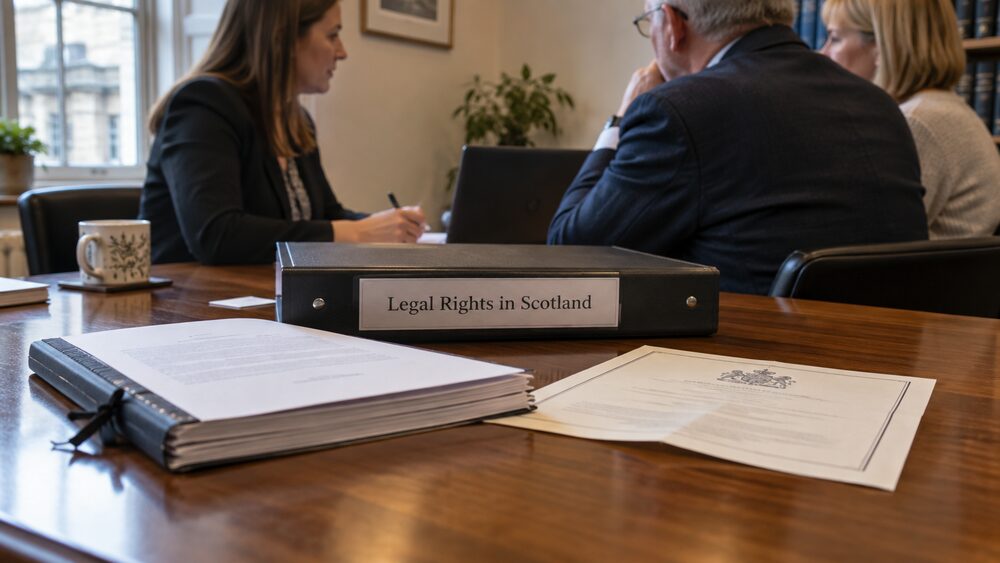
Scotland has its own inheritance rules, and they work differently from the rest of the UK. When someone dies in Scotland, a surviving spouse or civil partner may be able to claim prior rights, and a spouse, civil partner or child can claim legal rights. Prior rights only apply when there is no will. Legal rights apply whether or not there is a will.
Scotland has its own inheritance rules, and they work differently from the rest of the UK. When someone dies in Scotland, a surviving spouse or civil partner may be able to claim prior rights, and a spouse, civil partner or child can claim legal rights. Prior rights only apply when there is no will. Legal rights apply whether or not there is a will.
The amounts are set out in the intestacy rules. A spouse or civil partner with surviving children can claim £50,000 in cash, plus the home up to a value of £29,000 for its contents1. If there are no surviving children, the cash right rises to £89,0001. After prior rights are paid, legal rights give the spouse a third of the remaining estate if there are children, or half if there are none. Children share a third between them if there is a spouse, or half if there is no spouse1.
These rights exist because Scottish law protects certain family members from being left with nothing. A will cannot remove them, though a person can choose not to claim. This page explains what each right covers, who can claim, how the share is worked out, and what happens to the rest of the estate.
What prior rights and legal rights are
Prior rights and legal rights are two separate protections in Scottish inheritance law. They apply to different people in different circumstances, and they are paid in a set order.
Prior rights are available only to a surviving spouse or civil partner, and only when the person who died left no will. They give the survivor a cash sum, the family home up to a set value, and the contents of the home up to a set value1. Prior rights are paid first, before anything else is distributed.
Legal rights are available to a surviving spouse or civil partner, and to children of the person who died. They apply whether or not there is a will2. Legal rights are calculated as a share of what remains after prior rights have been paid. If there is a will, legal rights can override what it says. If there is no will, legal rights sit alongside the intestacy rules.
The estate is normally distributed in stages: prior rights first, then legal rights, then whatever remains2. This order matters because each stage reduces what is available for the next.
Prior rights: what a surviving spouse or civil partner can claim when there is no will
Prior rights only apply when someone dies without leaving a will. If there is a will, prior rights do not apply, though legal rights still do.
A surviving spouse or civil partner can claim three things under prior rights:
- A cash sum. If there are surviving children, this is £50,000. If there are no surviving children, it is £89,0001.
- The family home. The home is included up to a set value. The sources give the contents value as £29,000, but do not state a separate figure for the home itself1.
- The contents of the home. This is up to a value of £29,0001.
If the estate is large enough to cover all of these, the spouse or civil partner receives them in full. If the estate is smaller, the rights are met in order: the cash sum first, then the home, then the contents.
The home and its contents are treated separately. The £29,000 figure applies to the contents, not to the property itself1. If the home is worth more than the amount covered by prior rights, the excess may form part of the estate from which legal rights are calculated.
Legal rights apply whether or not there is a will
Legal rights are different from prior rights in one important way: they apply whether or not there is a will2. This means that even if someone makes a will leaving everything to one person, a spouse, civil partner or child may still be able to claim legal rights.
In Scotland, married or civil partners or children of the person who died can challenge the will if they do not agree with what it says, by claiming their legal rights2. This is a distinctive feature of Scottish law. In England and Wales, certain people can apply to court for reasonable financial provision, but the rules are different. In Scotland, legal rights are an entitlement, not a discretionary award.
Marriage does not revoke a will in Scotland. Under Scottish law, getting married gives your spouse legal rights to part of your estate3. This means that even if someone made a will before getting married, the new spouse may still have a claim.
Who can claim legal rights and how the share is worked out
Legal rights are available to two groups of people:
- A surviving spouse or civil partner. If there are surviving children, the spouse receives a third of the remaining estate. If there are no children, the spouse receives half1.
- Children of the person who died. If there is a surviving spouse, the children share a third of the remaining estate between them. If there is no surviving spouse, the children share half between them1.
The "remaining estate" means what is left after prior rights have been paid. If prior rights have used up most of the estate, there may be little or nothing left for legal rights.
| Who claims | With surviving children | With no surviving children |
|---|---|---|
| Spouse or civil partner | A third of the remaining estate | Half of the remaining estate |
| Children | A third, shared equally | Half, shared equally |
The shares are calculated on the remaining estate, not on the total estate. This means the order of distribution matters. Prior rights are paid first, then legal rights are calculated on what is left2.
"your spouse will receive a third and your children will receive a third (shared equally between them)"
Claiming legal rights or accepting what the will leaves
If a will leaves someone less than their legal rights, they have a choice: claim legal rights, or accept what the will says. The sources do not state a time limit for making this choice, but anyone in this position should take legal advice.
In Scotland, dealing with an estate involves applying for confirmation. Confirmation is the authority to deal with the estate of someone who has died4. If someone is named as executor in the will, they can apply for confirmation4. The equivalent in England and Wales is a grant of probate (if there is a will) or letters of administration (if there is not)5. In Scotland, the grant is a grant of confirmation6.
A will is only effective on death and has no legal authority before that point. A power of attorney is effective while you are alive and allows others to act on your behalf during your lifetime7. This distinction matters if someone is planning ahead for both incapacity and death.
Where these rights do not apply, and where to get help
Prior rights and legal rights do not apply to everyone. There are important limits.
Cohabiting partners. There are no automatic inheritance rights for unmarried cohabiting partners2. A surviving cohabiting partner may be able to apply to court for a share of the estate, but this is not the same as prior rights or legal rights. In Scotland, cohabiting partners can already make certain legal claims if they separate or if a partner dies without a will, but they have fewer rights than married couples and civil partners8.
Legal aid. Legal aid is not available for small claim actions in Scotland9. In Scotland and Northern Ireland, people making a claim may be entitled to legal aid, but if insurance is available the premium will not be repaid even if the claim is successful, and you may have to contribute towards legal aid depending on your financial situation10.
Where to get help. A solicitor can help with confirmation and with claiming prior rights or legal rights. The sources do not state that a solicitor is required, but the process involves legal steps. Free, impartial help is available from Citizens Advice Scotland and from MoneyHelper.
Sources10 cited
- Intestacy rules Which?, 2026-07-28
- After death: dealing with an estate Citizens Advice Scotland, 2026-09-26
- How to make a will Which?, 2026-02-26
- Things to do after a death Independent Age, 2026-09-26
- Bereavement help centre Bank of Scotland, 2026-09-27
- IHT400 Notes HM Revenue & Customs, 2026
- Power of attorney Which? Wills, 2026-09-26
- How cohabitation law reforms could affect your pension savings and inheritance Which?, 2026-06-12
- Sheriff court action National Debtline, 2026-09-25
- Mesothelioma compensation Macmillan Cancer Support, 2026-09-26





 MoneyHelperFree, impartial money and pensions guidance, set up by government
 Citizens AdviceFree advice on money, consumer and legal problems in England and Wales
 Turn2usFree benefits calculator and grants search from a charity
 GOV.UKOfficial information on tax, benefits and government services