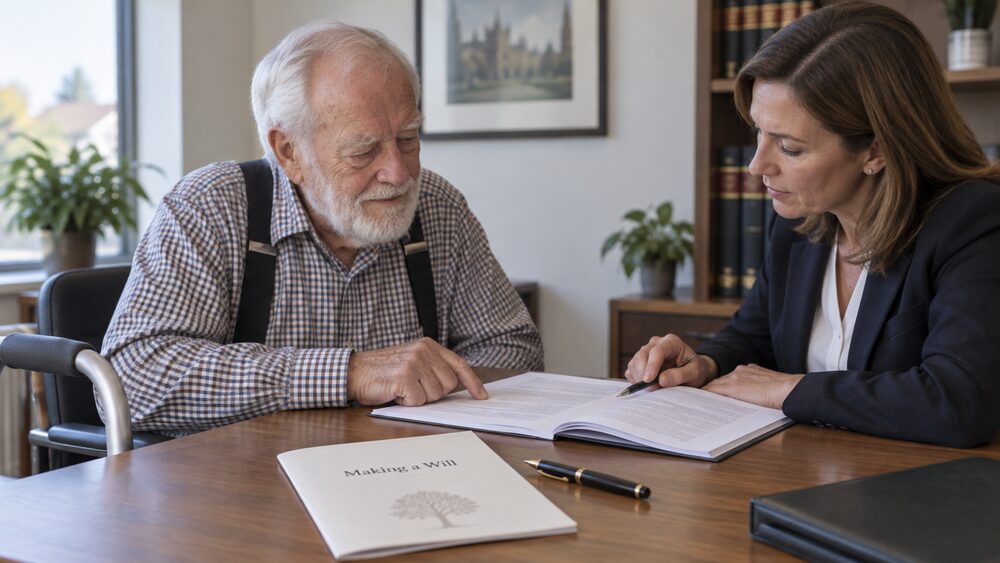
A will is an official statement of what you want to happen with any money or property after your death1. It lets you decide who will get your money and assets when you die, rather than leaving that decision to the intestacy rules, which distribute everything in a fixed order of priority among relatives2. Despite that, more than half of UK adults do not have a will, according to research published in January 20253.
Making one is simpler than many people expect. You do not have to use a solicitor: a will needs to be written and signed correctly to be valid, but who writes it is up to you4. Writing your own costs nothing, and is workable where your affairs are very straightforward5. A solicitor is generally recommended where a situation is complex, for example family circumstances that are difficult, financial support for a disabled friend or relative, assets or property abroad, or inheritance tax due on the estate5.
This page explains what a will can do, what happens without one, the ways to make one and what each costs, the signing and witnessing rules that make it valid, and how marriage, divorce and Inheritance Tax interact with it. The rules described here are mainly those of England, Wales and Northern Ireland, with the Scottish differences flagged where they matter, and set out fully in the guide to wills in Scotland.
What a will does: gifts, executors and trustees
A will does three main jobs. First, it sets out your gifts: who receives your money, your home and your possessions, and in what shares. If you own your home, a will is how you choose who will inherit it when you die and make your wishes clear8. Second, it appoints a trusted person or people to deal with your money and assets after you die, known as executors2. Third, where gifts go to children or others who cannot manage money themselves, it can set up the structure that controls how the gift is held.
The executor role is worth thinking about carefully. The executor collects in the estate, pays any debts and tax, and distributes what remains in accordance with the terms of the will9. Where the will leaves gifts to beneficiaries under 18, at least two trustees must be named to hold those gifts10. Choosing the same trusted people for both roles is common, but the will must say so.
A will can also do things beyond simple gifts. Putting a trust in a will means it takes effect only after your death, which would not work for some types of assets, such as pensions, death in service and life cover4. Where a dependant cannot look after themselves, including children under 18, independent guidance recommends making a will with a solicitor so the gift is structured properly11. A will also helps avoid disputes about inheritance, which is a practical reason to make your intentions explicit rather than leaving relatives to interpret them2.
What happens if you die without a will
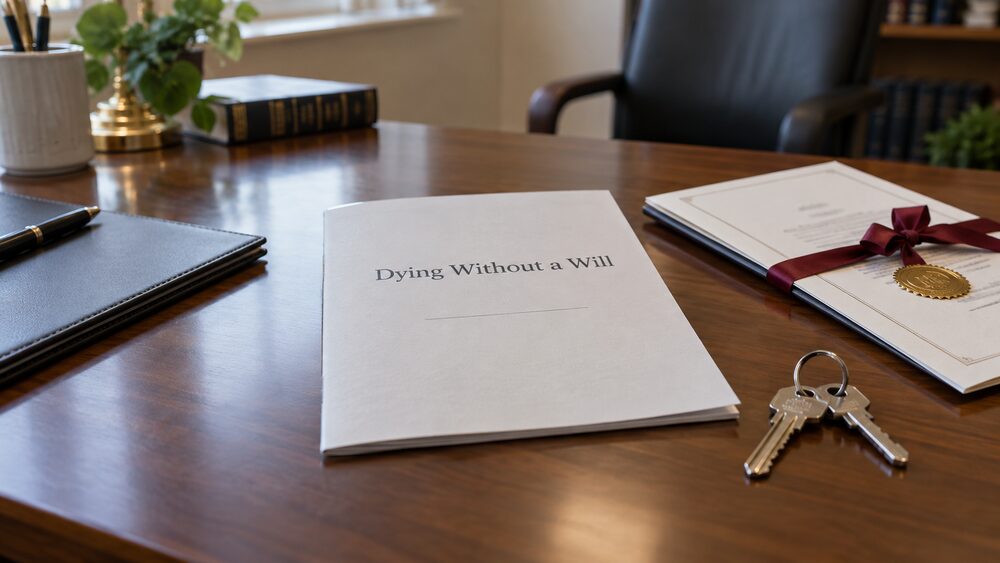
Dying without a will is called dying intestate2. In that situation the law of intestacy sets out who should inherit your estate, in a fixed order of priority among your relatives12. You have no say: the rules, not your wishes, decide who gets what, and some people you might expect to inherit, such as an unmarried partner, are not included at all. Under proposals consulted on in 2026, cohabiting couples would in future have a right to inherit under intestacy, similar to married couples and civil partners, but that is a proposed change, not the current rule6.
If you own your home and do not make a will, the home passes to your closest relatives, your next of kin, when you die8. That can produce outcomes you would not have chosen, for example a share of a home passing to a distant relative rather than the person you lived with.
The administration also works differently. Where there is a will, the executor applies for a grant of probate; where there is not, an administrator takes over, usually a relative or friend or a solicitor13. A relative may need to apply to the court for what are known as Letters of Administration before the estate can be dealt with2. The application paperwork differs too: with a will, the PA1P form is used; without one, the PA1A form9. The full rules are explained in the guide to dying without a will in England and Wales, and the practical aftermath in what to do when someone dies.
One further consequence is cost. Guidance on dealing with property after a death in Scotland warns that there may be additional costs, especially if the deceased person did not have a will, so the absence of a will can make the estate more expensive to administer14.
Who can make a will, and how the rules differ across the UK
The formal requirements for making a valid will differ across the UK, and the differences are practical ones that affect how you sign and store the document.
In England, Wales and Northern Ireland, a will must be signed in the presence of two independent witnesses who are 18 or over5. In Scotland, only one witness aged 16 or over is required, but you, the testator, must sign the will on every page5. The witness rules are strict: witnesses cannot be named as beneficiaries, and if you leave anything to a witness in your will, the gift will be void5.
| Requirement | England, Wales and Northern Ireland | Scotland |
|---|---|---|
| Witnesses | Two independent witnesses, aged 18 or over5 | One witness, aged 16 or over5 |
| Your signature | On the will | On every page of the will5 |
| Marriage | Automatically revokes an existing will6 | Does not revoke a will, but gives a spouse legal rights to part of the estate5 |
The age at which a person can make a will also differs: 18 in England, Wales and Northern Ireland, and 12 in Scotland, which is reflected in the lower witness age north of the border. Mental capacity matters as well. A person with dementia can still make or change a will, if they can show that they understand its effect12. The same principle underlies powers of attorney: you can still set one up provided you have the mental capacity to understand the document, your choice of attorneys and the consequences of the decision15.
DIY will pack or solicitor: how each option works
You can make a will yourself or see a solicitor. You can buy a will pack and fill in a will yourself, but these are only suitable if your will is going to be very simple2. Writing your own costs nothing5, but it is generally not advised and only suitable if your affairs are very straightforward5. The risk is not the writing but the formalities: it is crucial that the document is witnessed correctly and includes all major assets5.
A solicitor is generally recommended if your situation is complex5. The circumstances where professional help is advised include complex family circumstances, financial support for a disabled friend or relative, assets or property abroad, or inheritance tax due on your estate5. Using a solicitor is also a good option if the estate is complex or there might be a conflict, and it is worth understanding their likely charges for dealing with your estate16. A solicitor is better placed to advise on inheritance tax planning in most cases, and an accountant would not need to be involved in the drafting of your will16.
One practical difference is storage. Solicitors will usually store your will for you for free5. If you write your own, storing it safely is your job, covered below. The comparison page on writing your own will or using a solicitor goes deeper on the trade-offs.
Free ways to get help with a will
The cheapest option is to write your own, which costs £05. Beyond that, free help exists in specific forms. The Law Society has produced a booklet called Your guide to making a will2. Some charities publish free guidance: Mencap, for example, offers free wills and trusts guides, aimed particularly at families of people with a learning disability17. Free Wills Month campaigns, which offer free simple wills written by participating solicitors to people over 55 in return for considering a gift to charity, run in England, Wales and Scotland in some form, but check the current scheme's terms before relying on it, because participation and eligibility vary by campaign and year.
Two things are worth knowing about charitable gifts. Donations left to charity in your will are exempt from inheritance tax7. And a charitable legacy is always your choice: nothing in the rules requires one in exchange for a free or cheap will.
If your situation is not simple, free help has limits. Where a will involves a trust for a disabled family member, or assets abroad, or tax planning, the guidance above points to a solicitor, and the cost of that advice is set by the firm. Before paying anyone, ask for their charges in writing, and remember that a solicitor will usually store the finished will for free5.
Signing and witnessing: what makes a will valid
A will needs to be written and signed correctly in order to be valid18. The signing requirements are the point where homemade wills most often fail, so they are worth setting out in order.
Witnesses cannot be named as beneficiaries: any gift left to a witness in the will is void5. A will cannot be amended after it has been signed and witnessed, but official alterations can be made with a codicil, which must be witnessed and signed in the same way19. The will is normally kept securely bound, for example with a single staple in the top left hand corner, and removing staples or using a paperclip is discouraged5. Loose or tampered fastenings can raise questions later about whether pages were added or removed.
Once signed, the will is kept in a safe place where others can find it12. There is no requirement to register a will with any authority, but it needs to be kept safely and executors need to know where it is4. Storage options include a bank, a solicitor, a company that offers will storage, or HM Courts and Tribunals Service, and a fee may be charged to store it2. A secure, fireproof place in the home is another option described by guidance18. The detailed rules are in the guide to witness rules for a valid will.
Marriage, remarriage and separation can change your will
In England, Wales and Northern Ireland, getting married or entering a civil partnership automatically revokes a will6. The same rule applies on remarriage: if you remarry or enter a new civil partnership, this automatically revokes, or cancels, any existing will you have, so you will need to make a new one20. A will made in contemplation of a particular marriage can avoid this, but that is a matter for the drafting, and the safe assumption after any marriage is that the old will no longer stands.
Scotland is different. Marriage does not revoke a will in Scotland; instead, under Scottish law, getting married gives your spouse legal rights to part of your estate5. So the same life event has opposite effects either side of the border, which matters if you move or hold property in both.
Divorce does not cancel a will, but it changes who can benefit. Getting a divorce or dissolving a civil partnership does not automatically invalidate a will made during the marriage, but it does exclude your ex-spouse or ex-civil partner from benefitting20. Your former spouse is treated as though they are deceased, which means you will not be able to name them as either an executor or a beneficiary unless you create a new will21. Separation without divorce has no such effect: an estranged spouse you have not divorced remains a spouse in law, so you may also need a new will22.
The scale of the problem is large. Research done on behalf of Solicitors for the Elderly found that almost half of UK wills could be out of date due to life-changing events such as marriage or divorce21. The narrow guide to whether marriage or divorce cancels a will covers the detail, and the money side of splitting up is in separating or divorcing: a money checklist.
How to update or replace a will
Guidance varies on how often to review. One consumer body recommends reviewing your will every three years5, a rule of thumb echoed elsewhere: review every three years and whenever your family or financial circumstances change significantly21. Other advice, reflecting government guidance, suggests every five years and after major life events such as marriage or civil partnership, or the birth or adoption of a child6. Best practice is often put as reviewing every five years18. Whichever interval you adopt, the life events in the section above are the real triggers.
If the will does require updating, you need to make a codicil or a new will18. A codicil is a separate document used to make simple updates, such as changing an executor or adding a beneficiary. It must be signed and witnessed in the same way as your will5. For anything more substantial, a new will that revokes the old one is the cleaner route, and it avoids the risk of a codicil becoming separated from the will it amends.
There is also a mechanism that operates after death. An instrument of variation is a legal document which allows the beneficiaries of an estate to change the terms of the will or intestacy after the death23. Anyone who inherits under intestacy rules can use a deed of variation to change how their share of the inheritance is shared, provided they are over 18 with mental capacity6. This is a remedy for the beneficiaries, not for the person who made the will, and it is explained in the guide to deed of variation.
A will and Inheritance Tax
Inheritance tax is taken from your estate after you pass away and before gifts are given to the people named in your will4. In other words, the tax comes off the top: your beneficiaries receive what remains after the estate's tax bill is settled.
The responsibility for paying falls on the executor. Inheritance tax is paid by the executor of the will, and the executor must pay any inheritance tax within six months of the person named in the will passing away7. You must pay any Inheritance Tax and interest that is due before you can get a grant of representation24, which is why tax and probate are dealt with together, as the guide to paying Inheritance Tax explains.
There are provisions that ease the cash-flow burden, because estates can be asset-rich. Inheritance Tax on certain assets that may take time to sell can be paid by annual instalments, and once the first instalment has been paid, personal representatives can proceed to apply for probate25. You must say on Inheritance Tax account form IHT400 if you want to pay in instalments, and you can pay off the full tax and interest at any time by writing to HMRC asking for a final assessment26. Where a grant is needed but funds are tied up, you can apply for a grant on credit, but you must tell HMRC the maximum amount you can pay towards the Inheritance Tax before the grant can be issued27.
Two technical points can arise in drafting. If a will leaves a free of tax gift to a chargeable beneficiary and the residue is partly or completely exempt from Inheritance Tax, the estate may need to be grossed up, and HMRC provides a calculator for this; you will need a copy of the will, the total value of the assets and liabilities, the nil rate band that applies, whether any transferable nil rate band applies, and whether the reduced rate applies28. And gifts to charities in a will are exempt from inheritance tax7, which is one reason charitable legacies appear in tax planning.
Life insurance interacts with all this. If your life insurance is not written in trust, the payout will usually be treated as part of your estate when you die29. If it is written in trust, it is not counted as part of the estate and would not go towards the funeral expenses30, and your family will not need to go through the probate process to receive the insurance money31. Writing a policy in trust is normally free when you first buy it, and most insurers offer it during the application29, but it is an irrevocable act that cannot be undone31, so it should not be entered into casually.
Where to get help
Several sources of free, independent help exist. The Law Society's booklet, Your guide to making a will, is a starting point for the formalities2. Charities including Mencap publish free wills and trusts guides for families with specific needs17. For the tax side, HMRC's own guidance on paying Inheritance Tax, instalments and grossing up is the authoritative reference26.
For the aftermath of a death, the guides on applying for probate in England and Wales, being an executor and receiving an inheritance cover what the people you name in your will will actually have to do. Choosing executors who understand the role, and telling them where the will is stored, is one of the most useful things a will-maker can do.
Sources31 cited
- Glossary: Will StepChange Debt Charity
- How do I make a will? Mental Health and Money Advice, 2024-02-13
- Over half of UK adults don't have a will Money and Pensions Service, 2025-01-27
- Wills and trusts Sense, 2025-01
- How to make a will Which?, 2026-02-26
- Intestacy rules Which?, 2026-07-28
- FAQs about wills and inheritance tax Remember A Charity, 2026-09-26
- How to leave your home to a disabled family member Scope, 2026-09-08
- Dealing with the estate Age UK, 2026-09-21
- What is probate? Age UK, 2026-09-21
- How do I make a will? (Welsh) Mental Health and Money Advice, 2024-02-13
- Dementia and managing money nidirect, 2026-09-03
- Debt when someone dies nidirect, 2026-06-26
- What if my house is in joint names but my partner has died? Equity Release Council, 2026-01-16
- Managing money after a dementia diagnosis Which?, 2026-09-20
- Do I need a solicitor and accountant to write my will? Which?, 2026-02-02
- Wills and trusts service Mencap, 2026
- Making a will: four dos and three don'ts Which?, 2023-03-01
- The six mistakes that could invalidate your will Which?, 2023-07-18
- Financial and legal tips before remarrying Age UK, 2024-05-28
- Divorce financial mistakes to avoid Which?, 2024-01-09
- Relationships and your money Independent Age, 2026-09-26
- IHT400 2021 notes HM Revenue and Customs, 2021
- IHT400 notes HM Revenue and Customs
- Inheritance Tax on pensions: liability, reporting and payment HM Revenue and Customs, 2025-07-21
- Pay Inheritance Tax in yearly instalments GOV.UK, 2026-09-28
- Apply for a grant on credit for Inheritance Tax GOV.UK, 2024-04-01
- Inheritance Tax grossing up calculator GOV.UK, 2025-03-05
- Is your life insurance set up to pay the right person? Which?, 2026-07-11
- Recovery of funeral costs from a person's estate Social Security Scotland, 2026-09-26
- How to write life insurance in trust Which?, 2026-04-06


 MoneyHelperFree, impartial money and pensions guidance, set up by government
 Citizens AdviceFree advice on money, consumer and legal problems in England and Wales
 Turn2usFree benefits calculator and grants search from a charity
 GOV.UKOfficial information on tax, benefits and government services