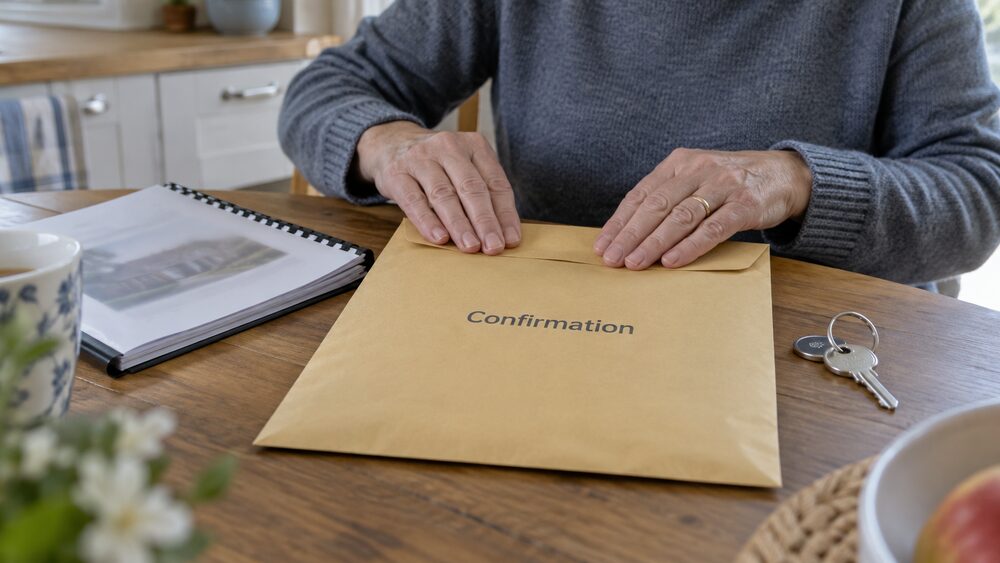
Confirmation is the Scottish legal document that gives an executor the authority to deal with the estate of someone who has died. It is needed whether or not there was a will, and an application is made to the sheriff court1. Where the estate is worth less than £36,000, it counts as a small estate, and the process is simpler: you can apply yourself, with the sheriff clerk helping you draw up the list of belongings, valuables and money1.
Confirmation is the Scottish legal document that gives an executor the authority to deal with the estate of someone who has died. It is needed whether or not there was a will, and an application is made to the sheriff court1. Where the estate is worth less than £36,000, it counts as a small estate, and the process is simpler: you can apply yourself, with the sheriff clerk helping you draw up the list of belongings, valuables and money1.
The £36,000 figure is the dividing line. Below it, a Bond of Caution is not needed, and the sheriff clerk can help with the inventory2. Above it, the estate is treated as a large estate and the process is more involved1. Getting the legal document back from the sheriff court usually takes 8 to 16 weeks, and administering the estate afterwards can take 9 to 12 months, sometimes longer3.
This page covers what the small estate process is, who can apply, what to take to the sheriff court, what happens when the estate is worth more than £36,000, and where to get free help.
Small estate confirmation: for estates worth less than £36,000
A small estate in Scotland is one valued at less than £36,0001. That figure is used across the bereavement processes of Scottish banks and investment firms: Halifax Share Dealing, for example, asks for a Small Estates and Indemnity Instruction Form for valuations up to £36,000 in Scotland5, and Scottish Widows classes a small estate as one with a total value of less than £36,0006.
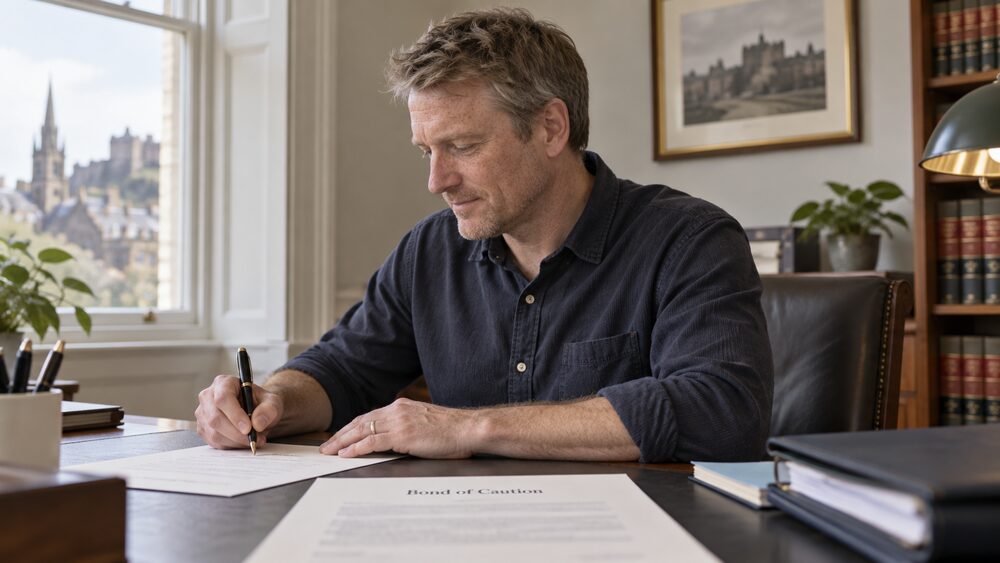
The threshold matters for two reasons. First, it decides whether a Bond of Caution is needed. A Bond of Caution is a form of insurance that protects the estate if an executor gets something wrong, and it is not required if the deceased's spouse or civil partner inherits the whole estate, or if it is a small estate worth less than £36,000 with sheriff clerk help on the inventory2. Second, it decides how much of the process the sheriff clerk will help with.
The £36,000 figure is specific to Scotland. In England and Wales, a grant of probate is often not needed for a smaller estate, usually one valued at less than £5,0007, and the same £5,000 figure is used by some banks as the point below which they will release funds without a grant8. The two figures are not interchangeable, and an estate that would be small in Scotland may still need a full grant south of the border.
Who can apply for small estate confirmation
The person who applies is the executor: the person named in the will, or, where there is no will, the person entitled to act under the intestacy rules4. In Scotland, if someone is named as executor in the will, they can apply for confirmation4.
Where there is no will, the intestacy rules decide who inherits and who can act. A spouse or civil partner has prior rights: the house up to a value of £473,000, the contents of the home up to £29,000, and part of the remaining estate2. If no surviving relatives can be found, the estate passes to the Crown2.
You do not need a solicitor to apply. The small estate process is designed so that the sheriff clerk can help you draw up the list of belongings, valuables and money1. The same principle applies to the Simple Procedure in the sheriff court, which does not require a solicitor9.
How to apply for small estate confirmation
The application is made to the sheriff court1. You make an appointment with the sheriff clerk, who will help you draw up the list of belongings, valuables and money1.
You must take all the relevant information with you to the court, including1:
- details of who died, including the original death certificate
- names and addresses of the executors
- the original will and any related papers, such as codicils
- bank and building society account details, with statements and balances
- details of property owned
- cash value found in the home
- furniture and personal effects, listed with an estimated value
- insurance policies
- other savings
The death certificate is a cost you will meet before the application: registering a death is free, but each copy of the death certificate costs £12 in Scotland4. You will need the original for the court.
When an estate is too large for the small estate process
If the estate is worth more than £36,000, it is a large estate1. The application still goes to the sheriff court, but the process is more involved, and a Bond of Caution is likely to be needed unless the deceased's spouse or civil partner inherits the whole estate2.
Unless a person's estate is quite small, you cannot access the funds from it until probate in England, Wales and Northern Ireland, or confirmation of the estate in Scotland, is granted10. That is why the threshold matters in practice: below it, banks and investment firms will often release money on a small estate form, and above it they will ask for the confirmation document itself.
Where there is not enough money in the estate to pay all debts, the estate may be insolvent, and creditors must be paid in a legal order of priority. Executors should get legal advice before making payments1.
Where to get help with confirmation in Scotland
The sheriff clerk is the first point of contact for a small estate, and the help with the inventory is part of the process rather than a separate service1.
Free and impartial help is available from Citizens Advice Scotland, which covers dealing with an estate after a death1, and from Age UK, which explains probate and confirmation in plain terms7. Marie Curie publishes guidance on paying for a funeral and on the bank accounts and finances of someone who has died10.
Where the estate involves a house, a solicitor is often used even for a small estate, because the property has to be transferred. Registers of Scotland will only accept an application for registration if the land transaction return has been made and the self-assessed Land and Buildings Transaction Tax has been paid12.
If the person who died had a Junior ISA, and the child's estate needs to be dealt with, applications in Scotland go to the Office of the Public Guardian in Scotland13.
Sources13 cited
- After a death: dealing with an estate Citizens Advice Scotland, 2026-09-26
- Intestacy rules Which?, 2026-07-28
- Bereavement support Bank of Scotland, 2026-09-27
- Things to do after a death Independent Age, 2026-09-26
- Bereavement support Halifax, 2026-09-27
- Bereavement Scottish Widows, 2026-09-26
- What is probate? Age UK, 2026-09-21
- Dealing with the estate Age UK, 2026-09-21
- How to use the small claims court Which?, 2026-07-22
- Paying for a funeral Marie Curie, 2024-02-08
- Bank accounts and finances Marie Curie
- Land and Buildings Transaction Tax legislation legislation.gov.uk, 2026
- Manage a Junior ISA GOV.UK, 2026-09-28



 MoneyHelperFree, impartial money and pensions guidance, set up by government
 Citizens AdviceFree advice on money, consumer and legal problems in England and Wales
 Turn2usFree benefits calculator and grants search from a charity
 GOV.UKOfficial information on tax, benefits and government services