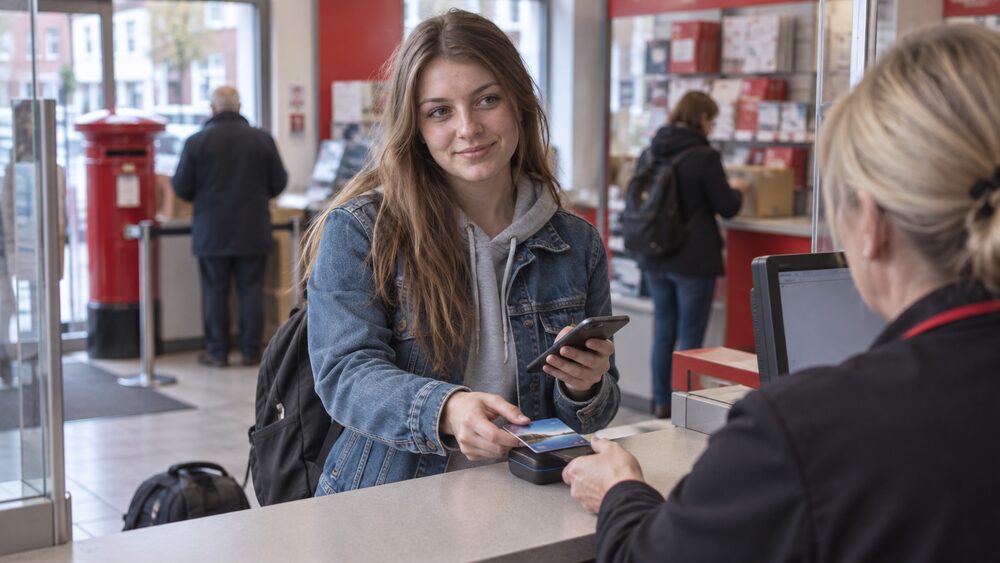
A prepaid travel money card is a card you load with money before you go abroad and then spend like a debit card while you are away. You cannot run up debt on it: you can only spend what you have already put on it1. The best-known example, the Post Office Travel Money Card, can be loaded with up to 22 currencies and used wherever the Mastercard acceptance mark is shown, in more than 200 countries2.
The attraction is control and cost. You load a currency when the exchange rate suits you, the rate is locked at that moment, and the Post Office card charges nothing for spending abroad from a supported currency balance2. There is no credit check, and the card is not linked to your bank account, which some people prefer for security2.
The trade-off is that money on a prepaid travel card is electronic money, not a bank deposit. It is not protected by the deposit rules that cover bank accounts, and if the provider can show you failed to take reasonable steps to protect your card's security, you could be liable for the first £35 of any loss4. This page explains how the cards work, what they charge, where they let you down, and what your rights are if something goes wrong.
How a prepaid travel money card works
A prepaid card works in the same way as a credit card, with one main difference: you can only ever spend what has been loaded onto it8. When you buy something, you are using money that is already on the card, not borrowing and not drawing on a bank account8. Abroad, prepaid cards can be used like a debit card9.
Physically, the card behaves like any other payment card. The Post Office Travel Money Card is protected by chip and PIN technology, just like debit and credit cards, and it is not linked to your bank or credit card account6. If it is lost or stolen you can freeze it, which is one of the features that makes these cards popular with travellers who do not want to carry their main bank card overseas6.
There is no credit check to get one. Prepaid travel cards do not require credit checks and are not linked to your bank account2, and independent guidance confirms there is no need for a credit check10. The Post Office states that its issuer checks your address electronically, stores the result, and that this does not affect your credit rating6. That makes these cards available to people who might not qualify for a credit card, including younger travellers and people with a poor credit record.
In everyday use, the card is accepted wherever its card scheme is taken. The Post Office card is a prepaid Mastercard, accepted at over 36 million locations worldwide in more than 200 countries, with cash withdrawals possible at over 2 million ATMs worldwide7. You can order one online, in the provider's app or by visiting a branch, and cards ordered online or in the app should arrive within 2 to 3 working days3.
Loading currencies and locking in the exchange rate
The defining feature of a travel money card is that you load it with foreign currency before you travel9. You choose which currencies to hold, and the exchange rate is locked when you load the card6. The Post Office card advertises 0% commission and the ability to lock in exchange rates at the time you buy, which protects your spending money from rate movements between loading and travelling2.
Loading is not limited to a bank transfer. The Post Office card can be topped up in branches, and friends or family can top it up on your behalf at any Post Office branch; all they need is your card number2. Monese, another provider, says its accounts can be topped up with cash at more than 84,000 payment point locations across the UK and Europe, including Post Office, PayPoint and Paysafecash points13.
One thing to watch is which currency you load. If you load pounds sterling onto the Post Office card rather than a foreign currency, you pay a 1.5% commission, with a minimum of £3 and a maximum of £507. Loading the foreign currency you actually plan to spend avoids that charge and locks the rate at the same time.
Fees and charges: loading, cash and unsupported currencies
Prepaid cards are not always free to use, and the charges sit in different places from card to card. Independent guidance notes that many travel money cards charge a percentage on the transaction as well as a flat rate fee for each withdrawal or transaction9, and that prepaid card accounts can charge you both for adding money to the card and for taking money out at cash machines14.
The Post Office Travel Money Card's own fee structure shows the pattern:
| Charge | Amount | When it applies |
|---|---|---|
| Loading sterling | 1.5% (minimum £3, maximum £50) | Loading pounds rather than a foreign currency7 |
| Cash withdrawal | £1.50 per transaction in the UK | Varies depending on the destination7 |
| Cross-border fee | 3% | Using the card where the local currency is not supported7 |
| Spending abroad | No charge | From an available balance of a supported local currency3 |
Two further charges are worth checking in any card's terms. Some cards charge fees if they are not used for a certain period, so a card left in a drawer after a trip can quietly lose money15. And some cards charge fees for withdrawing cash in the UK, so it may be cheaper to spend the remaining balance than to take it out of a machine15. Fee structures can also change over time or vary by card type: one prepaid card, HyperJar, charges £1 to load money beyond its allowance of ten £10 loads from a bank account per calendar month16, which shows why the loading terms matter as much as the spending terms.
For comparison, the alternatives carry their own costs. Most credit cards add a foreign transaction fee of around 3% on non-sterling purchases and cash withdrawals17, and using a debit card abroad typically brings a spending or cash machine charge of between £1 and £3 each time, except for euros in the EU18. A credit card cash withdrawal abroad can also attract a foreign transaction fee on top of the usual cash advance fee19. Prepaid cards can often avoid ATM withdrawal charges and other bank card charges9, but only if you have checked the specific card's terms first.
Spending abroad in a currency the card does not hold
A multi-currency card holds a set list of currencies. When you spend in one of them, the money comes from that currency's balance and, on the Post Office card, no charge applies3. When you spend in a currency the card does not hold, the card converts the payment, and a fee usually follows: the Post Office card charges a 3% cross-border fee if you use it in a country whose local currency is not supported7.
A separate decision comes at the card machine. When a terminal abroad asks whether you want to be charged in pounds or the local currency, choose the local currency: you will get a better exchange rate9. Letting the machine convert to pounds is a separate service called dynamic currency conversion, and it is explained on the page about paying in pounds or local currency.
It is also worth telling your card provider that you are going away. If you do not, the provider could block your card because it may think it is being used fraudulently9. That applies to prepaid travel cards as much as to bank cards, and a blocked card abroad is a problem you can avoid with a minute's preparation.
Limits on loading, balances and cash withdrawals
Prepaid travel cards carry limits on how much you can load, hold and withdraw. The Post Office card's limits give a picture of what to expect:
| Limit | Post Office Travel Money Card |
|---|---|
| Minimum load | £106 |
| Maximum load | £5,0006 |
| Maximum balance | £10,000 at any time7 |
| Maximum annual balance | £30,0007 |
| Top-up transactions | 3 per day7 |
| Cash withdrawals | £300 per day, 3 withdrawals maximum6 |
| Card transactions | 40 per day6 |
There are no spending limits as such on the Post Office card, but the maximum transaction limit of 40 per day applies6. Other providers structure their limits differently: Monese says each of its plans comes with its own allowances for ATM withdrawals worldwide and card spending in foreign currencies, that you can upgrade at any time and downgrade after your travels, and that the app shows the wholesale exchange rate of each transaction so you know what you have spent13.
A prepaid card account more broadly lets you spend and withdraw cash, but you cannot usually set up payments from it, such as direct debits or standing orders20. It is a spending tool, not a substitute for a current account.
Where a prepaid card may not work: hotel deposits, car hire and toll roads
Acceptance is not the same as suitability, and there are situations where a prepaid card is the wrong tool even though the shop or hotel takes it.
The most common is the pre-authorisation hold. Some companies need to temporarily hold a specific amount of your balance when you book, which is a common practice for hotel check-ins and car rentals2. Because a prepaid card only holds what you have loaded, a hold can tie up a large share of your travel money for days, leaving less to spend than you expected. Car hire desks and hotels may also prefer a credit card for this reason, since a hold on a credit card does not reduce your available cash.
Some places simply cannot process the card at all. The Post Office card's terms list some road toll booths and transactions on board cruise ships or aeroplanes, where transactions are usually declined because the payment cannot be authorised immediately6. Offline payment situations like these are a structural limit of any authorisation-based card, not a fault of the card.
Other exclusions come from the type of account. Prepaid accounts cannot be used to set up direct debits16, and a prepaid card account cannot be used for wages or other income14. Virtual prepaid cards, offered by some providers as an instant option while a physical card is posted, cannot be used for cash withdrawals, gambling purchases, cryptocurrency exchanges or money transfers21. Monese, for example, offers a virtual card so you can add money and start spending without waiting for a physical card to arrive13.
Lost or stolen cards: freezing, replacements and the £35 limit
Losing a card abroad is less alarming if the card only holds your travel money rather than access to your bank account. The Post Office card can be frozen if it is lost or stolen, and the provider runs a 24/7 line to report it6. If you lose your card the money is protected, but you may have to pay for a replacement card9.
The law sets the limits of liability. Under the Payment Services Regulations 2017, if the provider can show that the cardholder had not taken reasonable steps to protect the security of the card, such as the PIN or online security details, the cardholder could be liable for the first £35 of any loss incurred from unauthorised usage4. This is the figure that applies to prepaid cards and other payment services. For comparison, under the Consumer Credit Act 1974 the most a cardholder is responsible for on a lost or stolen credit card is the first £50 of unauthorised transactions made before the card was reported missing4.
Once the loss has been reported, the position improves sharply: the cardholder is not liable for any unauthorised payments taken after the provider is told that the card has been stolen or that someone else has got hold of the security details22. This is why the timing of a report matters, and why transactions are worth checking regularly for payments that are not recognised23.
If the provider will not give you your money back for an unauthorised transaction, you can report them to Trading Standards24, and you can take the complaint to the Financial Ombudsman Service, which handles complaints about electronic money5. The page on lost or stolen cards and cash abroad covers the wider steps, including what to do about cash and other cards.
Your money is e-money, not a bank deposit
The money on a prepaid travel card is electronic money, usually shortened to e-money. The Financial Ombudsman Service, which deals with complaints about these products, defines it as pre-paid money that you store electronically, on cards, devices, online systems and digital databases, for making payments5.
This matters because of what e-money is not. Under the regulator's guidance, electronic money does not constitute a deposit-taking activity, in view of its specific character as an electronic surrogate for coins and banknotes, used for making payments usually of limited amount and not as a means of saving25. E-money must be issued on receipt of funds, so it is a prepaid product, and credit cards are excluded from the definition25. In other words, when you load a travel card you are exchanging bank money for a prepaid payment instrument, not opening another bank account.
The practical consequences are worth stating plainly. Because the balance is not a deposit, it does not behave like a savings balance: it earns nothing and sits there until spent or refunded. The distinction is not always obvious from the outside, and some well-known products sit in this category: Revolut is technically a prepaid card rather than a bank account in this sense, and the since-closed account Bo functioned more like one too26. The fact that a product comes with an app, a sort-code-like experience and a card does not tell you which rules govern the money inside it.
If something goes wrong, the Financial Ombudsman Service can look at complaints about e-money5, so you are not without recourse. But the protection regime is different from the one around bank deposits, and anyone thinking of holding large sums on a prepaid card for long periods should understand that the product is designed for payments, not saving25.
Getting leftover money back and making a complaint
Travel trips usually leave a balance behind. Independent guidance is to aim to use unused funds from a prepaid card within 12 months of returning home, or before the card's expiry date, whichever comes sooner15. Some cards charge inactivity fees if they are not used for a certain period, so a balance left for months can shrink on its own15.
If the card has expired with money still on it, contact the provider to request your money back; this may involve a fee15. Where a trip is cancelled before you go, the Post Office states that refunds of funds loaded on the card usually take 3 to 5 working days to appear in your account7. The page on leftover foreign currency covers the wider options, including selling currency back.
For disputed transactions, the chargeback system applies to prepaid cards. Chargeback enables you to dispute a card transaction and request your money back for something you have paid for27, and it covers debit or prepaid card purchases, such as Visa, Mastercard or American Express cards28. Usually, you must make a chargeback claim within 120 days28. UK Finance gives the example of a cardholder who paid £1,000 for services a travel company did not supply: the cardholder could raise a chargeback claim for the full £1,000 with their issuing bank29.
Complaints about prepaid cards are relatively rare compared with other card products. Financial Ombudsman Service data for the first quarter of 2026/27 records 19 complaints about pre-paid cards, against 757 about debit cards and 5,783 about credit cards30. If a provider will not resolve a complaint, the Financial Ombudsman Service can consider it, including complaints about electronic money5, and it is free to use.
Who offers prepaid travel cards in the UK
Several providers offer prepaid travel cards in the UK, with different structures and features.
Post Office offers the Travel Money Card, a prepaid Mastercard holding up to 22 currencies, ordered online, in the app or in a branch, with top-ups in branches and the option for friends or family to top up on your behalf2. Monese offers a prepaid multi-currency card with cash top-ups at more than 84,000 payment points, a virtual card for immediate spending, Apple Pay and Google Pay support, and plan-based allowances for ATM withdrawals and foreign currency spending13. Travelex offers the Travelex Money Card, and Barclays offers the Barclays Travel Wallet.
Some digital accounts blur the line between a travel card and a bank product. Revolut is technically a prepaid card rather than a bank account in this context26, and the page on multi-currency accounts and currency wallets covers that end of the market. The comparison pages on a prepaid travel card or debit card abroad and taking cash or using a card on holiday set out the options, and the section page on money abroad brings together the rest of the subject.
Sources30 cited
- Do I need to speak to a specialist for credit card debt advice? Debt Advice Foundation
- Right travel card for spending abroad Post Office, 2026-04-07
- Post Office Travel Money Card Post Office, 2026-09-28
- Payment Services Regulations 2017 Which?, 2025-06-18
- Electronic money complaints Financial Ombudsman Service, 2026-09-26
- Post Office Travel Money Card help and support Post Office, 2026
- Post Office Travel Money Card Post Office, 2026
- Plastic cards Citizens Advice, 2026-09-25
- Travel money tips ABTA, 2026
- Spending abroad: the 4 dos and 5 don'ts Which?, 2024-07-26
- How do exchange rates work? Post Office, 2026-09-14
- Travel Money Card app features Post Office, 2026-09-28
- Monese travel money card Monese, 2026
- Bank accounts after bankruptcy StepChange, 2026-09-25
- I can't get my money out of my prepaid foreign currency card Which?, 2021-10-08
- Children's bank accounts: what options are there in 2025? Which?, 2025-04-27
- Should I get a credit card? Which?, 2026-09-18
- How to open, switch or close your bank account MoneyHelper, 2026-09-25
- The costs and charges of credit cards Citizens Advice Scotland, 2026-09-25
- How to choose the right bank account MoneyHelper, 2026-09-25
- What are virtual debit cards and should you use one? Which?, 2026-05-27
- Dealing with fraud Business Debtline, 2026-09-26
- Card fraud: protect yourself Take Five to Stop Fraud, 2026-09-26
- Your payment card was used without your permission Citizens Advice, 2026-09-25
- PERG 3A.3: guidance on electronic money Financial Conduct Authority, 2013-04-01
- N26 withdraws from the UK: what does it mean for your money? Which?, 2020-02-15
- How to complain about a takeaway and get your money back Which?, 2026-06-30
- Air travel: your rights Consumer Council Northern Ireland, 2026
- Chargeback rights and Section 75 UK Finance, 2026
- Quarterly complaints data Q1 2026/27 Financial Ombudsman Service, 2026







 MoneyHelperFree, impartial money and pensions guidance, set up by government
 FSCSProtects your money if a bank, insurer or investment firm fails
 Financial Ombudsman ServiceFree, independent help when a complaint about a firm is not put right
 FCA Warning ListCheck whether a firm is authorised before you deal with it
 Citizens AdviceFree advice on money, consumer and legal problems in England and Wales