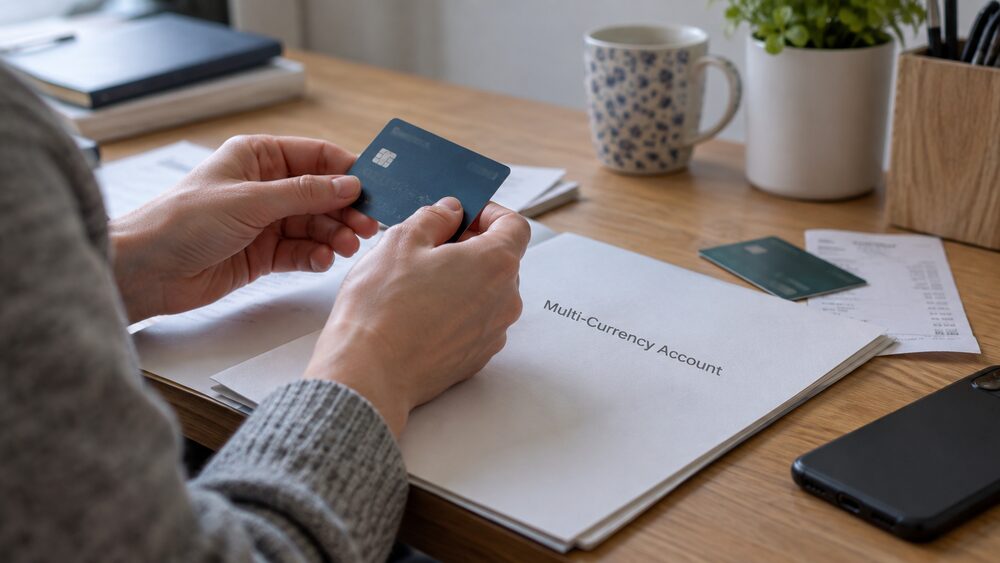
A multi-currency account lets you hold, send and receive money in several currencies, usually alongside pounds, from one app or account. A currency wallet is the app-based version of the same idea: balances in euros, dollars and other currencies that you can convert between, spend with a card, or keep until the exchange rate suits you. Wise, one of the best-known providers, says its account holds and exchanges 40+ currencies1.
The typical use is avoiding the repeated cost and hassle of converting money every time you are paid, pay a bill, or spend abroad. Instead of your bank converting each transaction automatically, you choose when to convert, or let a feature such as Wise's auto conversion do it when a rate you have set is reached2. Some providers also give you local account details, such as a euro IBAN, so you can receive payments in that currency directly3.
These accounts come in two broad shapes. App-based wallets, such as Wise's, are standalone products. Bank-linked euro accounts, such as Starling's, add a foreign currency balance to an ordinary UK current account. This page explains how both work, what they cost, what their cards can do, and how the money in them is held.
How multi-currency accounts and currency wallets work
The core idea is simple: instead of one balance in pounds, you have several balances, one per currency. When money arrives in a currency you hold, it stays in that currency until you convert it. When you spend in a currency you hold, the money comes from that balance rather than being converted from pounds at the point of sale. That separation is what gives you control over when conversion happens and what it costs.
Providers differ in how you get started and who can open an account. Monese offers a multi-currency account without asking for a UK address or credit history; you need an email address, a phone number and photo ID5. That makes this kind of account practical for people who are new to the UK, and for whom a mainstream bank account is harder to open. Other providers attach their currency features to an existing account: Starling's euro account, for example, requires a Starling personal account first3.
A currency wallet is usually operated through an app, with a linked debit card for spending. Wise describes its product as a digital wallet in which you hold and exchange currencies and order a card1. The wallet holds the balances, the card spends from them, and the app is where you convert between currencies, set up automatic conversions, and manage the card.
Whether this kind of account suits you depends on how you receive and spend money. It tends to fit people who are paid in one currency and spend in another, who regularly send money abroad, who travel often, or who buy from overseas websites. For a one-off holiday, an ordinary travel money card may do the same job with less to manage: see prepaid travel money cards and using a debit card abroad.
Holding 40+ currencies: what the main providers offer
The headline feature of the app-based wallets is breadth. Wise states that its account, and its current account product for students, let you hold and convert money in 40+ currencies1. The same provider says its card can pay online and in stores in over 40 currencies across 150 countries and territories7, and in another description, over 160 countries and 40 currencies8.
Bank-linked products are narrower but deeper in their chosen currency. Starling's euro account is a dedicated euro balance with its own unique IBAN, so you can send and receive euros directly, and Starling states that holding, sending and receiving euros is completely free of charge9. Starling says the account has 180,000 customers3. The euro account costs £0 per month, with a 0.4% conversion fee when you switch between pounds and euros3.
| Provider | What it holds | Monthly fee | Conversion cost |
|---|---|---|---|
| Wise | 40+ currencies1 | not stated | provider states mid-market rate with no hidden markups on auto conversion2 |
| Starling euro account | euros, with its own IBAN3 | £03 | 0.4% on conversion3 |
| Starling joint euro account | euros, held jointly3 | £0, no monthly account fees3 | 0.4% on conversion3 |
| Monese | multi-currency account, no UK address or credit history needed5 | not stated | not stated |
The choice between a wide wallet and a single-currency bank account usually comes down to what you receive. If you are paid rent in euros or receive a pension from abroad, a euro account with its own IBAN lets those payments arrive without conversion. If your money flows through several currencies, a 40-currency wallet covers more ground. For receiving payments from abroad generally, see IBAN, SWIFT and SEPA, and for keeping a UK account while living overseas, see banking while abroad.
Fees and charges: conversion fees, weekend timing and free holding
Holding a balance is usually free. Starling states that holding, sending and receiving euros are all free of charge, and its euro account carries no monthly fee9. Wise's virtual card is free for all customers in the UK10, though ordering a physical Wise card costs what the provider describes as a low, one-time fee1.
The main cost is conversion. Starling charges 0.4% when you convert between currencies, and uses what it calls its outbound exchange rate3. Currensea, a travel spending account linked to your existing bank account, applies a 0.5% markup on the exchange rate for personal accounts11. These percentages are small compared with typical airport exchange margins, but they apply every time you convert, so frequent small conversions add up.
Weekend timing matters. Currency markets close from Friday evening to Sunday evening, and providers handle this differently. Wise states that its automatic conversions are unavailable on weekends, from Friday 22:00 UTC until Sunday 22:00 UTC2. If you need to convert at the weekend, you may face different pricing or a rate set earlier, so check what the provider shows before you confirm.
The same principle applies to money arriving from official sources. The State Pension paid into an overseas account is usually converted into your local currency using the exchange rate at the time of the conversion13. In other words, you do not control the timing, which is one reason people have pension payments sent to a multi-currency account and convert the balance themselves. For tax on foreign income, see foreign income and UK tax.
Virtual and physical cards for spending in other currencies
Most multi-currency accounts come with a debit card. Wise describes its card as a debit card for everyday use, able to pay online and in stores in over 40 currencies and 150 countries and territories7. You can order a physical card delivered to your home, or get a virtual card immediately on your phone14.
A virtual card is a set of card details, usually in the app, that you can use online and add to a digital wallet. Wise says its virtual card is free to all customers with personal or business Wise accounts, except customers in the US or Japan, and that in the Wise app it appears under the name "digital card"15. You can open a balance in any of the 40+ currencies available and top up your account to get started15. The virtual card works with Apple Pay, Google Pay or another virtual wallet of your choice15.
Several banks offer similar features. Chase UK gives separate debit card details for its physical card and the virtual card used for online purchases16. PayPal lets PayPal Credit users apply for a virtual or physical card to spend their credit in store17. Several banks let you create virtual debit cards in your mobile banking app, so you do not share your primary physical card details with the retailer, and some let you set spending limits or link the card to a separate pot18.
Digital wallets sit on top of the card. Apple Pay, along with Google Wallet and Samsung Pay, lets you upload your card details to a digital wallet on your phone or tablet and tap to pay in shops and on some websites and apps19. Coutts, for example, supports adding cards to Apple Pay on iPhone and Apple Watch, and Google Pay on Android20.
Virtual cards have limits. They cannot be used for cash withdrawals, gambling purchases, cryptocurrency exchanges or money transfers such as Western Union16. And a virtual debit card does not carry the legal protection a credit card does: paying by credit card gives more protection on purchases over £100, and Which? advises paying by credit card for extra protection under Section 75 when buying from overseas online retailers21. For cash abroad, see cash machines abroad.
Bank-linked euro accounts and travel wallets
The second shape of product attaches the currency feature to a bank account you already hold. Starling's euro account is the clearest example: it sits alongside your Starling personal account, which you need to get started, and gives you a euro balance with its own unique IBAN3. Sending and receiving euros is free, and the account costs £0 per month3. A joint version is available, and it too has no monthly account fees, but you need a Starling joint pound account first3.
Bank-linked accounts matter for receiving money, not just spending it. Because the euro account has its own IBAN, an employer, tenant or pension provider in the eurozone can pay you in euros as if you had a local account. Starling also states that sending money abroad from its accounts is free of charge for holding, sending and receiving euros9. Compare this with a travel wallet, which is built mainly for spending and converting rather than for receiving regular payments.
Access to these accounts depends on your circumstances. Nationwide told Which? Money that if your current home is outside the EU or EEA, you have to wait until you have secured a UK address before you can open an account23. People with refugee status, EU settled or pre-settled status, or a current work or student visa can generally open UK bank accounts24. App-based multi-currency providers such as Monese sit outside much of this, asking only for an email address, phone number and photo ID5.
If you are switching to a payment provider in the EU, UK rules give you switching help: your UK provider must, free of charge, provide lists of standing orders and direct debit mandates, information on recurring incoming credit transfers for the previous 13 months, transfer any positive balance, and close the UK account25. For depositing foreign cash in the UK, note that some banks have stopped: Barclays has ended foreign currency cash deposits at branches because most foreign currency payments are now digital and the alternatives are more secure26. Leftover notes can be sold back or converted, as explained in leftover foreign currency.
Setting your own exchange rate with automatic conversion
The most distinctive feature of the app wallets is auto conversion. Wise describes it like this:
"With auto conversion, you can set it and forget it, pick your desired rate between two currencies and we'll convert"2
You choose two currencies, set the exchange rate you are willing to accept, and the provider's system watches the market for you. Wise states that its system is always on during weekdays, so you will not miss a good rate even if you are busy or asleep2. When your rate is reached, the money converts automatically.
The details are where this feature earns or loses its value. The chosen exchange rate must be live for at least 1 minute for the conversion to happen2. You can have up to 15 pending conversions at once, with some currency-specific limits2. Conversions use the mid-market rate, which Wise says ensures value without hidden markups2. You can cancel a pending conversion and create a new one with updated details2.
The weekend pause is the main limitation: auto conversions do not run from Friday 22:00 UTC until Sunday 22:00 UTC2. If the market moves to your rate on a Saturday, nothing happens. Setting a rate that is realistic matters too: a rate far from the current market level may simply never be reached, leaving your money sitting in the original currency.
The same disclosure rules that apply to point-of-sale conversion apply here in spirit: the provider must show you the charges and the rate basis before you agree4. Auto conversion is a tool for timing, not a guarantee of a better outcome. For fixing a rate on a large sum, such as a property purchase abroad, see buying property abroad.
Limits on what a currency wallet can do
Currency wallets are payment products, not full bank accounts, and the differences show up in what they cannot do. Virtual cards cannot be used for cash withdrawals, gambling purchases, cryptocurrency exchanges or money transfers such as Western Union16. Physical cards cover more ground, but the underlying account may not support the full range of banking services a current account does.
Interest is one limit. Current accounts that pay interest often cap how much money you can earn it on, and may require a minimum monthly pay-in27. Multi-currency balances are generally payment balances rather than savings, so if earning interest is the aim, a savings account is the right product: see savings accounts. Any interest you do earn in a joint account is usually split equally between the holders for tax purposes, with tax due only if a share exceeds the annual allowance28.
Joint access is possible but conditional. A joint account normally allows two or more people to receive payments, pay by debit card, transfer money and manage the account, depending on the bank28. Both account holders can manage the account and withdraw cash, so you need to trust the person you open it with29. Starling's joint euro account requires a joint pound account with the same provider first3.
Spending together is supported in other ways. Wise says its card lets you pay online and in stores in over 160 countries and 40 currencies8, and the provider markets spending with others as a use of the same account8. But wallets do not replace credit: there is no overdraft or borrowing attached to these balances, and the Section 75 protection that comes with a credit card does not apply to debit card spending, however the card is branded22.
Finally, wallets do not remove the ordinary risks of shopping online. There have been high-profile online security breaches and instances of card fraud, and identity theft can follow30. Avoiding saving card details on websites makes it easier to stop money leaving quickly if a retailer is compromised or if spending gets out of hand31. For the wider picture, see scams and fraud and consumer protection.
How money in a currency account is held
A multi-currency account holds your money as balances in the currencies you have chosen, rather than as a single pound balance. Some official accounts are defined in sterling only: the Help-to-Save account, for example, is denominated in sterling under the legislation that created it30. That is a reminder that many UK government-linked accounts and benefits assume pounds, so money you intend to use for those purposes needs converting back.
How the money is protected depends on the provider and its authorisation, and this differs between a bank account and an e-money wallet. Balances held with a provider that has a UK banking licence can be covered by the Financial Services Compensation Scheme, while money held with an e-money provider is instead safeguarded rather than protected by the Scheme. Before depositing significant sums, check with the provider directly: ask whether balances are covered by the Financial Services Compensation Scheme or held as safeguarded money, and what each would mean if the provider failed. The provider's terms and its entry on the FCA Register state which applies.
What the rules do guarantee is disclosure and switching support. Anyone offering you a currency conversion must disclose all charges and the exchange rate before you agree4. And if you move your payment account to an EU provider, your UK provider must hand over, free of charge, your standing orders and direct debit mandates, information on recurring incoming credit transfers for the previous 13 months, transfer any positive balance, and close the account25.
For most people, the practical points are these: keep only what you need for spending and receiving in the wallet, convert on your own timing rather than the provider's, and check the protection position before holding a large balance. Where to go for help: MoneyHelper offers free guidance on banking and joint accounts28, and the Financial Ombudsman Service can consider complaints about payment and e-money firms. For the wider context on sending money across borders, see money transfers.
Sources31 cited
- Wise digital wallet Wise, 2026-09-26
- Wise auto conversion Wise, 2026-09-26
- Starling euro bank account Starling Bank, 2026
- Payment Services Regulations 2017, Part 6 legislation.gov.uk, 2026
- How to open a bank account online Which?, 2026-04-23
- Wise students page Wise, 2026-09-25
- Wise card Wise, 2026-09-28
- Wise spend with others Wise, 2026-09-25
- Starling send money abroad Starling Bank, 2026
- Wise Moroccan dirham card Wise, 2026-09-26
- Spending abroad: the 4 dos and 5 don'ts Which?, 2024-07-26
- EU Payment Accounts Directive, Article 59(2) legislation.gov.uk, 2015-11-25
- State Pension if you retire abroad GOV.UK, 2026-09-26
- Wise travel money: Turkish liras Wise, 2026-09-26
- Wise virtual card Wise, 2026-09-26
- What are virtual debit cards and should you use one? Which?, 2026-05-27
- PayPal launches debit and credit card with up to 1.5% cashback Which?, 2025-11-22
- How to spot an online shopping scam Which?, 2026-08-03
- Scamwatch: has my Apple Pay been suspended? Which?, 2026-08-25
- How do I add a card to my digital wallet? Coutts, 2026-09-26
- Types of scam MoneyHelper, 2026-09-25
- I want to return something bought online Which?, 2026-03-10
- Ask an expert: struggling to open a UK bank account Which?, 2017-08-11
- How to open a bank account Shelter England, 2024-07-16
- Payment Accounts Regulations 2015 legislation.gov.uk, 2015-12-15
- Where can I deposit foreign cash? Which?, 2025-09-22
- Making the most of your bank account Independent Age, 2026-09-26
- Joint accounts MoneyHelper, 2026-09-25
- Can a joint bank account help me manage a loved one's finances? Which?, 2026-01-19
- Help-to-Save Regulations 2018 legislation.gov.uk, 2018-01-24
- How to protect yourself when shopping online Debt Advice Foundation, 2017-06-02




 MoneyHelperFree, impartial money and pensions guidance, set up by government
 FSCSProtects your money if a bank, insurer or investment firm fails
 Financial Ombudsman ServiceFree, independent help when a complaint about a firm is not put right
 FCA Warning ListCheck whether a firm is authorised before you deal with it
 Citizens AdviceFree advice on money, consumer and legal problems in England and Wales