A Travelex Money Card is a prepaid travel money card: you load it with foreign currency before you travel, then spend it as you would a debit card. It is an electronic money product that holds multiple currencies and can be used anywhere you see the Mastercard sign, including contactless1. Travelex sells it through its branches and online, and the card sits alongside its cash currency service, which covers over 60 currencies2.
The appeal is straightforward. Prepaid travel cards let you load them with local currency before you travel abroad, then spend as you would your everyday debit card3. Because the money is loaded in advance, you are spending money you already have rather than borrowing, and the exchange rate is fixed at the point you load rather than at the point you spend4.
What it costs depends on how you use it. Loading in one of the supported currencies, spending in that currency and withdrawing cash all carry their own terms, and the provider's own site has today's figures. This page explains how the card works, where it will not work, what happens when something goes wrong, and how to complain if you are unhappy.
What the Travelex Money Card is and how it works abroad
The card is a prepaid product rather than a credit or debit card linked to a bank account. You put money onto it in the currencies you expect to need, and you can only spend what is on there. That is the central difference from a travel credit card, which lets you spend now and settle later, and from a debit card, which draws on your current account.
Travel cards of this kind may help you save money abroad by offering lower international transaction fees and favourable exchange rates, without earning rewards1. The trade-off is that you have to plan ahead: you decide how much to load and in which currencies, and you carry the risk that the rate moves against you after you have loaded.
Once loaded, the card behaves like any other Mastercard. You can use it in millions of shops, restaurants and bars in more than 200 countries1, and it works with contactless payments. If you are weighing it up against other ways to spend abroad, our guide to prepaid travel money cards sets out how the category works, and prepaid card or debit card abroad compares the two approaches.
The card is issued by Travelex, and you can read more about the company on our Travelex page.
How the charges work: loading, conversion and spending
Travel money cards are not free products, and the charges come in several places. The main ones are the fee to load sterling onto the card, the fee if a transaction is converted from a currency you have not preloaded, and any charge for withdrawing cash. Travelex publishes its current fees on its own site, and they change, so the figures to work from are the ones shown there on the day you apply.
The conversion fee is the one that catches people out. If you spend in a currency you have not loaded, the card has to convert the transaction at the time, and that conversion carries a charge. Travelex's own published comparison material refers to a fee for non-preconversion, alongside an initial fee for sterling top-up and a fee for removing unspent funds7. Those are the three charges to look for in the terms.
| Charge | What triggers it | Where to find the figure |
|---|---|---|
| Sterling top-up fee | Loading pounds onto the card | Travelex's own site7 |
| Non-preconversion fee | Spending in a currency you have not loaded | Travelex's own site7 |
| Unspent funds fee | Removing a remaining balance | Travelex's own site7 |
| Cash withdrawal | Using an ATM abroad | Machine operator's own charge, plus any provider charge8 |
Credit cards work differently again. You will usually be charged for going over your credit limit, for using the card abroad and for late payments9, and if you withdraw cash on a credit card abroad you may be charged a foreign transaction fee on top of the usual cash advance fee9. A prepaid card avoids those particular charges because you are not borrowing.
Loading and topping up currency
You load the card before you travel, and the rate you get is fixed at that moment. Travelex locks in exchange rates at the time of loading, with the rate based on your total order value4. That means a larger load can attract a different rate from a smaller one, and it means the rate you see when you confirm is the rate you get for that money.
The card supports up to 22 currencies5. Travelex also sells over 60 currencies in cash, or 22 currencies for top-up on the Travel Money Card2, so the card covers the common holiday currencies but not every note you can buy over the counter.
There are practical limits on topping up. Travelex allows a maximum of 3 top-up transactions per day6. If you are loading several currencies in one go, that counts against the daily limit, so it is worth planning the load rather than adding currencies one at a time.
If you order cash and a card top-up together, Travelex treats orders that combine both cash currency and Travel Money Card top-ups as one transaction6. Both the cash and the card can be delivered to your home, but they must go to the same address, though cash can be delivered to a branch while the card goes to your home6.
Spending and cash withdrawals overseas
Spending from a loaded currency balance is the cheapest way to use the card, because no conversion is needed at the point of sale. Travelex states there are no charges when you spend abroad from an available balance of a supported local currency1. The provider's site has the current terms and any conditions attached to that.
Cash withdrawals are a separate matter. Withdrawing money from a machine abroad often carries a fee from the machine operator as well as any charge from your card provider. Halifax, for example, states that in addition to any service provider charges, a foreign currency transaction fee and foreign cash fee or foreign currency cash fee may apply to debit card withdrawals outside the UK10.
When a cash machine offers you a choice between being charged in pounds or in the local currency, take the local currency. The advice from ABTA is to choose the local currency when you're asked if you want charging in pounds or the local currency, because you'll get a better exchange rate11. Travelex's own guidance agrees: in most cases, it's better to pay in the local currency, as the retailer's rate is often less favourable than the card provider's4. Our page on dynamic currency conversion explains why the machine's rate is usually the worse one.
Paying with Apple Pay
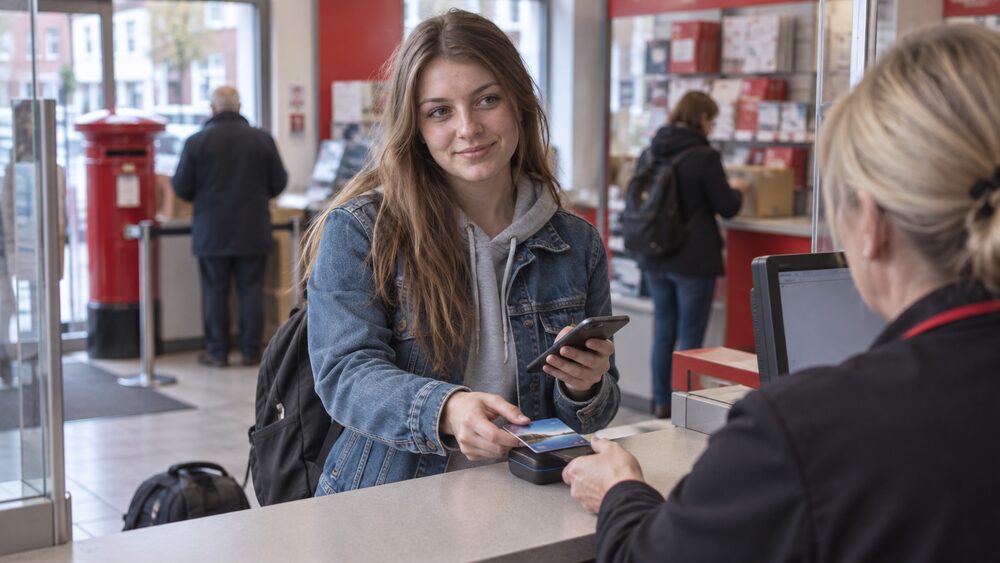
The card works with Apple Pay and Google Pay2. That means you can add it to your phone's wallet and pay with the phone rather than the plastic, which is useful if you would rather not carry the card itself.
There is a wrinkle worth knowing about. If you're adding your Travel Money Card via the travel app, you can only do this on iPhones and Apple Watches12. Apple Pay will use the currency of the country you are in, from the currencies preloaded on the card, so you don't have to select specific currencies while paying12. In practice that means the phone picks the right balance for you, provided you have loaded that currency.
Device compatibility is broad: iPhones, iPads, Apple Watches and MacBooks are all Apple Pay enabled, though for some it may only be more recent versions12. If your device is older, check before you rely on it at the till.
Where the Travelex Money Card cannot be used
A prepaid card is not accepted everywhere a normal card is. Travelex states that the card might not work in places where payments with it can't be authorised immediately, such as cruise ships, planes and toll roads5. The reason is that these merchants need to take payment without an immediate authorisation check, and a prepaid balance cannot always support that.
There is also a list of things the card cannot be used for at all. Travelex lists:
- all UK gambling transactions
- any online gambling including sports betting and online casinos
- money transfers
- adult service websites
- recurring payments such as direct debits and subscriptions
- business purchases such as stock and merchandise, not including business related travel5
Car hire and some hotel bookings are another grey area. Prepaid travel cards may not always be accepted, and you will need to check the T&Cs of your opted provider before you travel, for example for hiring a car or paying on a cruise13. If you plan to hire a car, it is worth having a credit card as a backup for the deposit.
Why hotels and car hire hold money on your card
Some companies might need to temporarily hold a specific amount of your balance when you book1. This is a pre-authorisation hold, common at hotel check-in and car rental pick-up. The money is not taken, but it is reserved, so your available balance drops until the hold is released.
The practical effect is that a card with a small balance can be refused even when you have enough for the bill itself, because the hold pushes the available amount below what the merchant wants to see. It is worth loading more than you expect to spend if you know a hold is coming, or using a different card for the deposit.
There is a second reason a card can be blocked abroad. ABTA advises telling your card provider that you're going away, because if you don't, they could block your card as they may think it's being used fraudulently11. Even on a prepaid card, an unexpected foreign transaction can trip a fraud check.
Lost or stolen cards, freezing and emergency cash
If the card goes missing, report it immediately. The general approach for payment cards is to call the provider's helpline so the card can be blocked and a new one sent out14. Travelex's app and support pages carry the number to use, and it is worth saving it somewhere other than your phone.
If you cannot find the card but do not think it has been taken, some providers let you freeze it rather than cancel it. Handelsbanken, for example, tells customers that if they can't find their Debit Card or Charge Card, but don't think it's lost or stolen, they can freeze it15. Freezing is reversible, so it buys you time to search without cancelling the card and ordering a replacement.
Always shield your PIN when entering it16. Card fraud abroad often starts with someone watching the keypad, and a prepaid card with a visible balance is an attractive target. Our guide to lost or stolen cards and cash abroad covers the steps in order, and emergency financial help abroad explains what consular support can and cannot do.
Disputes, complaints and the Financial Ombudsman
If something goes wrong with the card, the first step is a complaint to Travelex. If you are not satisfied with its final response, you can take the complaint to the Financial Ombudsman Service, which is free and independent. The ombudsman helps resolve complaints about issues such as account closures, disputed transactions, IT failures, and problems with switching services17, and it can look at problems with your bank, insurance company, pension, credit card or loan18.
Electronic money products fall within the ombudsman's remit. It can help with complaints about bank accounts and bank cards, insurance for your home, car or when you travel to another country, and problems with loans19. If you have been tricked into making a payment, the ombudsman can also look into complaints about the bank or payment service provider that received your money20.
The process is straightforward. You fill in the ombudsman's complaint form21, and it will consider the relevant law, regulations and industry codes of conduct, correspondence including the final response, payment records and your credit file21. The Payment Systems Regulator's advice is to contact your financial provider by phone first, and to contact the Financial Ombudsman Service if you are still unhappy22.
If a cash machine keeps your card, contact your card issuer to report it, and if the matter is not resolved, complain to the Financial Ombudsman Service24. Complaints about reduced in-person services, including access to cash withdrawals and services only available in branch, are among those the ombudsman sees25.
Sources25 cited
- Choosing the right travel card for spending abroad Post Office, 2026-04-07
- Foreign currency Post Office, 2026-09-26
- How does a travel money card work Currensea, 2026
- How do exchange rates work Post Office, 2026-09-14
- Travel Money Post Office, 2026-09-26
- Travel Money Card help and support Post Office, 2026
- Charges comparison explained Currensea, 2026
- How to open, switch or close your bank account MoneyHelper, 2026-09-25
- The costs and charges of credit cards Citizens Advice Scotland, 2026-09-25
- Credit vs debit cards Halifax, 2026-09-27
- Travel money ABTA, 2026
- Travel Money Card and Apple Pay Post Office, 2026
- Can I buy a prepaid travel card for someone else Currensea, 2026
- Choosing a bank account for your Universal Credit payment MoneyHelper, 2026-09-25
- Cards Handelsbanken, 2026
- Holiday fraud Take Five, 2026-09-26
- Banking and payments complaints Financial Ombudsman Service, 2026-09-25
- Who we can help Financial Ombudsman Service, 2026-09-28
- Consumer leaflet Financial Ombudsman Service, 2026-09-26
- Scams you've been tricked into making a payment Financial Ombudsman Service, 2026-09-27
- Complaints Financial Ombudsman Service, 2026-09-26
- When you make a payment Payment Systems Regulator, 2026-09-26
- Complain about a claims company GOV.UK, 2026-09-26
- Access to cash FAQ Payment Systems Regulator, 2026-09-26
- Quarterly complaints data Financial Ombudsman Service, 2026-09-28



 MoneyHelperFree, impartial money and pensions guidance, set up by government
 FSCSProtects your money if a bank, insurer or investment firm fails
 Financial Ombudsman ServiceFree, independent help when a complaint about a firm is not put right
 FCA Warning ListCheck whether a firm is authorised before you deal with it
 Citizens AdviceFree advice on money, consumer and legal problems in England and Wales