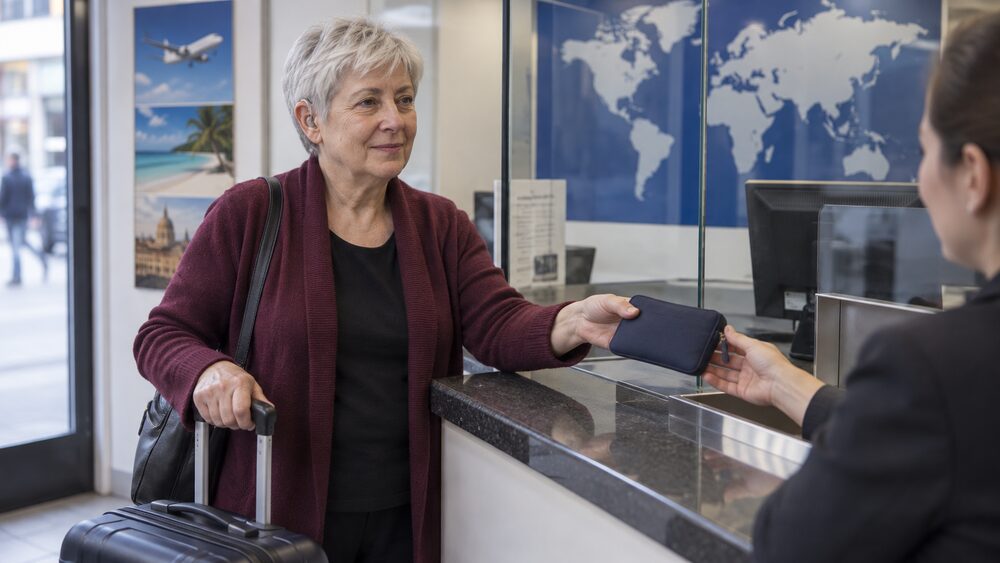
Most people come home from a trip with something left over: a few notes in a wallet, a handful of coins, or a balance sitting on a prepaid travel card. None of it is lost money, but none of it is doing anything either. The realistic options are to sell the currency back for pounds, keep it for a future trip, cash in a card balance, or give it away, and each one has a cost or a catch worth knowing about before you choose1.
The main thing to understand is that converting money twice works against you. You bought the foreign currency at one rate, and a bureau will buy it back at a lower one, because the difference between the two rates is how the bureau makes its money. On a small amount that difference may be a matter of a few pounds, which is why many people decide the simplest answer is to keep the cash, spend the card balance, or hand the coins to a charity box1.
This page sets out each option in turn: how selling back works and what a receipt has to do with it, what buy-back promises do and do not cover, what to do with a prepaid card balance, how withdrawn banknotes are treated, and where the fees and poor rates hide.
Selling it back: the buy-back rate is lower than the rate you paid
When you walk up to a bureau de change counter with unused notes, you are on the other side of the transaction from when you bought them. The bureau sold you euros or dollars at its selling rate; it buys them back at its buying rate, and the gap between the two, often called the spread, is the bureau's margin on both legs of the trip. There is no fixed spread: each operator sets its own rates on the day, so the amount you get back for the same notes can differ from one counter to another, and from one day to the next1.
That gap is the reason selling back small amounts often returns disappointingly little. If you spent most of your cash and are left with the equivalent of ten or twenty pounds, the difference between the two exchange rates may eat a noticeable share of it, and some counters will not deal in very small amounts at all. It is worth knowing what you have before you queue: count the notes, check the coins, and decide whether the pounds you will get back are worth the trip.
A few practical points make the process smoother. Notes in good condition are easier to sell than damaged or heavily worn ones, and some operators refuse notes below a certain condition. Less common currencies are harder to place than major ones: guidance on travel money suggests ordering less used currencies at least a week in advance when buying, and the same scarcity works in reverse when selling, since fewer counters want to hold stock in currencies they rarely trade1. If your leftover money is in an unusual currency, phone ahead rather than assuming any counter will take it.
If you would rather not convert at all, some UK accounts can hold or handle foreign money directly. A payment account with basic features may allow withdrawals and payment transactions in a currency other than sterling, and a small number of current accounts accept foreign cash deposits, converting them to pounds at the bank's own rate6. Where a conversion does happen, the standard approach is that an amount in an overseas currency is converted to pounds sterling using the exchange rate either on the date of the transfer or as otherwise agreed between the two sides7. The dedicated guides to buying foreign currency and multi-currency accounts cover these routes in more detail.
Buy-back guarantees and what they cover
Some currency sellers offer what is usually called a buy-back guarantee: a promise, made when you buy your travel money, to buy back whatever notes you do not spend. The appeal is obvious, because it removes the worry of being stuck with unusable cash, and it is typically offered as an add-on at the point of purchase rather than something every seller provides as standard.
What these promises have in common is that they are conditional, and the conditions are where the value sits. A typical arrangement covers unused notes bought from that seller, at the rate you originally paid, for a limited period after purchase, and it usually excludes coins, damaged notes and currencies the seller does not normally stock. Because terms vary between sellers, the practical approach is to treat the promise as a list of questions: which notes qualify, what rate applies, how long the offer lasts, whether coins are included, and whether you need the original receipt. If the answer to the last question is yes, keep the receipt with the currency itself, because a guarantee you cannot evidence is worth nothing.
It also pays to weigh the cost of the promise against the amount you are likely to bring back. If you usually return from trips with most of your cash spent, a buy-back add-on may cost more than it ever returns. If you habitually over-order cash, the certainty may be worth having. Either way, the guarantee does not change the underlying arithmetic of the spread described above: it fixes the rate at which you can undo the purchase, but it does not make the round trip free.
Do you need a receipt?
When you buy currency in the UK, the bureau is not doing you a favour by handing you a slip of paper: it is a legal requirement. Under the Price Indications (Bureaux de Change) Regulations 1992, the operator must furnish a receipt at the time the currency is supplied, and that receipt must show the date by reference to which the exchange rate is determined, the amount of foreign currency, the amount of sterling, the rate of exchange, the rate or amount of any commission or other charge not included in the exchange rate, the net amount paid to you, and the name and address of the operator3.
"he shall furnish to the consumer at the time when the currency is supplied a document (a "receipt") containing the following"
That list is worth reading closely, because it is exactly the information you need to judge any later buy-back offer. If the receipt shows the rate you paid and any commission, you can compare it with the buy-back rate on offer and see in plain numbers what the round trip is costing you. It also evidences the original purchase if a buy-back guarantee was part of the deal.
For selling back, a receipt is not always demanded, and many counters will buy notes from anyone without one. But if you bought with any kind of buy-back promise attached, assume you will be asked to prove it, and keep the receipt until you are certain the currency is finished with. If you have lost it, you can still sell at the counter's standard buy-back rate; what you are likely to lose is any special terms, not the ability to sell at all.
Keeping it for your next trip
The simplest option is often to do nothing. Foreign notes cost nothing to store, and keeping them avoids a second conversion entirely: the money stays in the currency you will need again, and the only thing that changes is what it is worth in pounds, which moves with the exchange rate rather than with a bureau's margin1. For anyone who travels to the same country or currency area regularly, this is usually the least lossy answer.
There are still a few things worth doing while the money is in a drawer. Keep notes and coins from different countries separate, so you are not sorting through a mixed pile at the airport next time. Check whether any of the notes are from a series that has been or is being replaced, since withdrawn notes are harder to use or sell later. And if the amount is substantial, it may be worth moving it somewhere safer than a jacket pocket, in the same way you would treat any cash at home.
Keeping cash also changes how you behave on the next trip, and that can work in your favour. Guidance on budgeting for nights out suggests ring-fencing money for spending so it does not leak into other budgets, and one suggested method for controlling spending is to take only cash and leave the cards at home9. Leftover travel money can serve that purpose: it is a pre-committed spending pot for the next holiday, already converted and immune from card fees. The comparison of taking cash or using a card abroad looks at when cash still makes sense.
One caution applies to the next trip itself: avoid taking cash out of foreign cash machines in lots of small amounts, because you may be charged per withdrawal1. The guide to withdrawing cash from machines abroad explains the charges in detail.
Leftover balances on prepaid travel cards
A prepaid travel card is one you load up with foreign currency before you travel, and abroad it can be used like a debit card1. That convenience creates the classic leftover problem: a balance in a foreign currency, sitting on a piece of plastic, that is easy to forget about entirely. Unlike notes in a drawer, a card balance can shrink on its own, because some cards charge fees if they are not used for a certain period2.
The suggested rule of thumb is to aim to use unused funds within 12 months of returning home, or before the card's expiry date, whichever is sooner2. Within that window, the options are to spend the balance on a future trip to a country that uses the currency, or to ask the provider to refund it. If the card has expired, you have not lost the money: contact your provider to request it back, though this may involve a fee2.
Before withdrawing the balance as cash in the UK, check the card's terms and conditions, because some cards charge fees for withdrawing cash in the UK and it may be cheaper to pay for purchases instead2. In other words, a card with a leftover euro balance may cost you less if you spend it on a European website or a future trip than if you convert it back.
The protections around prepaid cards differ from those around bank accounts, and the balance is not covered in the same way as money in a current account. The guide to prepaid travel money cards explains how these products work, what they charge and where protection starts and stops, and the comparison of a prepaid travel card or debit card abroad may help with the next trip's decision.
Withdrawn and unusual banknotes
A separate problem is notes that are no longer ordinary spending money in their own country. Countries periodically replace their banknotes, most often switching from paper to polymer, and once a series is withdrawn, shops and banks in that country stop accepting it. UK bureaux de change generally follow suit, because stock they cannot pass on is worthless to them, so a withdrawn note is much harder to sell than a current one.
That does not necessarily mean the note has no value. The usual route for withdrawn notes is the issuing country's own central bank or monetary authority, which commonly exchanges old series for new ones for a period after withdrawal, sometimes indefinitely, sometimes only at its counters in person. Whether that is worth doing depends on the amount involved: posting notes abroad carries postage costs and the risk of loss, and for a small amount those can exceed the value of the notes. For larger amounts, checking the issuing authority's own rules first is the sensible step, since each country sets its own deadlines and procedures.
Coins are a harder case still, and the same principle applies with more force: low individual value, high handling cost, and no obligation on any UK business to take them. Some charities and some bank travel money counters accept foreign coins, but acceptance is a choice, not a rule. If you are holding withdrawn or unusual notes, the honest summary is that their value depends entirely on what the issuing country will still do with them, and that answer changes over time, so it is worth checking before you assume either that they are worthless or that they can be spent.
Giving it to charity
For small amounts, especially coins, donation is often the most practical option. Airport charities, collection boxes and some high street retailers take foreign coins and notes, and the value to the charity comes from pooling thousands of small donations into a sum worth converting. For the donor, it converts money that is awkward to sell into something useful without any fees, queues or trips to a counter.
If you donate to a UK charity and you pay tax in the UK, Gift Aid increases what the charity receives: charities receive an additional 25p for every £1 you donate5. Gift Aid works on donations of money by UK taxpayers, and the charity claims the extra from HMRC, so a donation is worth more to the charity than the same amount sitting in your drawer is worth to you after a buy-back spread. The charity handles the conversion of foreign currency itself, which is one less thing for you to do.
This option suits the amounts that selling back handles worst: a handful of coins, a few low-value notes, currency from a country you are unlikely to visit again. It does not suit larger sums, where the pounds you would get back are worth having. As with everything on this page, the choice is a matter of circumstance rather than one right answer.
Watching for fees, minimum amounts and poor rates
Whichever route you take, the costs are what decide how much of your money comes back to you. The clearest illustration comes from card spending rather than cash: spending just £5 with a card that charges fees could set you back £1.15, an additional 23%4. That is the scale of margin that fees and rates can impose on small transactions, and the same logic applies to converting small amounts of currency.
The specific charges to watch for fall into a short list:
- The spread. The buy-back rate is lower than the rate you paid, and the gap is the operator's margin on both transactions1.
- Commission and charges. A receipt must show any commission or other charge not included in the exchange rate, so you can see the true cost before you commit3.
- Card fees. Many cards charge a percentage on the transaction as well as a flat rate fee for each withdrawal or transaction1.
- Debit card charges abroad. Using your debit card abroad typically brings a spending or cash machine charge of between £1 and £3 each time you use it, except for euros in the EU10.
- Cash machine costs. The UK's ATM network is funded in part by an interchange fee of around 25 pence per withdrawal, a cost structure that machines abroad often mirror with their own charges11.
- Inactivity and refund fees on prepaid cards. Some cards charge fees if unused, and refunding a balance, especially on an expired card, may involve a fee2.
Rules exist to make at least some of this visible. The FCA's Banking Conduct of Business rules require firms to give information about debit card use, including using a debit card to withdraw money in a foreign currency outside the UK and initiating a payment in a foreign currency to a payee outside the UK12. When you are abroad, choosing to pay in the local currency rather than pounds when a machine or terminal offers the choice gets you a better exchange rate, because the pounds option applies the merchant's own conversion1. The guide to dynamic currency conversion explains that choice in full.
If something goes wrong with a card transaction, there are routes to complain. Chargeback can help you get your money back on transactions under £100 that are not covered by Section 75, by asking your card provider to reverse a payment13. The guide to consumer protection in UK financial services sets out these rights more broadly.
Where to get help
For most leftover-currency questions, the first stop is the bureau or card provider itself: the receipt shows the operator's name and address, which is who you deal with over a disputed rate or a refused buy-back3. If a prepaid card provider will not return your balance, put the complaint to the provider first and keep a record of what you sent and when.
Beyond the firm, free and impartial help is available. MoneyHelper, the government-backed money guidance service, covers everyday banking questions including how to open, switch or close a bank account, which is relevant if you want an account that can handle foreign currency10. In Scotland, mygov.scot sets out consumer rights including what you are entitled to when a purchase goes wrong14. If a complaint against a financial firm cannot be resolved directly, the Financial Ombudsman Service can look at it, and the consumer protection guide explains when and how.
For the wider decisions around travel money, the section guide to money abroad brings together the related pages: travel money, buying foreign currency, prepaid travel money cards and using a debit card abroad.
Sources14 cited
- Travel money tips and advice ABTA, 2026
- I can't get my money out of my prepaid foreign currency card Which?, 2021-10-08
- The Price Indications (Bureaux de Change) Regulations 1992 legislation.gov.uk, 1992-02-19
- Spending abroad: the 4 dos and 5 don'ts Which?, 2024-07-26
- Tax reliefs Which?, 2026-04-06
- Payment Accounts Regulations 2015 legislation.gov.uk, 2015
- Stamp duty on shares GOV.UK, 2014-06-24
- Travel Money Refund Guarantee Post Office
- Save money on your social life StepChange Debt Charity, 2026-09-25
- How to open, switch or close your bank account MoneyHelper, 2026-09-25
- How we regulate the UK's ATM network Payment Systems Regulator, 2026-09-26
- BCOBS 7.5: information requirements FCA Handbook, 2018
- Letter to make a chargeback claim Which?, 2025-06-18
- Consumer rights mygov.scot, 2022-07-01


 MoneyHelperFree, impartial money and pensions guidance, set up by government
 FSCSProtects your money if a bank, insurer or investment firm fails
 Financial Ombudsman ServiceFree, independent help when a complaint about a firm is not put right
 FCA Warning ListCheck whether a firm is authorised before you deal with it
 Citizens AdviceFree advice on money, consumer and legal problems in England and Wales