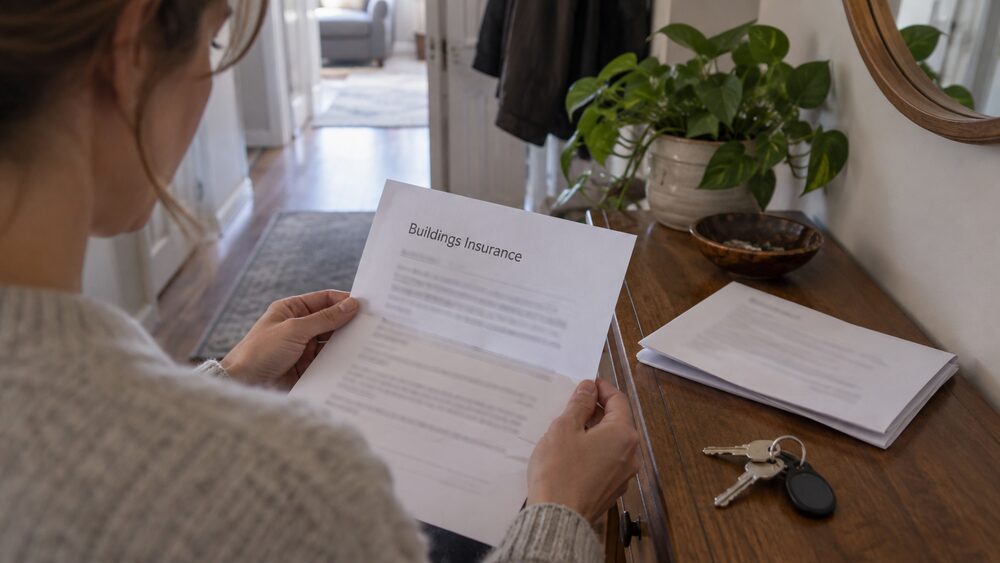
If you rent the home you live in, you do not need buildings insurance. The building belongs to your landlord, and arranging cover for the structure, the roof, the walls and the permanent fittings is the landlord's job, not yours1. The Financial Ombudsman Service puts it plainly: people who rent a property only need to buy contents insurance, because the landlord will be responsible for arranging buildings insurance1.
What renters need is cover for their own things. The landlord's policy insures the building, not your furniture, clothes, laptop or bike, and guidance for renters is explicit that renters need to insure their own belongings because the landlord's insurance will not provide cover for them4. Contents insurance is the product that does that, and it is not a legal requirement when you rent5.
The confusion usually comes from two places. First, buildings insurance is not a legal requirement for anyone in the UK, but it is effectively compulsory for homeowners with a mortgage, because lenders make it a condition of the loan6. Second, if you later buy a leasehold flat, the freeholder will usually insure the block and recover the cost through your service charge, so you still may not need your own buildings policy8.
Renters do not need buildings insurance: the landlord arranges it
The split of responsibility in a rented home is straightforward. Buildings insurance covers the structure of the building and the permanent fixtures and fittings, such as baths or fitted kitchens1. Because those belong to the landlord, the landlord carries the risk and the policy. Guidance from Halifax is blunt about it: if you are a renter, you will not need to buy buildings insurance, and your landlord should arrange cover for your home2. Lloyds Bank says the same, that renters will not need to get buildings insurance because this is the landlord's responsibility3.
That holds whether you rent privately, through an agent or from a housing association. It also holds for the fixtures. Citizens Advice notes that while the landlord usually takes out the insurance, a tenant may still be responsible for loss or damage to fixtures and fittings, which is a different point: the landlord insures the building, but a tenant can be held to account for damage they cause12.
There is one related product worth knowing about. Home emergency cover pays for urgent problems such as a burst pipe or a broken boiler. The Financial Ombudsman Service notes that if you are a private tenant and you bought home emergency cover, you may not need it, because sorting out emergencies is usually the landlord's responsibility13. If it has been sold alongside a tenancy, it is worth checking what it actually adds.
What buildings insurance covers: the structure, fixtures and fittings
Buildings insurance pays to repair damage to the structure of the property12. That means the walls, roof, floors, ceilings and the permanent fittings that come with the home, such as a fitted kitchen or a bathroom suite1. It is the cover that rebuilds or repairs the shell you live in, not the things you put inside it.
The risks a standard policy covers are well established. Citizens Advice lists fire, explosion, storms, floods and earthquakes; theft, attempted theft and vandalism; frozen and burst pipes; fallen trees, lampposts, aerials or satellite dishes; subsidence; and collisions by vehicles or aircraft12. Storm cover is broader than people expect: buildings insurance should cover damage caused by hail, wind, rain, snow and ice, including broken roofs, burst pipes, falling trees and power cuts14. After a claim, insurers will generally pay for cleaning up and repairing the property, as well as temporary accommodation if the home has been made uninhabitable15.
Two limits matter. The first is underinsurance: if the sum insured is set below the true rebuild cost, a claim can be scaled down, and Halifax and Bank of Scotland both publish guidance on how the shortfall is applied16. The second is that policies exclude gradual damage and wear and tear, so a roof that has slowly deteriorated over years is a maintenance matter, not a claim.
For a renter, none of this changes the position, because the policy is not theirs. It does explain why the landlord cares, and why a landlord who lets a property without cover is carrying a serious risk. The fuller picture of what a buildings policy does and does not do is in buildings insurance explained.
Contents insurance: the cover renters do need
Contents insurance is the policy that fits a tenant. It covers the items a tenant owns and keeps in the home: furniture, clothes, electronics, kitchen equipment and everything else that would have to be replaced if the place burned down or flooded. The Financial Ombudsman Service's guidance for renters is that contents insurance is the cover they need1, and insurers that sell to tenants describe it the same way, as cover that stops a tenant paying out of their own pocket to replace what they lose18.
It is not compulsory. HSBC states directly that it is not a legal requirement to have contents insurance when you are renting5. But the consequences of going without fall entirely on the tenant, because there is no other policy that will pick up their belongings. The landlord's cover stops at the building4.
A few practical points shape what a tenant's policy looks like:
- Sum insured. The amount is set to reflect what it would cost to replace everything owned, new for old, rather than what was paid for it.
- Accidental damage. Often sold as an add-on rather than included, and it is what covers a spilled drink over a laptop or a knocked-over television.
- Items away from home. Standard contents cover applies inside the home. Cover for belongings carried out of the home is a separate extension, and it is worth knowing how it works before relying on it: see personal possessions cover.
- Excess. Every policy has one, and it is deducted from any payout. How compulsory and voluntary excess interact is set out in insurance excess.
For what a contents policy should include, contents insurance explained covers the structure of the product, and new for old or indemnity cover explains the difference between replacing an item with a new one and paying out its worn value.
Leasehold flats: when the freeholder insures the building
If you own a leasehold flat rather than rent it, the same logic usually applies, but for a different reason. In most cases the freeholder arranges buildings insurance for the block and includes a share of the cost in each leaseholder's service charge or rent8. Guidance for leaseholders is consistent on this: if you live in a leasehold flat or maisonette, it is likely that the freeholder will already have buildings insurance9.
That does not mean the cost disappears. It arrives as part of the service charge, and the amount is set by the freeholder or managing agent rather than by the leaseholder. The government has consulted on introducing permitted insurance fees for landlords, freeholders and property managing agents, with the aim of preventing them from imposing opaque and excessive charges related to building insurance, often in the form of commissions20. The consultation notes that the Leasehold and Freehold Reform Act 2024 created powers to address concerns about opaque remuneration for arranging and managing buildings insurance20. Until any rules change, the practical step for a leaseholder is to read the lease and the service charge accounts.
The lease is the document that decides the arrangement. Citizens Advice notes that a lease may say a leaseholder should have buildings insurance with a named insurer, or that the freeholder may take out insurance and charge for it12. If a leaseholder holds a share of the freehold, or owns the freehold of a flat, the responsibility can fall on them and the other freeholders to arrange cover jointly21. There is more on the leasehold position, including how block policies work and how to challenge charges, in buildings insurance for leasehold flats and leaseholders: landlord fees and complaints about block policies.
Buildings insurance is not a legal requirement, but lenders insist on it
No law in the UK requires anyone to hold buildings insurance. Which? states it directly: home insurance is not a legal requirement, but a mortgage lender might make buildings insurance a condition of the loan6. RBS says the same in its own guidance, that buildings insurance is not a legal requirement but is required by most mortgage lenders and strongly recommended7. The Post Office frames it identically, that there is no legal obligation for homeowners to have buildings insurance, but lenders may make it a condition of lending22.
The distinction matters because it explains why the rule bites for owners and not for renters. A lender's interest is in the property that secures the loan: if the building is destroyed, the lender wants it rebuilt. Aviva's guidance describes buildings insurance as not a legal requirement unless there is a mortgage lender, in which case it is usually an obligation of the mortgage contract23. Lloyds Bank puts the practical consequence plainly, that a borrower may struggle to get a mortgage without cover in place19.
The timing catches buyers out. Mortgage lenders generally require buildings insurance from the date of exchange, not completion10. Most lenders require it in place when contracts are exchanged on a property11, and guidance for first-time buyers describes it as vital to have cover from the day of exchange, with most mortgage providers making it a condition of lending24. The gap between exchange and completion can be weeks, and during that time the buyer is responsible for a building they do not yet live in.
When a renter or leaseholder needs their own buildings insurance
The general rule is that buildings cover follows ownership. If you own your home, you will need buildings insurance, and it is usually a condition of your mortgage27. If you rent, your landlord is responsible for buildings insurance, and your own cover is for your personal belongings28.
The situations where a renter or a leaseholder ends up needing a buildings policy are specific:
- Buying the freehold of a flat, or a share of freehold. The freeholder's block policy no longer applies, and the freeholders collectively arrange cover21.
- Becoming a landlord. Anyone renting out a property they own needs buildings insurance for it, and buy-to-let lenders often require it as a condition of the mortgage29. Standard home cover is not designed for a let property, and letting it out without telling the insurer can affect the policy31.
- Taking in a lodger. Renting out a room can affect buildings and contents insurance, and the insurer may need to be told, with premiums possibly rising as a result32.
- Being in a part-ownership scheme. Post Office guidance notes that buildings insurance is only needed if you own or are planning to own a property, and that this includes part-ownership schemes such as Help to Buy22. Shared ownership arrangements vary, so the lease or scheme rules decide who insures what.
For anyone moving from renting to buying, the sequence of costs and requirements is set out in buying a home and how much buildings insurance do I need, which explains how the rebuild figure is worked out.
What happens after a flood or storm in a rented home
The division of labour after a flood is the clearest illustration of who insures what. If you rent your home, your landlord is responsible for most repairs to the property, and their buildings insurance may cover the flood damage33. The tenant's part is to tell the landlord promptly so they can contact the insurer: government guidance for Northern Ireland advises tenants to ask their landlord to contact the company that insures the home34.
A tenant's own losses are a separate claim on their own contents policy. That is where the cost of replacing ruined furniture, clothing and electrical goods sits, and a contents policy may also pay for alternative accommodation if the home is uninhabitable15. Keep evidence: photographs, receipts and a list of what was damaged, before anything is thrown away.
There is a limit worth knowing. A tenant is liable for damage they cause to the property during the tenancy, and the cost of fixing or replacing it can come out of the deposit35. That is not the same as the building being damaged by a storm or a flood, which is the landlord's risk, but it is the reason deposit deductions happen after an incident.
For help understanding rights as a tenant, Shelter and Citizens Advice both give free advice on repairs, deposits and landlord obligations. If a dispute with an insurer ends in a complaint that cannot be resolved, the Financial Ombudsman Service is the free, independent scheme that can look at it, and the process is set out in complaining about an insurer.
Sources35 cited
- Home insurance complaints Financial Ombudsman Service, 2026-09-26
- What is buildings insurance? Halifax, 2026-09-27
- Tenants and renters Lloyds Bank, 2026-09-27
- Which insurance policies are worth keeping Which?, 2023-08-07
- Contents insurance HSBC, 2026
- Santander home insurance review Which?, 2026-09-17
- Contents insurance RBS, 2026-09-25
- Shopping around for insurance Independent Age, 2026-09-26
- FCA ruling on multi-occupancy buildings AXA, 2026-09-26
- 6 questions to ask before you choose a home insurance policy Which?, 2025-10-15
- Costs of buying a property HSBC, 2026
- Buildings insurance Citizens Advice, 2020-02-20
- Home emergency insurance Financial Ombudsman Service, 2026-09-26
- 5 winter risks your home insurance might not cover Which?, 2026-09-26
- Does your insurance cover damage caused by bad weather? Which?, 2025-12-08
- What is underinsurance? Halifax, 2026-09-27
- Underinsurance Bank of Scotland, 2026-09-27
- Tenants insurance esure, 2026
- Buildings insurance Lloyds Bank, 2026-09-27
- Consultation on introducing permitted insurance fees for landlords, freeholders and property managing agents GOV.UK, 2024-12-02
- Buildings insurance My Urban Jungle, 2026-09-26
- Buildings insurance Post Office, 2026
- Buildings insurance Aviva, 2026-09-26
- How to buy a house Which?, 2026-05-29
- What is home insurance? Halifax, 2026-09-27
- What is home insurance? Lloyds Bank, 2026-09-27
- Is self-insurance ever a good idea? Which?, 2026-08-29
- House buying costs breakdown The Nottingham, 2026-09-25
- Becoming a landlord Coventry Building Society, 2026
- Landlord checklist Halifax, 2026-09-27
- Taking in a lodger if you have mortgage arrears Shelter England, 2026-09-14
- Flooding Shelter Cymru, 2026-08-17
- Housing help if your home is flooded Shelter England, 2026-08-17
- After a flood: making an insurance claim nidirect, 2024-08-29
- Renting a property RICS, 2026-09-26





 MoneyHelperFree, impartial money and pensions guidance, set up by government
 Financial Ombudsman ServiceFree, independent help when a complaint about a firm is not put right
 FSCSProtects your money if a bank, insurer or investment firm fails
 Citizens AdviceFree advice on money, consumer and legal problems in England and Wales
 GOV.UKOfficial information on tax, benefits and government services